预约演示
更新于:2026-09-19
Superoxide dismutase liposomal(Polymun Scientific Immunbiologische Forschung GmbH)
重组人铜锌超氧化物歧化酶(Polymun)
更新于:2026-09-19
概要
基本信息
在研机构- |
最高研发阶段无进展临床3期 |
首次获批日期- |
最高研发阶段(中国)- |
特殊审评- |


登录后查看时间轴
关联
2
项与 重组人铜锌超氧化物歧化酶(Polymun) 相关的临床试验NCT01513278
Randomized, Double-blind, Split-body, Placebo-controlled Phase Ib Study of APN201 (Liposomal Recombinant Human Cu/Zn-superoxide Dismutase) for the Prevention of Radiation-induced Dermatitis in Women With Breast Cancer
NCT00264186
Impact of rhCu/Zn SOD on Inflammation-Induced Impairment of Vascular Reactivity

100 项与 重组人铜锌超氧化物歧化酶(Polymun) 相关的临床结果
登录后查看更多信息
100 项与 重组人铜锌超氧化物歧化酶(Polymun) 相关的转化医学
登录后查看更多信息
100 项与 重组人铜锌超氧化物歧化酶(Polymun) 相关的专利(医药)
登录后查看更多信息
71
项与 重组人铜锌超氧化物歧化酶(Polymun) 相关的文献(医药)2026-01-01CLINICAL PHARMACOKINETICS
Randomized, Double-Blind, Phase I Pharmacokinetic Study of Subcutaneous Recombinant Human Superoxide Dismutase (rhSOD) in Healthy Volunteers
Article
作者: Schnidar, Harald ; Bergmann, Felix ; Zeitlinger, Markus ; Wölfl-Duchek, Michael ; Bashur, Rawad ; Vcelar, Brigitta ; Partl, Richard ; Al Jalali, Valentin ; Katinger, Dietmar ; Jorda, Anselm ; Bauer, Martin
BACKGROUND:
Excessive production of reactive oxygen species (ROS), particularly superoxide anion ( __-mml:math xmlns:mml="http://www.w3.org/1998/Math/MathML"-__O 2 · - O 2 · -
METHODS:
This randomized, double-blind, placebo-controlled Phase I study evaluated the safety, tolerability, and pharmacokinetics of recombinant human Cu/Zn-SOD (rhSOD, SOD1) following subcutaneous administration of 40 mg every 12 hours in 16 healthy volunteers. Eight subjects were enrolled each in the single-dose (SD) and multiple-dose (MD) cohorts. Study assessments, including pharmacokinetic sampling, were performed for 72 (SD) or 92 hours (MD). Injection site erythema was objectively assessed using the innovative Standardized Erythema Value (SEV*) method, derived from photographs taken with Scarletred®Vision software (SCARLETRED Holding GmbH).
RESULTS:
No serious adverse events occurred, and all treatment-related adverse events were mild. Injection site erythema was objectively assessed using the innovative standardized erythema value (SEV*) method, derived from photographs taken with Scarletred® Vision software (SCARLETRED Holding GmbH). The Visual Analog Scale scores and SEV* assessments were comparable between the rhSOD and placebo groups. Beyond safety and tolerability, pharmacokinetic analysis revealed that the volume of distribution, clearance, and half-life at presumed steady state were 129 ± 66.3 L, 5.97 ± 1.25 L/h, and 15.0 ± 6.69 h, respectively. Compared with the rapid systemic elimination after intravenous administration of SOD, subcutaneous administration resulted in a favorable plasma concentration-time profile.
CONCLUSIONS:
These findings suggest that subcutaneous rhSOD may be a promising therapeutic candidate for conditions characterized by excessive __-mml:math xmlns:mml="http://www.w3.org/1998/Math/MathML"-__O 2 · -
2018-06-01Life sciences3区 · 医学
Modified porcine surfactant enriched by recombinant human superoxide dismutase for experimental meconium aspiration syndrome
3区 · 医学
Article
作者: Kosutova, Petra ; Kopincova, Jana ; Mokra, Daniela ; Calkovska, Andrea ; Kolomaznik, Maros ; Mikolka, Pavol
AIMS:
Combination of exogenous surfactant with antioxidant enzyme recombinant human superoxide dismutase (rhSOD) was tested in the treatment of experimental meconium aspiration syndrome as oxidative processes play key role in its pathogenesis.
MATERIAL AND METHODS:
Young New Zealand rabbits were instilled by saline (Sal group) or by meconium suspension (Mec group). Some of meconium-instilled animals were treated by surfactant alone (Surf group) or surfactant in combination with rhSOD (Surf + SOD group) and oxygen-ventilated for 5 h. PaO2/FiO2, oxygenation index, oxygen saturation, PaCO2, ventilation efficiency index and alveolar-arterial gradient were evaluated every hour; post mortem, cells in bronchoalveolar lavage were counted, inflammatory and oxidative markers were assessed using ELISA in lung tissue homogenates.
KEY FINDINGS:
Exogenous surfactant combined with rhSOD improved oxygenation during the first hour after the treatment more than surfactant alone (p = 0.039 to 0.0001 vs. Mec and Surf group). Amelioration was also seen in CO2 elimination (p = 0.049 to 0.0096 vs. Mec group), alveolar-arterial gradient diminution (p = 0.024 to 0.0019 vs. Mec and Surf group), prevention of oxidative damage and cytokine production (p = 0.049 to 0.002 vs. Mec group).
SIGNIFICANCE:
It seems that inhibition of oxidative signalization may be strong supporting factor in surfactant treatment of MAS.
2012-06-01International journal of clinical pharmacology and therapeutics4区 · 医学
Human pharmacokinetics of intravenous recombinant human Cu/Zn superoxide dismutase
4区 · 医学
Article
作者: Vorauer-Uhl, Karola ; Dittrich, Peter ; Felizeter, Manuela ; Leuchten, Nicolai ; Gouya, Ghazaleh ; Vcelar, Brigitta ; Kapiotis, Stylianos ; Wolzt, Michael ; Schaller, Georg
OBJECTIVE:
Oxidative stress plays an important role in human disease, but antioxidant therapies are limited. Under physiological conditions superoxide is controlled by the enzyme superoxide dismutase. A recombinant human Cu/Zn superoxide dismutase (rhSOD) might open new therapeutic possibilities.
METHODS:
Safety profile and pharmacokinetics in plasma and urine were assessed in an open label phase I study with dose-escalation. 18 healthy male volunteers received a single intravenous 10-minute infusion of 150, 300, or 600 mg rhSOD, respectively (n = 6 per dose group).
RESULTS:
rhSOD was well tolerated. Peak plasma concentrations (cmax; mean ± SD) were reached at the end of infusion, with 32.96 ± 10.31, 51.60 ± 8.23, and 103.90 ± 19.02 μg/ ml, respectively. Non-compartmental halflife was 1.06 ± 0.37, 1.59 ± 0.64, and 1.63 ± 0.28 hours. Urinary excretion (10 h) showed dose-dependent relative increases with 11.28 ± 6.46 (7.5%), 54.93 ± 15.25 (18.3%), and 191.81 ± 104.60 mg (32.0%).
CONCLUSIONS:
Our results show a good safety profile and predictable pharmacokinetics of rhSOD, suggesting that therapeutic exploratory studies might be safely conducted in humans.
100 项与 重组人铜锌超氧化物歧化酶(Polymun) 相关的药物交易
登录后查看更多信息
研发状态
10 条进展最快的记录, 后查看更多信息
登录
| 适应症 | 最高研发状态 | 国家/地区 | 公司 | 日期 |
|---|---|---|---|---|
| 阴茎硬结 | 临床3期 | - | 2005-10-01 | |
| 早期乳腺癌 | 临床2期 | 奥地利 | 2012-01-01 | |
| 放射性皮炎 | 临床2期 | 奥地利 | 2012-01-01 |
登录后查看更多信息
临床结果
临床结果
适应症
分期
评价
查看全部结果
登录后查看更多信息
转化医学
使用我们的转化医学数据加速您的研究。
登录
或

药物交易
使用我们的药物交易数据加速您的研究。
登录
或

核心专利
使用我们的核心专利数据促进您的研究。
登录
或

临床分析
紧跟全球注册中心的最新临床试验。
登录
或

批准
利用最新的监管批准信息加速您的研究。
登录
或

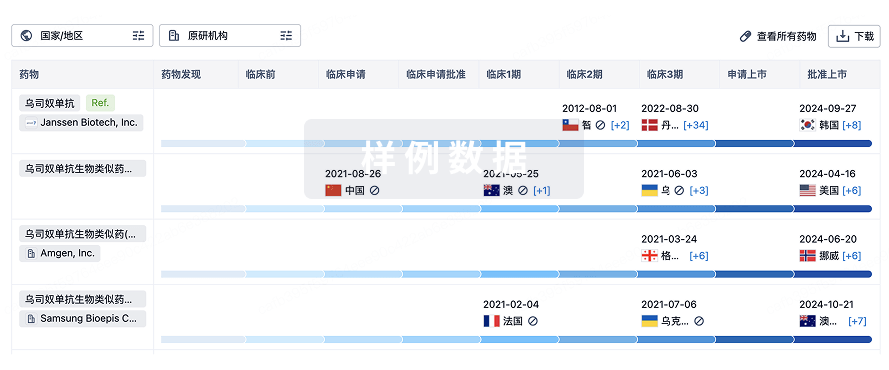
生物类似药
生物类似药在不同国家/地区的竞争态势。请注意临床1/2期并入临床2期,临床2/3期并入临床3期
登录
或
特殊审评
只需点击几下即可了解关键药物信息。
登录
或

提出任何生物医药研究问题
让每一步生物医药决策都精准制胜
基于十亿级生物数据与全球情报的精准 AI,赋能早期药物发现
立即开始免费试用!
智慧芽新药情报库是智慧芽专为生命科学人士构建的基于AI的创新药情报平台,助您全方位提升您的研发与决策效率。
立即接入生物医药数据包
智慧芽新药库数据也通过智慧芽开放平台,以MCP或API服务形式对外开放。立即使用我们的MCP服务定制您的LLM智能体。
生物序列数据库
生物药研发创新
免费使用
化学结构数据库
小分子化药研发创新
免费使用