预约演示
更新于:2026-01-31
PCB-101
更新于:2026-01-31
概要
基本信息
药物类型 酶 |
别名 crystalline endolysin (Procrysta Biologix)、PCB-101 |
作用方式 抑制剂 |
作用机制 肽聚糖抑制剂、细胞壁抑制剂 |
治疗领域 |
在研适应症- |
非在研适应症 |
在研机构- |
权益机构- |
最高研发阶段无进展药物发现 |
首次获批日期- |
最高研发阶段(中国)- |
特殊审评- |
关联
1
项与 PCB-101 相关的临床试验ChiCTR2500101921
Assessing the Safety and Efficacy of Endolysin Gel in the Treatment of Adult Patients with Mild to Moderate Atopic Dermatitis
开始日期2025-05-06 |
申办/合作机构- |
100 项与 PCB-101 相关的临床结果
登录后查看更多信息
100 项与 PCB-101 相关的转化医学
登录后查看更多信息
100 项与 PCB-101 相关的专利(医药)
登录后查看更多信息
141
项与 PCB-101 相关的文献(医药)2025-11-01·MARINE POLLUTION BULLETIN
Microplastics as the vector for the attachment of polychlorinated biphenyls: A case study of urbanized Langat River, Malaysia
Article
作者: Ibrahim, Yusof Shuaib ; Yusof, Ku Mohd Kalkausar Ku ; Khalik, Wan Mohd Afiq Wan Mohd ; Anuar, Sabiqah Tuan ; Azmi, Alyza Azzura ; Mohd Ali, Ahmad Ammarluddin
Researchers worldwide are currently facing an issue of microplastics and toxic chemical pollution in the ecosystem. Microplastics transport toxic chemicals in the ecosystem as a vector. This study investigated the occurrence and distribution of microplastics and Polychlorinated Biphenyls (PCBs) in the surface water of the Langat River, Malaysia, across six sites ranging from the open sea to riverine areas. Microplastic concentrations varied from 0.82 to 17.14 items/m3, with the highest levels observed at the station (S6), likely due to increased domestic and industrial activities. The surfaces of microplastics exhibited cracks, pitholes, particle adherence and diatom, with aluminium (Al) and potassium (K) detected via Scanning Electron Microscope/Energy Dispersive X-ray spectroscopy (SEM/EDS). Gas Chromatography-Mass Spectrometry (GC-MS) screening multiple PCB congeners on the microplastic surfaces, with PCB-28, PCB-42, PCB-101, and PCB-153 being among the most common. Environmental factors such as temperature, salinity, and pH influenced the sorption behaviour of PCBs, open sea conditions enhancing diffusion and potentially stabilizing persistent organic pollutants (POPs), while estuarine conditions impact surface charges on microplastics. The adsorption of PCBs onto microplastics, involves complex chemical and physicals mechanisms including hydrophobic interactions, π-π interactions and hydrogen-bonding, among the others. These findings emphasize the role of microplastics as substrate for co-pollutants attachment, thus the need for routine monitoring of microplastics in Malaysia and across Southeast Asia riverine.
2025-10-01·Asian Pacific journal of cancer prevention : APJCP
The Determining of Pesticide Residue Levels in Children Diagnosed with Acute Leukemia in Cukurova Region, Turkiye
Article
作者: Barutcu, Adnan ; Yagci Kupeli, Begul ; Ozkan, Ayse ; Leblebisatan, Goksel ; Sezgin, Gulay ; Goren, Ismail Ethem ; Boz, Nihal ; Inandiklioglu, Nihal ; Bayram, Ibrahim ; Daglioglu, Nebile ; Kupeli, Serhan ; Atasoy Aydin, Asli ; Yilmaz, Sema
BACKGROUND:
Acute lymphoblastic leukemia (ALL) is the most common childhood malignancy. in children. Children can be exposed to pesticides during pregnancy or by their parent carried out pesticides to home. The objective of this study was to study pesticide residues in both acute leukemia patients and healthy children.
METHODS:
Twenty nine patients with acute leukemia [22 boys (76%) and 7 girls (24%)] and 33 healthy children [(19 boys (57%), 14 girls (43%)] were included in the study. We analyzed eight PCB (PCB 28, PCB 52, PCB 101, PCB 118, PCB 138, PCB 153, PCB 180 and PCB 202), HCB, three HCH isomers, 4,4'-DDT, 4,4'-DDD and 4,4'-DDE were investigated in bone marrow of newly diagnosed acute leukemia patients and peripheral blood samples of healthy children.
RESULTS:
The most detectable OCPs were β-HCH, δ-HCH and PCB28, triflumizole and thiometon were commonly found as OPPs. The significant difference was found statistically between ALL cases and control group according to the residues of PCB28 (74,06±85,29), β-HCH (72,06±89,07) and δ-HCH (23,35±42,93) (p=0.001). Additionally, OPPs consisted triflumizole (7,23±9,17), thiometon (3,37±4,30) and halfenprox (1,90±3,22) showed distinctive difference statistically (p=0.001).
CONCLUSION:
Pesticide residues were estimated significantly in bone marrow of leukemia patients should be considered an important for public health with the decreasing or preventing of pesticide exposure which have a role in leukemia ethiology.
2025-10-01·Chinese Journal of Chromatography
Determination of trace polychlorinated biphenyls in environmental water samples by solid-phase microextraction-gas chromatography-tandem mass spectrometry using carbon nanotube composite microspheres materials
Article
作者: Wu, Yu-Xin ; Liu, Yu-Qing ; Zhu, Shu-Qi ; Song, Xin-Li ; Zhong, Li-Yan
Polychlorinated biphenyls (PCBs) pose serious threats to the environment and human health because they are among the most common and persistent organic pollutants globally. In this study, six PCBs were extracted from environmental water samples using multiwalled carbon nanotubes (MWCNTs) on polystyrene (PS) microspheres as the solid-phase microextraction (SPME) coating material for gas chromatography-tandem mass spectrometry (GC-MS/MS). This coating material is highly stable and exhibited a high extraction efficiency. 2,2',5,5'-Tetrachlorobiphenyl (PCB-52), 2,2',4,5,5'-pentachlorobiphenyl (PCB-101), 2,3',4, 4',5-pentachlorobiphenyl (PCB-118), 2,2',3,4,4',5'-hexachlorobiphenyl (PCB-138), 2,2',4,4',5,5'-hexachlorobiphenyl (PCB-153) and 2,2',3,4,4',5,5'-heptachlorobiphenyl (PCB-180) were chosen as target analytes. The main extraction factors were optimized using a single-factor optimization method, which led to the following optimum extraction conditions: adsorption time, 50 min; agitation speed, 600 r/min; pH, 6; NaCl concentration, 1.5 mol/L; desorption temperature, 280 °C; and desorption time, 4 min. GC coupled with triple quadrupole mass spectrometry was used to quantify PCBs in water samples. The chromatographic separation system was equipped with a TG-5 SILMS column (30 m×0.25 mm×0.25 μm), with electron impact ionization and multi-reaction monitoring modes used during mass spectrometry. Five batches of MWCNT@PS were used as SPME coating materials, which were determined to have relative standard deviations (RSD) of less than 8.8% for the six PCBs. The reusability of the MWCNT@PS coating was also investigated; RSD of the recoveries of 2.8%-9.3% were obtained after ten SPME cycles with the same coating. These results reveal that the MWCNT@PS coating materials are highly stable and reusable in SPME applications, with good results obtained under the optimal conditions. The established method exhibited linearity in the range of 0.03-1 000 ng/L for PCB-52 and PCB101, 0.07-1 000 ng/L for PCB118, PCB138, and PCB 153, and 0.10-1 000 ng/L for PCB-180, with correlation coefficients of 0.993-0.998. Limits of detection and quantification (LODs and LOQs, respectively) of 0.01-0.03 and 0.03-0.10 ng/L were determined for the developed method. The intra- and inter-day precisions exhibited RSDs of 1.64%-8.16% and 2.83%-8.41%, respectively, at 2 ng/L, 3.31%-7.19% and 3.79%-9.12%, respectively, at 10 ng/L, and 2.70%-9.38% and 4.04%-8.56%, respectively, at 100 ng/L. The established method was used to determine six PCBs in barreled drinking water, rainwater, and three environmental river water samples. No PCBs were found in barreled drinking water, rain water and river water. Satisfactory recoveries of 82.4%-113.2% were achieved at low, medium, and high levels. Accordingly, the MWCNT@PS-composite-coating-material-based SPME-GC-MS/MS method is accurate and effective. This study revealed that MWCNT@PS composites provide a good avenue for the rapid and sensitive detection of PCBs in water samples.
100 项与 PCB-101 相关的药物交易
登录后查看更多信息
研发状态
10 条进展最快的记录, 后查看更多信息
登录
| 适应症 | 最高研发状态 | 国家/地区 | 公司 | 日期 |
|---|---|---|---|---|
| 结核 | 药物发现 | 美国 | - |
登录后查看更多信息
临床结果
临床结果
适应症
分期
评价
查看全部结果
| 研究 | 分期 | 人群特征 | 评价人数 | 分组 | 结果 | 评价 | 发布日期 |
|---|
No Data | |||||||
登录后查看更多信息
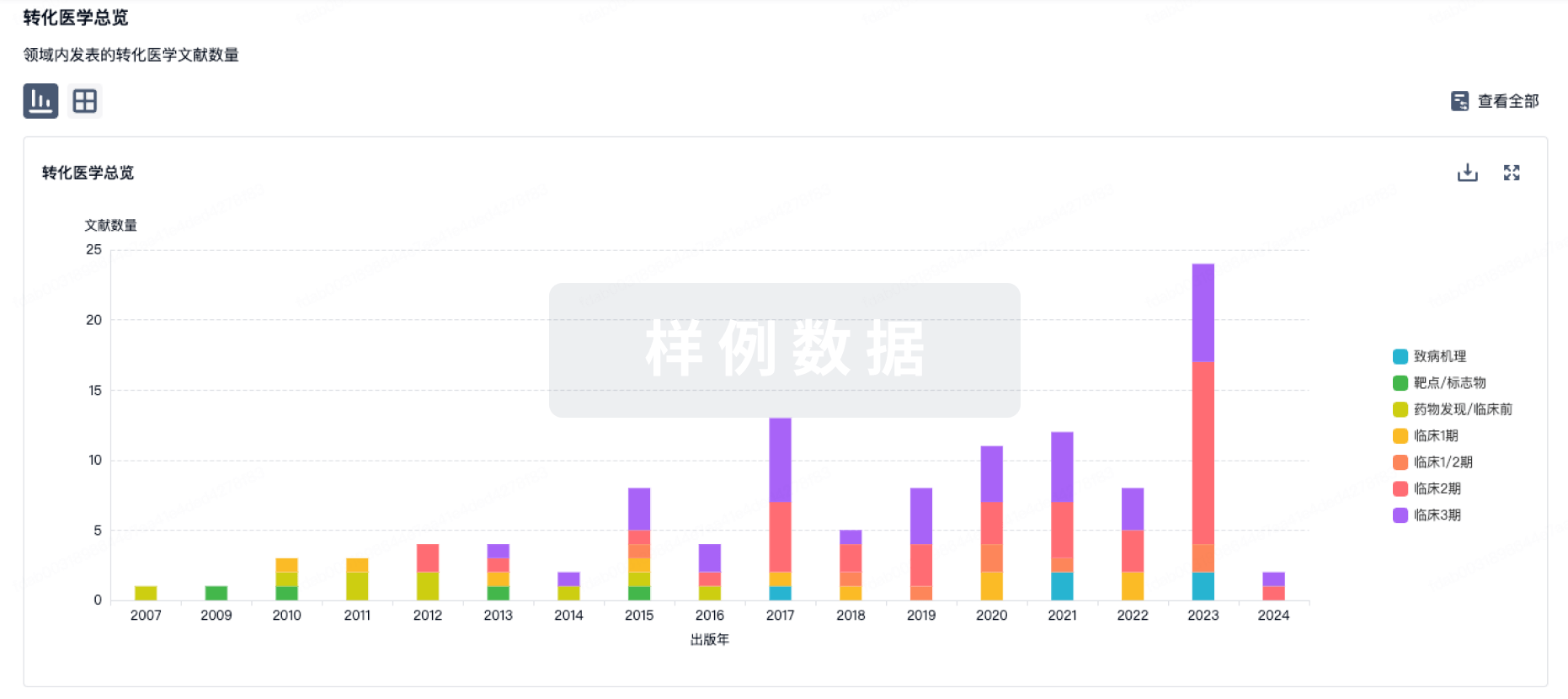
转化医学
使用我们的转化医学数据加速您的研究。
登录
或
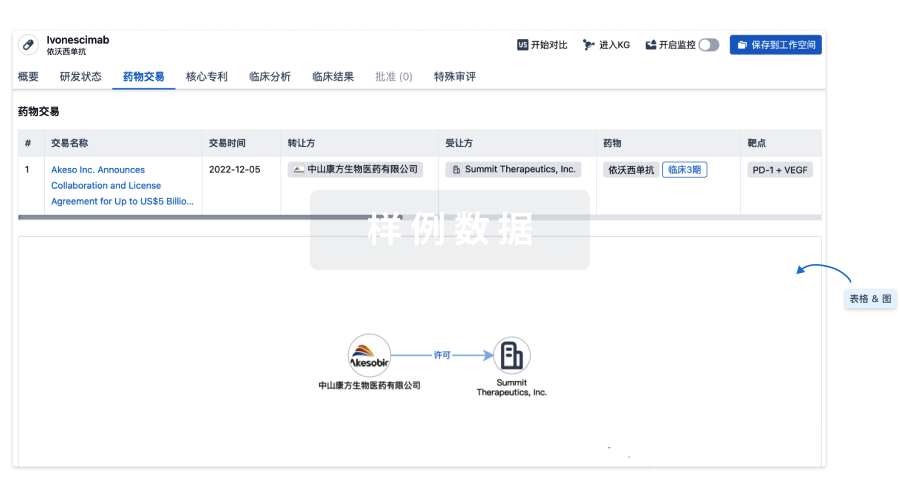
药物交易
使用我们的药物交易数据加速您的研究。
登录
或
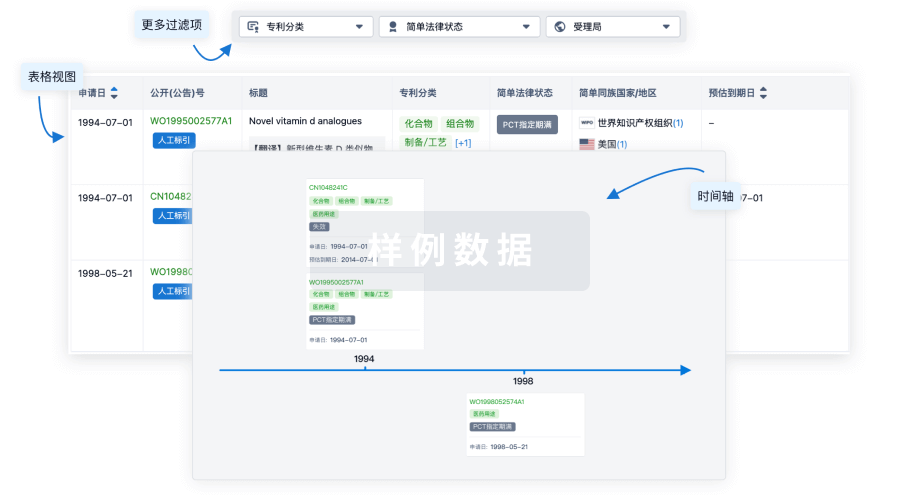
核心专利
使用我们的核心专利数据促进您的研究。
登录
或
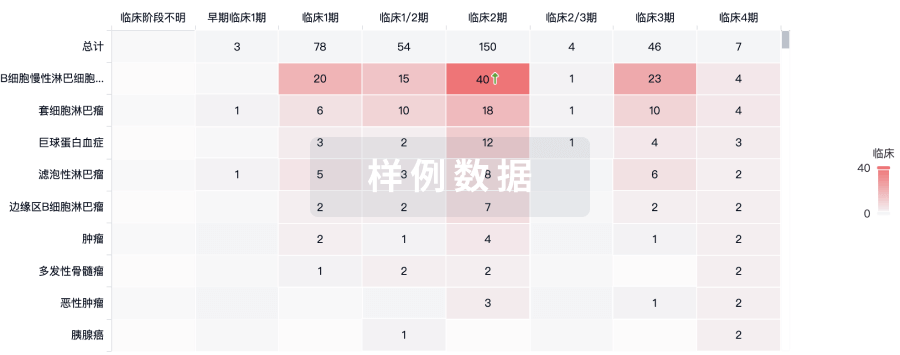
临床分析
紧跟全球注册中心的最新临床试验。
登录
或
批准
利用最新的监管批准信息加速您的研究。
登录
或
生物类似药
生物类似药在不同国家/地区的竞争态势。请注意临床1/2期并入临床2期,临床2/3期并入临床3期
登录
或
特殊审评
只需点击几下即可了解关键药物信息。
登录
或
生物医药百科问答
全新生物医药AI Agent 覆盖科研全链路,让突破性发现快人一步
立即开始免费试用!
智慧芽新药情报库是智慧芽专为生命科学人士构建的基于AI的创新药情报平台,助您全方位提升您的研发与决策效率。
立即开始数据试用!
智慧芽新药库数据也通过智慧芽数据服务平台,以API或者数据包形式对外开放,助您更加充分利用智慧芽新药情报信息。
生物序列数据库
生物药研发创新
免费使用
化学结构数据库
小分子化药研发创新
免费使用