预约演示
更新于:2026-09-26
Botulinum toxin type A (Huons)
A型肉毒毒素(Huons)
更新于:2026-09-26
概要
基本信息
非在研机构 |
最高研发阶段批准上市 |
首次获批日期 中国 (2026-01-05), |
最高研发阶段(中国)批准上市 |
特殊审评- |





登录后查看时间轴
关联
10
项与 A型肉毒毒素(Huons) 相关的临床试验NCT06205797
A Multicenter, Double-blind, Randomized, Parallel, Active-controlled, Phase III Clinical Trial to Evaluate the Efficacy and Safety of HU-045 Compared to Xeomin® in Adult Patients With Moderate or Severe Glabellar Lines
NCT05298449
A Multicenter, Double-blind, Randomized, Parallel, Active-controlled, Phase II Clinical Trial to Evaluate the Efficacy and Safety of HU-045 and Xeomin® in Patients With Moderate to Severe Glabellar Lines
NCT05289921
Multi Center, Phase III Clinical Trial to Evaluate the Safety and Efficacy of LIZTOX Inj in the Treatment of Post Stroke Upper Limb Spasticity
100 项与 A型肉毒毒素(Huons) 相关的临床结果
登录后查看更多信息
100 项与 A型肉毒毒素(Huons) 相关的转化医学
登录后查看更多信息
100 项与 A型肉毒毒素(Huons) 相关的专利(医药)
登录后查看更多信息
1,403
项与 A型肉毒毒素(Huons) 相关的文献(医药)2026-12-01Current Pain and Headache Reports
P2X7 Receptor as a Therapeutic Target for Neuropathic Pain: From Mechanisms to Translational Strategies
Review
作者: Yang, Zhanli ; Chen, Dan ; Mao, Peng ; Zhao, Xinrui ; Hai, Xiangjun ; Guo, Yanan ; Zhao, Guanghai ; Zhang, Shanming
PURPOSE OF REVIEW:
Neuropathic pain (NP) remains a therapeutic challenge due to the limited efficacy of conventional pharmacotherapies. This review aims to systematically consolidate the pathogenic role of the P2X7 receptor (P2X7R) in NP and to evaluate emerging translational strategies targeting this channel, including natural compounds, selective antagonists, drug repurposing, cell-based therapies, and neuromodulation.
RECENT FINDINGS:
Recent studies indicate that P2X7R is highly expressed in the spinal cord or dorsal root ganglia across multiple preclinical models of neuropathic pain, including peripheral nerve injury, diabetic neuropathy, chemotherapy-induced neuropathy, and postherpetic neuralgia, underscoring its pivotal role in the pathogenesis of neuropathic pain. In preclinical studies, targeting P2X7R with agents such as Brilliant Blue G, A-438079, botulinum toxin A, mesenchymal stem cell-derived secretomes, and high-frequency spinal cord stimulation produces marked, P2X7R-dependent analgesic effects. P2X7R stands out as a promising therapeutic target for neuropathic pain. Future priorities should focus on optimizing P2X7R-targeted pharmacodynamics, developing CNS-penetrant oral antagonists, and exploring combination strategies to maximize analgesic outcomes in NP patients.
2026-08-01TOXICON
Variant-aware computational assessment of neutralizing antibody binding robustness to botulinum toxin A
Article
作者: Webb, William Richard ; Saklayen, Golam ; Rao, Parinitha ; Joseph, John H ; Michon, Alain ; Rahman, Eqram ; Ahmed, Munim
Botulinum neurotoxin type A (BoNT/A) is a widely used biologic therapeutic, yet the influence of natural toxin sequence variation on the stability of neutralizing antibody binding remains poorly understood. In this study, we performed a comprehensive computational analysis to quantitatively assess antibody binding robustness across naturally occurring BoNT/A variants. Using a curated dataset spanning all major subtypes, we integrated sequence variability mapping, ensemble antibody docking, explicit-solvent molecular dynamics simulations (totalling >30 μs), Bayesian hierarchical modelling, and interface network analysis. Sequence analysis revealed that amino acid variability is strongly enriched in solvent-exposed regions, with mean Shannon entropy increasing from 0.07 in the light-chain core to 0.48 in surface loops of the heavy chain, and a significant association between entropy and solvent accessibility (Wilcoxon p < 10-6). Docking showed modest variant-dependent energetic dispersion (Cohen's d < 0.5) that poorly correlated with dynamic stability metrics (ρ = 0.18-0.31). In contrast, molecular dynamics simulations identified large variant-specific effects on interface stability, with multiple variants exhibiting >1 standard deviation increases in interface root-mean-square deviation (RMSD, a measure of average atomic displacement between structures) and reductions in contact persistence and hydrogen-bond occupancy. A composite Binding Robustness Index (BRI) separated high- and low-robustness variants by 2.1 to 2.7 standard deviations within antibody systems. Bayesian modelling indicated that 31-46% of variants had high posterior probability (>0.95) for reduced binding robustness. Interface network analysis revealed that low-robustness variants consistently disrupted cooperative interface topology, with 35-61% loss of high-betweenness residues and increased modularity, strongly correlating with Bayesian effect estimates (ρ = 0.74). These results demonstrate that natural BoNT/A sequence variation leads to substantial, antibody-specific differences in binding robustness, driven by localized disruption of cooperative interface networks rather than uniform binding weakening. This study provides a quantitative computational framework for assessing antibody binding stability across toxin variants, with implications for therapeutic durability and resistance mechanisms.
2026-07-04Journal of Cosmetic and Laser Therapy
Comparing patient satisfaction and pain control between vibration and topical anesthesia during botulinum toxin A injections: a randomized, double-blind, split-face clinical trial
Article
作者: de Carvalho, Daniel Coelho ; Machado Gonçalves, Letícia ; da Fonseca Josino, Fernanda Belo ; Soares Diniz, Rafael ; Rodrigues, Vandilson
This study aimed to evaluate pain levels, patient satisfaction, and preferences for different anesthetic techniques during the cosmetic application of botulinum toxin A in the upper third of the face. A randomized, double-blind, split-face clinical trial was conducted with 100 women undergoing esthetic procedures for facial wrinkle reduction. Patients were assigned to three groups: vibratory anesthesia versus placebo (Group I), topical anesthesia versus placebo (Group II), and vibratory anesthesia versus topical anesthesia (Group III). Pain levels were assessed using the visual analog scale (VAS). Patients identified the side with better pain control, expressed satisfaction, and provided recommendations for each technique. Group I (vibration 5.02 ± 2.56 vs. placebo 6.00 ± 2.75, p = .034), Group II (topical anesthetic 4.69 ± 2.45 vs. placebo 5.50 ± 2.38, p = .039), and Group III (topical anesthetic 4.89 ± 2.29 vs. vibration 6.06 ± 2.22, p = .048). While satisfaction levels showed no statistically significant differences between techniques, topical anesthesia in Group III received the highest recommendations (p = .010). This study suggests that topical anesthesia and vibratory stimulation both offer small-to-medium analgesic benefits over placebo during BoNT-A injections. Despite comparable satisfaction scores, patients preferred topical anesthesia for future use.
100 项与 A型肉毒毒素(Huons) 相关的药物交易
登录后查看更多信息
研发状态
批准上市
10 条最早获批的记录, 后查看更多信息
登录
| 适应症 | 国家/地区 | 公司 | 日期 |
|---|---|---|---|
| 眉间纹 | 中国 | 2026-01-05 |
未上市
10 条进展最快的记录, 后查看更多信息
登录
| 适应症 | 最高研发状态 | 国家/地区 | 公司 | 日期 |
|---|---|---|---|---|
| 脑卒中 | 临床3期 | 韩国 | 2022-03-04 | |
| 上肢痉挛 | 临床3期 | 韩国 | 2022-03-04 | |
| 鱼尾纹 | 临床3期 | 韩国 | 2018-11-01 |
登录后查看更多信息
临床结果
临床结果
适应症
分期
评价
查看全部结果
登录后查看更多信息
转化医学
使用我们的转化医学数据加速您的研究。
登录
或

药物交易
使用我们的药物交易数据加速您的研究。
登录
或

核心专利
使用我们的核心专利数据促进您的研究。
登录
或

临床分析
紧跟全球注册中心的最新临床试验。
登录
或

批准
利用最新的监管批准信息加速您的研究。
登录
或

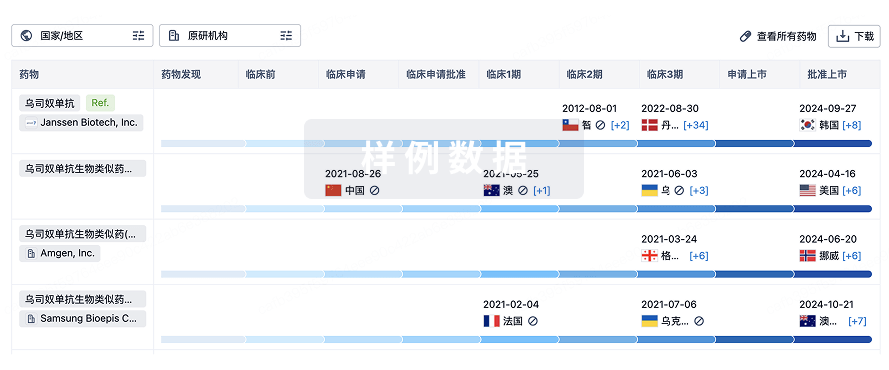
生物类似药
生物类似药在不同国家/地区的竞争态势。请注意临床1/2期并入临床2期,临床2/3期并入临床3期
登录
或
特殊审评
只需点击几下即可了解关键药物信息。
登录
或

提出任何生物医药研究问题
让每一步生物医药决策都精准制胜
基于十亿级生物数据与全球情报的精准 AI,赋能早期药物发现
立即开始免费试用!
智慧芽新药情报库是智慧芽专为生命科学人士构建的基于AI的创新药情报平台,助您全方位提升您的研发与决策效率。
立即接入生物医药数据包
智慧芽新药库数据也通过智慧芽开放平台,以MCP或API服务形式对外开放。立即使用我们的MCP服务定制您的LLM智能体。
生物序列数据库
生物药研发创新
免费使用
化学结构数据库
小分子化药研发创新
免费使用