预约演示
更新于:2026-01-31
SB24
更新于:2026-01-31
概要
基本信息
非在研机构- |
权益机构- |
最高研发阶段临床前 |
首次获批日期- |
最高研发阶段(中国)- |
特殊审评- |

结构/序列
Sequence Code 1120174450VH
Sequence Code 1281657905CDR1-H
Sequence Code 1281657906CDR2-H
Sequence Code 1281657907CDR3-H
关联
100 项与 SB24 相关的临床结果
登录后查看更多信息
100 项与 SB24 相关的转化医学
登录后查看更多信息
100 项与 SB24 相关的专利(医药)
登录后查看更多信息
5
项与 SB24 相关的文献(医药)2014-07-01·Zhonghua yu fang yi xue za zhi [Chinese journal of preventive medicine]
[Screening and identification of C7C peptide ligands of Mycobacterium tuberculosis].
Article
作者: Huang, Xiaochen ; Yang, Hua ; Hu, Zhongyi ; Lu, Junmei ; Liu, Zhonghua ; Ma, Hui
OBJECTIVE:
To obtain the C7C peptide ligands of Mycobacterium tuberculosis by affinity screening based on the phage-displayed random C7C peptide library, and preliminarily identify the binding capacity of the peptide to Mycobacterium.
METHODS:
Inactive Mycobacterium tuberculosis reference strain H37Rv was used as the target molecule to screen the Ph. D.-C7C peptide library, and Mycobacterium bovis, BCG was used for reverse screening. After 4 rounds of affinity screening, single phages eluted by H37Rv and BCG were selected for DNA sequencing. ELISA was used to detect the binding affinities of different single phage clones. The cyclic peptides displayed by the phage clones showing the highest appetency were synthesized in vitro with fluorescent markers. Fluorescence microscopy and flow cytometer was used to detect the binding affinities of synthesized cyclic peptides, comparing with linear binding peptides obtained before.
RESULTS:
After 4 rounds of biopanning, phages that could bind with target molecules were remarkable enriched. 16 common sequences were obtained by sequencing analysis of single phages. With ELISA, phage SB1, SB5, SB8 and SB26 all showed higher affinity with H37Rv and BCG, the ratio to negative control of which were ≥ 2.1, but could not bind to the 3 nonmycobacteria, which were identified as the positive clones. Based on the results of flow cytometer detection, the affinities to H37Rv of 4 cyclic peptides SB1, SB5, SB24, SB26 were (73.2 ± 6.3)%, (63.2 ± 5.3)%, (32.9 ± 3.1)%, (89.4 ± 7.0)%, and to BCG were (65.6 ± 6.1)%, (48.6 ± 4.5)%, (10.3 ± 1.8)%, (86.6 ± 7.9)%, separately, which were all higher than H8 ((4.0 ± 1.0)%, (5.5 ± 1.2)%) . From the results of fluorescence microscopy observation, all of the fluorescent labeled cyclic peptides SB1, SB5, SB24, SB26 could bind to H37Rv and showed higher fluorescence intensities, which also had certain affinities to other 18 mycobacteria, but the fluorescence intensities were lower than H37Rv, and didn't bind to 3 non-mycobacteria.
CONCLUSION:
Based on the replacement of linear 7 peptide library with C7C peptide library, new ligands of Mycobacterium tuberculosis were achieved successfully, which showed significantly higher binding affinities to mycobacteria.
2009-12-01·Plant disease2区 · 农林科学
Evaluation of Seed and Soil Treatments with Novel Bacillus subtilis Strains for Control of Soybean Root Rot Caused by Fusarium oxysporum and F. graminearum
2区 · 农林科学
Article
作者: Tambong, J. T. ; Zhang, J. X. ; Xue, A. G.
Fusarium root rot is an important disease of soybean in Ontario, Canada. This study is to select antagonistic bacterial agents as effective alternatives to chemical pesticides for the control of root rots caused by Fusarium oxysporum and F. graminearum. Twenty-two Bacillus subtilis strains from soybean and corn roots were tested in dual cultures for inhibition of mycelial growth of F. oxysporum and F. graminearum. All strains significantly reduced mycelial growth of F. oxysporum by approximately 17 to 48% and of F. graminearum by 10 to 32%. Ten B. subtilis strains selected based on their larger fungal inhibition zones were evaluated against macroconidial germination. These strains inhibited the spore germination of F. oxysporum by 20 to 48% and of F. graminearum by 14 to 32% in cell-free filtrates. Under greenhouse conditions, the efficacy of seed and soil treatments with B. subtilis strains against the two Fusarium root rot pathogens was evaluated based on root rot severity, seedling emergence, plant height, and root dry weight. Six B. subtilis strains (SB01, SB04, SB23, SB24, SB28, and SB33) from soybean roots and two strains (CB01 and CH22) from corn roots significantly reduced the severity of the two Fusarium root rots in seed or soil treatments. Strains SB01, SB04, SB23, and SB24 were the most effective treatments against both pathogens in either seed or soil treatment. When applied as seed treatments, these four strains reduced root rot severity by 43 to 63% and increased emergence by 13 to 17%, plant height by 9 to 18%, and root dry weight by 8.4 to 19%. When used as soil treatments, they reduced root rot severity by 68 to 74% and increased emergence by 14 to 18%, plant height by 11 to 23%, and root dry weight by 16 to 24%. These results suggest that the novel strains of B. subtilis identified in this research can be effective alternatives to fungicides in managing Fusarium root rots of soybean, and a greater level of efficacy may be achieved when they were used as soil treatments than seed treatments.
Zhonghua yu fang yi xue za zhi [Chinese journal of preventive medicine]
Screening and identification of C7C peptide ligands of Mycobacterium tuberculosis
作者: Huang, Xiaochen ; Yang, Hua ; Hu, Zhongyi ; Lu, Junmei ; Liu, Zhonghua ; Ma, Hui
Objective: To obtain the C7C peptide ligands of Mycobacterium tuberculosis by affinity screening based on the phage-displayed random C7C peptide library, and preliminarily identify the binding capacity of the peptide to Mycobacterium.Methods: Inactive Mycobacterium tuberculosis reference strain H37 Rv was used as the target mol. to screen the Ph. D. -C7C peptide library, and Mycobacterium boris, BCG was used for reverse screening.After 4 rounds of affinity screening, single phages eluted by H37 Rv and BCG were selected for DNA sequencing.The binding affinities of different single phage clones were detectd by ELISA.The cyclic peptides displayed by the phage clones showing the highest appetency were synthesized in vitro with fluorescent markers.Fluorescence microscopy and flow cytometer was used to detect the binding affinities of synthesized cyclic peptides, comparing with linear binding peptides obtained before.Results: After 4 rounds of biopanning, phages that could bind with target mols. were remarkable enriched. 16 common sequences were obtained by sequencing anal. of single phages.With ELISA, phage SB1, SB5, SB8 and SB26 all showed higher affinity with H37 Rv and BCG, the ratio to neg. control of which were > 2.1, but could not bind to the 3 nonmycobacteria, which were identified as the pos. clones.Based on the results of flow cytometer detection, the affinities to H37 Rv of 4 cyclic peptides SB1, SB5, SB24, SB26 were (73.2 ± 6.3)%, (63.2 ± 5.3)%, (32.9 ± 3.1)%, (89.4 ± 7.0)%, and to BCG were (65.6 ± 6.1)%, (48.6±4.5)%, (10.3 ± 1.8)%, (86.6±7.9)%, sep., which were all higher than H8 ((4.0 ± 1.0)%, (5.5 ± 1.2)%).From the results of fluorescence microscopy observation, all of the fluorescent labeled cyclic peptides SB1, SB5, SB24, 5B26 could bind to H37 Rv and showed higher fluorescence intensities, which also had certain affinities to other 18 mycobacteria, but the fluorescence intensities were lower than H37 Rv, and didn't bind to 3 non-mycobacteria.Conclusion: Based on the replacement of linear 7 peptide library with C7C peptide library, new ligands of Mycobacterium tuberculosis were achieved successfully, which showed significantly higher binding affinities to mycobacteria.
100 项与 SB24 相关的药物交易
登录后查看更多信息
研发状态
10 条进展最快的记录, 后查看更多信息
登录
| 适应症 | 最高研发状态 | 国家/地区 | 公司 | 日期 |
|---|---|---|---|---|
| 肿瘤 | 临床前 | 德国 | 2024-03-25 |
登录后查看更多信息
临床结果
临床结果
适应症
分期
评价
查看全部结果
| 研究 | 分期 | 人群特征 | 评价人数 | 分组 | 结果 | 评价 | 发布日期 |
|---|
No Data | |||||||
登录后查看更多信息
转化医学
使用我们的转化医学数据加速您的研究。
登录
或

药物交易
使用我们的药物交易数据加速您的研究。
登录
或

核心专利
使用我们的核心专利数据促进您的研究。
登录
或

临床分析
紧跟全球注册中心的最新临床试验。
登录
或

批准
利用最新的监管批准信息加速您的研究。
登录
或

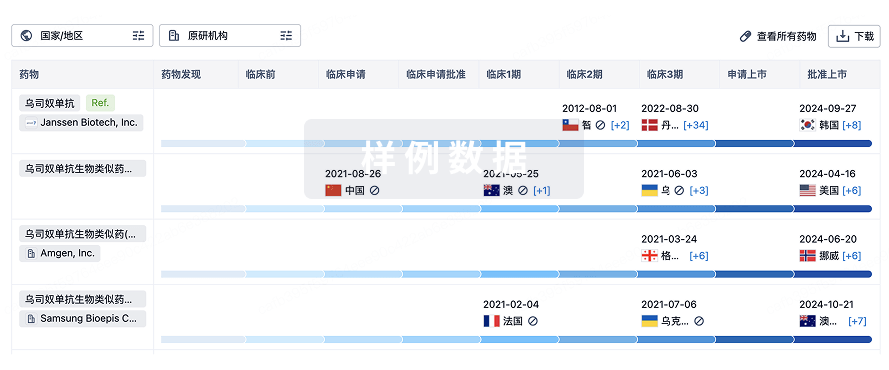
生物类似药
生物类似药在不同国家/地区的竞争态势。请注意临床1/2期并入临床2期,临床2/3期并入临床3期
登录
或
特殊审评
只需点击几下即可了解关键药物信息。
登录
或

提出任何生物医药研究问题
让每一步生物医药决策都精准制胜
基于十亿级生物数据与全球情报的精准 AI,赋能早期药物发现
立即开始免费试用!
智慧芽新药情报库是智慧芽专为生命科学人士构建的基于AI的创新药情报平台,助您全方位提升您的研发与决策效率。
立即接入生物医药数据包
智慧芽新药库数据也通过智慧芽开放平台,以MCP或API服务形式对外开放。立即使用我们的MCP服务定制您的LLM智能体。
生物序列数据库
生物药研发创新
免费使用
化学结构数据库
小分子化药研发创新
免费使用