预约演示
更新于:2026-10-03
MM-A01-01
更新于:2026-10-03
概要
基本信息
在研机构- |
权益机构- |
最高研发阶段无进展临床阶段不明 |
首次获批日期- |
最高研发阶段(中国)- |
特殊审评- |

关联
100 项与 MM-A01-01 相关的临床结果
登录后查看更多信息
100 项与 MM-A01-01 相关的转化医学
登录后查看更多信息
100 项与 MM-A01-01 相关的专利(医药)
登录后查看更多信息
9
项与 MM-A01-01 相关的新闻(医药)2026-04-23
Frederick National Laboratory for Cancer Research and the National Center for Advancing Translational Sciences Therapeutic Development Branch in the National Institutes of Health have launched the Gene Therapy Immunology and Standards Laboratory and Initiative, a national resource to aid the scientific community.
The laboratory promotes standardization in methods for studying and reporting on gene therapies, an emerging field of medicine that treats certain diseases by modifying the mutations that cause them.
Ligia Pinto, Ph.D., director of the Frederick National Laboratory’s Vaccine, Immunity, and Cancer Directorate, heads the program.
The Gene Therapy Immunology and Standards Laboratory draws on the Frederick laboratory’s strong history of standardization experience. Pinto’s team previously spearheaded the International HPV Serology Standardization Initiative in 2017 and the Serological Sciences Network, which focused on COVID-19.
“We have a team with a high level of expertise in immunology and standardization … and also the framework we established for standardization to support clinical trials in other areas. This laboratory [aims] to leverage that knowledge, those tools,” Pinto said.
The laboratory will standardize aspects of the gene therapy development process to aid different therapies moving toward clinical trials. When researchers use assays, protocols, standard operating procedures, and validated technologies set to the same standards across different studies, the results become more easily comparable.
“Then we all start talking the same ‘language,’” Pinto said.
Once that happens, the findings become easier for scientists to reproduce and verify. Conclusions can be drawn with more confidence and reliability.
Standardization is useful for “expediting public health decisions,” Pinto said.
When reliable data is generated and easily compared, conclusions and decisions are easier to make, leading to a faster and smoother road to clinical trials and, eventually, available treatments.
Gene therapies can be tailored toward specific illnesses, making them a prime option for rare diseases and precision medicine. However, because of the way some treatments—including some of those supported by the National Center for Advancing Translational Sciences—are delivered, via nonharmful viral vectors, it’s important to test patients for pre-existing immunity to the treatments to ensure they can safely participate in a clinical trial.
This is one area where the laboratory is making a difference. Researchers use blood sera sampling, an area of Pinto and team’s ’s expertise, to detect neutralizing antibodies against the vectors that could compromise the effectiveness of the therapy or increase the risk of adverse immune responses.
Because of the importance of having accurate and precise data before testing treatments, Pinto explains, it’s essential that strong, specific, sensitive, and reproducible methods are developed to test sera for these antibody responses.
In addition, they are working to develop assays to test how T cells, a type of immune cell, respond to gene therapies. This information can clarify how immune system responses might influence the therapy’s effectiveness.
The National Center for Advancing Translational Sciences supports gene therapy development through its work on the Platform Vector Gene Therapy (PaVe-GT) and MMA-101 projects, collaborations within the National Institutes of Health that are using vectors to deliver gene therapies for rare genetic diseases.
Standardizing the assays needed to perform these studies will enable researchers to compare results across them and compare the efficacy of different therapies. Future plans to share the process and standardization resources also align with PaVe-GT’s goal of disseminating information to the rare disease and gene therapy communities and can help other researchers develop quality data.
For the National Center for Advancing Translational Sciences, PaVe-GT is a way to expedite the pathway toward clinical trials for gene therapies for various rare diseases. The Gene Therapy Immunology and Standards Laboratory and Initiative is another way to hasten the development of high-quality data by creating a framework of standardization that can be applied across many gene therapy studies, making it easier to draw meaning from them.
Leveraging the expertise of both groups, as well as that of other stakeholders, will be the key to accelerating what’s possible in gene therapy studies.
“It takes a village,” said Pinto. “It takes time, and it takes involvement from many stakeholders. But it’s very important to develop standardization tools and have rich datasets to support and expedite those trials.”
2026-03-11
·罕见病
凌晨三点,又一次因为孩子代谢危象冲进急诊室时,你是否也问过自己:这样的日子,什么时候是个头?
我知道,当医生说出"终身治疗"这四个字时,那种无力感有多沉重。但今天,我想告诉你一个消息:这些年来我们苦苦等待的转折点,可能真的要来了。一张时间表:我们要等多久?
在开始详细介绍之前,先给你看个时间表。这是我根据权威信息整理的,让你心里有个底:
2025-2026年:mRNA疗法继续招募患者,国产羟钴胺注射液预计上市
2027年:CRISPR基因编辑疗法启动人体临床试验
2030年:如果进展顺利,MMA有望成为首个通过基因治疗实现"临床治愈"的有机酸代谢病
这不是科幻,是正在发生的现实。mRNA疗法:以后可能像打疫苗一样,定期输注就能控制病情
简单说:无需手术,每两周静脉输注一次,MUT型患者的血甲基丙二酸水平能平均下降67%,代谢危象发作次数减少58%。这意味着孩子们可能不用再频繁住院了。
2025年9月的阶段性成果——Moderna公司公布了mRNA-3705疗法(针对MUT型)的I/II期中期数据,22例患者接受治疗后,效果明显。它是怎么做到的?
想象一下,脂质纳米粒就像一辆微型货车,里面装着功能性MMUT基因的mRNA。货车进入肝细胞后,这些mRNA就像"使用说明书",指导细胞生产出正常的酶,帮助恢复代谢功能。为什么它特别适合?
不需要永久修改基因,安全性更高
可以根据需要调整剂量和频率
适合无法肝移植的MUT型患者
需要提醒的是,这种疗法目前仅针对MUT型患者,仍需重复给药。但相比终身严格饮食控制,已经是巨大的进步。基因治疗:从基础研究到临床应用的探索
如果mRNA疗法是"借来的力量",那基因治疗就是"根本性的修复"。不过需要坦诚告诉你:目前多数仍处于不同研究阶段,离真正应用还有距离。MMA-101项目
美国国立卫生研究院(NIH)正在开展这个项目,使用AAV8载体递送健康的MMUT基因。
需要提醒的是,这目前还只是小鼠实验,离人体应用还有距离。初步研究显示,这种疗法能有效降低小鼠模型的代谢异常水平,给未来的临床试验打了个好底子。新型载体44.9:破解免疫屏障
PMC发表的研究显示,一种名为AAV44.9的新型载体在MMA患者中的预存免疫抗体阳性率仅13%,远低于传统载体的26%。
这说明什么?意味着更多患者未来可能接受基因治疗,而且效果会更好。不过该载体仍处于基础研究阶段,后续还需要临床试验验证。CRISPR基因编辑:精准修复致病DNA
CRISPR Therapeutics开发的CTX-M101碱基编辑疗法,能在小鼠模型中实现MMUT基因突变的精准修复,计划2027年启动临床试验。
DNA就像一串字母,基因突变就是其中一个字母写错了。碱基编辑就是用精密的"分子剪刀"把错误的字母"剪掉",然后"粘贴"上正确的字母。
如果未来人体临床试验成功,有望实现"一次治疗、长期获益"的目标,为特定分型患者带来根治的可能。国产创新药:价格有望大幅降低
石药集团的高浓度盐酸羟钴胺注射液正在国内多家三甲医院开展III期临床试验,预计一两年内完成。
价格方面,相较于进口药物,国产羟钴胺注射液的价格预计将大幅下降,有望显著减轻患者家庭的用药经济负担。关于费用和挑战,想跟你说几句实话费用问题
目前国外部分MMA基因治疗项目单次费用约150万美元,价格高昂,大多数患者难以负担。
但这个价格听起来很吓人,参考其他罕见病基因治疗药物进入医保后的降价幅度,未来并非遥不可及。国内相关疗法仍处于研发阶段,随着国产研发推进,有望通过政策支持、医保纳入等方式降低费用。适用人群
MMA分型复杂,包括MUT型、cbl型等多种基因突变分型,还分为单纯型与合并型。不同治疗方案的适用人群存在明确差异,例如mRNA-3705疗法主要针对MUT型患者,需结合自身基因型选择合适的治疗方向。长期安全性
新疗法需要长期观察其安全性和有效性,这是所有新药研发必须经历的严谨过程。写在最后
从终身管理到可能的"临床治愈",这个跨越正在我们眼前发生。
也许明天,也许明年,也许再等几年——但请相信,那一天一定会到来。
在那一天到来之前,请记住:你不是在等待治愈,你是在走向治愈。每一天的坚持,每一次按时复查,都是你走向治愈的一步。
希望就在前方,而我们,一起在路上。参考资料
Moderna公司2025年9月国际遗传代谢病大会公布的mRNA-3705疗法中期数据
美国国立卫生研究院(NIH)MMA-101项目官方研究信息
PMC(PubMed Central)发表的AAV44.9载体研究
国家药品监督管理局药审中心关于石药集团高浓度盐酸羟钴胺注射液的临床试验批准公示
国际罕见病研究联盟(IRDIRC)预测报告
【免责声明】本文仅供科普参考,不构成医疗建议。具体治疗方案请咨询专业医生。
2022-03-11
Pictured: Selecta CEO Carsten Brunn/courtesy Selec
Selecta Biosciences is moving forward with development efforts for its gene therapy program for methylmalonic acidemia after the FDA lifted the hold on its clinical trial on March 9.
Selecta CEO Carsten Brunn/courtesy Selecta Biosciences.
Selecta Biosciences
is poised to move forward with development efforts for its gene therapy program for methylmalonic academia (MMA) after the U.S.
Food and Drug Administration
lifted the hold on its clinical trial on March 9.
The change was highlighted alongside the
announcement of positive results
for the full year to December 31, 2021. The FDA sent a
hold letter
against the firm’s Phase II/III trial of gene therapy candidate SEL-302 in November due to a lack of data on the chemistry, manufacturing process and controls related to the drug candidate. SEL-302 is a combination of ImmTOR and MMA-101.
MMA is a rare metabolic disorder that affects the body’s ability to process certain amino acids and fats, leading to metabolic acidosis, hyperammonemia and long-term complications such as developmental delays, chronic kidney disease and intellectual disability.
“I am pleased to announce that on March 9 the FDA lifted the clinical hold on our SEL-302 gene therapy program to treat methylmalonic acidemia. We look forward to starting our phase 1 clinical trial expeditiously and to bring hope to those patients and families seeking a potentially durable and lifelong treatment for this terrible disease,” commented Carsten Brunn, Ph.D., the president and chief executive officer of Selecta, in a statement.
In January, the company released positive preclinical data on the synergistic effects of ImmTOR when combined with a Treg selective IL-2. The combined product, ImmTOR-IL, may have the capacity to improve the induction and durability of antigen-specific regulatory T cells. If development efforts succeed, it could be a first-in-class antigen-specific therapeutic.
The good news presented at the earnings announcement was accompanied by a string of highlights and milestones for Selecta.
These include its engineering collaboration with Cyrus Biotechnology to harness IL-2 to promote the expansion of Treg and treat patients with autoimmune illnesses, an exclusive licensing deal to use Genovis AB’s IdeXork immunoglobulin G protease with ImmTOR to treat patients with pre-existing adeno-associated virus (AAV) immunity problems and a partnership with
Ginkgo Bioworks
to design AAV capsids and boost gene therapy delivery. Selecta also has a strategic license to develop gene therapies with
Takeda Pharmaceutical
, focusing on lysosomal storage disorders.
“We are incredibly excited about our future, and we are focused on continuing to prosecute our growing wholly owned pipeline, continuing to advance our technologies to enable AAV gene therapies, supporting our numerous collaboration partners and rapidly advancing our next generation ImmTOR-IL into the clinic,” Brunn added.
Selecta ended 2021 with $129.4 million in cash, cash equivalents, marketable securities and restricted cash, compared to the $140.1 million posted in the previous year. Revenue for the fourth quarter was logged at $29.9 million, from just $12 million in 2020, driven chiefly by its licensing deal with Sobi that resulted in a huge shipment of supplies and a large cost reimbursement from the Phase III DISSOLVE trial.
基因疗法引进/卖出临床3期临床1期
100 项与 MM-A01-01 相关的药物交易
登录后查看更多信息
研发状态
10 条进展最快的记录, 后查看更多信息
登录
| 适应症 | 最高研发状态 | 国家/地区 | 公司 | 日期 |
|---|---|---|---|---|
| 类风湿关节炎 | 临床阶段不明 | 韩国 | - |
登录后查看更多信息
临床结果
临床结果
适应症
分期
评价
查看全部结果
| 研究 | 分期 | 人群特征 | 评价人数 | 分组 | 结果 | 评价 | 发布日期 |
|---|
No Data | |||||||
登录后查看更多信息
转化医学
使用我们的转化医学数据加速您的研究。
登录
或

药物交易
使用我们的药物交易数据加速您的研究。
登录
或

核心专利
使用我们的核心专利数据促进您的研究。
登录
或

临床分析
紧跟全球注册中心的最新临床试验。
登录
或

批准
利用最新的监管批准信息加速您的研究。
登录
或

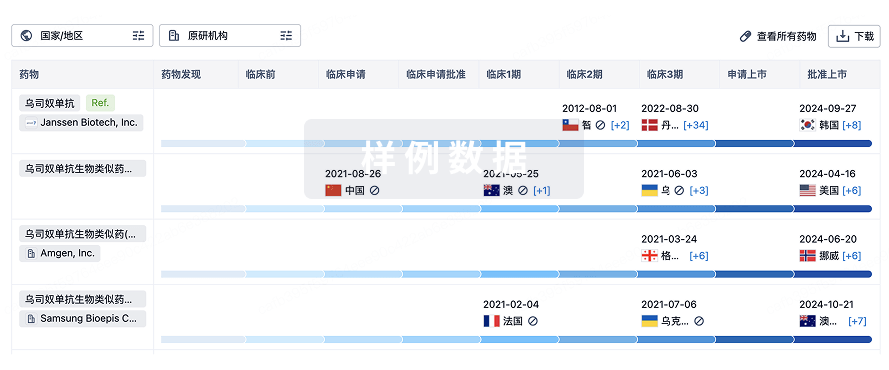
生物类似药
生物类似药在不同国家/地区的竞争态势。请注意临床1/2期并入临床2期,临床2/3期并入临床3期
登录
或
特殊审评
只需点击几下即可了解关键药物信息。
登录
或

提出任何生物医药研究问题
让每一步生物医药决策都精准制胜
基于十亿级生物数据与全球情报的精准 AI,赋能早期药物发现
立即开始免费试用!
智慧芽新药情报库是智慧芽专为生命科学人士构建的基于AI的创新药情报平台,助您全方位提升您的研发与决策效率。
立即接入生物医药数据包
智慧芽新药库数据也通过智慧芽开放平台,以MCP或API服务形式对外开放。立即使用我们的MCP服务定制您的LLM智能体。
生物序列数据库
生物药研发创新
免费使用
化学结构数据库
小分子化药研发创新
免费使用