预约演示
更新于:2026-10-21
Aflibercept Biosimilar (Alteogen)
阿柏西普生物类似药 (Alteogen)
更新于:2026-10-21
概要
基本信息
原研机构 |
非在研机构- |
权益机构- |
最高研发阶段批准上市 |
首次获批日期 欧盟 (2025-09-15), |
最高研发阶段(中国)- |
特殊审评- |

登录后查看时间轴
结构/序列
Sequence Code 4715606
当前序列信息引自: *****
关联
2
项与 阿柏西普生物类似药 (Alteogen) 相关的临床试验JPRN-jRCT2071210144
A Randomized, Phase 3, Double Masked, Parallel Group, Multicenter Study to Compare the Efficacy and Safety of ALT L9 Versus Eylea in Patients With Neovascular Age Related Macular Degeneration (ALTERA) (ALTERA)
NCT04058535
A Phase I Clinical Study of ALT-L9 in Patients With Neovascular Age-related Macular Degeneration
100 项与 阿柏西普生物类似药 (Alteogen) 相关的临床结果
登录后查看更多信息
100 项与 阿柏西普生物类似药 (Alteogen) 相关的转化医学
登录后查看更多信息
100 项与 阿柏西普生物类似药 (Alteogen) 相关的专利(医药)
登录后查看更多信息
1
项与 阿柏西普生物类似药 (Alteogen) 相关的文献(医药)2026-02-01Ophthalmology and Therapy
Therapeutic Equivalence of Eyluxvi (Aflibercept) to Eylea in Neovascular Age-Related Macular Degeneration: ALTERA Trial (Randomized)
Article
作者: Papp, Andras ; Jeong, Areum ; Raczynska, Dorota ; Kozub, Barbara ; Rauschning, Winrich ; Nowosielska, Agnieszka ; Ernest, Jan ; Baumane, Kristine ; Vajas, Attila ; Dusova, Jaroslava ; Lange, Natalia ; Kuneva, Irina ; Resch, Miklos ; Majtánová, Nora ; Oleksy, Piotr ; Akiyama, Kunihiko ; Bajdik, Beáta ; Briede, Eliza ; Sagong, Min
INTRODUCTION:
This study aimed to evaluate the efficacy and safety of Eyluxvi, an aflibercept biosimilar, compared with reference Eylea in patients with neovascular age-related macular degeneration (nAMD).
METHODS:
This phase 3, multicenter, randomized, double-masked, parallel-group study enrolled 431 patients at 79 sites across 12 countries. Patients were randomized 1:1 to receive intravitreal Eyluxvi or Eylea (2 mg) every 4 weeks through week 12, then every 8 weeks through week 48. The primary endpoint was change from baseline in best corrected visual acuity (BCVA) at week 8.
RESULTS:
The week 8 least-squares mean BCVA change was 5.771 letters with Eyluxvi vs 7.863 letters with Eylea (difference - 2.092 [95% confidence interval (CI) - 3.431 to - 0.753]). This equivalence was maintained through week 52. Week 52 adjusted mean changes were comparable for central subfield thickness (CST) (difference - 4.742 μm [95% CI - 22.006 to 12.521]) and choroidal neovascularization (CNV) area (difference 0.233 mm2 [95% CI - 0.724 to 1.191]). Safety profiles and immunogenicity were similar between groups.
CONCLUSION:
This study demonstrated therapeutic equivalence between Eyluxvi and Eylea in nAMD treatment, with comparable anatomical outcomes and safety profiles. These findings support the development of Eyluxvi as an aflibercept biosimilar, potentially increasing treatment accessibility for patients with nAMD.
TRIAL REGISTRATION:
EudraCT Identifier 2021-004530-11.
100 项与 阿柏西普生物类似药 (Alteogen) 相关的药物交易
登录后查看更多信息
研发状态
10 条最早获批的记录, 后查看更多信息
登录
| 适应症 | 国家/地区 | 公司 | 日期 |
|---|---|---|---|
| 脉络膜新生血管 | 韩国 | 2026-05-14 | |
| 视网膜静脉阻塞 | 韩国 | 2026-05-14 | |
| 糖尿病性黄斑水肿 | 欧盟 | 2025-09-15 | |
| 糖尿病性黄斑水肿 | 冰岛 | 2025-09-15 | |
| 糖尿病性黄斑水肿 | 列支敦士登 | 2025-09-15 | |
| 糖尿病性黄斑水肿 | 挪威 | 2025-09-15 | |
| 近视脉络膜新生血管 | 欧盟 | 2025-09-15 | |
| 近视脉络膜新生血管 | 冰岛 | 2025-09-15 | |
| 近视脉络膜新生血管 | 列支敦士登 | 2025-09-15 | |
| 近视脉络膜新生血管 | 挪威 | 2025-09-15 | |
| 视网膜静脉阻塞相关黄斑水肿 | 欧盟 | 2025-09-15 | |
| 视网膜静脉阻塞相关黄斑水肿 | 冰岛 | 2025-09-15 | |
| 视网膜静脉阻塞相关黄斑水肿 | 列支敦士登 | 2025-09-15 | |
| 视网膜静脉阻塞相关黄斑水肿 | 挪威 | 2025-09-15 | |
| 湿性年龄相关性黄斑变性 | 欧盟 | 2025-09-15 | |
| 湿性年龄相关性黄斑变性 | 冰岛 | 2025-09-15 | |
| 湿性年龄相关性黄斑变性 | 列支敦士登 | 2025-09-15 | |
| 湿性年龄相关性黄斑变性 | 挪威 | 2025-09-15 |
登录后查看更多信息
临床结果
临床结果
适应症
分期
评价
查看全部结果
登录后查看更多信息
转化医学
使用我们的转化医学数据加速您的研究。
登录
或

药物交易
使用我们的药物交易数据加速您的研究。
登录
或

核心专利
使用我们的核心专利数据促进您的研究。
登录
或

临床分析
紧跟全球注册中心的最新临床试验。
登录
或

批准
利用最新的监管批准信息加速您的研究。
登录
或

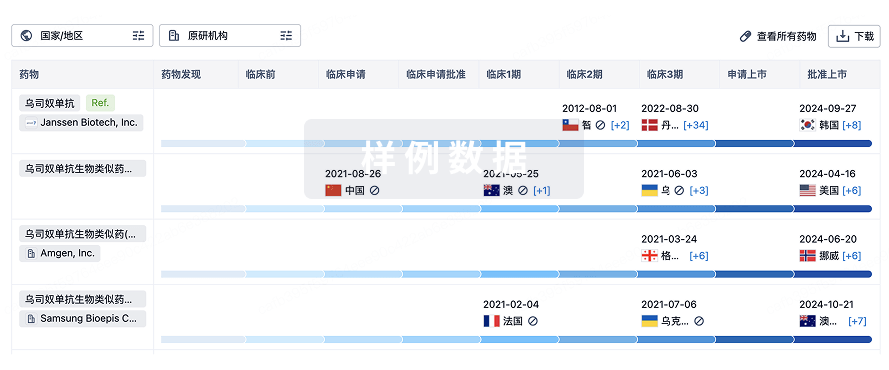
生物类似药
生物类似药在不同国家/地区的竞争态势。请注意临床1/2期并入临床2期,临床2/3期并入临床3期
登录
或
特殊审评
只需点击几下即可了解关键药物信息。
登录
或

提出任何生物医药研究问题
让每一步生物医药决策都精准制胜
基于十亿级生物数据与全球情报的精准 AI,赋能早期药物发现
立即开始免费试用!
智慧芽新药情报库是智慧芽专为生命科学人士构建的基于AI的创新药情报平台,助您全方位提升您的研发与决策效率。
立即接入生物医药数据包
智慧芽新药库数据也通过智慧芽开放平台,以MCP或API服务形式对外开放。立即使用我们的MCP服务定制您的LLM智能体。
生物序列数据库
生物药研发创新
免费使用
化学结构数据库
小分子化药研发创新
免费使用