预约演示
更新于:2026-08-22
Parathyroid hormone 1-34(National Institute of Diabetes & Digestive & Kidney Diseases)
更新于:2026-08-22
概要
基本信息
药物类型 多肽激素 |
别名 hPTH 1-34(National Institute of Diabetes & Digestive & Kidney Diseases) |
靶点 |
作用方式 激动剂 |
作用机制 PTH1R激动剂(甲状旁腺激素受体激动剂) |
治疗领域- |
在研适应症- |
非在研适应症- |
在研机构- |
权益机构- |
最高研发阶段无进展临床2期 |
首次获批日期- |
最高研发阶段(中国)- |
特殊审评- |

登录后查看时间轴
关联
1
项与 Parathyroid hormone 1-34(National Institute of Diabetes & Digestive & Kidney Diseases) 相关的临床试验NCT00004993
Can PTH Reverse Glucocorticoid-induced Osteoporosis
100 项与 Parathyroid hormone 1-34(National Institute of Diabetes & Digestive & Kidney Diseases) 相关的临床结果
登录后查看更多信息
100 项与 Parathyroid hormone 1-34(National Institute of Diabetes & Digestive & Kidney Diseases) 相关的转化医学
登录后查看更多信息
100 项与 Parathyroid hormone 1-34(National Institute of Diabetes & Digestive & Kidney Diseases) 相关的专利(医药)
登录后查看更多信息
24
项与 Parathyroid hormone 1-34(National Institute of Diabetes & Digestive & Kidney Diseases) 相关的文献(医药)2026-01-01AGING CELL
Senescent Cells Involved in Deterioration of Bone Microstructure by High‐Frequency Parathyroid Hormone 1–34 Administration and Bone Loss
Article
作者: Tateiwa, Daisuke ; Kitahara, Takayuki ; Furuichi, Takuya ; Hirai, Hiromasa ; Otsuru, Satoru ; Furuya, Masayuki ; Okada, Seiji ; Fujimori, Takahito ; Kaito, Takashi ; Kanie, Yuya ; Ukon, Yuichiro ; Ikuta, Masato ; Bun, Masayuki
ABSTRACT:
Osteoporosis is characterized by reduced bone mass and structural deterioration, leading to increased fracture risk, particularly in older adults. Parathyroid hormone (PTH) is a widely used anabolic therapy for osteoporosis; however, rapid bone loss after treatment discontinuation presents a significant clinical challenge. Cellular senescence has been implicated in age‐related bone fragility. However, its role in PTH‐induced bone remodeling and post‐treatment bone loss remains unclear. This study aimed to investigate the effects of PTH administration frequency on bone microarchitecture and cellular senescence in young and aged mice. High‐frequency PTH administration improved trabecular bone volume in both age groups, but caused cortical bone thinning, increased porosity, and elevated osteoclast activity in aged mice. PTH induces senescent osteoblast‐lineage‐enriched cell accumulation in aged, but not young mice, accompanied by upregulation of senescence‐associated markers and activation of the mechanistic Target of Rapamycin Complex 1 pathway. Co‐administration of the senolytic agents dasatinib and quercetin during PTH treatment reduced senescent cell burden, improved cortical porosity, and mitigated rapid bone loss after PTH discontinuation in aged mice. These findings indicate that senescent osteoblast‐lineage‐enriched cells contribute to bone fragility and post‐treatment bone loss in aged individuals, suggesting that targeting senescence may enhance the efficacy and sustainability of PTH therapy for osteoporosis.
2022-09-01Journal of oral biosciences
Histochemical examination of blood vessels in murine femora with intermittent PTH administration
Article
作者: Tomoka Hasegawa ; Haruhi Maruoka ; Yuhi Nakajima ; Minqi Li ; Miki Abe ; Alireza Nasoori ; Norimasa Iwasaki ; Tomohiro Shimizu ; Hotaka Ishizu ; Hiromi Hongo ; Mai Haraguchi-Kitakamae ; Shen Zhao ; Tomomaya Yamamoto ; Paulo Henrique Luiz de Freitas ; Masayuki Omaki ; Hirona Yoshino
OBJECTIVE:
To verify the biological effects of parathyroid hormone (PTH) on the blood vessels in the bone, this study aimed to investigate histological alterations in endomucin-positive blood vessels and perivascular cells in murine femora after intermittent PTH administration. For comparison with blood vessels in the bone, we examined the distribution of endomucin-positive blood vessels and surrounding αSMA-immunoreactive perivascular cells in the liver, kidney, and aorta with or without PTH administration.
METHODS:
Six-week-old male C57BL/6J mice received hPTH [1-34] or vehicle for two weeks. All mice were fixed with a paraformaldehyde solution after euthanasia, and the right femora, kidney, liver, and aorta were extracted for immunohistochemical analysis of endomucin, αSMA, ephrinB2, EphB4, and HIF1α. Light microscopic observations of semi-thin sections and transmission electron microscopic (TEM) observations of ultra-thin sections were performed on the left femora.
RESULTS:
After intermittent PTH administration, αSMA-reactive/ephrinB2-positive stromal cells appeared around endomucin-positive/EphB4-immunoreactive blood vessels in the bone. In addition, intense immunoreactivities of EphB4 and HIF1α were seen in vascular endothelial cells after the PTH treatment. Several stromal cells surrounding PTH-treated blood vessels exhibited well-developed rough endoplasmic reticulum under TEM observations. In contrast to bone tissues, αSMA-positive stromal cells did not increase around the endomucin-positive blood vessels in the kidney, liver, or aorta, even after PTH administration.
CONCLUSION:
These findings show that intermittent PTH administration increases αSMA-reactive/ephrinB2-positive perivascular stromal cells in bone tissue but not in the kidney, liver, or aorta, suggesting that PTH preferentially affects blood vessels in the bone.
2021-09-06Molecular pharmaceutics2区 · 医学
Discovery of a Long-Acting Parathyroid Hormone 1–34 Analogue to Treat Hypoparathyroidism
2区 · 医学
Article
作者: Dong, Yuanzhen ; Yang, Guiying ; Shangguan, Wenwen ; Ruan, Sida ; Lu, Weigen
Hypoparathyroidism (HP) is a rare disease with clinical manifestations of hypocalcemia and hyperphosphatemia, resulting from deficient or absent parathyroid hormone (PTH) secretion. Conventional treatment for patients with HP involves extensive calcium and vitamin D supplementation. In 2015, PTH1-84 was approved by the United States Food and Drug Administration as an adjunct for HP patients who cannot be well-controlled on conventional treatment. However, PTH1-84 therapy requires a daily injection, leading to poor patient compliance. The purpose of this study was to develop a long-acting PTH1-34 analogue by increasing its affinity to albumin. Three PTH1-34 variants were generated by substituting two of the three lysine (Lys) residues with arginine, reserving a single Lys as the modification site in each sequence. A series of side chains, containing fatty acid, deoxycholic acid, or biotin groups, were synthesized to modify these PTH1-34 variants by using a solid-liquid phase synthesis approach. In vitro bioactivity and albumin affinity tests were used to screen these new PTH1-34 analogues. Finally, Lys27-AAPC was selected from 69 synthesized analogues as a candidate therapeutic compound because it retained potency and exhibited a high albumin-binding capacity. In pharmacodynamic experiments, Lys27-AAPC demonstrated enhanced and prolonged efficacy in serum calcium elevating relative to PTH1-84. Moreover, a lyophilized powder for injection containing Lys27-AAPC was developed for further testing and represented a potential long-acting HP treatment.
100 项与 Parathyroid hormone 1-34(National Institute of Diabetes & Digestive & Kidney Diseases) 相关的药物交易
登录后查看更多信息
研发状态
登录后查看更多信息
临床结果
临床结果
适应症
分期
评价
查看全部结果
登录后查看更多信息
转化医学
使用我们的转化医学数据加速您的研究。
登录
或

药物交易
使用我们的药物交易数据加速您的研究。
登录
或

核心专利
使用我们的核心专利数据促进您的研究。
登录
或

临床分析
紧跟全球注册中心的最新临床试验。
登录
或

批准
利用最新的监管批准信息加速您的研究。
登录
或

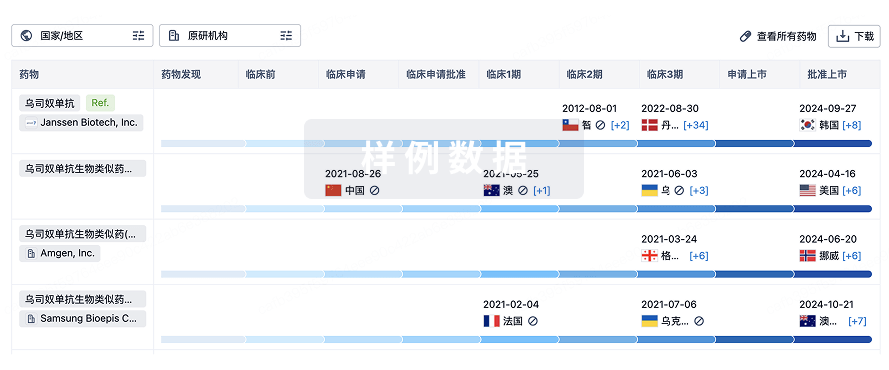
生物类似药
生物类似药在不同国家/地区的竞争态势。请注意临床1/2期并入临床2期,临床2/3期并入临床3期
登录
或
特殊审评
只需点击几下即可了解关键药物信息。
登录
或

提出任何生物医药研究问题
让每一步生物医药决策都精准制胜
基于十亿级生物数据与全球情报的精准 AI,赋能早期药物发现
立即开始免费试用!
智慧芽新药情报库是智慧芽专为生命科学人士构建的基于AI的创新药情报平台,助您全方位提升您的研发与决策效率。
立即接入生物医药数据包
智慧芽新药库数据也通过智慧芽开放平台,以MCP或API服务形式对外开放。立即使用我们的MCP服务定制您的LLM智能体。
生物序列数据库
生物药研发创新
免费使用
化学结构数据库
小分子化药研发创新
免费使用