预约演示
更新于:2026-10-10
Human Serum Albumin(Mitsubishi Tanabe Pharma Corp.)
更新于:2026-10-10
概要
基本信息
在研机构- |
权益机构- |
最高研发阶段撤市 |
首次获批日期 日本 (2007-10-19), |
最高研发阶段(中国)- |
特殊审评- |

登录后查看时间轴
结构/序列
Sequence Code 160295289
关联
2
项与 Human Serum Albumin(Mitsubishi Tanabe Pharma Corp.) 相关的临床试验NCT01843894
A Phase 1/2, First-in-Human, Double-Masked, Placebo-Controlled, Dose-Escalation Study Evaluating the Safety, Tolerability, and Efficacy of RU-101 Ophthalmic Solution in Patients With Severe Dry Eye
NCT01919710
Phase 1 Study of rHSA/GCSF in Neutropenia After Chemotherapy of Cancer Patients
100 项与 Human Serum Albumin(Mitsubishi Tanabe Pharma Corp.) 相关的临床结果
登录后查看更多信息
100 项与 Human Serum Albumin(Mitsubishi Tanabe Pharma Corp.) 相关的转化医学
登录后查看更多信息
100 项与 Human Serum Albumin(Mitsubishi Tanabe Pharma Corp.) 相关的专利(医药)
登录后查看更多信息
105
项与 Human Serum Albumin(Mitsubishi Tanabe Pharma Corp.) 相关的文献(医药)2026-09-01BIOTECHNOLOGY ADVANCES
Recombinant human serum albumin—A paradigm shift: From laboratory development to industrial-scale production, and clinical translation
Review
作者: Li, Shuang ; Cong, Di ; Gong, Guoli ; Li, Xiufeng ; Xiang, Wei ; Sun, Baojun ; Ning, Kequan
The transition from plasma-derived to recombinant human serum albumin (rHSA) represents a pivotal advancement in ensuring a safe and sustainable supply of this essential therapeutic protein. This review delineates the industrialization pathway of rHSA, highlighting yeast (Komagataella phaffii) and transgenic rice as the two dominant production platforms. Our analysis demonstrates that this paradigm arises not merely from considerations of yield, but from an optimal integration of scalability, cost-effectiveness, regulatory feasibility, and compatibility with next-generation purification strategies. Integrated multimodal purification technologies are critical for achieving the ultra-high purity required for high-dose therapeutic applications. We further synthesize clinical evidence confirming the biosimilarity and safety of rHSA produced from both platforms across key indications, thereby validating the entire technological pipeline from gene to final product. Looking ahead, we posit that the value of rHSA extends beyond substitution; its engineerability positions it as a versatile platform for innovative drug delivery and an essential animal-free component in advanced therapies. Realizing its full potential depends on overcoming the economic challenges of production scale-up, ensuring product consistency, and leveraging synthetic biology and intelligent manufacturing to pioneer a new generation of multifunctional biotherapeutics.
2026-02-01Hepatology International
A randomized, phase Ib trial of recombinant human serum albumin in cirrhotic patients with ascites
Article
作者: Wang, Zhongfeng ; Piao, Zhiyong ; Yang, Tao ; Gao, Runping ; Yu, Ge ; Hu, Yulin ; Wang, Yifei ; Pan, Yu ; Wang, Chong ; Piao, Hongxin ; Wang, Xinrui ; Zhou, Qiang ; Xu, Fang ; Xiang, Wei ; Guo, Xiaolin ; Jin, Qinglong ; Cai, Yanjun ; Qi, Yue ; Hua, Rui ; Xin, Guijie ; Fu, Zhaoxu ; Wang, Siqi ; Ji, Huifan ; Niu, Junqi ; Gao, Yanhang ; Wen, Xiaoyu ; Kong, Fei ; Jin, Jinglan ; Li, Xu ; Li, Wanyu ; Wang, Yang
Abstract:
Background:
Recombinant human serum albumin (rHA) is a promising alternative to human serum albumin (HSA) for managing ascites in cirrhotic patients. This phase Ib study aims to assess the safety, tolerability, and pharmacokinetics/pharmacodynamics (PK/PD) profiles of rHA in this population.
Methods:
This randomized, open-label, phase Ib trial was conducted between December 2019 and September 2020 at 3 medical centers in China. Patients with cirrhotic ascites were randomly assigned to receive rHA or HSA at 10 g/day, 20 g/day, or 30 g/day. Each group had 12 participants (nine receiving rHA and three receiving HSA as positive control). Treatment lasted up to 14 days or until serum albumin levels reached 35 g/L, followed by a 28-day follow-up. Adverse events monitored assessed safety and tolerability, while PK/PD was evaluated by tracking serum albumin levels and plasma colloid osmotic pressure (PCOP) before and after each dose (ClinicalTrials.gov No. NCT04701697).
Results:
Thirty-six Chinese participants were enrolled, with 32 completing the study. The incidence of adverse events was similar between the rHA and HSA groups (44.4% vs. 44.4%,
p
> 0.05). Serum albumin concentration increases were comparable between groups during treatment and follow-up. While most participants experienced weight and abdominal circumference decreases, no significant dose effect was observed (
p
> 0.05). No anti-drug antibodies were detected.
Conclusion:
In this study, rHA demonstrated similar safety and PK/PD to HSA in cirrhotic patients with ascites. rHA was well-tolerated, supporting the need to evaluate its safety and efficacy in a phase II clinical study.
2026-02-01Hepatology International
Methodological considerations for recombinant human serum albumin clinical translation
Letter
作者: Ruan, Bing ; Pan, Linye
19
项与 Human Serum Albumin(Mitsubishi Tanabe Pharma Corp.) 相关的新闻(医药)2026-09-29
·今日头条
临床3期申请上市引进/卖出
2026-09-24
·微信
2026-09-24
·有驾
100 项与 Human Serum Albumin(Mitsubishi Tanabe Pharma Corp.) 相关的药物交易
登录后查看更多信息
外链
| KEGG | Wiki | ATC | Drug Bank |
|---|---|---|---|
| - | - | - |
研发状态
批准上市
10 条最早获批的记录, 后查看更多信息
登录
| 适应症 | 国家/地区 | 公司 | 日期 |
|---|---|---|---|
| 低白蛋白血症 | 日本 | 2007-10-19 |
未上市
10 条进展最快的记录, 后查看更多信息
登录
| 适应症 | 最高研发状态 | 国家/地区 | 公司 | 日期 |
|---|---|---|---|---|
| 血友病 | 申请上市 | 日本 | 2007-10-01 | |
| 干眼综合征 | 临床2期 | 美国 | 2013-04-01 |
登录后查看更多信息
临床结果
临床结果
适应症
分期
评价
查看全部结果
登录后查看更多信息
转化医学
使用我们的转化医学数据加速您的研究。
登录
或

药物交易
使用我们的药物交易数据加速您的研究。
登录
或

核心专利
使用我们的核心专利数据促进您的研究。
登录
或

临床分析
紧跟全球注册中心的最新临床试验。
登录
或

批准
利用最新的监管批准信息加速您的研究。
登录
或

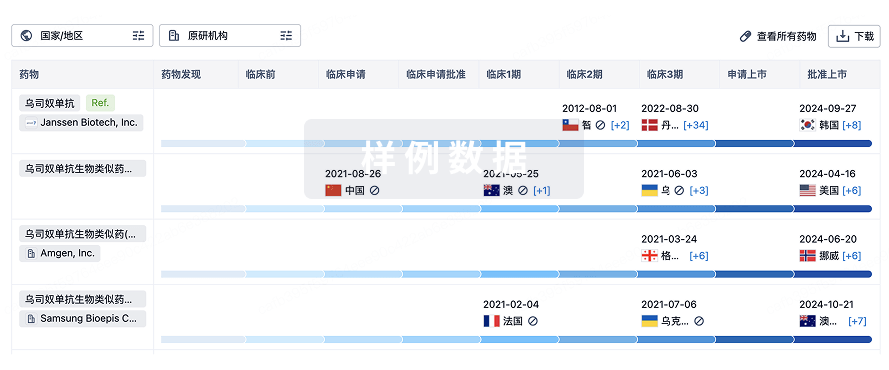
生物类似药
生物类似药在不同国家/地区的竞争态势。请注意临床1/2期并入临床2期,临床2/3期并入临床3期
登录
或
特殊审评
只需点击几下即可了解关键药物信息。
登录
或

提出任何生物医药研究问题
让每一步生物医药决策都精准制胜
基于十亿级生物数据与全球情报的精准 AI,赋能早期药物发现
立即开始免费试用!
智慧芽新药情报库是智慧芽专为生命科学人士构建的基于AI的创新药情报平台,助您全方位提升您的研发与决策效率。
立即接入生物医药数据包
智慧芽新药库数据也通过智慧芽开放平台,以MCP或API服务形式对外开放。立即使用我们的MCP服务定制您的LLM智能体。
生物序列数据库
生物药研发创新
免费使用
化学结构数据库
小分子化药研发创新
免费使用