预约演示
更新于:2025-05-07
TP73
更新于:2025-05-07
基本信息
别名 p53-like transcription factor、p53-related protein、P73 + [2] |
简介 Participates in the apoptotic response to DNA damage. Isoforms containing the transactivation domain are pro-apoptotic, isoforms lacking the domain are anti-apoptotic and block the function of p53 and transactivating p73 isoforms. May be a tumor suppressor protein. Is an activator of FOXJ1 expression (By similarity). It is an essential factor for the positive regulation of lung ciliated cell differentiation (PubMed:34077761). |
关联
100 项与 TP73 相关的临床结果
登录后查看更多信息
100 项与 TP73 相关的转化医学
登录后查看更多信息
0 项与 TP73 相关的专利(医药)
登录后查看更多信息
2,694
项与 TP73 相关的文献(医药)2025-08-01·Tissue and Cell
WWOX attenuates the progression of gallbladder cancer by suppressing cellular glycolysis through the modulation of the P73/HIF-1α signaling pathway
Article
作者: Su, Kun ; Wang, Lian-Min ; Wu, Tao ; Zou, Ren-Chao ; Wang, Qiu-Hong ; Tang, Bo ; Wei, Dong ; Cun, Dong-Yun ; Wang, Tao ; Yang, Xia-Wei ; Qu, Qi-Cai
2025-05-01·Neurobiology of Disease
Corrigendum to “Oxidative stress activates the c-Abl/p73 proapoptotic pathway in Niemann-Pick type C neurons” [Neurobiology of Disease Volume 41, Issue 1, January 2011, Pages 209–218]
作者: Zanlungo, Silvana ; Alvarez, Alejandra R ; Maldonado, Carola ; Robledo, Fermín ; Gonzalez, Marcela ; de Arce, Karen Perez ; Muñoz, Francisco J ; Hetz, Claudio ; Klein, Andres ; Vargas, Lina M
2025-04-10·Microbiology Resource Announcements
Interactome of the oncogenic ΔNp73α isoform in human papillomavirus 38 E6/E7-transformed keratinocytes
Article
作者: Tommasino, Massimo ; Taverniti, Valerio ; Zanier, Katia ; Negroni, Luc
12
项与 TP73 相关的新闻(医药)2024-11-06
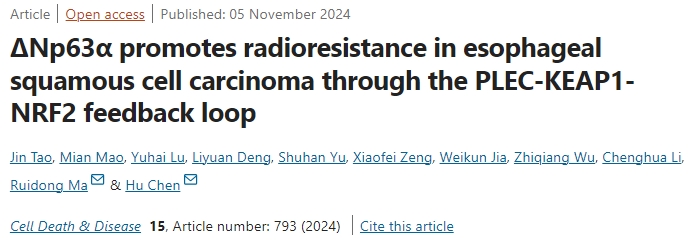
11月5日,成都医学院陈虎研究团队在期刊《Cell Death&Disease》上发表了研究论文,题为“ΔNp63α promotes radioresistance in esophageal squamous cell carcinoma through the PLEC-KEAP1-NRF2 feedback loop”,在本研究中,研究人员发现ΔNP63α在ESCC中高度表达,并与放射耐药相关。此外,ΔNP63α在放射耐药中发挥关键作用,可直接激活PLEC的表达。PLEC与KEAP1竞争性相互作用,导致NRF2从KEAP1中释放并从细胞质转移到核内,在那里激活基因表达以促进ROS消除。此外,放射治疗诱导的ROS还可通过NRF2激活ΔNP63α的表达。通过抑制NRF2,可有效改善裸鼠的放射敏感性。综合研究结果,强烈表明ΔNp63α/PLEC/NRF2轴在ESCC的放射耐药中起着关键作用,这表明靶向NRF2是治疗ESCC的一种有前途的治疗方法。
https://www.nature.com/articles/s41419-024-07194-4
背景信息
01
食管癌是全球第六大癌症相关死亡原因。根据组织病理学特征,食管癌可分为鳞状细胞癌(ESCC)和腺癌(ESCA)两种类型。全球近70%的食管癌病例发生在中国,其中90%为ESCC病例。在过去的十年中,靶向ESCC的早期诊断和治疗的临床方法已经发生了演变,在所有阶段都出现了新的范式取代传统方法。然而,超过50%的ESCC患者对目前的治疗方法反应不佳,大多数患者死于复发性癌症。ESCC被认为对抗癌疗法具有耐药性。越来越多的证据表明,ESCC容易产生放射性耐药,导致放疗失败。因此,了解放射性耐药的机制对于开发ESCC的新型治疗策略至关重要。
p63蛋白是由TP63基因编码的,是p53/p63/p73家族的成员,是表皮分化过程中的关键调节因子。p63也是鳞状细胞癌(SCC)中依赖于谱系的癌基因。TP63基因通过不同的启动子产生两种主要的异构体,TAp63和N-端截短的ΔNp63。ΔNp63α是TP63在表皮细胞和SCC(包括ESCC)中表达的主要异构体。ΔNp63α通过激活β-连环蛋白/c-Myc信号通路来促进ESCC细胞的侵袭和转移。ΔNp63α还通过Akt信号通路或DKK3/CKAP4促进ESCC细胞的生长。据报道,ΔNp63α在ESCC患者中的表达与生存率相关。然而,ΔNp63α是否参与ESCC的治疗耐药目前尚不清楚。
ΔNp63α通过降低放疗诱导的ROS来促进食管鳞癌的辐射耐药
02
为了评估ΔNp63α在放疗中的关键作用,研究人员首先筛选了一组ESCC细胞系,并选择了表达低水平(KYSE30和KYSE150)和高水平(KYSE180和KYSE450)ΔNp63α的两个细胞系。接下来,研究人员对细胞进行照射并测量细胞存活率。如图1B所示,ΔNp63α表达水平较高的KYSE450细胞在照射后表现出较高的存活率,而ΔNp63α表达水平较低的KYSE150细胞则没有。10 Gy的照射导致KYSE150细胞中ΔNp63α蛋白轻微升高,但未影响KYSE450细胞中的ΔNp63α表达。相反,ΔNp63α敲低显著降低了细胞在放疗后的存活率。另外,野生型ΔNp63α的过表达,但不是转录激活缺陷型突变体(R304W),在放疗时显著提高了细胞存活率。这些结果表明,ΔNp63α在ESCC的放疗耐药中起着关键作用。
图1:ΔNp63α通过抑制放疗诱导的ROS来促进辐射耐药性
放射疗法主要通过离子辐射和活性氧分子(ROS)引起的DNA损伤来发挥治疗作用,通过自由基破坏DNA的化学键。因此,DNA损伤检查点响应在细胞辐射敏感性中起着关键作用。在ΔNp63α过表达的KYSE150细胞中,由辐射引起的检查点蛋白ATM和CHK2的激活磷酸化显著增加,而在ΔNp63α敲除的KYSE450细胞中则降低,这表明ΔNp63α促进对DNA损伤的检查点激活。此外,在ΔNp63α敲除的KYSE450细胞中,由辐射引起的活性氧分子显著升高。通过N-乙酰半胱氨酸(NAC)清除活性氧分子可显著提高细胞存活率,并抑制由辐射引起的p-AMT和p-CHK2的表达。据报道,ΔNp63α激活RAD51(一种重组酶)以维持基因组完整性。研究人员在ΔNp63α敲除的KYSE450细胞中恢复了RAD51的表达,发现RAD51在一定程度上,但并非完全逆转了辐射治疗后的细胞存活率。然而,RAD51的恢复结合ROS清除完全恢复了辐射引起的细胞生存抑制,这表明RAD51在不解决ROS诱导的损伤的情况下并不足以发挥作用。总之,这些数据表明ΔNp63α通过减少放疗诱导的ROS来促进放射耐药性。
靶向NRF2抑制ΔNp63α介导的辐射耐药
03
为了研究激活或抑制NRF2对ROS水平和细胞存活率的影响,研究人员分别用SFN或ML385处理KYSE150或KYSE450细胞。研究显示,SFN激活NRF2明显降低了ROS水平,尽管这并未显著改善细胞存活率。相反,ML385抑制NRF2导致ROS水平显著升高,细胞存活率显著降低。这些结果表明,较低的内源性ROS水平可能不会显著影响细胞存活率。然而,在KYSE150细胞接受辐射治疗后,随着ROS水平的升高,细胞存活率明显降低。使用SFN或NAC可有效中和辐射诱导的ROS并显著改善细胞存活率。相反,ML385抑制NRF2进一步升高了辐射诱导的ROS。尤其是,NAC治疗几乎完全恢复了辐射后的细胞存活率。这些发现强调了NRF2在维持ROS水平和支持细胞存活方面的关键作用。
为了研究ΔNp63α和NRF2对食管鳞状细胞癌(ESCC)进展的影响,研究人员通过向裸鼠皮下注射转染的ESCC细胞来建立异种移植模型,并通过照射和NRF2抑制剂ML385进行治疗。研究显示,ΔNp63α的过表达可促进肿瘤生长和体重增加。照射显著降低了肿瘤生长和体重,而过表达ΔNp63α则在照射后促进肿瘤生长。照射结合NRF2抑制可显著抑制ΔNp63α介导的肿瘤生长,表明NRF2抑制可对抗ΔNp63α介导的辐射耐药。此外,免疫组织化学检测显示,照射后,ΔNp63α增加了Ki67+细胞并减少了Cleaved Caspase-3+(CC3)凋亡细胞,而NRF2抑制剂与照射结合则显著减少了Ki67+细胞并增加了CC3+凋亡细胞。这些结果表明,NRF2抑制可对抗ΔNp63α介导的ESCC辐射耐药。
结论
04
本研究结果表明,ΔNp63α/PLEC/NRF2信号通路和抗氧化防御机制可能是癌症治疗的有前景的治疗策略。(转化医学网360zhyx.com)
【参考资料】
https://www.nature.com/articles/s41419-024-07194-4
【关于投稿】
转化医学网(360zhyx.com)是转化医学核心门户,旨在推动基础研究、临床诊疗和产业的发展,核心内容涵盖组学、检验、免疫、肿瘤、心血管、糖尿病等。如您有最新的研究内容发表,欢迎联系我们进行免费报道(公众号菜单栏-在线客服联系),我们的理念:内容创造价值,转化铸就未来!
转化医学网(360zhyx.com)发布的文章旨在介绍前沿医学研究进展,不能作为治疗方案使用;如需获得健康指导,请至正规医院就诊。
放射疗法
2024-05-10
·生物探索
引言p53是最重要的抑癌基因,功能广泛而强大。自从1979年p53蛋白被发现以来,p53一直是分子生物学和肿瘤学的“明星分子”。在PubMed数据库中用p53为关键词搜索,可以找到超过十万篇文献。在 Nature 杂志2017年的一项统计中,p53以绝对优势位列过去几十年最热门研究基因榜第一名。2024年是p53蛋白被发现45周年。为庆祝这一事件,2024年5月9日,美国哥伦比亚大学欧文医学中心顾伟教授课题组(刘彦卿博士为第一作者)应邀在 Cancer Cell 杂志撰写了题为:Understanding the complexity of p53 in a new era of tumor suppression 的长文综述。该综述全方位地总结了p53的发现、结构、功能、调节、在生理病理过程中的作用、作为疾病治疗靶点的潜力,以及p53研究领域的一些未解之谜。一、p53的发现、进化与结构p53的研究在过去几十年经历了几次关键的转折,是现代分子肿瘤学发展的一个缩影。1979年,多个实验室在SV40以及其它方式转化的细胞进行研究时独立发现了p53蛋白。最初,p53被认为是一个促进细胞转化的癌基因。然而,1989年一系列论文揭示野生型p53(WT p53)实际上是一个肿瘤抑制因子(图1)。图1 p53研究领域里程碑发现人类p53基因家族包含三个成员p53\p63和p73。该家族起源于至少8亿年前,随后发生基因复制和结构多样化从而产生这三个家族成员。一个有趣的发现是p53家族基因存在于一些单细胞真核生物中,例如领鞭毛类Monosiga brevicollis,这表明p53家族在多细胞生物的进化可能存在重要作用。单细胞真核生物中的p53家族基因被认为可以维持基因组稳定性以应对各种刺激。而p53基因出现在最早的脊椎动物中,并在进化上一直保守。鉴于低等生物患癌症的风险极小,p53家族在低等生物中的存在是引人注目的。这就提出了一个关于p53家族在进化中的最原始功能的问题。该家族最初可能参与维持生殖细胞的完整性,其众所周知的肿瘤抑制能力是在很久以后才获得的。p53蛋白的主要是作为一个转录因(TF)调控基因表达,但它也存在TF非依赖的功能(图2)。人类的全长p53蛋白(FLp53)包含393个氨基酸,这些氨基酸被组织成五个不同的结构域:N端转录激活结构域(TAD)、富含脯氨酸的结构域(PRD)、中间的DNA结合结构域(DBD)、四聚化结构域(TD)和C端调节结构域(CTD)。p53的 TAD分为两个子结构域TAD1和TAD2。在未受刺激的细胞中,p53蛋白同时以单体、二聚体和四聚体的混合状态存在,其中二聚体占主导地位。在不同类型的刺激信号(包括DNA损伤、癌基因激活、核糖体应激、端粒损伤、营养缺乏和缺氧等),p53蛋白通过其TD快速组装成功能性四聚体(一个“二聚体的二聚体“结构”)。通过使用 DBD,该四聚体可识别位于靶基因启动子或增强子处的p53结合位点以调节转录。p53的DBD折叠很好,其结构已被解析。然而,p53的TAD和CTD存在很多无序区,导致其并没有一个确定的结构。但这一特点有利于它们与转录相关的cofactor相互作用。这些无序区也可能通过与别的蛋白发生相分离介导转录活动。这两个结构域也是进行翻译后修饰 (PTM) 的主要区域。此外,PRD也有助于p53的转录调节活性。p53通过由两个十聚体重复组成的特定反应元件(RE)被招募到 DNA:RRRCWWGYYY(R,嘌呤;W、A 或 T;和 Y,嘧啶)。p53直接调控300多个靶基因的转录。而考虑到间接调节的基因,p53可以调节数千个基因的表达。目前大多数被报道的p53靶基因是蛋白质编码基因,但p53还调节各种非编码 RNA,比如miRNA、lncRNA,甚至circRNA。二、p53的调节:蛋白翻译后修饰是关键为了准确地执行其多方面的功能,p53的表达和活性需要在蛋白质、DNA和RNA水平上受到精细和多层次的调控(图2)。图2 p53的调节蛋白层面的调节p53蛋白可经历多种类型的PTM,包括ubiquitination、phosphorylation、acetylation、methylation、SUMOylation、NEDDylation、OGlcNAcylation、ADP-ribosylation、UFMylation、hydroxylation、β-hydroxybutyrylation、sulfation及isoLG adduction。不同的刺激信号决定PTM的位点和类型。p53的许多PTM是可逆的。PTM对p53的影响包括改变其蛋白质水平、细胞定位、cofactor招募、靶基因选择性,甚至蛋白质聚集。其中,泛素化、磷酸化和乙酰化在影响p53功能方面最常见且最有影响力。泛素化通常发生在p53 的C赖氨酸残基处。MDM2是最著名的p53调节因子,它使p53发生泛素化而受到降解,以维持未受刺激的细胞中的低p53水平或将核p53输出到细胞质。许多刺激和调节因子是通过减轻MDM2的抑制来激活p53。例如,p14ARF蛋白可以通过抑制MDM2介导的p53降解来稳定p53。支持MDM2介导的p53抑制的重要性的令人信服的证据来自小鼠模型,其中MDM2缺陷引起的胚胎致死可以通过敲除p53来回复。有趣的是,MDM2本身就是p53的靶基因。MDM2-p53构成的反馈环路是p53相关通路的核心。MDMX(或MDM4)是MDM2的家族成员,虽然其本身缺乏E3泛素连接酶活性,但可以与MDM2形成异二聚体,增强p53的降解。其他可降解p53的E3泛素连接酶包括ARF-BP1/HUWE1、COP1、CHIP和Pirh2。 丝氨酸和苏氨酸磷酸化位点分布在整个p53蛋白。ATM对p53的磷酸化是最早用于解释p53如何响应DNA损伤的机制。S15、T18和S20的磷酸化会破坏MDM2对p53的结合和抑制,同时增强p53与CBP等转录辅助因子的相互作用。其结果是p53介导的转录被激活,诱导细胞周期停滞和细胞凋亡。严重的DNA损伤进一步使p53在S46处磷酸化,从而加强细胞凋亡。p53乙酰化的发现是最早发现非组蛋白也可以发生乙酰化的例子。DBD中几个赖氨酸残基的乙酰化对于p53激活的能力至关重要,可以以启动子特异性的方式影响细胞周期停滞、细胞凋亡、衰老、铁死亡和mTOR通路。p53乙酰化在肿瘤抑制中的作用可以通过一系列乙酰化缺陷型(KR mutation)基因敲入小鼠模型得到最好的说明。例如,尽管p53-3KR突变体保留了其DNA结合活性,但却不能激活p21等主要靶基因。然而 p53-3KR突变小鼠却不易患肿瘤。而p53-4KR和p53-5KR突变体进一步消除了p53调节铁死亡和mTOR通路的能力,使得p53基本丧失肿瘤抑制功能。值得注意的是,CTD乙酰化的作用很复杂:CTD相同的赖氨酸残基也可以发生甲基化、泛素化、SUMOylation和NEDDylation等修饰。因此,CTD乙酰化缺陷突变体(p53-6KR和p53-7KR)小鼠未能表现出对肿瘤抑制的显著影响,因为这些突变体同时消除了不同类型PTM对p53功能的正面和负面影响。事实上,模拟乙酰化 (p53-KQ)的突变小鼠在转录和肿瘤抑制中表现出明显的p53激活(即便p53蛋白水平并未显著增加),这一发现强调了CTD乙酰化在体内状态的作用。总而言之,多种多样的蛋白修饰类型一起调节了p53的活性。值得注意的是,虽然in vitro研究表明很多PTM都对p53的功能有重要影响,但这些结果在in vivo状态未必可以得到重复。要想弄清某种蛋白修饰对p53的功能影响,最合适的是使用knock-in的小鼠模型。在蛋白质水平上,cofactor是另一个影响p53活性的重要因素。p53蛋白可以与多种cofactor结合,包括activator和inhibitor,这对其蛋白折叠、稳定性、细胞定位、DNA 结合、转录激活能力和靶基因选择有重要影响。例如,许多分子伴侣可以调节调节p53的折叠和稳定性。MDM2和MDMX结合p53的TAD以抑制其转录激活活性(不依赖于与MDM2作为E3泛素连接酶的作用)。多种转录调节因子(例如PBRM1、SET和Dicer)能够与p53相互作用。m6A甲基转移酶复合物的组成部分METTL3和 RBM15与p53相互作用,选择性地修饰部分p53靶基因的mRNA。 局部的染色质结构和表观遗传状态在决定p53的DNA结合和有效转录激活方面也起着至关重要的作用。在胶质母细胞瘤中,BRD8通过在p53靶基因位点招募组蛋白变体H2AZ来维持抑制性的染色质状态,从而阻止p53的结合。而TRIM24可以同时结合 p53和未甲基化的H3K4,阻止p53打开染色质。p53还可以与其他临近结合的TF合作建立易接近的染色质状态并增强转录。DNA和RNA层面的调节p53基因拥有两个启动子,从而导致选择性转录起始。p53基因的启动子区域可以发生DNA甲基化和组蛋白甲基化,从而影响p53基因本身的转录。多种转录因子可以控制p53基因的转录。p53的pre-mRNA可以发生选择性剪接。此外,p53 mRNA的稳定性、细胞定位和翻译都受到严格调控。另外,p53的激活是不是一个简单的“全或无”的模式,而是一个高度动态的过程。细胞的异质性、刺激的特性、上述多样化的调控因素以及其下游靶基因的稳定性共同决定了p53活性的动态变化。p53的variant、isoform和家族成员上述调节主要针对野生型p53。除此之外,p53还存在多种变体(包括单核苷酸多态性SNP和突变体)、不同转录本(isoform)和另外两个家族成员p63和p73。p53 SNPs: twins are differentP72R多态性是p53研究最广泛的SNP。与R72变体相比,P72变体诱导细胞凋亡的能力较弱,因此与R72变体相比,其个体寿命更长,但癌症死亡率更高。然而,也有报道称,携带R72变体的小鼠比P72的小鼠表现出更高的代谢功能障碍倾向,但它们也表现出雌性胚胎着床率的提高。p53基因中还有一些种族特异性的SNP,可能影响疾病易感性和治疗。p53 mutants: guardian has a dark side除了SNP之外,p53基因还会经历其他类型的遗传变异,例如基因缺失,以及更常见的基因突变。p53是癌症中最常见的突变基因之一,超过一半的癌症具有突变的 p53。错义突变是p53的主要突变类型。p53错义突变有6个最主要的突变位点:R175、G245、R248、R249、R273和R282,均位于DBD。它们的突变占p53所有错义突变的近 30%。其他错义突变发生率相对较高的位点包括H179和Y220。所有错义突变都能不同程度地影响p53的热稳定性。一般来说,p53的错义突变可分为“接触突变”和“结构/构象突变”。接触突变维持p53的整体构象但破坏了p53与DNA的结合(例如R248W和R273H);而结构/构象突变则显著改变DBD的构象和稳定性(例如R175H、G245S和R249S),均会破坏p53的转录激活活性。R196、R213、R306和R342是p53无义突变的主要位点。虽然大多数癌症患者的p53突变发生在其体细胞中,但Li-Fraumeni综合征(LFS)患者携带一个生殖细胞来源的p53突变。他们一生中患一种或多种癌症的风险高达90%,其中50%在30岁之前罹患癌症。值得注意的是,正常体细胞也可能含有p53突变和其他致癌突变,这引出了一个问题:这些细胞在某些条件下是否更容易发生癌变。突变体p53的功能可归因于三种不同的效应:1)功能缺失(LOF):突变体p53失去WT p53的活性。例如,p53突变体诱导细胞周期停滞和细胞凋亡的能力常常受到损害。2)显性负效应(DNE):突变体p53干扰剩余的WT p53的功能。在人类多能干细胞中,突变型p53促进细胞自我更新。然而,正常组织中的这种DNE可能不像癌细胞中那样常见,因为正常细胞中突变型p53的水平通常保持在较低水平,类似于WT p53。3)功能获得(GOF):突变体p53获得了缺失WT p53所未观察到的额外活性,通常是通过与特定cofactor的相互作用来实现。突变体p53的GOF很大程度上归因于其在癌细胞中可以积累到很高水平。例如,突变体p53可以与WT p53和其他肿瘤抑制因子(例如p63和p73)发生聚集。p53热点突变体可能获得抑制铁死亡的活性,从而促进肿瘤生长。通过调节促转移基因的表达,p53突变体能够增强不同小鼠模型中癌细胞的转移潜力。尽管大量证据表明p53突变体GOF的重要性,最近的一项研究表明,在不同的实验设置下,LOF比GOF更为关键。然而,将p53突变的功能仅归类为这三种效应之一过于简单化。GOF还是LOF在体内发挥更主导的作用可能取决于具体情况。很明显,p53突变引起的总体效果是上述所有三种效应综合作用的结果。p53 isoforms: one root, many branches除了全长p53(FLp53)之外,p53基因还可以产生其它转录本(isoform),这是由启动子选择、选择性剪接、选择性翻译,甚至FLp53的翻译后切割引起的。由四种不同 N 末端(ATG1、Δ40、Δ133和Δ160)和三个不同的C末端(α、β和γ)的不同组合方式,p53蛋白有至少12 种典型isoform。这些isoform的表达取决于其种类、发育阶段、组织类型,并且还受到各种调节机制的影响。这些isoform可能具有独特的活性。整体而言N端亚型比C端亚型得到更好的研究。特别地,它们在不同的癌症中经常表达异常。例如,Δ40p53抑制肿瘤细胞生长,而Δ160p53可以与突变型p53协作促进肿瘤发生。p63 and p73: siblings stand togetherp53与p63和p73具有高度的结构相似性,尤其是在它们的DBD。然而,它们在结构上也存在差异。这些结构特征导致这三种蛋白质之间既有共同,又有不同的功能。p63和p73都能够调节许多p53的靶基因并表现出肿瘤抑制活性。与p53相比,p63和p73在生殖细胞保护、生育力维持和发育调节方面发挥更多作用。例如,p63敲除(KO)小鼠表现出肢体、颅面和上皮发育缺陷,而p73 KO小鼠则表现出神经系统异常。三、p53的功能:多样性与复杂性p53可以调节多种功能,这些功能共同组成了复杂的p53功能网络(图3)。图3 p53的功能以及其在生理病理过程中的作用细胞周期停滞、凋亡、衰老与基因组稳定性诱导细胞周期停滞、凋亡和衰老是p53最早被发现的几项功能。各种刺激信号可以诱导p53发挥这些功能,其中DNA损伤是最有效的刺激类型。DNA损伤后,p53蛋白被稳定并激活以阻止细胞周期进行,为细胞提供时间窗口和足够的物质和能量,以修复受损的DNA。如果损伤太严重而无法修复,p53就会引发细胞凋亡和衰老,以消除受损的细胞。值得注意的是,p53激活的结果还取决于细胞和DNA损伤的类型。这三种功能被广泛认为是p53预防肿瘤发生的主要屏障。另外,p53也能被CRISPR-Cas9编辑基因组时产生的DNA损伤激活,从而降低基因编辑的效率。另一方面,未能消除受损细胞会导致基因组不稳定。p53的缺失,包括失杂合性(LOH)和双等位基因失活或缺失,会促进基因组不稳定并驱动肿瘤细胞基因组的进化。p53被誉为“基因组的守护者”。p53可以直接促进DNA伤修复。事实上,许多p53靶基因有助于DNA修复过程。然而,目前仍不清楚p53介导的这些DNA修复相关靶基因的激活是否足以独立于其他p53功能从而抑制肿瘤发生。代谢和铁死亡p53是调节葡萄糖、脂质、氨基酸、核苷酸、铁和氧化还原代谢的重要调节因子(参见一阴一阳之谓道:顾伟实验室总结p53基因在肿瘤代谢中的复杂作用)。此外,它还调节自噬,并与AMPK、AKT和mTOR等关键代谢调节因子存在广泛的交互作用。p53的这一功能将其与多种代谢性疾病(包括癌症)联系起来。一般来说,p53抑制合成代谢过程(例如脂肪从头生成和核苷酸合成),同时促进分解代谢(包括氧化磷酸化、脂肪分解和脂肪酸氧化)。增强的糖酵解会产生多种用于癌细胞生物合成的分子原料(Warburg效应),因此也会受到p53的抑制。p53的这些代谢功能抑制了癌细胞快速增殖的需求,从而导致肿瘤抑制。然而,p53在许多代谢过程中表现出双向作用。这种矛盾的活动本质在于p53功能的复杂性。p53在ROS控制中的作用提供了一个很好的例子。当ROS强度较低时(代表轻度、短暂、可耐受和可缓解的刺激),p53发挥抗氧化作用,减少ROS,保护细胞免受损伤(促生存)。相反,当ROS水平过高并可能造成无法控制的损伤(代表严重、长期、有害且无法缓解的刺激)时,p53会进一步提高ROS水平,导致细胞死亡,从而保护附近未受损的细胞(促死亡)。铁死亡是一种铁依赖的受调节细胞死亡方式,发生在脂质过氧化水平过高时,与代谢途径密切相关。p53是铁死亡的主要调节因子之一(参见重新界定铁死亡基本类型:顾伟实验室总结p53在铁死亡调节中的复杂作用)。p53的几个代谢靶基因(包括SLC7A11、VKORC1L1、GLS2和PLTP)直接参与调节铁死亡。与DNA损伤反应期间的细胞凋亡类似,铁死亡能够消除代谢应激过程中严重受损的细胞。p53介导的铁死亡被认为是肿瘤抑制中的重要武器。有趣的是,一个非洲人群特异性p53 SNP可能减弱p53诱导铁死亡的能力从而损害了其肿瘤抑制功能。与细胞凋亡不同,经典铁死亡的发生通常需要用铁死亡诱导剂(例如GPX4抑制剂)对细胞进行处理。值得注意的是,最近的一项研究表明,在缺乏常见铁死亡诱导剂的情况下,PHLDA2介导的磷脂酸过氧化会触发非经典铁死亡反应。由于p53能够同时促进经典和非经典铁死亡过程,因此一个有意思的问题是哪种铁死亡途径在p53介导的肿瘤抑制中发挥了更重要的作用。干细胞与细胞竞争干细胞与癌细胞有许多相似之处,包括持续增殖能力、代谢重编程和核心的转录因子网络。因此,p53在各种类型的干细胞中限制细胞干性并调节细胞命运。在胚胎干细胞(ESC)中,p53抑制维持干性的基因,同时激活促进分化相关的基因。在成体干细胞(ASC)中,p53抑制细胞自我更新、促进干细胞耗竭、维持干细胞静止或刺激分化。p53限制细胞干性的能力对其肿瘤抑制功能至关重要,因为这可以阻碍癌症干细胞的形成。p53调节的特异性分化途径有助于肺癌的肿瘤抑制。p53的丢失或突变可能会导致癌症中的去分化、细胞重编程和细胞可塑性增加。产生诱导型多能干细胞(iPSC)的过程类似于去分化和细胞癌化。p53是这一过程中的主要抑制因子之一,沉默p53可以大幅提高产生iPSC的效率。细胞竞争在正常发育、组织损伤修复、肿瘤进化和转移中至关重要。 一般来说,由于p53抑制合成代谢和增殖,同时促进细胞死亡,不利于细胞在竞争中胜过邻近细胞,因此高水平的p53活性往往标志着细胞竞争中的“失败者”状态。然而,有研究表明果蝇里的超级竞争者细胞需要p53活性才能消除附近的正常细胞。p53对细胞竞争的调节具有重要的生理意义。携带突变p53的细胞可能会发生克隆扩增,可能驱动肿瘤的发生和进化。这些p53突变细胞并不总是被保留,因为它们可能通过与附近的正常细胞竞争而经历坏死性凋亡,或者被具有更高适应度的其它基因突变的细胞所淘汰。肿瘤转移p53以细胞自主和非自主的方式在多个阶段抑制转移。在肿瘤细胞中,p53限制其移动性和上皮-间充质转化(EMT)过程。循环系统中的转移性癌细胞可能会发生失巢凋亡和铁死亡,这两个过程均可以被p53促进,以防止癌细胞迁移到新位点。在转移扩散的每一步,癌细胞都会采用专门的代谢程序来满足其能量和生物分子的需求,p53则可能抑制这些细胞代谢过程。另一方面,p53塑造了不利于转移的肿瘤微环境(TME)。例如,p53抑制血管生成和淋巴管生成,阻断通过血液和淋巴系统这两条的要转移途径。它还可以维持细胞外基质的完整性,增强肿瘤细胞在其上面的粘附,限制肿瘤细胞的运动。此外,p53还可以激活抑制肿瘤转移的炎症反应。免疫p53的另一个重要功能是调节免疫反应。p53通过多种机制在先天免疫和适应性免疫中发挥作用。肿瘤细胞和非肿瘤细胞中的p53协同构建肿瘤抑制免疫网络。在肿瘤细胞中,p53通过上调miR-34间接抑制PD-L1表达,使肿瘤细胞对抗肿瘤免疫反应和免疫治疗敏感。p53激活cGAS-STING通路以诱导抗肿瘤活性。在小鼠肝癌模型中,恢复p53表达会诱导肿瘤细胞衰老,引发炎症细胞因子的释放,并引发先天免疫反应以消灭肿瘤细胞。在肝星状细胞中,p53诱导的细胞衰老也表现出肝癌抑制作用—通过建立衰老相关分泌表型(SASP),可增强M1巨噬细胞极化以维持肿瘤抑制性TME。在小鼠骨髓前体细胞的亚型中,p53驱动其分化为Ly6c+CD103+单核抗原呈递细胞,从而增强抗肿瘤免疫。肿瘤细胞或TME细胞中p53的缺失可以将肿瘤抑制性免疫微环境逆转为免疫抑制状态,促进肿瘤细胞的免疫耐受或逃逸,或建立有利于肿瘤转移的炎症环境。突变的p53可能会刺激肿瘤细胞免疫逃避。有趣的是,p53突变体本身可以产生作为肿瘤免疫治疗靶点的肿瘤抗原。p53也参与自身免疫反应和针对各种病原体的免疫防御。值得注意的是,并非p53的所有免疫相关活性都会促进免疫细胞功能或有益于健康。p53可能抑制某些T细胞亚型的增殖和功能。例如,p53抑制抗原非特异性CD4+T细胞增殖,这一过程可以通过T细胞受体(TCR)信号通路消除。一些病毒依赖于p53引起细胞周期停滞来进行复制。p53功能的再思考p53是一个强大的调节因子,具有一系列多样化且复杂的功能,很难仅用几句话来概括其作用。这些功能由这种单一蛋白质精细协调,以实现统一的生物学目的。一些简化的表述通常被用于描述p53的工作模式,例如“基因组的守护者”、“保护者或杀手”、以及“促生存或促死亡”。p53的工作模式源于低等生物中p53同源基因对生殖细胞的保护。人类p53在体细胞中发挥类似的保护作用。在大多数表达p53或p53样基因的物种中,该基因本质上是一个刺激反应因子,而不仅仅是肿瘤抑制因子。因此,p53也可以被称为“细胞卫士”。p53的肿瘤抑制作用可能是一种巧合,因为它的一些卫士功能本质上与许多癌细胞特性是拮抗的。因此,p53的正常活性附带地抑制了肿瘤的发生和发展。四、p53在生理病理过程中的作用基于其广泛的功能,p53在正常生理活动中有重要作用。另外,p53也在疾病中发挥正面或负面的作用(图3)。生殖、发育、再生、修复和衰老p53主要影响雌性的生殖。p53可以转录激活激活LIF基因,这是胚胎着床的关键细胞因子。p53缺失的雌性小鼠中较低的LIF水平会导致着床失败。在35岁以下不孕女性中,p53的P72变体(对LIF转录激活作用比R72更弱)的比例更高,表明p53活性与着床率之间存在正相关。p53对发育的调节源于其在细胞周期、细胞死亡、干细胞和细胞竞争中的关键作用。p53维持胚胎干细胞的基因组完整性,促进分化,维持正常发育。早期发育中的p53必须受到控制,p53失调(缺失、过度激活或突变)与小鼠和人类的各种发育缺陷有关。p53还在不同类型的成体干细胞中发挥作用,通过保护成体干细胞完整性、使它们处于休眠状态、微调分化途径、阻止无限增殖、无序分化和去分化过程,以及抑制肿瘤发生,来维持体细胞层次结构。p53也在组织再生中发挥作用。最近的一项研究发现,p53通过调节AT1分化来促进肺泡再生。由于伤口愈合过程与肿瘤转移有许多相似之处,p53可能会抑制这个过程。理论上,p53的活性同时具有促衰老和抗衰老作用。一方面,p53介导的应激(尤其是DNA损伤,这是衰老的关键驱动因素)反应利于细胞存活、去除受损细胞、保护组织完整性并维持机体稳态,从而有可能延缓衰老。然而,p53调节的过度且持续的DNA损伤反应会对衰老产生相反的影响。另一方面,p53导致的干细胞耗竭会加速衰老过程,但也有反例。此外,p53调节代谢、免疫活性及其与Sirtuins家族蛋白的相互作用也与衰老有关。p53活性、肿瘤抑制和衰老之间的关系已在不同的小鼠模型中进行了研究,但尚未达成共识,这可能源于p53功能的高度环境依赖性。对p53、癌症和衰老之间关系的深入了解可以通过研究小鼠以外的动物来获得。一个值得注意的例子是大象,它有20个p53基因拷贝,并且表现出低肿瘤发生率和较长的寿命。目前还需要投入更多努力来探索p53在衰老中的作用,希望开发出能够更好地平衡肿瘤抑制与衰老的干预措施,或者可能在降低肿瘤发病率的同时实现长寿。神经退行性疾病p53在衰老调节中的作用与其在各种神经退行性疾病(NDD)中的功能密切相关。p53蛋白水平在这些疾病中通常是升高的。p53主要通过诱导细胞凋亡来促进NDD进展。最近,铁死亡被认为在NDD中发挥着重要作用。作为铁死亡的主要调节者,p53可能通过调节铁死亡参与NDD进展。此外p53蛋白聚集与阿尔茨海默病有关。在开发通过针对p53通路来进行癌症治疗或延缓老年人衰老的的药物时,应考虑p53对NDD的影响。放射病、化疗毒性和缺血性损伤接触辐射和基因毒性试剂(出于意外或者是作为癌症治疗的一部分),都会激活p53依赖性细胞凋亡和铁死亡,导致不同器官出现病变。特别是,这种机制是肿瘤放疗和化疗中主要副作用的基础。在基因毒性刺激下,p53的存在并不总是有害的。p53对辐射的反应是组织特异性的;虽然它会刺激造血系统、毛囊和脊髓中与辐射相关的细胞死亡,但它对胃肠道具有辐射防护作用。同样,p53促进的细胞凋亡和铁死亡会导致大脑(例如中风)、肾脏(例如肾移植)和心脏(例如心肌梗塞)等器官的缺血性损伤。代谢性疾病p53在多种代谢疾病中,包括肥胖、糖尿病、酒精性和非酒精性脂肪肝病(AFLD和NAFLD)以及心血管疾病,发挥着复杂的作用。它的多方面活性,特别是在代谢调节方面的功能,影响不同细胞、组织和器官(例如胰腺β细胞、肝脏、肌肉和脂肪组织)中发生的代谢性疾病。关于p53在这些疾病中的功能,经常有看似相互矛盾的结果。例如,骨骼肌祖细胞和agouti-related peptide neuron中的p53可以预防肥胖。而肝脏中的R72 p53变体却可促进脂肪积累和NAFLD。此外,在内皮细胞中,p53会加剧饮食性肥胖。因此,在讨论p53在全身代谢和相关代谢疾病中的功能时,必须将其置于特定的背景下。以p53为靶点治疗某些代谢疾病时必须小心,以避免扰乱其他代谢过程,并最大限度地降低受体细胞癌变的风险。癌症如前所述,p53拥有一系列功能来对抗癌症的所有Hallmarks,这些功能可能由于其在癌细胞中的突变、缺失或抑制而丢失或逆转(图4)。图4 p53与cancer hallmarks虽然只需要一个p53等位基因的突变就可能导致细胞癌化,p53基因的失杂合性(LOH)经常发生。p53突变背后的机制尚不完全清楚。有些可能是由环境和化学致癌物引起的,例如紫外线辐射、黄曲霉素和烟草,它们会在p53基因上留下特征突变指纹。p53突变的频率和模式由性别、组织类型和细胞等因素决定。此外,不同肿瘤之间p53突变发生的时间也不同。即使在同一肿瘤类型中,不同的p53突变体也可能不会导致相同的表型。之前介绍过,突变型p53通过LOF、DNE和GOF促进肿瘤发展,这在小鼠模型中得到了很好的证明。虽然人们广泛关注p53热点突变,但其它突变也不应忽视。例如,破坏p53寡聚化的错义突变可导致肿瘤发生。p53 PRD中的错义突变可能会影响其肿瘤抑制功能。肿瘤中针对突变p53的血清抗体、突变p53的免疫组化结果,以及突变p53的DNA片段可用作肿瘤患者的诊断和预后生物标志物。p53突变还可作为某些肿瘤治疗效果的预测因子,并可用于患者分类。p53基因位于17号染色体的短臂(17p13.1)上,这是肿瘤中经常缺失的区域。p53 缺失以多种不同方式促进肿瘤生长和转移。p53缺失通常与附近基因(例如POLR2A和EIF5A)的缺失有关,这些基因的缺失也有助于肿瘤发生。同时靶向这些一起缺失的基因有可能更好地治疗肿瘤。由于p53突变和缺失对癌症发生有显著影响,p53突变或缺失已被有效地应用于建立各种小鼠肿瘤模型。一个紧密相关的问题是,p53的LOF、DNE和GOF中,哪一个对于p53相关的肿瘤进展更重要?虽然p53突变体的GOF对肿瘤的促进作用已获得大量证据支持,但也有研究表明,LOF和DNE比GOF对细胞癌化的贡献更大。LFS患者中等的p53 LOH发生率(40-60%)对这个问题有提示作用。目前还需要进行更多研究来澄清这个问题。此问题的答案很可能是随不同的肿瘤类型发生变化。 相当大比例的肿瘤保留了两个完整的野生型p53等位基因。这些肿瘤可能使用不同的方法来减弱p53及其相关通路的活性。一种常见的方法是通过上调p53的负调节因子来增强对p53蛋白水平、入核、启动子结合和转录激活活性的抑制。肉瘤和胶质母细胞瘤中MDM2基因的扩增就是一个显著的例子。除了扩增之外,MDM2的T309G SNP 和p14ARF的缺失都会增强肿瘤中MDM2对WT p53的抑制。许多致癌病毒(例如SV40、EBV和KSHV)通过抑制p53来转化细胞。WT p53会通过多种机制错误折叠成pseudo-mutant。除了直接抑制p53外,p53下游效应分子的抑制也会损害WT p53的肿瘤抑制作用。尽管p53是众所周知的肿瘤抑制因子,但零星报道表明在某些情况下,WT p53活性可能促进肿瘤发生和肿瘤存活。这可能发生在癌前阶段和肿瘤生长期间。WT p53的激活还可能破坏肿瘤治疗的疗效,促进肿瘤耐药,导致肿瘤复发。这些情况都源于癌前细胞或肿瘤细胞为了生存和发展而利用了p53的一种或多种功能。相应地,一些p53靶基因,例如MDM2和TIGAR,可以发挥癌基因作用。因此,p53不应被简单而刻板地视为一个肿瘤抑制因子。p53还影响其他一些疾病。总而言之,除了其最著名的在癌症中的功能之外,p53在正常生理和病理过程中都有广泛作用(图 3)。机体健康是通过维持身体各方面的稳态来实现的,这是一个动态和平衡的过程。作为主要的应激反应因子,p53可以保护细胞稳态免受各种刺激的影响。然而,它的活性可能对健康产生积极和消极的影响,因此应被保持在一个平衡状态。p53活性不足和过度都会破坏健康状态。因此,在设计靶向p53的健康促进和疾病治疗策略时,应认真仔细地考虑p53的双刃剑角色。五、靶向p53以治疗疾病靶向p53治疗癌症其“肿瘤抑制转录因子”的特性使得p53看起来很难成为靶向治疗的靶点。尽管如此,研究者已经开发了多种方法来增强或恢复野生型p53的功能,这具体取决于p53在癌细胞中的状态(抑制、突变或者丢失)(图 5)。图5 靶向p53治疗癌症在保留WT p53的癌细胞中,一个直观的想法是消除对p53的抑制。这可以通过降低p53抑制蛋白的蛋白质水平(使用siRNA、PROTAC或分子胶水等)或活性来实现。然而,这些方法通常缺乏靶点特异性,因为许多p53抑制因子具有p53之外的其它靶标。因此,人们付出了大量努力来寻找特异性破坏p53与其抑制因子之间的蛋白质-蛋白质相互作用(PPI)的小分子。MDM2是提高WT p53蛋白水平和活性的主要靶点。Nutlin是第一个干扰MDM2结合并降解p53的小分子。基于它,包括RG7112和更有效的RG7388 (idasanutlin)在内的几种衍生物已被开发出来并在临床试验中进行测试。MDM2拮抗剂idasanutlin在一项名为“复发性或难治性急性髓系白血病的总体生存(MIRROS)”临床试验中,尽管与阿糖胞苷加安慰剂组相比,阿糖胞苷加idasanutlin组的总体缓解率令人鼓舞,但尚未达到主要终点(总体生存率)。更重要的是,idasanutlin治疗可能会引起血细胞和胃肠道毒性,凸显了p53激活药物的潜在副作用。MDM2-p53相互作用的其他小分子抑制剂包括APG-115和AMG 232(KRT-232),两者均正在临床试验中。ALRN-6924是一种装订肽,可同时减轻MDM2和MDMX对p53的抑制。p53的其他负调节因子,如USP7、HPV E6、SIRT1/2、VPRBP和SETD8都是很有前景的激活p53的靶标。鉴于PTM对调节p53活性至关重要,靶向这些cofactor具有不错的潜力。同样,如何特异性影响p53的蛋白翻译后修饰状态(而不影响别的蛋白)是一个很大的挑战。另外,调节WT p53蛋白质折叠、细胞定位、DNA结合和活性动态的cofactor也应考虑用于靶向治疗。与p53表达和活性相关的其他方面,包括选择性剪接和翻译、mRNA稳定性和SNP,也可以作为治疗靶点。在携带p53错义突变的癌细胞中,目前主要努力方向集中在恢复WT p53的活性。多项证据提示WT和突变体p53的构象可能是可互换的。这种可能性为使用专门设计的小分子(corrector)来恢复突变型p53的肿瘤抑制构象提供了机会。1999年,CP-31398成为第一个被发现能够恢复突变p53转录激活能力并抑制肿瘤生长的化合物。此后,发现了更多突变p53的corrector,例如PRIMA-1。PRIMA-1的降解代谢物亚甲基奎宁环酮(MQ),与突变体p53中半胱氨酸的硫醇基团共价结合,以恢复其WT构象。然而,它还通过与其他蛋白质反应,以p53非依赖的方式改变细胞的氧化还原状态。其衍生物PRIMA-1MET(APR-246或eprenetapopt)和APR-548正在进行多项临床试验。一种缩氨基硫脲药物COTI-2也处于临床试验中。上海交通大学卢敏教授课题组发现,三氧化二砷(ATO),一种治疗急性早幼粒细胞白血病的药物,可以恢复许多p53突变体,其效率取决于突变体的可溶性和温度敏感性。该组还发现抗寄生虫药物酒石酸锑钾(PAT)也可以恢复温度敏感型p53突变体,如p53-V272M。上述这些corrector可以恢复多个p53突变体,但它们的广谱性质可能会限制它们对特定突变的效率。针对特定突变的靶向corrector将更适合个性化治疗。例如PhiKan083、PK7088、PC14586和KG13可以用于纠正p53-Y220C突变体。此外,西奈山医学院金坚教授课题组发现了一种p53乙酰化靶向嵌合体(AceTAC)-MS78可促进p53-Y220C的K382乙酰化,从而专门恢复其肿瘤抑制活性。对于更常见的p53-R175H突变体,缩氨基硫脲药物ZMC1(NSC319726)可促进突变p53与锌结合使突变体形成WT构象。ReACp53和ADH-6可以缓解突变体p53的聚集。解离的突变体p53部分恢复了肿瘤抑制活性。突变体 p53的某些GOF方面也是可靶向的。例如,NSC59984促进突变型p53降解,从而释放被束缚的p73以抑制肿瘤生长。其他药物,如ganetespib、MCB-613和biomimetic nanoreceptor也促进突变型p53降解。为了治疗p53的无义突变,可以使用诱导翻译通读(readthrough)或抑制“无义介导的mRNA降解(NMD)” 的小分子,例如G418、2,6-DAP、CC-90009和NMDI14。对于p53突变的癌细胞,另一种方法是溶瘤病毒疗法。ONYX-015是一种改良的腺病毒,仅在p53失活的细胞中复制,因此选择性地杀死具有p53突变的癌细胞,同时不伤害正常细胞。要治疗p53缺失的肿瘤,一种方法是直接引入p53蛋白或使用基因疗法来传递p53的mRNA或DNA进入肿瘤细胞,从而恢复WT p53蛋白的表达。腺相关病毒(AAV)和纳米颗粒技术的进步可能会增强p53基因治疗的开发和应用。CRISPR-Cas9碱基编辑技术在纠正肿瘤中p53突变方面的潜力也值得重视。靶向p53可以涉及肿瘤微环境中的多种细胞类型,以实现肿瘤抑制的效果。例如,p53激活会诱导内源性逆转录病毒的表达,从而增强免疫治疗。如前所述,突变型p53可以产生免疫治疗可靶向的肿瘤新抗原。例如,工程化抗体P1C1TM可以区分WT和p53突变细胞上的识别p53肽段的MHC,介导细胞毒性或作为抗体药物偶联物(ADC)以特异性消除p53突变的肿瘤细胞。双特异性抗体H2-scDb,可将呈递p53-R175H新抗原的癌细胞与T细胞连接起来,有效促进T细胞对癌细胞的破坏。识别突变型p53衍生的新抗原还可以增强过继性细胞疗法(例如CAR-T和TCR-T)和p53疫苗的开发。近年来mRNA疫苗技术的成功鼓励了在p53疫苗方向的进一步探索。靶向免疫细胞和肿瘤基质细胞(例如癌症相关成纤维细胞)中的p53也可以增强抗肿瘤效果。p53的状态可以显著影响对某些癌症治疗的敏感性。通常,p53靶向疗法会与其他疗法联合使用,这主要有两个目的:增强激活或恢复p53的功效,以及利用由同时激活 p53并干预其他途径产生的合成致死效应。例如,在急性髓性白血病中,p53的激活与 Bcl-2抑制相结合有助于克服对其中任何单个治疗方法的耐药性并增强癌细胞凋亡。除了直接靶向p53蛋白之外,p53通路关键的下游成分,尤其是对p53介导的肿瘤抑制至关重要的效应分子,也可以进行靶向从而部分激活p53信号通路。这种方法虽然可能不如直接激活WT p53有效,但可能比激活p53更容易实现,并且可以作为p53靶向治疗策略的补充。除了治疗和预防应用之外,p53在诊断和预后方面的价值也不应被忽视。虽然从来不缺乏靶向p53的思路,但能进入临床试验的药物和疗法只是少数,更不用说成功获批进入临床应用了。在p53靶向药物真正造福癌症患者之前,还需要克服以下几个障碍:1、需要优化药物的吸收、分布、代谢和排出(ADME)。2、p53靶向治疗的效率受到多种因素的影响。尽管p53具有强大的肿瘤抑制能力,但其激活并不总是能保证有效地根除肿瘤细胞。患者分类和联合治疗等策略可能会提高疗效。3、一些药物的特异性较低,可能会导致脱靶效应。4、药物on-target或off-target所引起的副作用是主要的安全问题。这在正常细胞通过阻断MDM2-p53相互作用来激活WT p53时尤其明显。鉴于诱导细胞周期停滞、细胞凋亡和衰老对于p53的肿瘤抑制并非必不可少(而这几个效应却是p53激活的副作用产生的主要机制),开发在不损害正常细胞的情况下依然保留p53抗肿瘤作用的疗法是一个切实可行的目标。另一个令人担忧的问题是,在携带p53突变的正常细胞中,MDM2抑制剂可能通过稳定这些p53突变体来激活它们的致癌功能。这一问题值得临床实践中认真关注。特异性地向肿瘤细胞递送药物可以降低毒性。值得注意的是,如前所述,p53介导的细胞死亡对肿瘤放疗和化疗过程中出现的副作用有明显贡献。因此,抑制p53活性可能有利于减少这些与治疗相关的副作用。有趣的是,如果控制得当,p53的轻度激活可用于cyclotherapy,从而起到保护正常细胞的作用。5、p53靶向治疗存在驱动肿瘤进化的风险,以及筛选出p53突变,导致治疗抵抗和肿瘤复发。适当的联合治疗可能有助于减轻这种风险。6、如前所述,p53在极少情况下会促进肿瘤存活、进展、耐药性和复发。在这些情况下,需要仔细考虑以确定是否应该激活p53来治疗肿瘤。随着人工智能、结构生物学和多组学等领域的进步,这些问题最终将得到解决。靶向p53治疗其它疾病在正常生理过程和非癌症疾病中靶向p53的探索并不像在癌症中那样广泛和深入。然而,鉴于p53的广泛作用,调节其活性可能改善正常生理功能和以及减轻p53相关疾病,从而增强健康。例如,激活子宫中的p53可能会提高胚胎着床的成功率,而抑制p53则可能会预防神经退行性疾病并减少缺血性器官损伤。在代谢性疾病和衰老中,p53的作用仍然存在争议,值得进一步研究。为了抑制p53活性,可以采用多种方法,例如使用p53特异性抑制剂,破坏p53与其激活因子之间的蛋白结合,或增强p53抑制因子的功能。这些方法正好与用于激活p53的方法相反。需要注意的是,抑制p53可能会无意中增加肿瘤发生的风险。进行短期干预和针对某些细胞进行特异性递送p53抑制药物等策略可以降低这种风险。展望未来,p53的临床应用将不仅仅局限于癌症治疗;靶向p53以改善健康的前景充满希望。六、p53领域亟待解决的重要问题p53领域在过去45年的发展里取得了巨大的进展。p53基本的作用机制,调节方式,以及疾病治疗潜力得到了阐明。但这个领域依然存在一些基本的问题需要解决。第一、基础水平的p53有什么作用。在静息状态的细胞中,p53蛋白的表达和活性都保持在较低水平,直到各种刺激稳定并激活它。然而,p53执行某些功能(例如调节细胞干性、细胞竞争、ROS水平和免疫活动)时并不总是需要明显的刺激。那么基础水平的p53在未应激的细胞中如何发挥作用?p53的基础活性是否有助于肿瘤抑制?基础表达的p53可以与其部分靶基因的启动子或增强子结合,建立一个对刺激进行快速反应的准备状态。重要的是,它还维持一个特定的靶基因表达谱。特别地,基础水平的p53可以维持一些肿瘤抑制基因,如PTEN的表达。基础水平p53和p53激活所调节的靶基因谱可能存在差异。另外,p53的蛋白积累、完全的转录激活能力、以及四聚体的构象对于其肿瘤抑制作用并不是绝对必要的。因此,利用p53的基础活性可能有助于最大限度地减少对正常细胞的副作用,并降低因其激活而选择p53突变的风险。研究基础水平p53的功能需要合适的实验模型。虽然敲除肿瘤细胞系中的p53可能会提供一些见解,但将细胞从体内转移到培养皿的这个过程本身就可能激活p53。因此,培养皿细胞中的p53水平可能无法反映真正无应激的基础p53状态,这在解释体外实验结果时需要注意。更重要的是,培养的细胞缺乏体内存在的多样化环境刺激,因此无法完全模拟实际的成瘤过程。此外,在p53 KO小鼠中观察到的表型不应仅仅归因于基础p53活性的丧失,因为激活的p53的功能也被消除了。第二、p53的抑制性靶基因对其功能有何贡献?p53的作用不仅限于激活转录。人们还发现它可以抑制许多基因的表达,包括SLC7A11、NANOG和VKORC1L11。在大多数情况下,p53在转录或转录后水平间接抑制基因表达。它与其它转录因子竞争DNA结合,激活基因表达的负调节因子,或抑制转录激活因子的表达。但也有报道表明,通过识别特殊的结合位点,p53可以直接抑制转录,干扰增强子功能,以及重塑染色质结构。尽管p53是否可以直接抑制转录尚存争议,需要进一步研究。但一个无可争议的事实是,数百个基因在p53激活时下调,或在p53缺失时上调。未来的研究将更明确地阐明p53是否以及如何直接抑制转录,以及这些抑制性靶基因在p53网络中发挥什么样的作用。第三,基因工程小鼠模型(GEMM)对于p53研究是否足够有效?虽然GEMM极大地增进了我们对p53的理解,但它们也存在固有的局限性。最值得注意的是人类和小鼠之间的物种差距,许多人类p53与小鼠 p53的靶基因并不重叠,更不用说免疫系统或其他生物系统之间的差异了。在体外研究中获得的有关p53的结果经常在小鼠模型中进行测试。尽管如此,在小鼠中大多数可重复的结果不能直接转化应用到人类身上。目前,人源化小鼠模型和人类类器官可作为GEMM的补充。然而,这些替代方案也有其局限性。因此,迫切需要为p53研究开发更实用且与人类生理病理相关的实验系统。第四,p53环境依赖性活性的基础机制和生物学相关性是什么?上述各部分内容里,一个反复重申的事实是p53功能高度依赖具体的环境。p53的靶基因谱表现出显著的器官特异性和随时空不同而变化。p53表达的异质性在单个肿瘤的不同细胞里也很明显。即使在同一细胞内,p53激活的靶点选择性和结果也由多种变量决定。此外,性别也可以决定某些受p53调节的人类行为。在解释与p53相关的实验结果时,将它们置于特定的背景中至关重要。目前仍需进一步努力,更深入地了解p53活性调控机制,以根据不同情境开发针对p53的特定治疗方案。第五,靶向p53真的是治疗癌症的可靠方法吗?癌症中p53的多种失调形式和p53错义突变的多样性使针对每种类型的p53变化而设计的特定药物变得困难。p53活性的背景依赖性使这个问题变得更加复杂。然而,以p53为靶点来治疗癌症仍然是一种吸引人的方法。考虑到频繁的副作用,p53通路中是否还有其他元件可以作为比MDM2更安全的靶点,而不影响抗肿瘤功效?是否有可能通过激活或抑制p53来治疗所有p53相关疾病,并改善整体健康,特别是延长寿命,从而实现“双药包治百病”的目标?这个目标看似遥不可及,但确实值得探索。同样,其他几个重要问题仍然没有答案。p53的新靶基因不断被发现。一个值得注意的例子是ZMAT3基因,它在p53的肿瘤抑制中发挥着关键作用。p53的未被发现靶点和功能有哪些?p53介导肿瘤抑制不可或缺的靶点或功能有哪些?p53的两个TAD的功能多样性和进化意义是什么?它们如何合作执行p53的肿瘤抑制功能?该领域已取得一些进展,但尚未得到充分解决。p53的non-cell-autonomous活性是癌症治疗的可行靶标吗?在什么情况下p53会支持肿瘤的发展?我们能否利用p63和p73与p53靶向药物协同治疗癌症或其他疾病?这个问题清单可以更长。未来还会涌现出新的问题。正是在寻找这些问题的答案的过程中,我们对p53的认识得到更新和加深。七、结论在过去45年里,对p53研究是一段非凡历程。如上所述,无数发现使人们更好地了解在不同生理环境下p53功能的复杂性。p53能调节多种肿瘤抑制活动,这提出了一个问题:哪种机制对于抑制不同类型的肿瘤更为关键。此外,虽然p53被广泛认为是一种肿瘤抑制因子,但并非所有p53诱导的活性都是肿瘤抑制所必需的。例如,p53介导的促细胞生存活性似乎与其在肿瘤中的生长抑制功能不一致。然而,这种活性对于正常细胞稳态可能很重要,允许正常细胞在应激反应期间存活。如何激活p53功能来治疗癌症依然没有很完善的答案。将MDM2靶向方法转化为临床应用的困难引发了一个重要的问题,即如何在不伤害正常组织的情况下杀死癌细胞。目前尚不清楚MDM2抑制剂(特别是在骨髓中)引起的毒性是MDM2途径或是p53激活所特有的。如果是前者,则应认真考虑靶向p53激活的不同途径。值得注意的是,与细胞凋亡等经典活动相比,许多涉及代谢、铁死亡和免疫的p53靶点不会直接对细胞造成严重伤害。研究这些靶基因的特异性激活是否能有效抑制肿瘤生长而不引起严重毒性将是很值得探索的方向。该综述通讯作者为哥伦比亚大学医学院顾伟教授,第一作者为顾伟教授实验室刘彦卿博士。本文写作过程中得到了p53主要发现者之一的Arnold Levine院士的帮助。苏振毅博士(近期已回到南京医科大学建立实验室)和Omid Tavana博士对本文亦有贡献。通讯作者介绍:顾伟教授,1986年毕业于北京大学,1995年获美国哥伦比亚大学博士学位,1995-1998在洛克菲勒大学从事博士后研究(导师为真核生物RNA聚合酶发现者、拉斯克奖得主Robert Roeder教授)。1999年入职哥伦比亚大学。2007年至今在哥伦比亚大学医学中心担任正教授、哥伦比亚大学Institute for Cancer Genetics的Abraham and Mildred Goldstein教授。顾伟教授顾伟教授主要从事p53在肿瘤抑制中的功能研究。他在p53相关调控通路(乙酰化和泛素化)以及铁死亡领域取得了杰出成就,在 Cell、Nature、Science、Cancer Cell、Nature Cell Biology、Nature Cancer、Cell Metabolism 和 Molecular Cell等国际权威杂志上发表论文60余篇,包括以通讯作者在Cell(7篇)、Nature(6篇)和Science(1篇)发表论文14篇,论文总被引近60000次,H指数95,并担任 Cell、Nature 和 Science 等国际权威期刊的审稿人。原文链接https://www.cell.com/cancer-cell/abstract/S1535-6108(24)00133-8文章来源|“生物世界”End往期精选围观一文读透细胞死亡(Cell Death) | 24年Cell重磅综述(长文收藏版)热文Nature | 破除传统:为何我们需要重新思考肿瘤的命名方式热文Nature | 2024年值得关注的七项技术热文Nature | 自身免疫性疾病能被治愈吗?科学家们终于看到了希望热文CRISPR技术进化史 | 24年Cell综述
2024-05-10
·精准药物
p53的故事具有启发意义。目前有大概12万篇论文涉及对p53这一强大的肿瘤抑制因子的研究。而就在几年前,编码p53的TP53基因被选为最‘‘热门’’的人类基因之一。现在,在Cell杂志创刊50周年之际,科学家反思了目前我们究竟对p53了解多少?本篇综述阐述了一个悖论:根据p53在癌症中的突变状态,p53既可以是肿瘤抑制因子,又可以是明显的癌基因。本篇综述还讨论了将海量p53知识转化为临床实践面临的主要挑战。接下来,就从回顾p53如何成为如此耀眼的“明星分子”开始……01早期实验表明:TP53是一个癌基因1979年,几个美国和欧洲的团队描述了一个新的细胞蛋白质。最初,每个团队都给它取了不同的名字,但随后这一小撮科学家最终一致同意将其称为‘‘p53’’。这个名字没有指定任何特定的功能,据说是根据它在聚丙烯酰胺凝胶中的迁移速度推断出的分子量而来的(回顾起来,根据p53的实际分子量,它应该被称为‘‘p44’’,在克隆p53后确定)。尽管如此,对于p53来说,情况似乎非常简单:在正常细胞中几乎不存在,但在癌细胞(图1)和被SV40 DNA病毒转化的细胞中通常更丰富。许多RNA肿瘤病毒已被证明可以劫持细胞基因并驱使其过度表达,从而将它们从原癌基因转化为癌基因。因此,合理地假设p53是一种类似的癌蛋白质,其由肿瘤病毒或其他机制的上调可能会促进癌症的发生。但是,要严格推断出任何功能,首先需要克隆p53基因。这是在人类基因组测序之前很久,甚至是PCR发明的几年之前。因此,研究人员不得不采用一种繁琐的程序,通过仔细鉴定RNA(通过与数百个不同的重组DNA克隆物杂交)来进行,这些RNA可以转译成与p53特异性抗体反应的蛋白质。因此,现在由一名有能力的本科生可以在几周内完成的工作,曾经需要数年的密集团队合作才能完成。最终,成功地从几种癌细胞系中克隆出了p53基因(主要是cDNA)。在实验中测试时,它们产生了效果,包括使原代细胞永生化、在培养中产生多层生长,并在体内增加肿瘤发生的效果(图1),这确实与p53的原癌效应一致。因此,所有的迹象都指向p53是另一个癌基因。因此,癌症研究会议通常在其‘‘癌基因’’分会场次中讨论p53。然而,p53是一种癌蛋白的概念并没有持续很长时间。图1.
p53研究的高度概要时间线0220世纪80年代晚期:野生型p53被证实为真正的肿瘤抑制因子在20世纪70年代初期,Knudsen提出了儿童癌症视网膜母细胞瘤需要两个单独‘‘打击’’的假设。这一开创性的假设暗示了肿瘤抑制基因的存在,并最终导致了在20世纪80年代中期克隆了RB1基因,使肿瘤抑制基因成为了分子现实。随后,1989年发现了人类结肠直肠癌肿瘤中存在一个TP53等位基因被删除,而另一个等位基因发生突变,这符合肿瘤抑制基因而不是癌基因的预期。很快,在许多其他癌症类型中也很快发现了类似的突变。值得注意的是,p53基因的缺失已经在一些小鼠癌症模型和人类癌细胞系中早先观察到,但这些观察被认为是不违背‘‘p53癌基因’’规则的例外。然而,当真正的野生型(WT)p53最终被测试时,它不仅未能引起培养细胞的癌变——事实上,它还强烈抑制了由典型癌蛋白驱动的转化,包括MYC和RAS。因此,真正的野生型p53表现为肿瘤抑制因子,而不是癌基因(图1)。20世纪80年代末标志着对p53作为中心肿瘤抑制因子的现代研究时代的开始。如当时指出的(直到现在仍然如此),通过对大量患者数据集的分析,TP53是人类癌症中突变最频繁的基因。TP53突变谱在某种程度上对于一个肿瘤抑制基因来说是有些不寻常的。TP53突变主要是错义变异,即点突变,导致完整长度、通常高表达的蛋白质。在这些突变中,有几个‘‘热点’’突变远远超过其他突变的频率。值得注意的是,DNA测序揭示了之前研究的所有癌基因p53 cDNA克隆体,这些克隆体是从癌细胞中分离出来的,也都携带了类似的点突变;正如下文所讨论的,这种突变体可以阻止WT p53的功能,并且甚至可能获得癌基因活性。此外,在许多保留了WT TP53的肿瘤中,它们的p53蛋白的功能性被其他改变所破坏,例如p53的负调控因子MDM2和MDM4(又称MDMX)的过度表达,这些因子可以单独功能性地抑制p53,并且也可以一起作用以将p53靶向蛋白酶体降解。未来所面临的挑战是解释WT p53的功能是什么?它如何作为肿瘤抑制因子发挥作用?以及p53突变如何促进癌症的发生?0320世纪90年代:p53的黄金时代p53成为热门话题后,90年代就产生了一系列关键发现,极大地推动了我们对p53的理解。科学界对p53的兴奋达到了顶点,1993年被选为《科学》杂志的年度分子。p53还被《新闻周刊》(1996年)封面报道,并成为众多报纸文章的主题,证明其名声甚至传播到了普通大众中。新的关键发现似乎完全澄清了p53的作用机制。首先是发现Li-Fraumeni综合征(Li-Fraumeni syndrome, LFS)易患癌症的家族携带有生殖系TP53突变(他们出生时一个等位基因为野生型,另一个为突变型),而绝大多数LFS患者的肿瘤已经失去了野生型等位基因。这证实了p53在人类中是一个肿瘤抑制因子。但是对于老鼠呢?它们对于确定p53在生理环境中的作用方式至关重要,并且是研究p53生物化学的必不可少的配套工具。基于对p53作为肿瘤抑制因子的兴奋,1991年6月在普林斯顿举办了国际p53研讨会。在几天的讲座中介绍了p53的功能和作用机制后,得知将有一个‘‘最新消息’’的报告,来自一组已经制备了p53敲除小鼠的团队;值得一提的是,就像前一个十年的基因克隆一样,工程敲除小鼠并不像现在那样简单。当消息最终被大众所了解时,已成功生成不表达任何p53的小鼠。但让所有人失望的是,现在三个月大的老鼠看起来完全正常。哦不!如果老鼠无论是否有p53都无所谓,那么为什么还要研究p53呢?幸运的是,对于研究人员来说(但对于老鼠来说是不幸的),那些外表正常的老鼠在普林斯顿研讨会后几个月就患上了侵袭性淋巴瘤(图1)。p53毕竟还是很重要的,并最终满足了所有符合资格成为一个全面的肿瘤抑制因子的标准。研究人员急切地希望利用这些小鼠的细胞来测试他们对p53可能如何起作用的想法,而最早的一个重要观察结果是来自p53缺失小鼠的细胞比它们的野生型对照的基因组更加不稳定。从p53缺失小鼠得出的关键发现并不止于此。事实上,随着逐渐增加复杂性的鼠模型的生成,许多关于p53的基本发现都有了牢固的基础。90年代还发现了p53的两个同源基因,p63和p73(便于称呼)。尽管每个基因都是非常有趣的研究对象,但可以肯定地说,它们都尚未完全被认识,即它们是否、何时以及如何发挥作用来抑制(或促进)癌症。与小鼠遗传实验并行的是关于p53作为蛋白质以及其在人类细胞中作用的研究。p53是一种DNA序列依赖性转录因子,其蛋白序列包括N端转录活化结构域和中央DNA结合结构域(DBD),后面是一个寡聚化结构域,以及在其极端C末端的复杂调节结构域。值得注意的是,大多数p53错义突变形式,包括频繁出现的热点突变体,都集中在DBD中。当DBD的晶体结构报告出来时,显示了p53如何结合到特定DNA序列上,它也指出了为什么热点突变体失败的原因。研究还表明p53在响应广泛的来自上游损伤传感器(如ATM)的压力信号时会经历广泛的翻译后修饰。这些修饰最重要的是通过破坏p53与MDM2/MDM4之间的相互作用来促进p53的活化,这些相互作用通常限制p53的基线水平和活性。巩固这些相互作用的重要性的发现是,鼠Mdm2或Mdm4的缺失会导致早期胚胎致死,而p53的共缺失完全挽救了这一情况,这一发现最终扩展到了活体老鼠的许多组织中。事实上,如果没有MDM2/MDM4,细胞中的p53可能会杀死我们!增加p53活性的细胞结果,包括细胞周期停滞、细胞衰老和凋亡细胞死亡,与p53作为肿瘤抑制因子的功能非常一致。与此同时,意识到p53是一个压力依赖的转录调节因子,引发了对其转录靶点的搜索。最早的发现表明,激活的p53诱导细胞周期停滞蛋白依赖性激酶抑制剂p21(又称Cip1、WAF1或CDKN1A)和促凋亡蛋白BAX的表达,进一步支持了一个简单的图景,即只需诱导几个关键基因,即可引起细胞增殖停滞或(更好的是)细胞死亡,这就是p53在癌症预防中如此重要的原因。然而,随着p53研究进入21世纪,故事变得更加复杂……042000年及以后:p53是复杂的!野生型p53对肿瘤抑制的错综复杂性随着研究人员继续热情地探索这种蛋白质的奥秘,p53展现了其惊人的复杂性。许多问题涌现出来,至今仍然没有答案。最初简单的观点认为,野生型p53有几个转录靶点,这些转录靶点可以解释其阻止细胞增殖或杀死细胞,并从而保护各种组织类型免受不同形式的癌症,但这种观点很快就被打破了。事实上,p53被证明是一种极具多功能性的蛋白质,它可以调节成百上千个基因,这些基因产物的种类多种多样,并且匹配了许多远远超出细胞周期停滞、凋亡和衰老的细胞结果。此外,不断增长的证据表明,p53对靶基因的调控在不同的细胞类型和组织之间存在很大差异,因此展示了p53作为转录调节因子的显著的上下游依赖性。现在我们知道p53可以组织大量的生物过程和细胞状态,包括多种关键的代谢途径、不同的DNA修复过程、干细胞调节、衰老、发育、生育等等。同样,p53在细胞死亡中的作用不仅仅局限于凋亡。例如,p53被证明是调节铁死亡的关键因子,铁死亡是细胞死亡类型中相对令人兴奋的新成员。此外,不同的压力信号引发不同的p53依赖性转录响应,进而产生多样化的细胞结果。因此,p53表现出了很高程度的‘‘分子智能’’。此外,显而易见的是,p53还具有非细胞自主活动。最值得注意的是p53与免疫系统的相互作用,其中野生型p53支持表达一些分泌因子,指导抗肿瘤的免疫微环境的形成。然而,这还不够令人望而却步,当有报道称缺乏诱导细胞增殖停滞、衰老或凋亡能力的p53突变体仍然能够抑制老鼠体内的癌症时,故事变得更加复杂了。因此,看似解决了的p53如何抑制肿瘤形成的问题再次变得开放。显然,并不能将单一的细胞结果归因于p53的工作方式。正如癌症可以被视为许多不同的疾病,随着起源组织和特定微环境的不同而变化,所以p53可能已经进化成了保护不同关键过程的机制,这些过程是特定组织背景下可能发生肿瘤的唯一性质。05突变型p53的谜团:权衡得失让我们回到使用突变p53(mutp53)的早期实验。为什么它们会增强转化和肿瘤生长?为什么癌细胞经常显示出过量的mutp53,以至于在组织学切片中强烈的p53染色被认为是肿瘤中存在TP53突变的一种指标?为了解决这个问题,有人提出一些mutp53变体可能已经获得了新的增强功能(gain of function, GOF)致癌活性(图1),重新提出了‘‘p53癌基因’’的概念,尽管形式有所变化。这也是基于这样的证据,即经过基因工程改造的mutp53敲入小鼠相对于p53敲除小鼠发展出了不同且更具转移性的癌症形式。进一步的对mutp53 GOF的支持逐渐出现,通过研究表明常见的与癌症相关的mutp53变异体在它们施加一系列分子和生化效应方面与WT p53的能力呈相反的镜像,包括细胞自主和非细胞自主的效应(图2),改变转录谱;破坏代谢;抑制DNA修复;诱导非整倍体;增强细胞增殖、存活、迁移和侵袭;削弱抗肿瘤免疫力;促进转移,所有这些可能都有助于癌症的发生。值得注意的是,WT和肿瘤来源的p53突变形式似乎在直接相反地调节着Hanahan和Weinberg提出的几乎所有经典的‘‘癌症标志’’。mutp53 GOF主要通过与其他细胞蛋白质的相互作用来发挥作用,包括特异性转录因子。特别有趣的靶点是p63和p73,它们是扩展p53家族的转录因子和成员。就像围绕着野生型p53的肿瘤抑制作用的混乱一样,最近实验上也对mutp53的GOF存在提出了挑战。如何解决这种明显的争议呢?几乎不可避免的结论是,mutp53的GOF是依赖于上下文的:同一个p53突变体在特定的环境下可能具有GOF,而在不同的环境下完全缺乏。这一点最典型的例子是观察到,p53热点突变体的影响可以从肿瘤抑制转变到促进癌症,这取决于肠道微生物分泌的代谢产物。图2. 不同的方法揭示了野生型和突变型p53的相反结果顶部:p53已经通过细胞和分子生物学方法、高分辨率结构分析以及包括蠕虫、果蝇和小鼠在内的众多动物模型系统进行了研究(在某种程度上,甚至包括大象),并结合对人类癌症患者数据集的广泛挖掘。底部:野生型(WT)p53有助于维持代谢稳态和基因组完整性,并抑制与癌症相关的过程,从而抑制肿瘤发生。与癌症相关的TP53突变消除了WT p53的肿瘤抑制活性,在missense突变的情况下,可能赋予产生的突变p53(mutp53)蛋白具有肿瘤促进的增益功能活性,进一步促进了癌症的进展。06药物在哪里?自从人们意识到p53的重要性以来,制药业和学术界都进行了大量的工作,以开发基于p53的治疗方法,主要目的是在失去p53功能的癌细胞中重建p53功能,从而希望引发它们的灭亡。早在20世纪90年代,至少有两种基于p53的策略已经进入了三期临床试验,这p53很快成为肿瘤学家的重要武器燃起了极大的希望。这两种策略都使用了改良的腺病毒,一种将野生型p53基因传递到肿瘤中,因此代表了真正的基因治疗;另一种则选择性地杀死缺乏功能性p53的癌细胞(溶瘤病毒)。然而,不幸的是,世纪之交时期病毒介导的基因治疗临床研究中出现的致命并发症触发了进一步基因治疗工作的几乎完全停止。尽管如此,基于p53的基因治疗在随后又在中国得到了重新审视,2005年批准用于癌症治疗的Gendicine的上市,这是一种表达p53的重组腺病毒。关于Gendicine的疗效,仍在等待最终结论。由于基因治疗不受青睐,随后对基于p53的治疗的工作主要采取了两个主要方向,取决于所治疗的癌症的TP53状态。大约一半的人类肿瘤没有TP53突变,但它们的野生型p53显然未能发挥其肿瘤抑制作用。由于p53主要受到MDM2/MDM4的直接结合限制,干扰这种结合的化合物是促进p53增强的首选候选物。另一方面,在表达mutp53的肿瘤中,设计能够“纠正”缺陷mutp53的化合物似乎是合理的,例如,通过促进其正确的重折叠,从而将过量的mutp53转变为过量的野生型p53。这也将消除假定的mutp53 GOF,在一个药物中达到双重“打击”。同样,以降解mutp53为靶点的化合物也应该消除其GOF。值得注意的是,靶向mutp53蛋白特别具有吸引力,因为这些蛋白是癌细胞特有的。事实上,多年来已经开发出许多MDM2/MDM4结合抑制剂和mutp53靶向化合物,并且在体外和动物模型中展示出令人印象深刻的抗癌活性。那么为什么临床上还没有批准的基于p53的药物呢?对于这个问题有多种答案。值得注意的是,MDM2抑制剂不仅会增强癌细胞中的p53,还会增强正常细胞中的p53,而这些正常细胞的p53被MDM2抑制。一些正常细胞,尤其是骨髓中的细胞,会受到影响,这使得MDM2抑制剂止步于临床试验。另一方面,虽然检测的mutp53重新激活分子表现出更可耐受性,但到目前为止它们在临床试验中尚未表现出足够的疗效。努力开发基于p53的癌症治疗仍在积极进行。一个有希望的途径可能是针对个别p53突变体的选择性化合物。例如PC14586就专门针对Y220C突变体。此外,受癌症免疫治疗取得的显著成功启发,越来越多的工作正在将p53知识用于肿瘤免疫根除,例如通过调节p53活性来改变肿瘤免疫微环境,或者通过引导免疫系统攻击展现mutp53衍生新抗原的癌细胞。太明显了,p53不容忽视。我们相信,尽管存在许多障碍,成功的基于p53的癌症治疗最终将成为现实。写在最后p53的故事生动地展示了最初看似清晰简单的东西实际上并非如此。许多曾经被认为已经完全回答的问题仍然需要更好的答案。此外,通过小鼠模型和人类疾病,现在已经认识到p53不仅是一个肿瘤抑制基因,还在发挥其他生理作用。这些研究能否为除癌症以外的其他疾病提供新的治疗方法?未来的研究肯定会扩大我们对这一令人惊奇的蛋白质的理解,并且甚至可能提供人们一直如此热切追求的长期期待的治疗突破。参考资料:[1] p53: A tale of complexity and context[2] The
first 30 years of p53: growing ever more complex[3] Insights
into wild-type and mutant p53 functions provided by genetically engineered mice[4] A
dominant-negative effect drives selection of TP53 missense mutations in myeloid
malignancies[5]The
gut microbiome switches mutant p53 from tumour-suppressive to oncogenic[6]Glimmers
of Hope for Targeting p53声明:发表/转载本文仅仅是出于传播信息的需要,并不意味着代表本公众号观点或证实其内容的真实性。据此内容作出的任何判断,后果自负。若有侵权,告知必删!长按关注本公众号 粉丝群/投稿/授权/广告等请联系公众号助手 觉得本文好看,请点这里↓
临床1期核酸药物
分析
对领域进行一次全面的分析。
登录
或
生物医药百科问答
全新生物医药AI Agent 覆盖科研全链路,让突破性发现快人一步
立即开始免费试用!
智慧芽新药情报库是智慧芽专为生命科学人士构建的基于AI的创新药情报平台,助您全方位提升您的研发与决策效率。
立即开始数据试用!
智慧芽新药库数据也通过智慧芽数据服务平台,以API或者数据包形式对外开放,助您更加充分利用智慧芽新药情报信息。
生物序列数据库
生物药研发创新
免费使用
化学结构数据库
小分子化药研发创新
免费使用