预约演示
更新于:2026-04-28
Recombinant Human Hyaluronidase (BaoPharma)
人玻璃酸酶(宝济药业)
更新于:2026-04-28
概要
基本信息
药物类型 酶 |
别名 Recombinant human hyaluronidase(Kangju Biotechnology)、重组人透明质酸酶(宝济药业)、KJ-017 + [2] |
作用方式 调节剂 |
作用机制 透明质酸调节剂 |
治疗领域 |
在研适应症 |
非在研适应症- |
原研机构 |
在研机构 |
非在研机构 |
权益机构- |
最高研发阶段批准上市 |
首次获批日期 中国 (2026-03-31), |
最高研发阶段(中国)批准上市 |
特殊审评- |


登录后查看时间轴
关联
4
项与 人玻璃酸酶(宝济药业) 相关的临床试验NCT06604546
Pharmacodynamic Clinical Trail of Recombinant Human Hyaluronidase Assisted Subcutaneous Infusion in Healthy Volunteers
CTR20210453
注射用重组人透明质酸酶在中国健康受试者中辅助皮下输液的药效学研究

ChiCTR1900026052
Clinical Study for Safety, Tolerance, Pharmacokinetics and Immunogenicity of Single Administration of Recombinant Human Hyaluronidase for Injection in Chinese Healthy Volunteers
100 项与 人玻璃酸酶(宝济药业) 相关的临床结果
登录后查看更多信息
100 项与 人玻璃酸酶(宝济药业) 相关的转化医学
登录后查看更多信息
100 项与 人玻璃酸酶(宝济药业) 相关的专利(医药)
登录后查看更多信息
1
项与 人玻璃酸酶(宝济药业) 相关的文献(医药)2026-06-01EUROPEAN JOURNAL OF PHARMACEUTICS AND BIOPHARMACEUTICS
Recombinant human hyaluronidase PH20 facilitates rapid subcutaneous infusion: two randomized, double-blind, self-controlled phase III clinical trials
Article
作者: Lu, Xiaoyu ; Xiu, Jianping ; Zhang, Hengyan ; Yu, Yanxia ; Qiao, Yun ; Wang, Zheng ; Ma, Haiping ; Zhang, Li ; Tang, Hongtai ; Qian, Xiaofeng ; Li, Juan ; Zhang, Luyao ; Cao, Mengdie ; Liu, Yanjun ; Zhao, Naping
BACKGROUND:
Hyaluronidases (HAase) increase tissue permeability by depolymerizing hyaluronan in the extracellular matrix. Consequently, the subcutaneous (SC) delivery of substantial volumes of fluids or biotherapeutics is facilitated. Recombinant human hyaluronidase PH20 (rHuPH20) has been developed to overcome the allergic and immunologic risks associated with animal-derived HAase. However, standalone rHuPH20 products remain unavailable in China despite increasing clinical demand.
METHODS:
Two randomized, double-blind, self-controlled phase III clinical trials (phase IIIa and IIIb) were conducted to evaluate the SC infusion rate, tolerability and safety of KJ017, a rHuPH20, in healthy participants receiving gravity-driven SC infusion. The primary outcome was SC infusion rate. The secondary outcomes included arm circumference, time to recover baseline arm circumference, and safety evaluations, such as adverse events (AEs).
RESULTS:
Across both trials, SC infusion rates in all KJ017 groups (128/150 IU, 385 IU, and 1540/1500 IU) were significantly higher than those in the placebo groups (all P < 0.001). KJ017 administration was associated with minimal increases in limb circumference at the infusion site, suggesting reduced local fluid accumulation and more efficient tissue dispersion of the infused solution. SC administration of KJ017 across a dose range of 128 IU to 1540 IU was well tolerated and safe, and no allergic reactions were documented.
CONCLUSIONS:
These phase III trials demonstrate that KJ017 effectively enhances gravity-driven SC infusion performance while maintaining favorable safety and tolerability. By increasing SC tissue permeability, KJ017 enables the delivery of clinically relevant fluid volumes through the SC route across multiple anatomical sites. These findings support the further development of KJ017 as an enabling agent for large-volume SC administration and for potential co-administration with therapeutic agents requiring rapid or high-volume SC delivery. Trial registrationChictr.org.cn, ChiCTR2100049727 and ClinicalTrials.gov, NCT06604546.
100 项与 人玻璃酸酶(宝济药业) 相关的药物交易
登录后查看更多信息
研发状态
10 条最早获批的记录, 后查看更多信息
登录
| 适应症 | 国家/地区 | 公司 | 日期 |
|---|---|---|---|
| 药物辅助 | 中国 | 2026-03-31 |
登录后查看更多信息
临床结果
临床结果
适应症
分期
评价
查看全部结果
登录后查看更多信息
转化医学
使用我们的转化医学数据加速您的研究。
登录
或

药物交易
使用我们的药物交易数据加速您的研究。
登录
或

核心专利
使用我们的核心专利数据促进您的研究。
登录
或

临床分析
紧跟全球注册中心的最新临床试验。
登录
或

批准
利用最新的监管批准信息加速您的研究。
登录
或

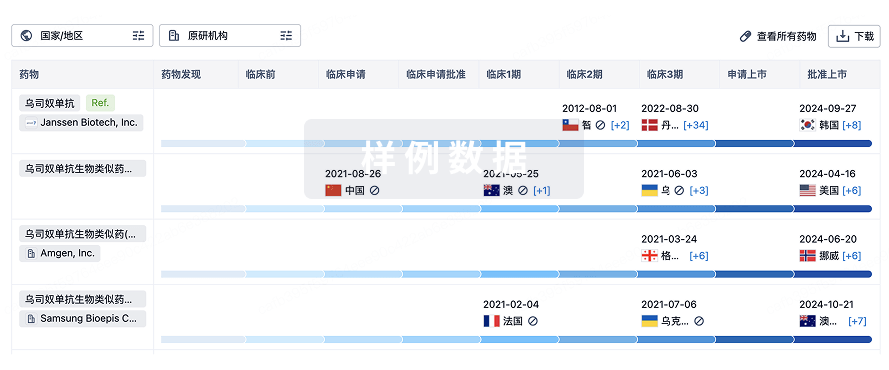
生物类似药
生物类似药在不同国家/地区的竞争态势。请注意临床1/2期并入临床2期,临床2/3期并入临床3期
登录
或
特殊审评
只需点击几下即可了解关键药物信息。
登录
或

提出任何生物医药研究问题
让每一步生物医药决策都精准制胜
基于十亿级生物数据与全球情报的精准 AI,赋能早期药物发现
立即开始免费试用!
智慧芽新药情报库是智慧芽专为生命科学人士构建的基于AI的创新药情报平台,助您全方位提升您的研发与决策效率。
立即接入生物医药数据包
智慧芽新药库数据也通过智慧芽开放平台,以MCP或API服务形式对外开放。立即使用我们的MCP服务定制您的LLM智能体。
生物序列数据库
生物药研发创新
免费使用
化学结构数据库
小分子化药研发创新
免费使用