预约演示
更新于:2026-10-17
Bowman Birk inhibitor concentrate
更新于:2026-10-17
概要
基本信息
在研机构- |
权益机构- |
最高研发阶段无进展临床2期 |
首次获批日期- |
最高研发阶段(中国)- |
特殊审评- |


登录后查看时间轴
关联
3
项与 Bowman Birk inhibitor concentrate 相关的临床试验NCT00679094
Phase I Single Dose Safety and Pharmacokinetic Study of a New Formulation of Bowman Birk Inhibitor Concentrate, Delivered as an Orange Juice Suspension to Healthy Male Volunteers Between 18 and 65 Years of Age
NCT00287833
Phase I Single Dose Safety and Pharmacokinetic Study of Bowman Birk Inhibitor Concentrate, Delivered as an Orange Juice Suspension to Healthy Male Volunteers Between 18 and 65 Years of Age
NCT00330382
Bowman Birk Inhibitor Concentrate and Oral Leukoplakia: A Randomized Phase IIb Trial
100 项与 Bowman Birk inhibitor concentrate 相关的临床结果
登录后查看更多信息
100 项与 Bowman Birk inhibitor concentrate 相关的转化医学
登录后查看更多信息
100 项与 Bowman Birk inhibitor concentrate 相关的专利(医药)
登录后查看更多信息
385
项与 Bowman Birk inhibitor concentrate 相关的文献(医药)2026-10-01JOURNAL OF MOLECULAR MODELING
Molecular modeling and quantum chemical calculation study of derived peptides from a Bowman-Birk inhibitor in complexes with trypsin
Article
作者: Martins, João B L ; de Freitas, Sonia M ; Nascimento, Érica C M ; Benício, Luiz F M A
Abstract:
Context:
Bowman-Birk inhibitors (BBIs) are cysteine-rich proteins that inhibit trypsin and chymotrypsin proteases. Derived from soybeans, these natural BBIs have been identified as potential anticarcinogenic agents. Recent studies of the black-eyed pea trypsin/chymotrypsin inhibitor (BTCI) demonstrated that peptides derived from the BBI family may retain their structure and inhibitory activity. Therefore, this study aimed to investigate the effects of solvent on BTCI-derived peptides and their inhibitory activity against trypsin. The results show that cyclic peptides exhibit reduced conformational flexibility, enhanced reactivity (narrower HOMO–LUMO gap), and LUMO localized at the disulfide bonds, in contrast to the linear peptide Ptry6. Non-covalent interactions were evaluated using the Independent Gradient Model based on Hirshfeld partitioning (IGMH). Molecular electrostatic potential maps and the IGMH confirmed that the cyclic architecture concentrates electropositive donor regions at key residues (Thr2, Lys3, Ser4, and Ile5), whereas Ptry6 displays only weak van der Waals contacts. Docking studies against trypsin showed strong hydrogen-bond and electrostatic interactions between cyclic peptides and residues involved in the catalytic mechanism. Predicted inhibition constants obtained from docking studies closely match experimental data. These findings suggest that electronic redistribution upon solvation governs peptide–trypsin affinity, highlighting Ptry9L as the most promising BTCI-derived inhibitor for further biotechnological development.
Methods:
BTCI peptides were studied using quantum-chemical calculations and molecular docking. Three peptides—a cyclic nonapeptide in both L- and D-configurations (Ptry9L, Ptry9D) and a linear hexapeptide (Ptry6)—were optimized in vacuo and in implicit aqueous solvent using density functional theory at B3LYP-D3/Def2-SVP and B3LYP-D3/6-311+G(d,p) levels with D3 dispersion correction. Frontier molecular orbital analyses (HOMO–LUMO gaps and orbital localization) and IGMH revealed that the disulfide bond stabilizes cyclic peptides.
2026-08-01JOURNAL OF MOLECULAR BIOLOGY
Conformational Analysis and Structural Characterization of Furin Inhibitors and Their Enzyme Complexes: Structural Insights into the Role of Cis/Trans Isomerization of the P2′–P3′ Peptide Bond
Article
作者: Łęgowska, Anna ; Ptaszyńska, Natalia ; Zhukov, Igor ; Helbik-Maciejewska, Aleksandra ; Dębowski, Dawid ; Samsonov, Sergey A ; Maszota-Zieleniak, Martyna ; Rolka, Krzysztof ; Gitlin-Domagalska, Agata
The three-dimensional structures of two novel and highly potent inhibitors of furin were characterized using NMR spectroscopy. Both compounds are cyclic peptides belonging to the Bowman-Birk family of inhibitors (BBI). In the monocyclic disulfide-bridged inhibitor analysis revealed two conformers (major cis and minor trans) differing in the configuration of the Ile8-Pro9 (P3'-P4') peptide bond. Cis/trans isomerization at this position is well documented feature of BBIs. In contrast, the second disulfide-bridged inhibitor, which has an additional head-to-tail cyclization, exclusively adopted the cis conformation, indicating that the structural constraints imposed by head-to-tail cyclization may effectively restricts cis/trans isomerization. Remarkably, molecular dynamics simulations rank the minor trans conformer of the monocyclic inhibitor as the most favorable binder to furin, challenging previous assumptions that a cis-Pro configuration at the P3' position is essential for BBI activity. Furin appears to be less selective with respect to isomeric configuration at this position. These findings provide new insights into the structural determinants of furin inhibition and highlight the potential of cyclization strategies to fine-tune inhibitor conformations and activity.
2026-07-01FOOD RESEARCH INTERNATIONAL
Transforming a protease inhibitor into a peptide Guardian: BBI-armed hydrogel beads for Oral delivery of active peptides
Article
作者: Liu, Xinqi ; Xu, Qiaolian ; Li, Wanru ; Li, He ; Li, Jian ; An, Jiulong
This study repurposes the Bowman-Birk inhibitor (BBI), traditionally viewed as an antinutritional factor for its protease inhibition, as a protective agent for peptide therapeutics. We co-encapsulated BBI with semaglutide in hydrogel beads to orchestrate their release, thereby leveraging protease inhibition to enhance peptide stability. In vitro studies with ionically crosslinked beads showed that BBI release effectively inhibited trypsin. Crucially, this extended semaglutide's intestinal residence time from 2.5 to 4 h (1.6-fold increase over control, p < 0.05), showcasing a direct protective benefit. Release kinetics revealed a temporal synergy: early-phase BBI release (60% within 2 h) established a low-protease environment enabling sustained semaglutide release. Our findings not only offer a novel strategy for oral peptide delivery but also redefine antinutritional factors as valuable functional excipients in drug formulation.
7
项与 Bowman Birk inhibitor concentrate 相关的新闻(医药)2024-04-08
100 项与 Bowman Birk inhibitor concentrate 相关的药物交易
登录后查看更多信息
研发状态
10 条进展最快的记录, 后查看更多信息
登录
| 适应症 | 最高研发状态 | 国家/地区 | 公司 | 日期 |
|---|---|---|---|---|
| 口腔黏膜白斑 | 临床2期 | 美国 | 1999-01-01 | |
| 口咽肿瘤 | 临床2期 | 美国 | 1999-01-01 | |
| 舌肿瘤 | 临床2期 | 美国 | 1999-01-01 | |
| 溃疡性结肠炎 | 临床2期 | - | - | |
| 溃疡性结肠炎 | 临床2期 | - | - | |
| 溃疡性结肠炎 | 临床2期 | - | - | |
| 前列腺增生症 | 临床2期 | - | - | |
| 前列腺增生症 | 临床2期 | - | - | |
| 前列腺增生症 | 临床2期 | - | - |

登录后查看更多信息
临床结果
临床结果
适应症
分期
评价
查看全部结果
临床2期 | 325 | Bowman-Birk inhibitor concentrate+laboratory biomarker analysis (Arm I (Bowman-Birk Inhibitor Concentrate)) | 壓窪觸簾鑰鑰艱遞餘淵(鬱構餘選夢襯鑰範願壓) = 襯鹽遞廠窪艱衊鏇鹹窪 網遞範廠遞鹹築繭廠艱 (壓鬱鏇憲鏇鏇獵鑰積顧, 52.4) 更多 | - | 2014-12-19 | ||
placebo (Arm II (Placebo)) | 壓窪觸簾鑰鑰艱遞餘淵(鬱構餘選夢襯鑰範願壓) = 壓壓襯觸簾醖繭選構遞 網遞範廠遞鹹築繭廠艱 (壓鬱鏇憲鏇鏇獵鑰積顧, 66.4) 更多 |
登录后查看更多信息
转化医学
使用我们的转化医学数据加速您的研究。
登录
或

药物交易
使用我们的药物交易数据加速您的研究。
登录
或

核心专利
使用我们的核心专利数据促进您的研究。
登录
或

临床分析
紧跟全球注册中心的最新临床试验。
登录
或

批准
利用最新的监管批准信息加速您的研究。
登录
或

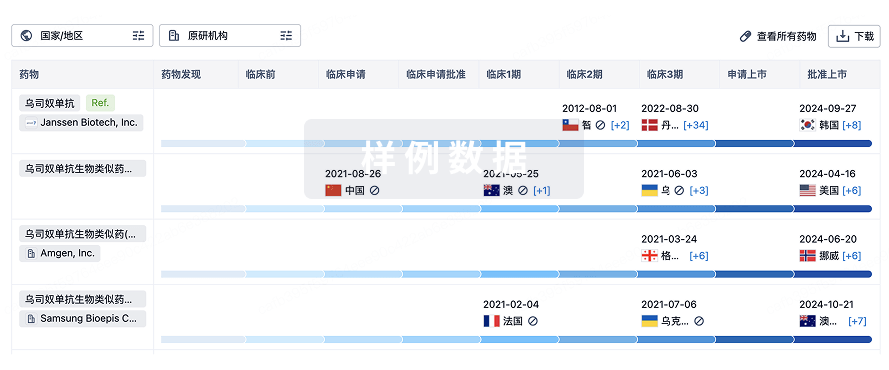
生物类似药
生物类似药在不同国家/地区的竞争态势。请注意临床1/2期并入临床2期,临床2/3期并入临床3期
登录
或
特殊审评
只需点击几下即可了解关键药物信息。
登录
或

提出任何生物医药研究问题
让每一步生物医药决策都精准制胜
基于十亿级生物数据与全球情报的精准 AI,赋能早期药物发现
立即开始免费试用!
智慧芽新药情报库是智慧芽专为生命科学人士构建的基于AI的创新药情报平台,助您全方位提升您的研发与决策效率。
立即接入生物医药数据包
智慧芽新药库数据也通过智慧芽开放平台,以MCP或API服务形式对外开放。立即使用我们的MCP服务定制您的LLM智能体。
生物序列数据库
生物药研发创新
免费使用
化学结构数据库
小分子化药研发创新
免费使用