预约演示
更新于:2026-10-03
Botulinum toxin type A(HSM)
A型肉毒毒素 (君合盟)
更新于:2026-10-03
概要
基本信息
原研机构 |
在研机构 |
非在研机构- |
权益机构- |
最高研发阶段申请上市 |
首次获批日期- |
最高研发阶段(中国)申请上市 |
特殊审评- |
登录后查看时间轴
关联
12
项与 A型肉毒毒素 (君合盟) 相关的临床试验NCT07242300
A Phase III Clinical Study to Evaluate the Efficacy and Safety of Recombinant Botulinum Toxin Type A (Eveotox) in Adult Patients With Upper Limb Spasticity
This is a phase III clinical study to evaluate the efficacy and safety of recombinant botulinum toxin type A(Eveotox)in adult patients with upper limb spasticity. The purpose of this study was to observe efficacy and safety of Eveotox compared with placebo in adult patients with upper limb spasticity.
开始日期2025-12-11 |
申办/合作机构 |
NCT06937944
A Phase 3 Clinical Study to Evaluate the Efficacy and Safety of Recombinant Botulinum Toxin Type A for Injection (Eveotox) Compared With a Single Treatment of Botox and Placebo,and Repeated Treatment of Eveotox in Moderate to Severe Glabellar Lines
This is a Phase 3 clinical study to evaluate the efficacy, safety, and immunogenicity of single/repeated injections of Eveotox in the treatment of moderate to severe glabellar lines. The study consists of Study Part 1 (randomized double-blind controlled study) and Part 2 (open-label study). Part I is a multicenter, randomized, double-blind, single-injection, active-controlled and placebo-controlled study to evaluate the efficacy, safety, and immunogenicity of Eveotox in the treatment of moderate to severe glabellar lines; Part 2 is an open-label study to evaluate the efficacy, safety, and immunogenicity of repeated injections of Eveotox in the treatment of moderate to severe glabellar lines.
开始日期2025-04-30 |
申办/合作机构 |
IRCT20101012004920N11
Comparison the efficacy and safety of botulinum toxin type A of Plasma Darman Sarve Sepid Company with Dysport® of Ipsen Co. in the treatment of the moderate to severe glabellar lines: a randomized, active controlled, double-blind, non-inferiority phase 3 trial
开始日期2025-04-21 |
申办/合作机构- |
100 项与 A型肉毒毒素 (君合盟) 相关的临床结果
登录后查看更多信息
100 项与 A型肉毒毒素 (君合盟) 相关的转化医学
登录后查看更多信息
100 项与 A型肉毒毒素 (君合盟) 相关的专利(医药)
登录后查看更多信息
2,454
项与 A型肉毒毒素 (君合盟) 相关的文献(医药)2027-03-01·Value in Health Regional Issues
Botulinum Toxin Type A for the Treatment of Focal Spasticity in Children With Cerebral Palsy in Thailand: A Cost-Utility and Budget Impact Analysis
Article
作者: Kumthornthip, Witsanu ; Srinonprasert, Varalak ; Chueluecha, Chuenchom ; Leelahavarong, Pattara ; Prawjaeng, Juthamas ; Ploypetch, Teerada ; Lomaninoparat, Ratcha ; Jintakul, Nawarat ; Wathanadilokul, Ubonwon ; Hadnorntun, Phorntida
OBJECTIVES:
Cerebral palsy (CP) causes lifelong functional impairment and societal burden. In Thailand, botulinum toxin type A (BoNT-A) is not reimbursed for CP-related focal spasticity. This study evaluated the cost-utility and budget impact of adding abobotulinumtoxinA (aboBoNT-A) or onabotulinumtoxinA (onaBoNT-A) to standard care (SoC) versus SoC alone.
METHODS:
A Markov model (societal perspective; lifetime horizon; 3% annual discount) was used to estimate costs and outcomes for SoC+aboBoNT-A and SoC+onaBoNT-A compared with SoC. Direct medical and nonmedical costs, utility, and transitional probabilities were collected from tertiary hospitals. Treatment efficacies were derived from a network meta-analysis. Deterministic and probabilistic sensitivity analyses were conducted. Lifetime cost, life-years, quality-adjusted life-years (QALYs), and an incremental cost-effectiveness ratio were estimated and assessed against a Thai threshold of 160 000 (US $4468) THB per QALY. A budget impact analysis was conducted using epidemiological estimates and projected uptake rates (30% in year 1, 50% in year 2, and up to 100% thereafter; alternative scenario: 80% from year 3 onward).
RESULTS:
SoC + aboBoNT-A and SoC + onaBoNT-A elicited 0.0033 and 0.0026 QALYs gained with additional costs of US $20 and US $29, yielding incremental cost-effectiveness ratios of US $6003 and US $11 147 per QALY, respectively. Results were most sensitive to direct nonmedical costs among nonresponders. The 5-year budget impact was US $228 961 to $284 805, with similar estimates under conservative uptake.
CONCLUSION:
Neither SoC + BoNT-A therapy was cost-effective, although both improved spasticity-related quality of life. A 14% price reduction for aboBoNT-A could improve cost-effectiveness. The projected 5-year budget impact was modest across uptake scenarios.
2026-12-01·Techniques in Coloproctology
Efficacy of botulinum toxin type A administration within the current therapeutic algorithm for chronic anal fissure: study protocol for the prospective multicentre observational study FISURBOT-GECO6
Article
作者: Cerdán, Carlos ; Arredondo, Jorge ; Cano-Valderrama, Oscar ; Fernández, Tamara ; Reyes-Diaz, Maria Luisa ; Martín-Pérez, Beatriz ; Calderón, Teresa ; Cristóbal, Lidia ; Marinello, Franco ; Ortega-Torrecilla, Nuria
Abstract:
Background:
Chronic anal fissure is a common, benign anorectal condition associated with impaired quality of life. Despite the availability of several therapeutic options, considerable variability persists in its management, particularly regarding the role of botulinum toxin type A administration within the current treatment algorithms. Although botulinum toxin type A injection is a widely used approach to achieve chemical sphincterotomy, its real-world efficacy and safety across different clinical scenarios remain insufficiently characterised.
Aim:
Our objective is to evaluate the efficacy and safety of botulinum toxin type A injection for the treatment of chronic anal fissure after failure of topical therapy or lateral internal sphincterotomy in routine clinical practice settings by analysing the healing rate, continence outcomes and the need for subsequent surgical intervention in predefined clinical scenarios.
Methods:
FISURBOT-GECO6 (0143–2024-OBS) is a national, multicentre, prospective, pragmatic observational study. Consecutive patients with chronic anal fissure in whom botulinum toxin treatment is recommended according to routine clinical practice are eligible. Patients will be classified into three clinical scenarios: (1) chronic anal fissure with sphincter hypertonia and no risk factors for anal incontinence after failure of topical therapy; (2) chronic anal fissure with recognised risk factors for anal incontinence after failure of topical therapy; and (3) chronic anal fissure persisting or recurring at least 12 weeks after lateral internal sphincterotomy. Botulinum toxin type A administered at a dose of 50 or 100 IU, according to routine practice. Patients will be evaluated at 1, 3 and 12 months after treatment. The primary outcome is clinical healing. Secondary outcomes are anal continence, procedure-related morbidity, need for repeat treatment or surgery and patient satisfaction.
Expected relevance:
This study will provide prospective, real-world data on the efficacy and safety of botulinum toxin type A injection for chronic anal fissure management in clinically relevant scenarios. The results are expected to help clarify the role of this approach within current therapeutic algorithms and inform clinical decision-making in daily practice.
Trial Sponsor:
Spanish Society of Coloproctology (AECP).
2026-11-01·TOXICON
Botulinum toxin injection combined with rehabilitation training for peroneal spastic flatfoot: A pilot case series
Article
作者: Huang, Xiuying ; Chen, Yaping ; Wang, Lu ; Zhang, Ran ; Tian, Yuxin
Peroneal spastic flatfoot (PSFF) involves peroneal spasm and subtalar restriction, yet optimal conservative care is undefined. This pilot retrospective study explored the preliminary outcomes of botulinum toxin type A (BoNT-A) injection combined with rehabilitation in 19 PSFF patients (10 with structural abnormalities [SA], 9 without [NSA]). Pain (VAS), spasticity (MAS), and function (AOFAS-AH) were assessed at baseline, 1, 3, and 6 months. Significant improvements were observed across all metrics (P < 0.05). The median VAS decreased from 4 to 0, median AOFAS-AH improved from 67 to 100, and median MAS reduced from grade 4 to grade 0 at 6 months relative to baseline. In subgroup comparisons, NSA patients achieved superior outcomes, with significantly higher AOFAS-AH and lower MAS at 3 and 6 months (P < 0.05) and 100% satisfaction versus 40% in SA patients (P < 0.05). One patient experienced transient calf swelling. These exploratory findings suggest BoNT-A combined with rehabilitation may warrant further investigation as a potential conservative option for PSFF, particularly among patients without structural abnormalities. Due to the small sample size and lack of control group, these results should be interpreted as exploratory rather than confirmatory. LEVEL OF EVIDENCE: Level IV, retrospective case series.
43
项与 A型肉毒毒素 (君合盟) 相关的新闻(医药)2026-09-28
·肌密研析
2026年9月28日,合成生物学创新药企君合盟生物迎来里程碑时刻:旗下自主研发的注射用重组A型肉毒毒素(君纾妥®),用于治疗成人中重度眉间纹的上市许可申请,正式获得国家药品监督管理局受理(受理号:CXSS2600156)。一旦顺利获批,君纾妥®将成为国内医美赛道第二款重组A型肉毒素产品,重塑国内肉毒素市场格局。
本次申报由君合盟全资子公司君合盟生物制药(通化)有限公司负责生产与申报工作。作为新一代肉毒素,重组A型肉毒素依托合成生物学技术,区别于传统梭菌发酵来源肉毒素,凭借工艺、纯度、免疫原性等多重优势,被行业视作肉毒素赛道的下一代核心产品。
国内肉毒素市场盘点:
传统肉毒群雄逐鹿,重组肉毒开启新赛道
A型肉毒素兼具消费医疗与严肃医疗双重价值,市场空间广阔。除大众熟知的眉间纹除皱等医美适应症外,A型肉毒素在眼科、神经内科、康复科、泌尿外科等多个治疗领域都拥有成熟的临床应用,兼具医疗刚需与消费属性。
截至目前,国内获批上市的A型肉毒素共计7款传统发酵型产品,市场参与者包含国际巨头与本土老牌企业:美国艾尔建保妥适®、兰州生物衡力®、法国益普生吉适®、韩国Hugel乐提葆®、德国Merz思奥美®、美国Revance达希斐®以及韩国Hutox解索橙。
在重组A型肉毒素赛道,此前仅有华东医药代理的重庆誉颜芮妥欣®获批上市。随着君合盟君纾妥®提交上市申请,国内重组肉毒素赛道迎来第二名选手,赛道竞争正式拉开序幕。
值得一提的是,君纾妥®不止布局医美抗衰。在严肃医疗领域,该产品同步推进4大治疗适应症开发:原发性眼睑痉挛、成人下肢痉挛、成人脑卒中后上肢痉挛、原发性腋窝多汗症。医美+严肃医疗双线并行,最大化释放产品价值。
管线矩阵全面开花:
重组肉毒、全长重组胶原、生长激素多线布局
君合盟生物成立于2020年11月,是一家聚焦合成生物学的创新高科技企业。公司核心产品覆盖内分泌疾病治疗、神经疾病治疗、皮肤抗衰以及新一代生物医用材料四大方向。依托自主搭建的重组蛋白药物开发平台,掌握重组蛋白高效表达系统、微变性分离纯化技术、蛋白体外折叠自组装、长效缓释等产业化高壁垒核心技术。
公司管线围绕消费医疗与严肃医疗双赛道深度布局,核心在研产品矩阵丰富:JHM03重组A型肉毒毒素(君纾妥®)、JHM08重组I型人胶原蛋白、JHM09重组III型人胶原蛋白、JHM01重组人生长激素注射液、JHM02重组长效生长激素注射液。
✅重组胶原蛋白赛道:
君合盟在研JHM08重组I型人胶原蛋白、JHM09重组III型人胶原蛋白,为全长序列、与天然人I/III型胶原序列完全一致,具备完整三螺旋结构的重组胶原产品。完整三螺旋结构是保障胶原生物活性的关键,也是当前重组胶原领域研发的核心难点,两款产品未来有望在皮肤修复、抗衰、软组织填充等领域落地应用。
✅重组A型肉毒素:
传统肉毒素通过肉毒梭状芽孢杆菌发酵制备,而君合盟重组A型肉毒素依托合成生物学技术生产,拥有显著差异化优势:生产工艺更简洁、单批次产量更大、产品纯度更高,不含有易诱发免疫原性的杂质。
回顾这款产品的临床推进历程,节奏十分稳健:
2024年4月,成人中重度眉间纹医美适应症完成Ⅰ期临床;同年完成Ⅱ期临床入组;也是全球第二家进入临床阶段的重组A型肉毒素;
2024年9月14日,严肃医疗适应症「成人脑卒中后上肢痉挛」临床研究,在组长单位复旦大学附属华山医院完成首例受试者入组;
2025年4月30日,医美适应症「成人中重度眉间纹」Ⅲ期临床试验于北京大学第一医院启动并完成首例入组;脑卒中后上肢痉挛Ⅱ期临床在华山医院完成全部受试者入组;
2025年12月11日,脑卒中后上肢痉挛Ⅲ期临床试验获NMPA批准,由华山医院李放教授、上海市养志康复医院靳令经教授联合牵头,完成该适应症全球首例患者入组。
✅重组生长激素:
在内分泌管线,君合盟采用短效重组人生长激素注射液+重组长效生长激素注射液双产品策略,覆盖低端至中高端不同消费人群。
其中重组长效生长激素潜力突出,临床数据支持每两周给药一次,药效优于现有已上市同类产品,安全性具备差异化优势,蛋白结构与制备技术属于国际首创;短效重组人生长激素注射液,体内外药效、药代动力学及毒理特性,均可对标诺和诺德诺泽®。
资本持续加持:
累计融资超8亿,C轮近2亿资金助力产业化
成立至今,君合盟已经顺利完成六轮融资,资本认可度持续走高:
2021年,数千万元Pre-A轮融资;
2022年10月,约2亿元A轮融资;
2023年1月,约1亿元A+轮融资;
2024年5月,1亿元B轮融资;
2024年9月,超2亿元B+轮融资;
2026年6月,近2亿元C轮融资。
本次C轮融资由钱塘和达产业基金、和盟创投联合领投,承树投资跟投,本草资本、光点资本、弘盛资本等老股东持续加码;凯乘资本连续多轮担任独家财务顾问。累计融资金额突破8亿元,充足资金将持续支撑公司重组肉毒素、重组胶原蛋白、生长激素等多条管线的临床推进与产业化落地。
行业展望:
重组蛋白崛起,国产创新重塑医美与神经治疗格局
传统肉毒素市场长期由海外品牌主导,国内厂商以发酵工艺路线为主。以君纾妥®为代表的重组A型肉毒素,是合成生物学赋能消费医疗与严肃医疗的标志性产品。相比传统肉毒素,更低的免疫原性、更高纯度、规模化量产潜力,是其核心竞争力。
一方面,医美端,眉间纹适应症上市之后,将给医生与求美者带来全新选择,打破现有肉毒素市场格局;另一方面,严肃医疗四大适应症落地后,可为眼睑痉挛、肢体痉挛、多汗症等患者提供新的治疗方案,满足尚未被充分满足的临床刚需。
除肉毒素外,全长三螺旋重组人胶原、长效生长激素管线同步推进,君合盟正在构建一个以重组蛋白技术平台为根基的创新企业。随着君纾妥®进入上市审评阶段,国产重组肉毒素赛道正式进入收获期,我们持续关注后续审评进展,期待国产创新生物药早日落地,惠及更多患者与求美者。
#君合盟生物 #君纾妥 #重组A型肉毒毒素 #合成生物学 #重组蛋白 #肉毒素市场 #重组肉毒素 #医美抗衰 #重组胶原蛋白 #生长激素 #NMPA受理 #上市许可申请 #国产创新 #国产替代 #低免疫原性 #高纯度
亲爱的颜究生们,动动手指星标《肌密研析》——精彩推送不迷路!我们不定时深挖硬核护肤新知,助你变美路上少走弯路,轻松避坑~
2026-09-09
2009年,van der Veer 等人在 Burns 发表了一篇综述[1],至今被引用超过 350 次,是增生性瘢痕(HTS)发病机制领域引用量最高的文献之一。其核心是以“细胞层面”和“分子层面”二分法梳理驱动因素,并提出一个统一框架:肌成纤维细胞凋亡失败,是 HTS 的核心病理事件。
该综述在学术史中占据独特位置:此前 HTS 研究聚焦 TGF-β1 单通路,此后学界认识到HTS 是多细胞、多通路、多物理因素共同驱动的复杂纤维化病。Mony 等人在 2023 年 Cells 上发表的更新综述,将其引为HTS从“单基因假设”走向“系统病理学”的转折点文献[2]。本文以其核心论述为经纬,结合这十五年的新进展,逐层拆开看。一、背景:增生性瘢痕的临床问题与知识空白临床特征
van der Veer 2009 在开篇即描述了 HTS 的临床特征:局限于原始创面边界内的隆起性、红色、质硬的纤维增生病变,常在烧伤、手术切口或深达真皮的创伤后数周至数月出现。
它和瘢痕疙瘩(keloid)最大的区别在“边界”:后者会越过创面边界向正常皮肤侵袭;HTS 严守创面边界,部分可在 1~2 年内自行软化、变平、褪色。HTS 与瘢痕疙瘩:本质是两回事
Berman 等人 2017 年完善了两者的鉴别框架:在外观、组织病理、分子特征、遗传易感性,都有本质区别[3]。HTS 是以III 型胶原平行排列结节为主,keloid 以杂乱 I 型胶原束为特征。
但在2009年,两者的分子边界边界更模糊、常被混为一谈,该综述严格区分HTS与Keloid的研究证据,规避了“病种混淆”的陷阱。当年悬而未决的三个问题
尽管2009 年 TGF-β/Smad 通路的核心地位已被公认,但有三个问题仍悬而未决:
01
同样都暴露于 TGF-β1 的创面成纤维细胞,为什么有人发展为HTS、有人不会?
02
肌成纤维细胞(既表达平滑肌收缩蛋白(α-SMA)又具有合成胶原能力的杂合细胞)在正常创面里增殖期末就会凋亡清除,是什么让它们在 HTS 中持续存活?
03
机械张力作为一个物理变量,是如何被翻译为细胞的促纤维化分子程序的?
整篇综述,就是围绕这三个问题展开的。
图1 增生性瘢痕与瘢痕疙瘩的鉴别诊断关键差异二、细胞学因素:问题出在"细胞没死成"核心论点:凋亡失败,而非单一因子异常
van der Veer 2009的核心贡献在于:HTS 的根本原因,不是某个单一基因突变或者某个单一细胞因子异常,而是肌成纤维细胞凋亡失败——本该在增殖期末自动清除的细胞,因凋亡程序缺陷而持续存活,持续合成、堆积过量胶原,把有序修复转化为无序增生。证据一:干扰素-α2b干预实验
Nedelec等(2001),给 HTS 患者皮损内注射干扰素-α2b(IFN-α2b),发现瘢痕里的肌成纤维细胞显著减少——因为它们恢复了凋亡程序[4]。证据二:对死亡信号天然"装死"
Desmoulière 等人发现:HTS 来源的成纤维细胞,对凋亡诱导信号(FasL)。同样浓度的 FasL 刺激下:
正常真皮成纤维细胞 24 小时凋亡率约 40%;HTS 来源的成纤维细胞凋亡率 不足 10%。肌成纤维细胞的凋亡抵抗,不是 TGF-β 过表达的“副现象”,而是 HTS 形成的“核心病理事件”——TGF-β 升高、机械张力增加、炎症延长都是促发因素,而凋亡失败,才是最终导致纤维化不可逆的“板机事件”。证据三:治疗端反向验证
Kim 等人 2020 年用 elesclomol靶向诱导 HTS 肌成纤维细胞凋亡,兔耳模型瘢痕厚度和胶原密度都明显下降,其机制为选择性诱导氧化应激[5]——发表十一年后验证了“靶向凋亡即可治 HTS”。另外三个"帮凶"细胞
除肌成纤维细胞凋亡缺陷,综述还讨论了其他三个细胞学层面的潜在原因:
角质形成细胞:分泌异常 TGF-β1、CTGF,旁分泌激活下方成纤维细胞;
肥大细胞:数量显著增加,释放组胺等介质直接刺激增殖产胶原;
血管内皮细胞:屏障受损致缺氧,而缺氧是 TGF-β1 上调的最强刺激之一。图2 肌成纤维细胞凋亡失败作为HTS核心病理事件的分子机制三、分子学因素:TGF-β1 是"头号反派"
以 TGF-β1/Smad 为核心的信号网
分子层面以 TGF-β1/Smad 通路 为核心,其他分子异常(生长因子、细胞因子、基质金属蛋白酶和ECM成分的比例失衡)都定位为这一核心通路的上下游节点。TGF-β1 的三个促纤维化效应
TGF-β1是该综述叙事中的“一号反派”。作者梳理了其在HTS中的三个促纤维化效应:
① 促进成纤维细胞向肌成纤维细胞分化;
② 促进 I、III 型胶原合成;
③ 抑制胶原降解酶、减少 ECM 分解。
三者叠加:胶原被过度合成,又被“禁止分解”。更关键的是,TGF-β1 还能抑制凋亡通路,直接让肌成纤维细胞"死不掉"——这正是连接分子异常与凋亡失败的桥梁。两个被忽视的"放大器":CTGF 与 HSP47
该综述特别关注当时较少被讨论的两个分子:结缔组织生长因子(CTGF/CCN2)与热休克蛋白 47(HSP47)。CTGF 作为 TGF-β1 的“共激活因子”,可不依赖核心通路即放大对低浓度 TGF-β1 的反应——解释部分 HTS 局部 TGF-β1 并不显著高于正常创面。PDGF:站在 TGF-β1 上游的"点火者"
血小板源性生长因子(PDGF)被定位为 TGF-β1 的上游“点火者”:烧伤创面破坏的血小板释放 PDGF,促进成纤维细胞增殖并启动其 TGF-β1 自分泌,解释“烧伤后 HTS 发生率远高于手术切口”。被低估的炎症维度
Wang等人在2020年提出“炎症是皮肤瘢痕形成的指挥者”,并补充该综述分子层面对 TGF-β 中心权重过高,低估了 Th2(IL-4、IL-13)的独立促纤维化角色[6]——这一批评公允的,因其发表于 IL-13 作用大量涌现前。四、机械张力:被忽视的"驱动因素"
这篇综述最具前瞻性的部分之一,是讨论了机械张力在HTS形成中的作用。当时机械生物学尚未成为创面愈合研究的主流,大多数研究仍以化学信号异常为主要框架。
作者明确提出:创面边缘皮肤张力越大,肌成纤维细胞受的机械刺激越强,就越容易通过整合素-FAK-RhoA 信号轴,变成持续活化的“应力纤维化”表型。换句话说,机械张力不是 HTS 的“加重因素”,而是和 TGF-β1 并行的“驱动因素”——它走的是自己独立的机械敏感通路。后续验证
Aarabi 等人 2007 年发现:小鼠背部高张力区域愈合后的瘢痕面积,明显大于低张力区域;即便阻断 TGF-β 信号,差异仅部分缩小——说明机械张力至少部分独立于 TGF-β 通路。
Wong 等人 2012 年鉴定 FAK-ERK-MLCK 为核心级联。临床佐证来自硅酮凝胶片——其疗效除保湿水合外,重要一面是“减轻创面承受的皮肤张力”。五、它如何改变了 HTS 的治疗思路
这篇综述对临床最持久的贡献,是以肌成纤维细胞凋亡失败为框架给出明确“最终靶点”:治疗是否有效,最终看能否诱导肌成纤维细胞凋亡或抑制其活化。肉毒毒素 A:从"除皱"到"抗瘢痕"
Austin 等人 2019 年在系统综述梳理了 A 型肉毒毒素(BoNT-A)的证据[7]:其机制与“机械张力→肌成纤维细胞活化”该轴吻合——BoNT-A 通过化学去神经,减少创面周围肌肉张力、降低机械负荷,从而减少机械信号向促纤维化信号的转化。多项 RCT 显示,切口愈合期局部打 BoNT-A,能明显改善瘢痕外观和宽度。靶向凋亡的新药方向
除 elesclomol外,ABT-263( Bcl-2 抑制剂)在 2021 年被 Zhang 等人报道能减少兔耳模型 HTS 形成[8]。
这些药都还没进 III 期临床,但研发逻辑均可追溯回 van der Veer 2009 奠定的那句话:“肌成纤维细胞凋亡失败 → HTS”。激光与脂肪移植:2023 的治疗全景
Mony 等人 2023 年全面更新全景[2]:脉冲染料激光(PDL)和点阵 CO2激光,已成HTS 的一线辅助治疗(Monstrey 2014 支持[9])。
脂肪移植通过旁分泌抑制成纤维细胞的 TGF-β/Smad 信号、促进 ECM 重塑,改善 HTS 质地和柔韧性。新疗法层出不穷,说明该框架仍是 HTS 领域最繁忙的通道。六、局限性与今天的视角局限一:时间维度的天然限制
最显著的局限是时间维度的天然限制:单细胞转录组、空间蛋白质组、机械生物学在2009 年都未成熟。比如“角质形成细胞-成纤维细胞串扰”,当时只能引用批量共培养实验;而今天单细胞层面已经看清,HTS 里的成纤维细胞至少有四个功能亚群,对 TGF-β 的响应和凋亡抵抗差异大——这是2009年不可预见的。局限二:免疫微环境讲得不够
第二处局限是对免疫微环境论述不足。该综述提及肥大细胞、巨噬细胞但未系统阐述 Th2(IL-4/13/5)独立角色;现在知道 IL-13 可不依赖 TGF-β 直接激活胶原转录,为其“TGF-β 核心”框架未容纳的平行通路。局限三:"有意义的不完整"
综述提出凋亡失败假说却未深究“为何失灵”。2013 年 Liu 等发现 HTS 肌成纤维细胞的死亡信号复合物组装被 c-FLIP 异常高表达阻断——细胞“看到了却拒绝执行”,补上了框架最薄环节。结语:为什么今天还值得读
van der Veer 2009 之所以今天仍是必读,不在于它“没有说错什么”——任何十五年前的综述细节都可能被修正——而在于它“说对了一件事”:肌成纤维细胞的持续存活是 HTS 形成的最核心病理事件。这一判断为机制研究与药物研发提供清晰“靶心”——只要在适当时间窗清除过度活化的肌成纤维细胞,就可能将纤维化进程摁下“暂停键”。
Mony 等 2023 年写道:"van der Veer 2009 提出的框架经受住了时间和技术的双重考验。”[2] 基础成果按月淘汰的今天,十五年前的综述获此评价,即是对其学术质量的最高褒奖。
参考文献
[1] van der Veer WM, Bloemen MC, Ulrich MM, et al. Potential cellular and molecular causes of hypertrophic scar formation. Burns. 2009;35(1):15-29.PMID:18952381. DOI: 10.1016/j.burns.2008.06.020
[2] Mony MP, Harmon KA, Hess R, Dorafshar AH, Shafikhani SH. An Updated Review of Hypertrophic Scarring. Cells. 2023;12(5):678. PMID: 36899815. DOI: 10.3390/cells12050678
[3] Berman B, Maderal A, Raphael B. Keloids and Hypertrophic Scars: Pathophysiology, Classification, and Treatment. Dermatol Surg. 2017;43(Suppl1):S3-S18.PMID:27347634.DOI:10.1097/DSS.00000
00000000819
[4] Nedelec B, Shankowsky H, Scott PG, Ghahary A, Tredget EE. Myofibroblasts and apoptosis in human hypertrophic scars: the effect of interferon-alpha2b. Surgery. 2001;130(5):798-808. PMID: 11685189. DOI: 10.1067/msy.2001.116453
[5] Kim J, Kim B, Kim SM, et al. Targeted apoptosis of myofibroblasts by elesclomol inhibits hypertrophic scar formation. EBioMedicine.2020;54:102715.PMID:32251998.DOI:10.1016/j.ebiom.2020.10
2715
[6] Wang ZC, Zhao WY, Cao Y, et al. The Roles of Inflammation in Keloid and Hypertrophic Scars. Front Immunol. 2020;11:603187. PMID: 33343575. DOI: 10.3389/fimmu.2020.603187
[7] Austin E, Koo E, Jagdeo J. Botulinum toxin type A for the treatment and prevention of hypertrophic scars and keloids: Updated review. J Cosmet Dermatol. 2019;18(1):10-19. PMID: 30548742. DOI: 10.1111/jocd.12828
[8] Zhang J, Li Y, Bai X, et al. ABT-263 Reduces Hypertrophic Scars by Targeting Apoptosis of Myofibroblasts. Front Pharmacol. 2021;11:615505. PMID: 33519480. DOI: 10.3389/fphar.2020.615505
[9] Monstrey S, Middelkoop E, Vranckx JJ, et al. Prevention or treatment of hypertrophic burn scarring: A review of when and how to treat with the Pulsed Dye Laser. Burns. 2014;40(5):797-804. PMID: 24439925. DOI: 10.1016/j.burns.2013.12.017
扫码关注
微信号:Luoxi-ir
声明:本号转发内容仅限学术交流,不含商业用途,不代表本号立场与观点。如存在版权及其他相关问题,可随时联系小编,我方将尽快处理。本号原创文章版权专属,欢迎朋友圈等非媒体渠道合理分享。
临床研究临床终止引进/卖出申请上市
2026-08-28
·网易号
来源:新浪证券-红岸工作室8月28日,通化东宝涨0.25%,成交额1.41亿元,换手率0.88%,总市值160.21亿元。异动分析创新药+重组蛋白+减肥药+合成生物1、根据2025年9月26日互动易:截至目前,公司3款一类创新药已推进至II期临床试验阶段。2、2024年5月8日公告:公司以自有资金 10,000万元通过增资形式对君合盟生物制药(杭州)有限公司 进行投资,以取得本次增资完成后在全面稀释基础上公司 8.6759%的股权。君合盟是一家前沿蛋白药物的创新企业,在神经治疗、皮肤抗衰、皮下填充、内分泌等领域,从事重组蛋白质创新药物的开发以及合成生物学领域创新产品开发,主要在研产品有 JHM03(重组 A 型肉毒毒素)、 JHM08(重组 I 型人胶原蛋白)、 JHM09(重组 III 型人胶原蛋白)、 JHM01(重组人生长激素注射液) 和 JHM02(重组长效生长激素注射液)。3、2025年2月27日互动易,GLP-1类药物在一定程度上可能会延缓患者开始使用胰岛素的时间,但胰岛素仍然是糖尿病患者的终极治疗手段。并且在GLP-1产品方面,公司目前已构建了包括利拉鲁肽、司美格鲁肽、口服小分子GLP-1、GLP-1/GIP双靶点受体激动剂在内的多层次、多样化的GLP-1产品梯队,并布局了糖尿病、减重适应症。4、2024年5月8日公告:通化东宝以自有资金1亿元通过增资形式对君合盟生物制药(杭州)有限公司进行投资,以取得本次增资完成后在全面稀释基础上公司8.6759%的股权。君合盟是一家专注于重组蛋白创新药物及合成生物学领域创新产品开发的公司,拥有多个国内外首创的重组蛋白表达及分离纯化平台,已实现了包括重组I/III型人胶原蛋白原液及制剂、重组A型肉毒毒素等在内的高端重组蛋白产品的规模化放大,研发及产业化能力处于国内领先水平。(免责声明:分析内容来源于互联网,不构成投资建议,请投资者根据不同行情独立判断)资金分析今日主力净流入1211.11万,占比0.09%,行业排名1/55,该股当前无连续增减仓现象,主力趋势不明显;所属行业主力净流入-9.65亿,连续2日被主力资金减仓。区间今日近3日近5日近10日近20日主力净流入1211.11万-516.22万-1263.82万-6247.35万-4538.22万主力持仓主力没有控盘,筹码分布非常分散,主力成交额4880.22万,占总成交额的5.32%。技术面:筹码平均交易成本为8.47元该股筹码平均交易成本为8.47元,近期筹码减仓,但减仓程度减缓;目前股价靠近支撑位8.11,注意支撑位处反弹,若跌破支撑位则可能会开启一波下跌行情。公司简介资料显示,通化东宝药业股份有限公司位于吉林省通化县东宝新村,成立日期1992年12月28日,上市日期1994年8月24日,公司主营业务涉及硬胶囊剂、片剂(含激素类)、颗粒剂、小容量注射剂、原料药(重组人胰岛素)、生物工程产品(重组人胰岛素注射液);Ⅱ类6854手术室、急救室、诊疗设备及器具;Ⅱ类6815注射穿刺器械;Ⅲ类6815注射穿刺器械。通化东宝所属申万行业为:医药生物-生物制品-其他生物制品。所属概念板块包括:独家药品概念、非酒精性脂肪性肝炎(NASH)、互联医疗、医保、减肥药等。截至6月30日,通化东宝股东户数11.47万,较上期增加11.19%;人均流通股17071股,较上期减少10.07%。2026年1月-6月,通化东宝实现营业收入15.53亿元,同比增长13.06%;归母净利润2.96亿元,同比增长35.79%。分红方面,通化东宝A股上市后累计派现60.95亿元。近三年,累计派现15.68亿元。机构持仓方面,截止2026年6月30日,通化东宝十大流通股东中,香港中央结算有限公司位居第四大流通股东,持股2320.09万股,相比上期减少599.30万股。创新药(159992)位居第五大流通股东,持股1942.71万股,相比上期增加150.07万股。招商国证生物医药指数A(161726)位居第六大流通股东,持股1791.68万股,相比上期增加41.02万股。广发创新药ETF联接A(012737)位居第七大流通股东,持股1267.25万股,相比上期增加221.83万股。天弘国证生物医药ETF(159859)位居第九大流通股东,持股1095.25万股,为新进股东。
100 项与 A型肉毒毒素 (君合盟) 相关的药物交易
登录后查看更多信息
外链
| KEGG | Wiki | ATC | Drug Bank |
|---|---|---|---|
| - | - | - |
研发状态
10 条进展最快的记录, 后查看更多信息
登录
| 适应症 | 最高研发状态 | 国家/地区 | 公司 | 日期 |
|---|---|---|---|---|
| 上肢痉挛 | 临床3期 | 中国 | 2025-12-10 | |
| 眉间纹 | 临床3期 | 中国 | 2025-04-28 | |
| 眼睑痉挛 | 临床申请批准 | 中国 | 2026-01-05 | |
| 下肢痉挛 | 临床申请批准 | 中国 | 2026-01-05 | |
| 原发性腋窝多汗症 | 临床申请批准 | 中国 | 2025-12-31 |
登录后查看更多信息
临床结果
临床结果
适应症
分期
评价
查看全部结果
| 研究 | 分期 | 人群特征 | 评价人数 | 分组 | 结果 | 评价 | 发布日期 |
|---|
No Data | |||||||
登录后查看更多信息
转化医学
使用我们的转化医学数据加速您的研究。
登录
或

药物交易
使用我们的药物交易数据加速您的研究。
登录
或

核心专利
使用我们的核心专利数据促进您的研究。
登录
或

临床分析
紧跟全球注册中心的最新临床试验。
登录
或

批准
利用最新的监管批准信息加速您的研究。
登录
或

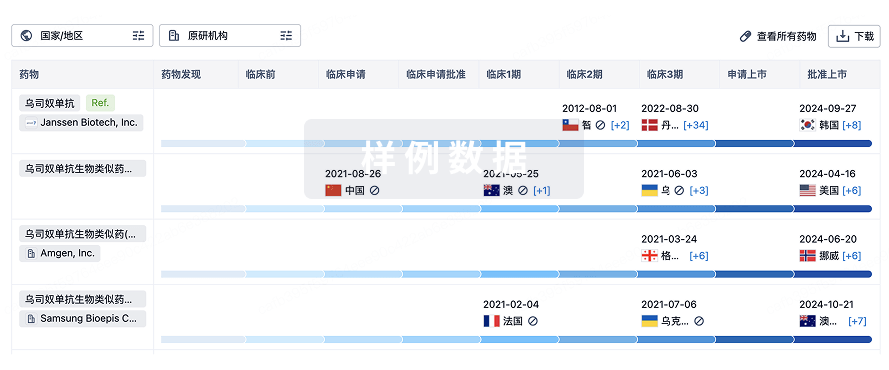
生物类似药
生物类似药在不同国家/地区的竞争态势。请注意临床1/2期并入临床2期,临床2/3期并入临床3期
登录
或
特殊审评
只需点击几下即可了解关键药物信息。
登录
或

提出任何生物医药研究问题
让每一步生物医药决策都精准制胜
基于十亿级生物数据与全球情报的精准 AI,赋能早期药物发现
立即开始免费试用!
智慧芽新药情报库是智慧芽专为生命科学人士构建的基于AI的创新药情报平台,助您全方位提升您的研发与决策效率。
立即接入生物医药数据包
智慧芽新药库数据也通过智慧芽开放平台,以MCP或API服务形式对外开放。立即使用我们的MCP服务定制您的LLM智能体。
生物序列数据库
生物药研发创新
免费使用
化学结构数据库
小分子化药研发创新
免费使用