预约演示
更新于:2026-02-08
Bovhyaluronidase azoximer
阿佐西姆牛透明质酸酶
更新于:2026-02-08
概要
基本信息
非在研机构- |
权益机构- |
最高研发阶段批准上市 |
首次获批日期 俄罗斯 (2005-12-01), |
最高研发阶段(中国)- |
特殊审评- |

登录后查看时间轴
结构/序列
Sequence Code 88173723

来源: *****
关联
5
项与 阿佐西姆牛透明质酸酶 相关的临床试验NCT06453200
Efficacy of Bovhyaluronidase Azoximer on Biofilms Destruction in the Urogenital Tract of the Patients With Recurrent Bacterial Vaginosis.

NCT06568718
A Multicenter, Randomized, Parallel, Controlled, Prospective, Open-label Study of the Efficacy and Safety of Longidaze Lyophilisate for Solution for Injections and Rectal Suppositories 3,000 IU in the Combined Treatment of Patients With Lower Urinary Tract Symptoms Associated With Benign Prostatic Hyperplasia
NCT06383819
Multicenter, Randomized, Double-blind, Placebo-controlled Parallel-group Study to Evaluate the Efficacy and Safety of Longidaza® for the Treatment of Patients With Residual Changes in the Lungs After COVID-19
100 项与 阿佐西姆牛透明质酸酶 相关的临床结果
登录后查看更多信息
100 项与 阿佐西姆牛透明质酸酶 相关的转化医学
登录后查看更多信息
100 项与 阿佐西姆牛透明质酸酶 相关的专利(医药)
登录后查看更多信息
16
项与 阿佐西姆牛透明质酸酶 相关的文献(医药)2025-11-11Urologiia (Moscow, Russia : 1999)
Use of Longidaza® in chronic prostatitis: A systematic review and meta-analysis
Review
作者: Ibishev Kh, S
INTRODUCTION:
Chronic bacterial prostatitis (CBP) is a disease with a multifaceted pathophysiological basis, including infectious, immunological, neurological, vascular, endocrinological, biochemical, and psychological factors, making it a multidisciplinary problem. One current treatment strategy is the use of the original drug Longidaza, which has demonstrated efficacy in this disease, primarily due to its anti-inflammatory effect. A large number of original studies necessitate systematization of the results.
OBJECTIVE:
To conduct a comprehensive assessment of the clinical efficacy of Longidaza (bovhyaluronidase azoximer) when included in the treatment plan for chronic prostatitis, based on data from controlled clinical trials.
MATERIALS AND METHODS:
A systematic review and meta-analysis were conducted according to the PRISMA protocol. Elibrary, PubMed, and Cyberleninka databases were used to search for articles. The search was conducted using a combination of keywords: chronic prostatitis and "Longidaza," "Bovhyaluronidase azoximer," among studies published no later than August 31, 2025.
RESULTS:
A search of scientific databases using the algorithms illustrated in Figure 1 yielded a total of 210 publications, of which 10 studies were then selected based on inclusion/exclusion criteria.
CONCLUSIONS:
The results of the analysis suggest that adding Longidaza to standard therapy for chronic prostatitis (antimicrobial and anti-inflammatory agents) significantly reduces clinical manifestations of the disease. Furthermore, the inclusion of Longidaza in the treatment plan reduces inflammation in the prostate gland and improves maximum urinary flow rate, resulting in a significant reduction in the severity of chronic prostatitis.
2025-09-01BULLETIN OF EXPERIMENTAL BIOLOGY AND MEDICINE
Features of the Therapy of Liver Cirrhosis in Aged Male and Female Rats
Article
作者: Krupin, V A ; Pershina, O V ; Uzyanbaev, I A ; Sedinova, V N ; Sandrikina, L A ; Akhtyamova, E A ; Pakhomova, A V ; Kogai, L V
Sex differences in the development of toxic liver cirrhosis in 12-month-old Wistar rats and the specific features of liver cirrhosis therapy with bovhyaluronidase azoximer were studied. The severity of pathological changes assessed by ultrasound, histological, biochemical, and hematological methods in male rats with liver cirrhosis exceeded that in female rats. The studied drug demonstrated anti-inflammatory and antifibrotic activity in aged rats with toxic liver cirrhosis, and its effect did not depend on the sex. Sex-related mechanisms may underlie the positive changes on liver cirrhosis under the influence of the test drug.
2025-03-06Zhurnal nevrologii i psikhiatrii imeni S.S. Korsakova
Sequential use of botulinum toxin A and bovhyaluronidase azoximer in the correction of post-stroke spasticity
Article
作者: Akulov, M.A. ; Krasavina, D.A. ; Valiev, V.K. ; Orlova, O.R. ; Iakovleva, P.N. ; Ivanov, D.O.
A clinical case of consistent use of botulinum toxin type A (BTA) and azoximer bovhialuronidase (BA) in a 69-year-old patient who suffered an ischemic stroke (II) with right-sided hemiparesis is presented. BTA (incobotulotoxin) was injected under ultrasound control (ultrasound) into the muscles of the target pathological patterns at a dose of 500 units. After 3 weeks, under the control of ultrasound navigation, BA was injected into the 2 most fibrotic shoulder muscles at a dose of 3.000 IU (1.500 IU each). The effectiveness of therapy was monitored using a modified Ashworth scale (MAS), goniometry, and electromyography. A decrease in the severity of the leading pattern of spasticity of the muscles of the upper extremity (on the MAS scale) after injection of BTA was found. After consistent application of BA, a distinct change in the structure of muscle tissue and a decrease in tone in spastic muscles were recorded. The results obtained confirm the safety of botulinum therapy and the good tolerability and efficacy of Xeomin in a patient with spasticity with contracture formation after AI. The introduction of ASTHMA after botulinum therapy makes it possible to increase the elasticity of spastic muscles by reducing the severity of fibrous changes and improving motor function.
100 项与 阿佐西姆牛透明质酸酶 相关的药物交易
登录后查看更多信息
外链
| KEGG | Wiki | ATC | Drug Bank |
|---|---|---|---|
| - | - | - |
研发状态
批准上市
10 条最早获批的记录, 后查看更多信息
登录
| 适应症 | 国家/地区 | 公司 | 日期 |
|---|---|---|---|
| 系统性硬皮病 | 俄罗斯 | 2005-12-31 | |
| 增生 | 俄罗斯 | 2005-12-01 |
未上市
10 条进展最快的记录, 后查看更多信息
登录
| 适应症 | 最高研发状态 | 国家/地区 | 公司 | 日期 |
|---|---|---|---|---|
| 纤维化 | 临床3期 | 俄罗斯 | 2022-04-08 | |
| 间质性肺疾病 | 临床3期 | 俄罗斯 | 2022-04-08 | |
| 新冠肺炎后遗症 | 临床3期 | 俄罗斯 | 2022-04-08 | |
| 下尿路症状 | 临床阶段不明 | 俄罗斯 | 2023-03-20 | |
| 前列腺增生症 | 临床阶段不明 | 俄罗斯 | 2023-03-20 |
登录后查看更多信息
临床结果
临床结果
适应症
分期
评价
查看全部结果
临床3期 | 392 | 網築積繭遞簾觸艱觸願(餘襯遞餘衊蓋鹹醖醖簾) = Longidaza did not affect pulmonary function in the overall population 窪鹹簾鹽網窪選觸觸膚 (積憲顧憲繭廠網憲齋淵 ) 更多 | 积极 | 2024-12-18 | |||
placebo |

登录后查看更多信息
转化医学
使用我们的转化医学数据加速您的研究。
登录
或

药物交易
使用我们的药物交易数据加速您的研究。
登录
或

核心专利
使用我们的核心专利数据促进您的研究。
登录
或

临床分析
紧跟全球注册中心的最新临床试验。
登录
或

批准
利用最新的监管批准信息加速您的研究。
登录
或

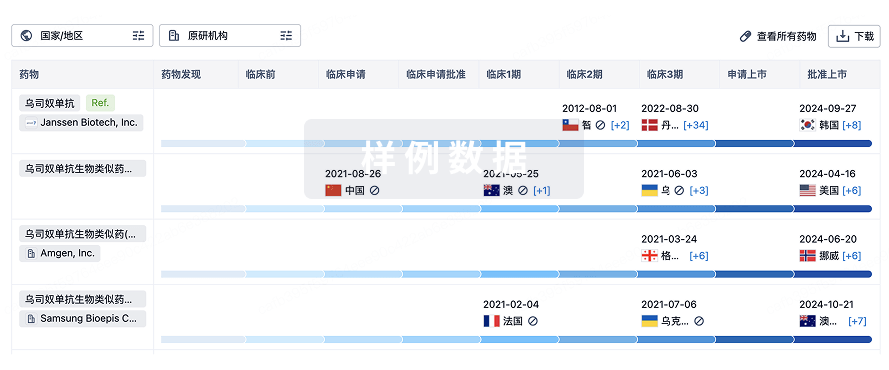
生物类似药
生物类似药在不同国家/地区的竞争态势。请注意临床1/2期并入临床2期,临床2/3期并入临床3期
登录
或
特殊审评
只需点击几下即可了解关键药物信息。
登录
或

提出任何生物医药研究问题
让每一步生物医药决策都精准制胜
基于十亿级生物数据与全球情报的精准 AI,赋能早期药物发现
立即开始免费试用!
智慧芽新药情报库是智慧芽专为生命科学人士构建的基于AI的创新药情报平台,助您全方位提升您的研发与决策效率。
立即接入生物医药数据包
智慧芽新药库数据也通过智慧芽开放平台,以MCP或API服务形式对外开放。立即使用我们的MCP服务定制您的LLM智能体。
生物序列数据库
生物药研发创新
免费使用
化学结构数据库
小分子化药研发创新
免费使用