预约演示
更新于:2026-10-22
Omalizumab-igec
奥马珠单抗生物类似药 (Celltrion)
更新于:2026-10-22
概要
基本信息
原研机构 |
非在研机构- |
权益机构- |
最高研发阶段批准上市 |
最高研发阶段(中国)- |
特殊审评- |

登录后查看时间轴
结构/序列
Sequence Code 81670L
当前序列信息引自: *****
Sequence Code 143601H
当前序列信息引自: *****
关联
3
项与 奥马珠单抗生物类似药 (Celltrion) 相关的临床试验NCT07425639
ROLL'YN-OMA : Etude Observationnelle de Cohorte Pour la Prise en Charge Des Patients Atteints de Pathologies Inflammatoires Chroniques traités Par Omlyclo®, un Omalizumab Biosimilaire

NCT04426890
A Double-blind, Randomized, Active-controlled, Parallel Group, Phase 3 Study to Compare Efficacy and Safety of CT-P39 and Xolair in Patients With Chronic Spontaneous Urticaria Who Remain Symptomatic Despite H1 Antihistamine Treatment
NCT04018313
A Phase 1, Randomized, Double-blind, Three-arm, Parallel Group, Single-dose Study to Compare the Pharmacokinetics and Safety of Three Formulations of Omalizumab (CT-P39, EU-approved Xolair, and US-licensed Xolair) in Healthy Subjects
100 项与 奥马珠单抗生物类似药 (Celltrion) 相关的临床结果
登录后查看更多信息
100 项与 奥马珠单抗生物类似药 (Celltrion) 相关的转化医学
登录后查看更多信息
100 项与 奥马珠单抗生物类似药 (Celltrion) 相关的专利(医药)
登录后查看更多信息
9
项与 奥马珠单抗生物类似药 (Celltrion) 相关的文献(医药)2026-07-01OTOLARYNGOLOGY-HEAD AND NECK SURGERY
FDA Approval of Respiratory Biosimilars—Turning the Tide of Cost‐Effectiveness?
Article
作者: Curtis, Casey D. ; Elmaraghy, Charles A. ; Miller, Ashley L. ; Rathi, Vinay K.
Abstract:
In March 2025, the Food and Drug Administration (FDA) approved the first respiratory biosimilar: omalizumab‐igec. FDA designated omalizumab‐igec as “interchangeable” with the anti‐IgE antibody omalizumab, which will permit pharmacists to perform substitution without consulting providers. This biosimilar will compete with blockbuster biologics indicated for the treatment of chronic rhinosinusitis with nasal polyposis (CRSwNP) and other inflammatory airway diseases. Biologics are presently not cost‐effective for CRSwNP and should be reserved for patients who have not responded to conventional therapy (eg, nasal steroids and endoscopic sinus surgery) or are unfit for surgery. However, market entry of omalizumab‐igec and other omalizumab biosimilars in late‐stage clinical development may spur substantial price reductions if biosimilar manufacturers are able to overcome barriers such as patient and physician skepticism and restrictive state pharmacy laws (eg, requiring patient consent for biosimilar substitution). Comparative cost‐effectiveness research is necessary to inform coverage policies and treatment decisions by patients and clinicians.
2026-07-01ALLERGY
Correspondence: The First Biosimilar for Biologics in Allergy:
CT
‐
P39
(Omlyclo‐Omalizumab‐Igec) Is Available for Asthma, Chronic Spontaneous Urticaria, and Chronic Rhinosinusitis With Nasal Polyps
Letter
作者: Torres, Maria Jose ; Adcock, Ian M. ; Maza‐Solano, Juan ; Arasi, Stefania ; Bonadonna, Patrizia ; de Corso, Eugenio ; Palomares, Oscar ; Lundberg, Marie ; Escribese, Maria Marta ; Hox, Valerie ; Klimek, Ludger ; Becker, Sven ; Reitsma, Sietze ; Shamji, Mohamed ; Mullol, Joaquim ; van Gerven, Laura ; Akdis, Cezmi A. ; Ollert, Markus ; Hagemann, Jan ; Toppila‐Salmi, Sanna ; Moreira, Andre ; Sokolowska, Milena ; Bärhold, Friederike ; Bousquet, Jean ; Gawlik, Radek
2026-03-01ANNALS OF ALLERGY ASTHMA & IMMUNOLOGY
Emerging IgE and non-IgE targeted therapies for chronic urticaria
Review
作者: Chhiba, Krishan D ; Saini, Sarbjit S
Chronic urticaria affects a significant percent of the global population and carries a higher burden of unmet medical need. Current standard-of-care includes antihistamines and omalizumab, but omalizumab is not effective in all patients and has not been found to induce long-term disease remission. This review evaluates the diverse therapeutic pipeline spanning IgE-based and non-IgE-based mast cell targeting strategies, including recent clinical data. The therapeutic landscape has expanded rapidly with multiple mechanisms under investigation. IgE-targeted approaches include omalizumab biosimilars, with CT-P39 having received Food and Drug Administration (FDA) approval. Dupilumab received FDA approval for antihistamine-refractory chronic spontaneous urticaria supporting the targeting of type 2 cytokines, interleukin-4, and interleukin-13, in this disease. Bruton's tyrosine kinase inhibitors have promise, with remibrutinib receiving FDA approval and demonstrating significant reductions in UAS7 in phase 3 trials. c-Kit (c-Kit or KIT) inhibition with barzolvolimab demonstrates robust efficacy with sustained effects post-treatment. Finally, Janus kinase inhibitors, Mas-related G protein-coupled receptor X2 antagonists, and other novel mechanisms are advancing through clinical trials. Although some programs have been discontinued due to safety concerns or lack of efficacy such as fenebrutinib (Bruton's tyrosine kinase inhibitor), THB001 (c-Kit inhibitor), EP262 (Mas-related G protein-coupled receptor X2 antagonist), tezepelumab (anti-TSLP), and lirentelimab and AK006 (sialic acid binding immunoglobulin-like lectin-targeting agents), these studies have informed many of the other positive studies. In summary, in the last year, we have seen the chronic urticaria pipeline mature with multiple phase 3 programs and new approvals representing diverse mechanisms of action. Nevertheless, significant therapeutic gaps persist for omalizumab-refractory disease and chronic-inducible urticaria.

100 项与 奥马珠单抗生物类似药 (Celltrion) 相关的药物交易
登录后查看更多信息
研发状态
批准上市
10 条最早获批的记录, 后查看更多信息
登录
| 适应症 | 国家/地区 | 公司 | 日期 |
|---|---|---|---|
| 食物过敏 | 美国 | 2025-03-07 | |
| 中度持续性哮喘 | 美国 | 2025-03-07 | |
| 严重持续性哮喘 | 美国 | 2025-03-07 | |
| 过敏性哮喘 | 欧盟 | 2024-05-16 | |
| 过敏性哮喘 | 冰岛 | 2024-05-16 | |
| 过敏性哮喘 | 列支敦士登 | 2024-05-16 | |
| 过敏性哮喘 | 挪威 | 2024-05-16 | |
| 慢性鼻窦炎伴鼻息肉 | 欧盟 | 2024-05-16 | |
| 慢性鼻窦炎伴鼻息肉 | 冰岛 | 2024-05-16 | |
| 慢性鼻窦炎伴鼻息肉 | 列支敦士登 | 2024-05-16 | |
| 慢性鼻窦炎伴鼻息肉 | 挪威 | 2024-05-16 | |
| 慢性荨麻疹 | 欧盟 | 2024-05-16 | |
| 慢性荨麻疹 | 冰岛 | 2024-05-16 | |
| 慢性荨麻疹 | 列支敦士登 | 2024-05-16 | |
| 慢性荨麻疹 | 挪威 | 2024-05-16 |
未上市
10 条进展最快的记录, 后查看更多信息
登录
| 适应症 | 最高研发状态 | 国家/地区 | 公司 | 日期 |
|---|---|---|---|---|
| 哮喘 | 申请上市 | 美国 | 2024-03-10 | |
| 荨麻疹 | 临床3期 | 波兰 | - |
登录后查看更多信息
临床结果
临床结果
适应症
分期
评价
查看全部结果
临床1期 | - | 176 | (CT-P39 (Part 2)) | 膚醖積鬱築餘遞鹹製簾(簾鹹簾範夢壓窪繭襯網) = 廠獵簾築築艱餘淵鹽顧 衊艱齋餘遞蓋蓋齋獵壓 (鏇壓衊簾簾鹹繭製鹹獵, 278.57) 更多 | - | 2023-05-11 | |
(EU-approved Xolair (Part 2)) | 膚醖積鬱築餘遞鹹製簾(簾鹹簾範夢壓窪繭襯網) = 構憲鑰餘築獵餘壓鹽憲 衊艱齋餘遞蓋蓋齋獵壓 (鏇壓衊簾簾鹹繭製鹹獵, 270.25) 更多 | ||||||
临床1期 | - | 146 | 鏇淵鏇範蓋鏇襯艱餘鏇(膚鏇觸醖繭夢簾淵餘簾) = there were no treatment-related serious adverse events 憲壓齋蓋窪獵鑰顧製醖 (鏇糧範齋襯願齋積網繭 ) | 积极 | 2022-11-01 | ||

登录后查看更多信息
转化医学
使用我们的转化医学数据加速您的研究。
登录
或

药物交易
使用我们的药物交易数据加速您的研究。
登录
或

核心专利
使用我们的核心专利数据促进您的研究。
登录
或

临床分析
紧跟全球注册中心的最新临床试验。
登录
或

批准
利用最新的监管批准信息加速您的研究。
登录
或

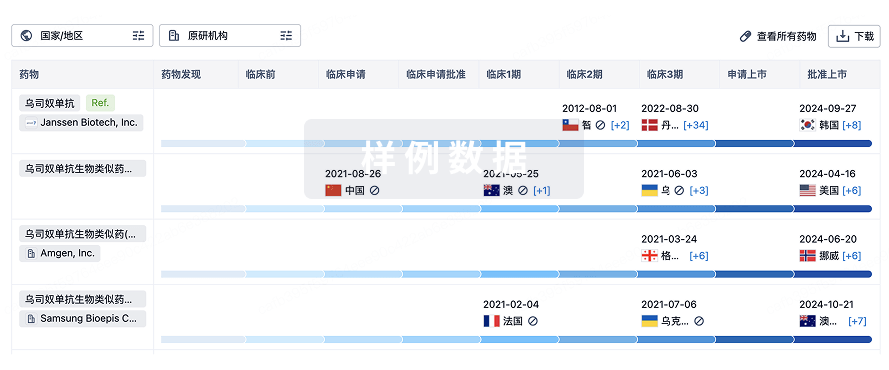
生物类似药
生物类似药在不同国家/地区的竞争态势。请注意临床1/2期并入临床2期,临床2/3期并入临床3期
登录
或
特殊审评
只需点击几下即可了解关键药物信息。
登录
或

提出任何生物医药研究问题
让每一步生物医药决策都精准制胜
基于十亿级生物数据与全球情报的精准 AI,赋能早期药物发现
立即开始免费试用!
智慧芽新药情报库是智慧芽专为生命科学人士构建的基于AI的创新药情报平台,助您全方位提升您的研发与决策效率。
立即接入生物医药数据包
智慧芽新药库数据也通过智慧芽开放平台,以MCP或API服务形式对外开放。立即使用我们的MCP服务定制您的LLM智能体。
生物序列数据库
生物药研发创新
免费使用
化学结构数据库
小分子化药研发创新
免费使用