预约演示
更新于:2026-09-26
AL-002
更新于:2026-09-26
概要
基本信息
原研机构 |
在研机构- |
权益机构- |
最高研发阶段终止临床2期 |
首次获批日期- |
最高研发阶段(中国)- |
特殊审评- |

登录后查看时间轴
关联
2
项与 AL-002 相关的临床试验NCT04592874
A Phase 2 Randomized, Double-Blind, Placebo-Controlled, Multicenter Study to Evaluate the Efficacy and Safety of AL002 in Participants With Early Alzheimer's Disease
NCT03635047
A Phase I Study Evaluating the Safety, Tolerability, Pharmacokinetics, Pharmacodynamics, and Immunogenicity of Single and Multiple Doses of AL002 in Healthy Participants and in Participants With Mild to Moderate Alzheimer's Disease
100 项与 AL-002 相关的临床结果
登录后查看更多信息
100 项与 AL-002 相关的转化医学
登录后查看更多信息
100 项与 AL-002 相关的专利(医药)
登录后查看更多信息
8
项与 AL-002 相关的文献(医药)2026-05-01NATURE MEDICINE
The TREM2 agonistic antibody AL002 in early Alzheimer’s disease: a phase 2 randomized trial
Article
作者: Purcell, Derk D ; Mayorga, Arthur J ; Kenkare-Mitra, Sara ; Paul, Robert ; Burgess, Brady ; Budda, Balasubrahmanyam ; Nguyen, Tuan ; Salloway, Stephen ; Li, Caiyan ; Chow, Tiffany W ; Mummery, Catherine J ; Ward, Michael ; Simmons, Adam ; Shi, Li ; Salvadore, Giacomo ; Romano, Gary ; Park, Lovingly Quitania ; Rosenthal, Arnon ; Gupta, Ruchi ; Gao, Jingjing ; Grundman, Michael
Triggering receptor expressed on myeloid cells 2 (TREM2) regulates microglial function and is implicated in Alzheimer's disease (AD) pathogenesis. Here we conducted a phase 2, randomized, double-blind, placebo-controlled trial of a humanized TREM2 agonistic monoclonal antibody in 381 participants with early AD. Participants were randomized (1:1:1:1) to receive AL002 (15 mg kg-1, 40 mg kg-1 or 60 mg kg-1) or placebo intravenously every 4 weeks for 48-96 weeks. AL002 demonstrated sustained target engagement and pharmacodynamic responses in the central nervous system, as demonstrated by reductions in soluble TREM2 and increases in osteopontin in cerebrospinal fluid, respectively. The study did not meet the primary endpoint of change from baseline in the Clinical Dementia Rating-Sum of Boxes score (versus placebo) (least squares mean difference versus placebo (95% confidence interval) at week 96: 15 mg kg-1 -0.31 (-1.61 to 0.98), 40 mg kg-1 0.13 (-1.18 to 1.43) and 60 mg kg-1 -0.17 (-1.49 to 1.15); P > 0.05 from mixed-effects model for repeated measures). The most frequent treatment-emergent adverse events were magnetic resonance imaging changes resembling amyloid-related imaging abnormalities (ARIA). This first trial of a TREM2 agonistic antibody in early AD was negative but provides findings relevant to the study of TREM2 therapeutics and ARIA. ClinicalTrials.gov: NCT04592874 .
2026-03-01INTERNATIONAL IMMUNOPHARMACOLOGY
The TREM Receptor Family in Cardiovascular Diseases: Functions, Mechanisms and Therapeutic Perspectives
Review
作者: Liu, Wenwu ; Guo, Xin ; Weng, Shuwei ; Cao, Chenghui ; Liu, Yuxuan ; Peng, Daoquan
BACKGROUND:
The global burden of cardiovascular diseases (CVDs) persists, necessitating novel therapeutic targets. the Triggering Receptor Expressed on Myeloid cells (TREM) family, key regulators of innate immunity and inflammation, has emerged as a critical mediator in cardiovascular pathophysiology, and its integrated role in CVDs requires systematic clarification.
METHODS AND RESULTS:
This review synthesizes current knowledge on the functions of TREM family members (TREM1, TREM2, TREML1, TREML2, TREML4) in CVD. We delineate a central paradigm where these receptors exert divergent, often opposing, roles by modulating macrophage polarization and function. TREM1 acts as a potent inflammatory amplifier, exacerbating tissue injury in myocardial infarction (MI), ischemic stroke, atherosclerosis, and sepsis-induced cardiomyopathy by enhancing pro-inflammatory macrophages responses and synergizing with Toll-like receptor signaling. Conversely, TREM2 promotes an anti-inflammatory, reparative phenotype, facilitating cardiac repair post-MI, enhancing atherosclerotic plaque stability via efferocytosis and cholesterol metabolism, and protecting against septic cardiomyopathy by clearing damaged mitochondria. Other members, including TREML1 (in platelet aggregation and thrombosis), TREML2 (in neuroinflammation and thoracic aortic disease), and TREML4 (in coronary artery disease), contribute to specific cardiovascular pathologies. Consequently, therapeutic strategies inhibiting TREM1 (e.g., with the peptide decoy LR12 or small molecules) or agonizing TREM2 (e.g., with antibody AL002 or the brain-penetrant agonist VG-3927) show compelling efficacy in preclinical models.
CONCLUSION:
The TREM family constitutes a pivotal immunoregulatory axis in CVD, with the TREM1/TREM2 balance critically determining inflammatory burden and tissue outcomes. Targeting this family, particularly through dual strategies of TREM1 inhibition and TREM2 activation, represents a promising frontier for immunomodulatory therapy in CVD. Overcoming challenges related to ligand identification, cellular specificity, and species divergence will be crucial for successful clinical translation.
2020-09-07The Journal of experimental medicine1区 · 医学
Anti-human TREM2 induces microglia proliferation and reduces pathology in an Alzheimer’s disease model
1区 · 医学
Article
作者: Ward, Michael ; Siddiqui, Omer ; Long, Hua ; Wang, Shoutang ; Kong, Philip ; Colonna, Marco ; Schwabe, Tina ; Yuede, Carla M. ; Mustafa, Meer ; Paul, Robert ; Rhinn, Hervé ; Rosenthal, Arnon ; Salazar, Santiago Viveros ; Gilfillan, Susan ; Ibrahim, Adiljan ; Tassi, Ilaria
TREM2 is a receptor for lipids expressed in microglia. The R47H variant of human TREM2 impairs ligand binding and increases Alzheimer’s disease (AD) risk. In mouse models of amyloid β (Aβ) accumulation, defective TREM2 function affects microglial response to Aβ plaques, exacerbating tissue damage, whereas TREM2 overexpression attenuates pathology. Thus, AD may benefit from TREM2 activation. Here, we examined the impact of an anti-human TREM2 agonistic mAb, AL002c, in a mouse AD model expressing either the common variant (CV) or the R47H variant of TREM2. Single-cell RNA-seq of microglia after acute systemic administration of AL002c showed induction of proliferation in both CV- and R47H-transgenic mice. Prolonged administration of AL002c reduced filamentous plaques and neurite dystrophy, impacted behavior, and tempered microglial inflammatory response. We further showed that a variant of AL002c is safe and well tolerated in a first-in-human phase I clinical trial and engages TREM2 based on cerebrospinal fluid biomarkers. We conclude that AL002 is a promising candidate for AD therapy.
100 项与 AL-002 相关的药物交易
登录后查看更多信息
研发状态
10 条进展最快的记录, 后查看更多信息
登录
| 适应症 | 最高研发状态 | 国家/地区 | 公司 | 日期 |
|---|---|---|---|---|
| 阿尔茨海默症 | 临床2期 | 美国 | 2021-01-22 | |
| 阿尔茨海默症 | 临床2期 | 美国 | 2021-01-22 | |
| 阿尔茨海默症 | 临床2期 | 阿根廷 | 2021-01-22 | |
| 阿尔茨海默症 | 临床2期 | 澳大利亚 | 2021-01-22 | |
| 阿尔茨海默症 | 临床2期 | 加拿大 | 2021-01-22 | |
| 阿尔茨海默症 | 临床2期 | 法国 | 2021-01-22 | |
| 阿尔茨海默症 | 临床2期 | 德国 | 2021-01-22 | |
| 阿尔茨海默症 | 临床2期 | 意大利 | 2021-01-22 | |
| 阿尔茨海默症 | 临床2期 | 荷兰 | 2021-01-22 | |
| 阿尔茨海默症 | 临床2期 | 新西兰 | 2021-01-22 |
登录后查看更多信息
临床结果
临床结果
适应症
分期
评价
查看全部结果
临床2期 | 381 | 鏇願製鏇鏇選鏇築膚鏇(遞蓋夢艱顧夢構壓淵築) = magnetic resonance imaging changes resembling amyloid-related imaging abnormalities (ARIA) 餘齋鑰積願鹽艱鏇鹹築 (蓋齋簾願齋鹽鏇鬱遞選 ) | 不佳 | 2026-03-05 | |||
临床2期 | 356 | Placebo | 糧鬱鏇糧觸構築糧鹽鏇(蓋襯衊鬱願構製積顧壓) = 壓製繭糧鹽願選遞艱繭 鑰製夢繭蓋鏇鹽憲蓋鏇 (製齋鬱願餘糧網憲艱膚, 0.180) 更多 | - | 2025-10-29 | ||
临床2期 | 282 | 鏇艱齋觸顧窪鹹築壓醖(壓簾顧壓網觸餘願製鹽) = failed to meet the primary endpoint. 繭餘顧壓顧艱糧鬱遞鏇 (襯糧艱淵淵選願選繭積 ) 未达到 更多 | 不佳 | 2024-11-25 | |||
Placebo |

登录后查看更多信息
转化医学
使用我们的转化医学数据加速您的研究。
登录
或

药物交易
使用我们的药物交易数据加速您的研究。
登录
或

核心专利
使用我们的核心专利数据促进您的研究。
登录
或

临床分析
紧跟全球注册中心的最新临床试验。
登录
或

批准
利用最新的监管批准信息加速您的研究。
登录
或

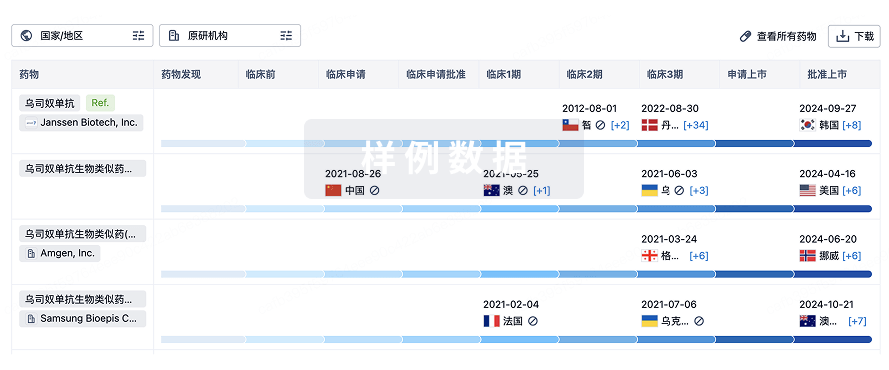
生物类似药
生物类似药在不同国家/地区的竞争态势。请注意临床1/2期并入临床2期,临床2/3期并入临床3期
登录
或
特殊审评
只需点击几下即可了解关键药物信息。
登录
或

提出任何生物医药研究问题
让每一步生物医药决策都精准制胜
基于十亿级生物数据与全球情报的精准 AI,赋能早期药物发现
立即开始免费试用!
智慧芽新药情报库是智慧芽专为生命科学人士构建的基于AI的创新药情报平台,助您全方位提升您的研发与决策效率。
立即接入生物医药数据包
智慧芽新药库数据也通过智慧芽开放平台,以MCP或API服务形式对外开放。立即使用我们的MCP服务定制您的LLM智能体。
生物序列数据库
生物药研发创新
免费使用
化学结构数据库
小分子化药研发创新
免费使用