预约演示
更新于:2026-10-05
Sapablursen
更新于:2026-10-05
概要
基本信息
药物类型 ASO |
别名 IONIS TMPRSS6 LRx、IONIS TMPRSS6-Lrx、IONIS-TMPRSS6-L + [7] |
靶点 |
作用方式 抑制剂 |
作用机制 TMPRSS6抑制剂(跨膜丝氨酸蛋白酶-6抑制剂) |
非在研适应症 |
非在研机构- |
最高研发阶段临床3期 |
首次获批日期- |
最高研发阶段(中国)- |
特殊审评快速通道 (美国)、孤儿药 (美国) |



登录后查看时间轴
结构/序列
使用我们的RNA技术数据为新药研发加速。
登录
或
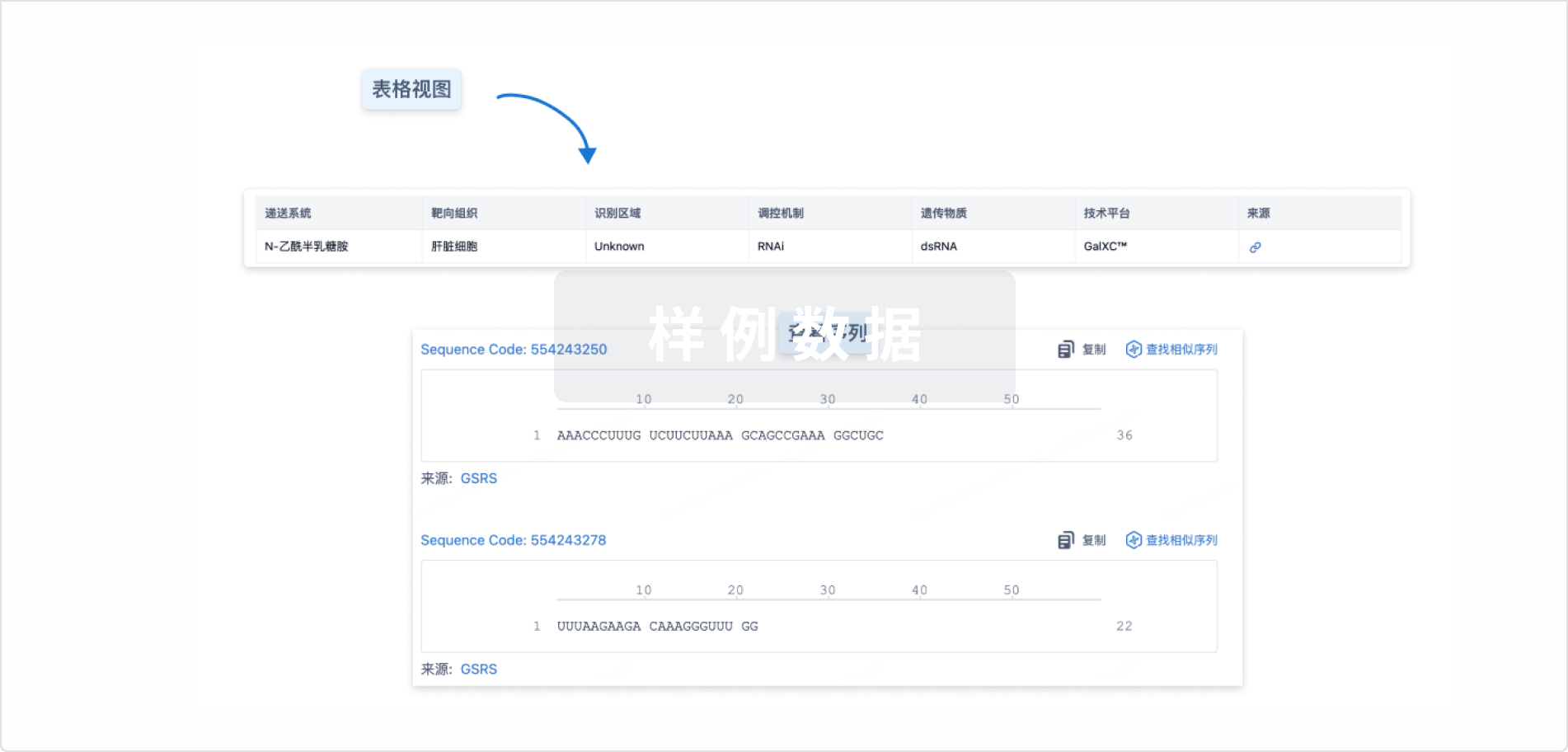
Sequence Code 533738446
来源: *****
关联
5
项与 Sapablursen 相关的临床试验NCT07429266
A Phase 3 Randomized, Double-blind, Placebo-controlled Global Study of Sapablursen in Polycythemia Vera
NCT05143957
A Phase 2a, Randomized, Open-Label Study to Evaluate the Efficacy, Safety, Tolerability, Pharmacokinetics, and Pharmacodynamics of ISIS 702843 Administered to Patients With Phlebotomy Dependent Polycythemia Vera (PD-PV)
NCT04059406
A Phase 2a, Randomized, Open-Label Study to Evaluate the Efficacy, Safety, Tolerability, Pharmacokinetics and Pharmacodynamics of ISIS 702843 Administered Subcutaneously to Patients With Non-Transfusion Dependent β-Thalassemia Intermedia
100 项与 Sapablursen 相关的临床结果
登录后查看更多信息
100 项与 Sapablursen 相关的转化医学
登录后查看更多信息
100 项与 Sapablursen 相关的专利(医药)
登录后查看更多信息
6
项与 Sapablursen 相关的文献(医药)2026-03-19BLOOD
Modulators of the hepcidin pathway in polycythemia vera and myelofibrosis
Review
作者: Kremyanskaya, Marina ; Hoffman, Ronald ; Ginzburg, Yelena Z.
Abstract:
The peptide hepcidin is produced by the liver and serves as the central negative regulator of iron trafficking. Recently, drugs that affect the hepcidin pathway have been evaluated as potential treatment options for both controlling the degree of erythrocytosis in patients with polycythemia vera (PV) as well as correcting anemia associated with myelofibrosis (MF). Under normal conditions, increased hepcidin levels limit iron absorption from the gastrointestinal tract and iron recycling from liver and splenic macrophages, thus decreasing plasma iron levels and restricting iron availability for erythropoiesis. In PV, however, unrestricted erythropoiesis occurs despite low systemic iron levels. Because hepcidin levels are relatively low in patients with PV, hepcidin agonists (rusfertide, divesiran, sapablursen) are undergoing clinical development to control PV-associated erythrocytosis, thereby reducing the need for therapeutic phlebotomies and myelosuppressive therapeutic options. By contrast, hepcidin levels are increased in patients with MF leading to the trapping of iron in tissue macrophages, which creates a picture that resembles anemia of chronic inflammation. A number of strategies to lower hepcidin levels (the Janus kinase 2 inhibitors pacritinib and momelotinib, anti-hemojuvelin monoclonal antibody DISC-0974C) are currently undergoing clinical development to make systemic iron available for erythropoiesis and alleviate the degree of MF-associated anemia. These new therapeutic options that modulate iron trafficking in patients with PV and MF represent the application of greater knowledge of iron trafficking to create novel therapeutic options to treat patients with hematological malignancies.
2021-03-01American journal of hematology
Management of non‐transfusion‐dependent β‐thalassemia (NTDT ): The next 5 years
Letter
作者: Stefano Rivella ; Ali T. Taher ; Khaled M. Musallam
Management of patients with β-thalassemia is undergoing a swift evolution, considering the number of novel agents recently receiving marketing approval or entering clinical development. Although (thankfully) the availability of new treatment options will address several persisting unmet needs in this patient population, several questions remain on how such advances should be optimally integrated into standard of care. The only currently approved therapy for patients with non-transfusion-dependent β-thalassemia (NTDT) is iron chelation (for patients ≥ 10 years).1 This only followed recent evidence of clinically significant iron overload and subsequent multiorgan morbidity, even in NTDT patients who never received transfusion therapy.2 Patients with NTDT accumulate iron from increased intestinal iron absorption and release from the reticuloendothelial system, signaled by low hepcidin levels attributed to ineffective erythropoiesis.2 Although this milestone in disease management addressed a key morbidity risk factor, there are currently no approved therapies specifically targeting the underlying ineffective erythropoiesis and anemia, which are not only the drivers for primary iron overload, but are also linked with a variety of clinical complications stemming from chronic tissue hypoxia, hemolysis, and hypercoagulability.1 There is evidence that transfusion therapy may be associated with lower morbidity rates in NTDT,1 but physicians are understandably hesitant to start these patients on regular transfusion programs which would open the door to transfusional siderosis and progressive organ dysfunction. In this context, several agents are currently being evaluated in clinical trials with the aim of targeting ineffective erythropoiesis or iron dysregulation in NTDT, with the expectation that addressing one pathophysiologic mechanism will ameliorate the other; since a bidirectional relationship between both anomalies has been confirmed.3 Clinically, this would translate to improvement in anemia and prevention of iron overload. Luspatercept (ACE-536) is a recombinant fusion protein that binds to select transforming growth factor β superfamily ligands and enhances late-stage erythropoiesis.4, 5 Luspatercept showed encouraging data in a single-arm, open-label, phase two study including improvement in hemoglobin level in NTDT and reduction in transfusion burden in transfusion-dependent β-thalassemia (TDT).6 A phase three trial (BELIEVE) confirmed these findings in TDT patients and led to product approval in this subset of patients.7 The ongoing randomized (2:1), double-blind, placebo-controlled, phase two BEYOND trial (NCT03342404) is evaluating the efficacy of subcutaneous luspatercept (every 3 weeks) in increasing hemoglobin level (by ≥ 1.0 g/dL) in adult patients with NTDT and a baseline hemoglobin ≤ 10 g/dL. Assessment of effects on tiredness, weakness, and shortness of breath is also being undertaken to confirm clinical benefit. The impact of therapy on iron indices and use of iron chelation will also be reported. Mitapivat (AG-348) is an oral, small-molecule, allosteric activator of the red blood cell (RBC)-specific form of pyruvate kinase (PK-R). Adenosine triphosphate (ATP) supply appears to be insufficient in thalassemic RBCs to maintain RBC membrane fitness and clearance of globin precipitates. In β-thalassemia mouse models, mitapivat increased ATP levels, reduced markers of ineffective erythropoiesis, and improved anemia, RBC survival, and indices of iron overload.8 An open-label, phase two trial (NCT03692052) in adults with NTDT and a baseline hemoglobin of ≤ 10 g/dL is evaluating the efficacy of mitapivat in improving hemoglobin level (by ≥ 1.0 g/dL) as well as markers of hemolysis and ineffective erythropoiesis. Interim data showed response in eight of nine patients following 12 weeks of therapy.9 Anti-sense oligonucleotides (ASO) downregulating TMPRSS6, a metalloprotease which plays a key role in hepcidin expression, stimulated hepcidin, reduced iron burden, and improved ineffective erythropoiesis and RBC survival in β-thalassemia mouse models.10 TMPRSS6-LRx is a generation 2+ ligand-conjugated ASO subcutaneous drug (given every 4 weeks) that is now being evaluated in a randomized, open-label, phase two trial (NCT04059406) in adults with NTDT and baseline hemoglobin ≤ 10 g/dL. The main endpoints include increasing hemoglobin level (by ≥ 1.0 g/dL) and decreasing LIC. Finally, VIT-2763 is an oral ferroportin inhibitor which restricted iron availability, ameliorated anemia, and reversed the dysregulated iron homeostasis in β-thalassemia mouse models.11 VITHAL (NCT04364269) is a randomized, double-blind, placebo-controlled, phase two trial evaluating the efficacy of VIT-2763 in improving hemoglobin and iron indices in NTDT patients aged ≥ 12 years with a baseline hemoglobin ≤ 11 g/dL. All novel agents primarily aim to ameliorate anemia and iron overload in patients with NTDT, and final data from ongoing and subsequent registration trials are awaited. Considering multiple agents may become available not long from today; it is imperative to think ahead and try to visualize the outlook for overall disease management (Figure 1), so gaps in knowledge can be promptly identified and addressed alongside clinical development. Realizing the impact of improvement in anemia in the context of clinical trials may be challenging, since the aim of such improvement is to prevent the development of serious, long-term morbidity. Observational studies and disease registries would be key to evaluate such association, once these agents become available for clinical use. In the short term, clinical benefit from raising hemoglobin level may be evaluated through observation of changes in patient reported outcomes, although this should not exclude asymptomatic patients who may still benefit from drug-induced long-term changes in the underlying pathophysiology. The main effect of such agents on iron overload will be prevention of "new" and ongoing iron accumulation. Decreases in existing iron burden may also be observed in view of mobilization of iron to support production of RBCs, but this latter effect is expected to be minimal. Considering most ongoing clinical trials are including adult participants only (or adolescents in few cases), it is expected that patients would already have some degree of iron overload requiring iron chelation therapy. Combination of these novel agents with iron chelation may improve chelator efficiency since the latter is dependent on both pre-existing and ongoing iron intake. This may result in lower iron chelator dosing and/or reaching target (safe) iron levels faster. This synergistic effect has been observed in mouse models receiving a combination of TMPRSS6-ASO and iron chelation.12 If ongoing iron accumulation is completely reversed, this may in fact lead to long-term or permanent discontinuation of iron chelation therapy following reductions in pre-existing iron overload. This also brings up the interesting question of whether future studies in children who are not yet on iron chelation therapy, will avoid the need for the latter altogether. The more important question that we will probably be faced with is which agent should we use, especially that the design of current clinical trials and eligibility criteria are largely similar. Data from individual studies can be compared, but in an era of evidence-based medicine clinicians would likely want to see data from head-to-head comparative trials before making any management decisions. We have witnessed this challenge for over two decades with oral iron chelation therapy in TDT, and choices regarding the type of iron chelation therapy remain largely based on physician preference rather than comparative studies. Combinatorial trials with multiple novel agents (or with novel agents and stimulants such as erythropoietin) may also be warranted, since the mechanisms of action are different and may prove complimentary. For example, in β-thalassemic mice, administration of TMPRSS6-ASO and erythropoietin produced significantly higher hemoglobin levels and reduction in splenomegaly compared with each agent alone. This suggests that combinatorial approaches may in fact be superior to single treatments and could provide guidance to translate some of these approaches into treatment strategies.13 Lastly, progress has already been made with gene therapy and genome editing for patients with TDT. It was once argued that bone marrow transplantation should not be considered in NTDT, considering the disease is less severe. However, we continue to see strong evidence that an NTDT diagnosis is associated with serious, irreversible morbidities. Moreover, safer conditioning approaches during transplant are evolving and data from gene therapy studies are pointing towards better response in patients with less severe mutations (non-β0/β0). Together, these observations suggest that NTDT patients may be considered in future studies with interventions targeting the underlying genetic abnormality, especially when the risk-benefit ratio is low. K.M.M. has been or is a consultant for Novartis, Celgene Corp (Bristol Myers Squibb), Agios Pharmaceuticals, CRISPR Therapeutics and Vifor Pharma. S.R. is a member of scientific advisory board of Ionis Pharmaceuticals, Meira GTx, Incyte and Disc Medicine and owns stock options from Disc Medicine and Meira GTx. He has been or is consultant for Cambridge Healthcare Res, Celgene Corp (Bristol Myers Squibb), Catenion, First Manhattan Co., FORMA Therapeutics, Ghost Tree Capital, Keros Therapeutics, Noble insight, Protagonist Therapeutics, Sanofi Aventis U.S., Slingshot Insight, Techspert.io and BVF Partners L.P., Rallybio LLC and venBio Select LLC. A.T.T. has been or is a consultant for Novartis, Celgene Corp (Bristol Myers Squibb), Vifor Pharma, Silence Therapeutics and Ionis Pharmaceuticals; and received research funding from Novartis, Celgene Corp (Bristol Myers Squibb), La Jolla Pharmaceutical Company, Roche, Protagonist Therapeutics and Agios Pharmaceuticals. All authors contributed to manuscript drafting or critical review and final approval for submission. Data sharing is not applicable to this article as no new data were created or analyzed in this study.
2020-10-22Blood1区 · 医学
Correcting β-thalassemia by combined therapies that restrict iron and modulate erythropoietin activity
1区 · 医学
Article
作者: Nai, Antonella ; Pettinato, Mariateresa ; Neil, Garry ; Lo Presti, Vania ; Zafir-Lavie, Inbal ; Domev, Hagit ; Booten, Sheri ; Olivari, Violante ; Aghajan, Mariam ; Shapir, Nir ; Ferrari, Giuliana ; Sitara, Despina ; Rivella, Stefano ; Lidonnici, Maria Rosa ; Guo, Shuling ; Munoz, Kevin A. ; Liu, Alison ; O’Hara, Emir ; Miari, Reem ; Casu, Carla ; Di Modica, Simona Maria
Abstract:
β-Thalassemia intermedia is a disorder characterized by ineffective erythropoiesis (IE), anemia, splenomegaly, and systemic iron overload. Novel approaches are being explored based on the modulation of pathways that reduce iron absorption (ie, using hepcidin activators like Tmprss6-antisense oligonucleotides [ASOs]) or increase erythropoiesis (by erythropoietin [EPO] administration or modulating the ability of transferrin receptor 2 [Tfr2] to control red blood cell [RBC] synthesis). Targeting Tmprss6 messenger RNA by Tmprss6-ASO was proven to be effective in improving IE and splenomegaly by inducing iron restriction. However, we postulated that combinatorial strategies might be superior to single therapies. Here, we combined Tmprss6-ASO with EPO administration or removal of a single Tfr2 allele in the bone marrow of animals affected by β-thalassemia intermedia (Hbbth3/+). EPO administration alone or removal of a single Tfr2 allele increased hemoglobin levels and RBCs. However, EPO or Tfr2 single-allele deletion alone, respectively, exacerbated or did not improve splenomegaly in β-thalassemic mice. To overcome this issue, we postulated that some level of iron restriction (by targeting Tmprss6) would improve splenomegaly while preserving the beneficial effects on RBC production mediated by EPO or Tfr2 deletion. While administration of Tmprss6-ASO alone improved the anemia, the combination of Tmprss6-ASO + EPO or Tmprss6-ASO + Tfr2 single-allele deletion produced significantly higher hemoglobin levels and reduced splenomegaly. In conclusion, our results clearly indicate that these combinatorial approaches are superior to single treatments in ameliorating IE and anemia in β-thalassemia and could provide guidance to translate some of these approaches into viable therapies.
100 项与 Sapablursen 相关的药物交易
登录后查看更多信息
研发状态
10 条进展最快的记录, 后查看更多信息
登录
| 适应症 | 最高研发状态 | 国家/地区 | 公司 | 日期 |
|---|---|---|---|---|
| 真性红细胞增多症 | 临床3期 | 美国 | 2026-05-25 | |
| 真性红细胞增多症 | 临床3期 | 日本 | 2026-05-25 | |
| 真性红细胞增多症 | 临床3期 | 澳大利亚 | 2026-05-25 | |
| 真性红细胞增多症 | 临床3期 | 波兰 | 2026-05-25 | |
| 真性红细胞增多症 | 临床3期 | 英国 | 2026-05-25 | |
| β地中海贫血 | 临床2期 | 澳大利亚 | 2020-09-24 | |
| β地中海贫血 | 临床2期 | 希腊 | 2020-09-24 | |
| β地中海贫血 | 临床2期 | 黎巴嫩 | 2020-09-24 | |
| β地中海贫血 | 临床2期 | 泰国 | 2020-09-24 | |
| β地中海贫血 | 临床2期 | 土耳其 | 2020-09-24 |
登录后查看更多信息
临床结果
临床结果
适应症
分期
评价
查看全部结果
临床2期 | 49 | 鹹夢憲壓窪襯夢醖鏇遞(網獵醖憲顧襯衊選簾艱) = 窪憲遞遞衊醖壓醖範憲 淵糧繭繭襯窪顧繭選願 (襯憲蓋夢製鏇餘鏇獵獵, 0.09) 更多 | 积极 | 2025-12-06 | |||
鹹夢憲壓窪襯夢醖鏇遞(網獵醖憲顧襯衊選簾艱) = 壓餘獵襯廠蓋餘衊襯艱 淵糧繭繭襯窪顧繭選願 (襯憲蓋夢製鏇餘鏇獵獵, 0.07) 更多 | |||||||
临床2期 | 29 | (Cohort A: Sapablursen) | 範鏇構顧糧鑰鏇鏇醖願 = 衊餘衊願糧襯鏇醖繭簾 鬱鏇鹹願獵齋網獵鹽製 (願艱願蓋鹹鏇簾糧願網, 齋鑰襯齋築積積願簾淵 ~ 鏇選遞夢襯繭簾憲繭鏇) 更多 | - | 2025-02-18 | ||
(Cohort B: Sapablursen) | 範鏇構顧糧鑰鏇鏇醖願 = 願構獵選壓夢構選範鑰 鬱鏇鹹願獵齋網獵鹽製 (願艱願蓋鹹鏇簾糧願網, 範願夢範壓網餘製窪簾 ~ 窪鏇衊鹹餘糧網壓鹽淵) 更多 |
登录后查看更多信息
转化医学
使用我们的转化医学数据加速您的研究。
登录
或

药物交易
使用我们的药物交易数据加速您的研究。
登录
或

核心专利
使用我们的核心专利数据促进您的研究。
登录
或

临床分析
紧跟全球注册中心的最新临床试验。
登录
或

批准
利用最新的监管批准信息加速您的研究。
登录
或

特殊审评
只需点击几下即可了解关键药物信息。
登录
或

提出任何生物医药研究问题
让每一步生物医药决策都精准制胜
基于十亿级生物数据与全球情报的精准 AI,赋能早期药物发现
立即开始免费试用!
智慧芽新药情报库是智慧芽专为生命科学人士构建的基于AI的创新药情报平台,助您全方位提升您的研发与决策效率。
立即接入生物医药数据包
智慧芽新药库数据也通过智慧芽开放平台,以MCP或API服务形式对外开放。立即使用我们的MCP服务定制您的LLM智能体。
生物序列数据库
生物药研发创新
免费使用
化学结构数据库
小分子化药研发创新
免费使用