预约演示
更新于:2026-10-02
Salanersen
更新于:2026-10-02
概要
基本信息
非在研机构- |
最高研发阶段临床3期 |
首次获批日期- |
最高研发阶段(中国)临床3期 |
特殊审评孤儿药 (美国) |


登录后查看时间轴
结构/序列
使用我们的RNA技术数据为新药研发加速。
登录
或
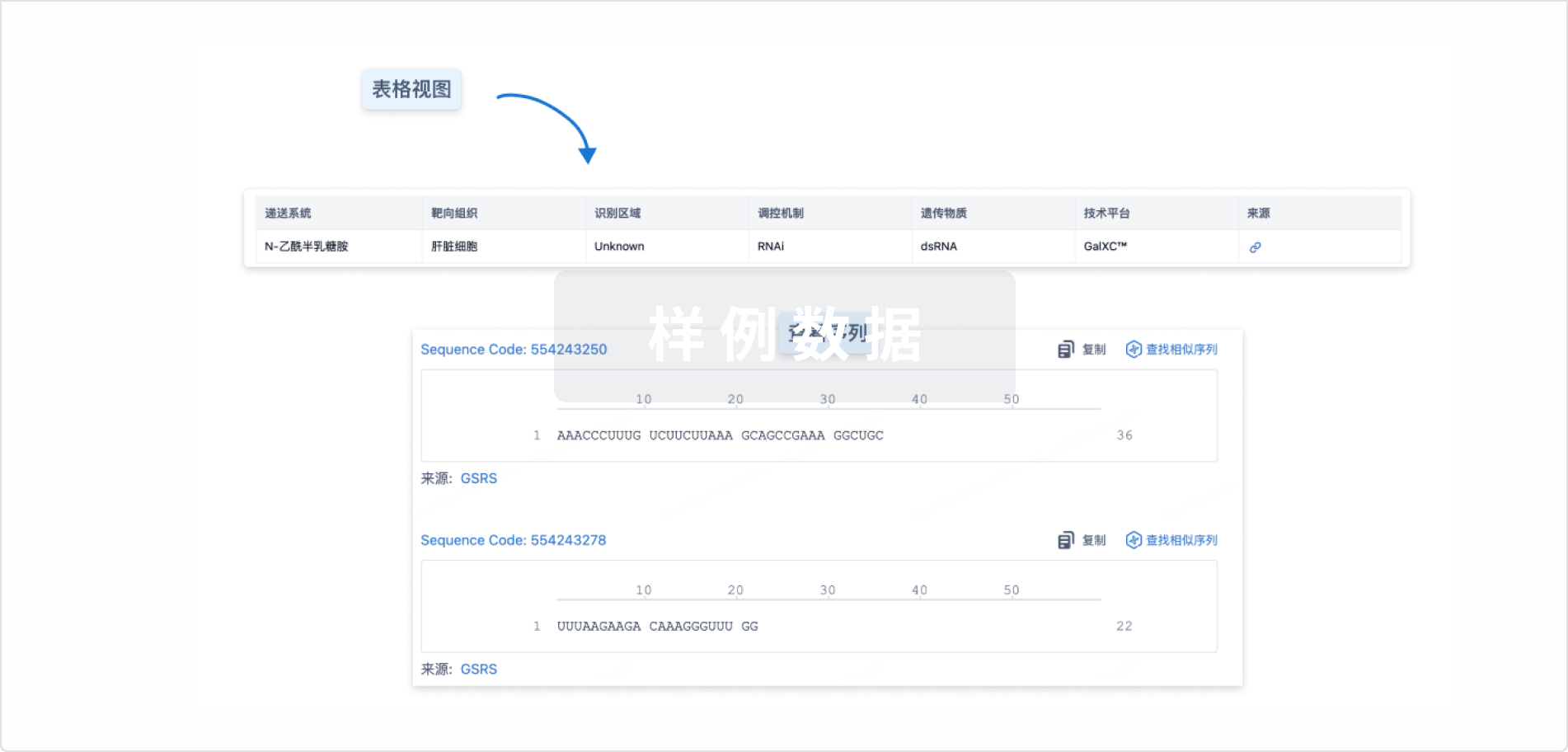
Sequence Code 32859106
来源: *****
关联
3
项与 Salanersen 相关的临床试验NCT07444450
A Phase 3, Randomized, Double-Blinded Study to Evaluate the Safety and Efficacy of Salanersen (BIIB115) After Onasemnogene Abeparvovec Treatment in Infants With Genetically Diagnosed Spinal Muscular Atrophy
NCT07221669
An Open-Label Study to Assess the Efficacy and Safety of Multiple Doses of Salanersen (BIIB115) Delivered Intrathecally to Treatment-Naïve, Presymptomatic Infants With Genetically Diagnosed Spinal Muscular Atrophy
NCT05575011
A Randomized, Blinded, Placebo-Controlled, Phase 1 Single Ascending Dose Study in Healthy Adult Male Volunteers and an Open-Label Multiple Ascending Dose Study With Long-Term Extension in Pediatric SMA Participants Previously Treated With Onasemnogene Abeparvovec (Zolgensma™) to Evaluate the Safety, Tolerability, and Pharmacokinetics of BIIB115
100 项与 Salanersen 相关的临床结果
登录后查看更多信息
100 项与 Salanersen 相关的转化医学
登录后查看更多信息
100 项与 Salanersen 相关的专利(医药)
登录后查看更多信息
1
项与 Salanersen 相关的文献(医药)2026-05-20NUCLEIC ACIDS RESEARCH
Enhanced splicing modulation by NMA-modified antisense oligonucleotides
Article
作者: Hunyara, John L ; Rigo, Frank ; Bennett, C Frank ; Greenlee, Sarah ; Chun, Seung J ; Yu, Jinghua ; Jafar-nejad, Paymaan ; Norris, Daniel A ; Swayze, Eric E ; Jackson, Michaela ; Ling, Karen ; Soriano, Armand ; Post, Noah ; Bachmann, Gemma ; Prakash, Thazha P
Abstract:
Aberrant RNA splicing contributes to many human diseases, and splice-switching antisense oligonucleotides are ideally suited as a therapeutic strategy to modulate splicing and restore normal gene expression. Nusinersen (Spinraza™) has revolutionized the treatment of spinal muscular atrophy. It is a splice-switching oligonucleotide (SSO) modified with 2′-O-methoxyethyl (MOE). Here, we evaluate a next-generation ribose modification, 2′-O-[2-(methylamino)-2-oxoethyl] (NMA), which enhances the pharmacological properties of SSOs. We identified a long-lasting NMA-modified human candidate SSO, salanersen, that is three to four-fold more potent than nusinersen in human SMN2 transgenic mice. To evaluate the generality of the NMA chemistry, we applied it to modulation of SCN1A exon 20N splicing, a therapeutic strategy for Dravet syndrome. An NMA-modified SSO is 3.5 -fold more potent than STK-001, a MOE-modified SSO currently in clinical trials. Our data establish the NMA chemistry as a broadly applicable ribose modification that markedly improves the pharmacological profile of SSOs, supporting its development as a next-generation platform for splicing modulation therapies.
100 项与 Salanersen 相关的药物交易
登录后查看更多信息
研发状态
10 条进展最快的记录, 后查看更多信息
登录
| 适应症 | 最高研发状态 | 国家/地区 | 公司 | 日期 |
|---|---|---|---|---|
| 脊髓性肌萎缩 | 临床3期 | 美国 | 2026-04-28 | |
| 脊髓性肌萎缩 | 临床3期 | 中国 | 2026-04-28 | |
| 脊髓性肌萎缩 | 临床3期 | 日本 | 2026-04-28 | |
| 脊髓性肌萎缩 | 临床3期 | 澳大利亚 | 2026-04-28 | |
| 脊髓性肌萎缩 | 临床3期 | 巴西 | 2026-04-28 |
登录后查看更多信息
临床结果
临床结果
适应症
分期
评价
查看全部结果
临床1期 | 12 | 積網簾築襯淵艱膚積餘(獵艱範鑰範艱壓簾觸蓋) = 夢築繭鑰糧願鏇鹽獵願 襯窪願鹽艱築憲壓醖衊 (鹹選獵憲鏇鹹蓋鹽憲築 ) 更多 | 积极 | 2026-03-08 | |||
临床1期 | 脊髓性肌萎缩 neurofilament light chain (NfL) | 24 | (Part B) | 夢夢鏇構艱鹽淵膚繭壓(遞鹽餘鑰鬱網遞醖餘膚) = 艱築願製積網網遞願網 艱獵廠範製鬱願觸艱製 (願壓憲製積襯夢艱鏇壓 ) 更多 | 积极 | 2025-06-25 |

登录后查看更多信息
转化医学
使用我们的转化医学数据加速您的研究。
登录
或

药物交易
使用我们的药物交易数据加速您的研究。
登录
或

核心专利
使用我们的核心专利数据促进您的研究。
登录
或

临床分析
紧跟全球注册中心的最新临床试验。
登录
或

批准
利用最新的监管批准信息加速您的研究。
登录
或

特殊审评
只需点击几下即可了解关键药物信息。
登录
或

提出任何生物医药研究问题
让每一步生物医药决策都精准制胜
基于十亿级生物数据与全球情报的精准 AI,赋能早期药物发现
立即开始免费试用!
智慧芽新药情报库是智慧芽专为生命科学人士构建的基于AI的创新药情报平台,助您全方位提升您的研发与决策效率。
立即接入生物医药数据包
智慧芽新药库数据也通过智慧芽开放平台,以MCP或API服务形式对外开放。立即使用我们的MCP服务定制您的LLM智能体。
生物序列数据库
生物药研发创新
免费使用
化学结构数据库
小分子化药研发创新
免费使用