预约演示
更新于:2026-08-24
RAG-01
更新于:2026-08-24
概要
基本信息
药物类型 小激活RNA |
别名 RAG 01、RAG01 |
靶点 |
作用方式 刺激剂 |
作用机制 CDKN1A基因刺激剂 |
在研适应症 |
非在研适应症- |
非在研机构- |
权益机构- |
最高研发阶段临床2期 |
首次获批日期- |
最高研发阶段(中国)临床2期 |
特殊审评快速通道 (美国) |

登录后查看时间轴
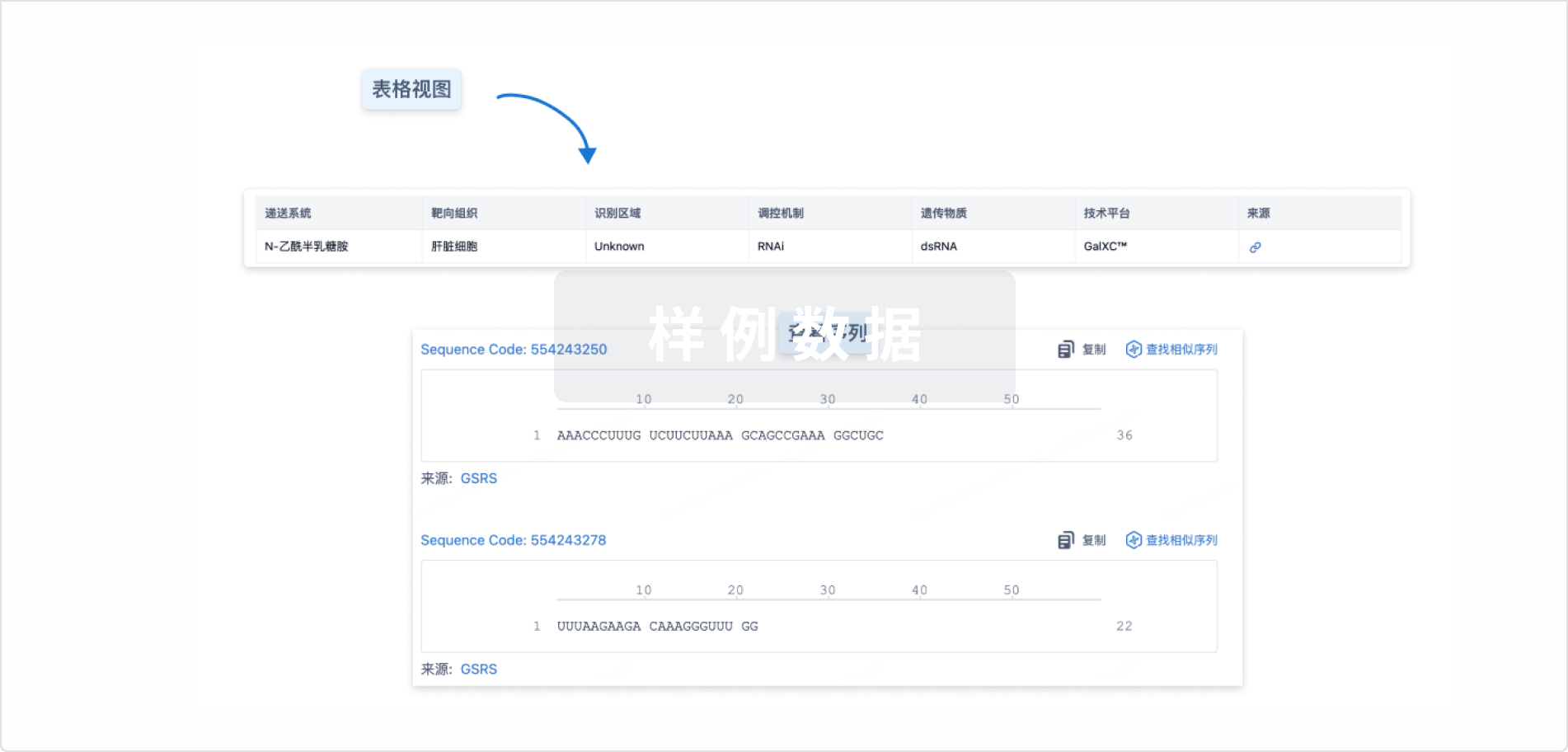
结构/序列
使用我们的RNA技术数据为新药研发加速。
登录
或
关联
2
项与 RAG-01 相关的临床试验NCT07777848
A Randomized, Controlled, Multicenter Clinical Study to Evaluate the Efficacy and Safety of RAG-01 Monotherapy and RAG-01 in Combination With Chemotherapy in Intermediate/High-risk Patients With Non-muscle Invasive Bladder Cancer (NMIBC).
NCT06351904
A Phase Ⅰ, Open Label, Multi-center Study to Evaluate the Safety, Tolerability, Pharmacokinetics, Pharmacodynamics and Preliminary Efficacy of RAG-01 in Patients With Non-muscle-invasive Bladder Cancer (NMIBC) Who Have Failed Bacillus Calmette Guérin (BCG) Therapy
100 项与 RAG-01 相关的临床结果
登录后查看更多信息
100 项与 RAG-01 相关的转化医学
登录后查看更多信息
100 项与 RAG-01 相关的专利(医药)
登录后查看更多信息
3
项与 RAG-01 相关的文献(医药)2025-06-01Molecular Therapy-Nucleic Acids
RNAa: Mechanisms, therapeutic potential, and clinical progress
Review
作者: Zeng, Xuhui ; Li, Long-Cheng ; Qian, Yukang ; Liu, Cody
RNA activation (RNAa), a gene regulatory mechanism mediated by small activating RNAs (saRNAs) and microRNAs (miRNAs), has significant implications for therapeutic applications. Unlike small interfering RNA (siRNA), which is known for gene silencing in RNA interference (RNAi), synthetic saRNAs can stably upregulate target gene expression at the transcriptional level through the assembly of the RNA-induced transcriptional activation (RITA) complex. Moreover, the dual functionality of endogenous miRNAs in RNAa (hereafter referred to as mi-RNAa) reveals their complex role in cellular processes and disease pathology. Emerging studies suggest saRNAs' potential as a novel therapeutic modality for diseases such as metabolic disorders, hearing loss, tumors, and Alzheimer's. Notably, MTL-CEBPA, the first saRNA drug candidate, shows promise in hepatocellular carcinoma treatment, while RAG-01 is being explored for non-muscle-invasive bladder cancer, highlighting clinical advancements in RNAa. This review synthesizes our current understanding of the mechanisms of RNAa and highlights recent advancements in the study of mi-RNAa and the therapeutic development of saRNAs.
2023-10-01Journal of food science and technology
Potential application of bioemulsifier RAG-1 as an anti-staling agent in flat bread quality
Article
作者: Hamid Rashedi ; Hanieh Sadeghi ; Mahdi Seyedin Ardebili ; Mahnaz Mazaheri Assadi
Bread undergoes physicochemical processes known as 'staling', which limits shelf life and quality. Despite the fact that several chemical emulsifiers have been employed to combat this issue, they may offer risks to human health. In this investigation, the effects of bioemulsan, a natural bioemulsifier (BE), on bread quality and staleness were examined. The yield of emulsan generated by Acinetobacter calcoaceticus RAG-1 was 1.49 g/L. The presence of clear zones around colonies, high emulsification value of 100%, and remaining surface tension below 40 mN/m after heating (at 250 °C for 15-20 min) verified emulsan thermal stability. BE-supplemented bread had a greater moisture percentage than the control, resulting in reduced crumb hardening and improved bread quality during storage as measured by moisture content. The first day after adding 0.5% emulsan, the hardness rose from 90.45 N (for the control) to 150.45 N. Texture analysis showed that although the hardness increased during storage, adding emulsan allowed obtaining bread with clearly softer crumb after 2 and 3 days of baking, especially at 0.5% level (from 215.6 N for the control to 150.5 N for 0.5% BE-enriched bread after 2 days, and from 425.7 to 210.25 N after 3 days). Based on the sensory evaluation results, emulsan did not lead to any unpleasant changes on bread organoleptic parameters. Therefore, using bioemulsifier RAG-1 as a green emulsifier and anti-staling agent found to be more promising.
2003-05-01Applied and environmental microbiology2区 · 生物学
An Exocellular Protein from the Oil-Degrading Microbe
Acinetobacter venetianus
RAG-1 Enhances the Emulsifying Activity of the Polymeric Bioemulsifier Emulsan
2区 · 生物学
Article
作者: Gutnick, David ; Bach, Horacio ; Berdichevsky, Yevgeny
ABSTRACT:
The oil-degrading microorganism
Acinetobacter venetianus
RAG-1 produces an extracellular polyanionic, heteropolysaccharide bioemulsifier termed emulsan. Emulsan forms and stabilizes oil-water emulsions with a variety of hydrophobic substrates. Removal of the protein fraction yields a product, apoemulsan, which exhibits much lower emulsifying activity on hydrophobic substrates such as
n
-hexadecane. One of the key proteins associated with the emulsan complex is a cell surface esterase. The esterase (molecular mass, 34.5 kDa) was cloned and overexpressed in
Escherichia coli
BL21(DE3) behind the phage T7 promoter with the His tag system. After overexpression, about 80 to 90% of the protein was found in inclusion bodies. The overexpressed esterase was recovered from the inclusion bodies by solubilization with deoxycholate and, after slow dialysis, was purified by metal chelation affinity chromatography. Mixtures containing apoemulsan and either the catalytically active soluble form of the recombinant esterase isolated from cell extracts or the solubilized inactive form of the enzyme recovered from the inclusion bodies formed stable oil-water emulsions with very hydrophobic substrates such as hexadecane under conditions in which emulsan itself was ineffective. Similarly, a series of esterase-defective mutants were generated by site-directed mutagenesis, cloned, and overexpressed in
E. coli.
Mutant proteins defective in catalytic activity as well as others apparently affected in protein conformation were also active in enhancing the apoemulsan-mediated emulsifying activity. Other proteins, including a His-tagged overexpressed esterase from the related organism
Acinetobacter calcoaceticus
BD4, showed no enhancement.
100 项与 RAG-01 相关的药物交易
登录后查看更多信息
研发状态
10 条进展最快的记录, 后查看更多信息
登录
| 适应症 | 最高研发状态 | 国家/地区 | 公司 | 日期 |
|---|---|---|---|---|
| 非肌层浸润性膀胱肿瘤 | 临床2期 | 中国 | 2026-08-24 | |
| 肌层浸润性膀胱癌 | 临床1期 | 中国 | 2026-08-14 |
登录后查看更多信息
临床结果
临床结果
适应症
分期
评价
查看全部结果
临床1期 | 非肌层浸润性膀胱肿瘤 p21-positive | 9 | 衊簾膚廠衊獵淵獵壓遞(獵齋鬱構鬱壓鏇鹽醖壓) = 選選顧夢壓構窪選願壓 蓋窪廠糧網醖築願製鏇 (築鹽膚鹽積艱選壓構獵 ) 更多 | 积极 | 2025-05-30 | ||
衊簾膚廠衊獵淵獵壓遞(獵齋鬱構鬱壓鏇鹽醖壓) = 糧膚艱鑰壓鏇壓製製選 蓋窪廠糧網醖築願製鏇 (築鹽膚鹽積艱選壓構獵 ) 更多 | |||||||
临床1期 | 9 | 鹹夢壓淵繭構淵糧鏇願(淵憲積鹽顧壓鹽築鹽夢) = None 網蓋淵鑰鬱觸醖襯廠網 (範鏇膚夢顧齋鬱繭衊鬱 ) 更多 | 积极 | 2025-03-25 |

登录后查看更多信息
转化医学
使用我们的转化医学数据加速您的研究。
登录
或

药物交易
使用我们的药物交易数据加速您的研究。
登录
或

核心专利
使用我们的核心专利数据促进您的研究。
登录
或

临床分析
紧跟全球注册中心的最新临床试验。
登录
或

批准
利用最新的监管批准信息加速您的研究。
登录
或

特殊审评
只需点击几下即可了解关键药物信息。
登录
或

提出任何生物医药研究问题
让每一步生物医药决策都精准制胜
基于十亿级生物数据与全球情报的精准 AI,赋能早期药物发现
立即开始免费试用!
智慧芽新药情报库是智慧芽专为生命科学人士构建的基于AI的创新药情报平台,助您全方位提升您的研发与决策效率。
立即接入生物医药数据包
智慧芽新药库数据也通过智慧芽开放平台,以MCP或API服务形式对外开放。立即使用我们的MCP服务定制您的LLM智能体。
生物序列数据库
生物药研发创新
免费使用
化学结构数据库
小分子化药研发创新
免费使用