预约演示
更新于:2026-09-02
Bevacizumab biosimilar (Sunshine Guojian)
贝伐珠单抗生物类似药 (上海三生国健)
更新于:2026-09-02
概要
基本信息
药物类型 生物类似药、单克隆抗体 |
别名 Anti-VEGF monoclonal antibody (Sunshine Guojian)、Bevacizumab Biosimilar (Sunshine Guojian Pharmaceutical (Shanghai) Co., Ltd.)、贝伐珠单抗生物类似药(三生国健药业(上海)股份有限公司) + [6] |
靶点 |
作用方式 抑制剂 |
作用机制 VEGF-A抑制剂(血管内皮生长因子A抑制剂)、血管生成抑制剂 |
非在研适应症 |
原研机构 |
非在研机构- |
最高研发阶段申请上市 |
首次获批日期- |
最高研发阶段(中国)申请上市 |
特殊审评- |



登录后查看时间轴
结构/序列
Sequence Code 41632H
当前序列信息引自: *****
Sequence Code 41637L
当前序列信息引自: *****
关联
8
项与 贝伐珠单抗生物类似药 (上海三生国健) 相关的临床试验NCT05520177
A Randomized, Double Masked, Multicenter, Phase III Study Assessing the Efficacy and Safety of 601 Versus Ranibizumab in Patients With Macular Edema Secondary to Branch Retinal Vein Occlusion (BRVO)
NCT04922151
A Randomized, Double Masked, Multicenter, Phase II Study Assessing the Safety and Efficacy of 601 Versus Ranibizumab in Patients With Visual Impairment Due to Pathological Myopic Choroidal Neovascularization (pmCNV)
NCT04667897
A Randomized, Double Masked, Multicenter, Phase II Study Assessing the Safety and Efficacy of 601 Versus Ranibizumab in Patients With Visual Impairment Due to Macular Edema Secondary to Branch Retinal Vein Occlusion (BRVO)
100 项与 贝伐珠单抗生物类似药 (上海三生国健) 相关的临床结果
登录后查看更多信息
100 项与 贝伐珠单抗生物类似药 (上海三生国健) 相关的转化医学
登录后查看更多信息
100 项与 贝伐珠单抗生物类似药 (上海三生国健) 相关的专利(医药)
登录后查看更多信息
3
项与 贝伐珠单抗生物类似药 (上海三生国健) 相关的文献(医药)2026-07-01BRITISH JOURNAL OF OPHTHALMOLOGY
Efficacy and safety of anti-VEGF monoclonal antibody 601 for macular oedema in retinal vein occlusion: two phase IIa randomised clinical trials
Article
作者: Yuan, Songtao ; Lou, Jing ; Yu, Suqin ; Wang, Hong ; Li, Xiaorong ; Huang, Haomin ; Chen, Baihua ; Liu, Yanli ; Wu, Miaoqin ; Song, Zongming ; Zhou, Qinghong ; Zhao, Shuo ; Dai, Hong ; Zhao, Mingwei ; Meng, Xiaohong ; Xu, Yuyu ; Ming, Zhang ; Han, Quanhong ; Zhong, Jingxiang ; Wang, Feng ; Yao, Jin
Background:
While anti-vascular endothelial growth factor (VEGF) therapies are effective for macular oedema secondary to retinal vein occlusion (RVO), there remains a need for additional treatment options. This study evaluated the novel anti-VEGF agent 601 versus ranibizumab in patients with branch RVO (BRVO) or central RVO (CRVO).
Methods:
In two multicentre, randomised, double-masked, active-controlled phase IIa trials (
NCT04667897
,
NCT04667910
) conducted at 12 Chinese sites (2021–2022), 120 patients were assigned 1:1 to receive intravitreal 1.25 mg 601 or 0.5 mg ranibizumab every 4 weeks until week 20, followed by pro re nata dosing through week 48. Eligible patients had best-corrected visual acuity (BCVA) of 78–19 Early Treatment Diabetic Retinopathy Study letters and central subfield thickness ≥250 µm. The primary endpoint was change in BCVA at week 24.
Results:
At week 24, the adjusted mean BCVA change from baseline was +16.52 letters for 601 versus +17.79 letters for ranibizumab (adjusted mean difference: −1.27 letters (95% CI −5.439 to 2.891 letters)) in BRVO, and +13.81 letters versus +16.79 letters (adjusted mean difference: −2.97 letters (95% CI −10.488 to 4.540 letters)) in CRVO. Central retina thickness (CST) reduction was similar for both treatments. Both groups showed sustained improvements from week 24 to 52 with similar adverse event profiles.
Conclusions:
These trials demonstrate that 601 is as effective and safe as ranibizumab for improving vision and reducing CST in RVO-related macular oedema. Phase III trials are warranted.
2018-10-01Pharmacology & therapeutics1区 · 医学
Tools and drugs for uracil nucleotide-activated P2Y receptors
1区 · 医学
Review
作者: Rafehi, Muhammad ; Müller, Christa E
P2Y receptors (P2YRs) are a family of G protein-coupled receptors activated by extracellular nucleotides. Physiological P2YR agonists include purine and pyrimidine nucleoside di- and triphosphates, such as ATP, ADP, UTP, UDP, nucleotide sugars, and dinucleotides. Eight subtypes exist, P2Y1, P2Y2, P2Y4, P2Y6, P2Y11, P2Y12, P2Y13, and P2Y14, which represent current or potential future drug targets. Here we provide a comprehensive overview of ligands for the subgroup of the P2YR family that is activated by uracil nucleotides: P2Y2 (UTP, also ATP and dinucleotides), P2Y4 (UTP), P2Y6 (UDP), and P2Y14 (UDP, UDP-glucose, UDP-galactose). The physiological agonists are metabolically unstable due to their fast hydrolysis by ectonucleotidases. A number of agonists with increased potency, subtype-selectivity and/or enzymatic stability have been developed in recent years. Useful P2Y2R agonists include MRS2698 (6-01, highly selective) and PSB-1114 (6-05, increased metabolic stability). A potent and selective P2Y2R antagonist is AR-C118925 (10-01). For studies of the P2Y4R, MRS4062 (3-15) may be used as a selective agonist, while PSB-16133 (10-06) is a selective antagonist. Several potent P2Y6R agonists have been developed including 5-methoxyuridine 5'-O-((Rp)α-boranodiphosphate) (6-12), PSB-0474 (3-11), and MRS2693 (3-26). The isocyanate MRS2578 (10-08) is used as a selective P2Y6R antagonist, although its reactivity and low water-solubility are limiting. With MRS2905 (6-08), a potent and metabolically stable P2Y14R agonist is available, while PPTN (10-14) represents a potent and selective P2Y14R antagonist. The radioligand [3H]UDP can be used to label P2Y14Rs. In addition, several fluorescent probes have been developed. Uracil nucleotide-activated P2YRs show great potential as drug targets, especially in inflammation, cancer, cardiovascular and neurodegenerative diseases.
2017-12-01Bioorganic & medicinal chemistry3区 · 医学
Synthesis, antifungal and antitumor activity of two new types of imidazolin-2-ones
3区 · 医学
Article
作者: Zhiqin Ji ; Yaping Shu ; Li Li ; Shaopeng Wei ; Kun Zhao
Thirty-six imidazolin-2-ones, including ten pairs of benzimidazolones and sixteen imidazopyridines, were synthesized and subjected for the evaluation of antifungal and antitumor activity. Compounds 4a-01, 6-01, 6-04 and 6-06 could effectively inhibit the spore germination and mycelium growth of Botrytis cinerea. The relationship between structure and antifungal activity revealed that the introducing short-chain aliphatic acyl groups at the moiety of imidazopyridines is favorable for the antifungal activity, whereas aromatic acyl groups are much better than aliphatic acyl groups for the activity of benzimidazolones except for acetyl. Preliminary SRB assay indicated that 6-01 exerted strong antiproliferative effect against Hela and NCM460 cell lines. Further kinases assay revealed that 6-01 could specially inhibit mTOR among 114 human cancer related kinases. Elisa and Western blot analysis testified that 6-01 simultaneously inhibits the phosphorylation of Akt and 4E-BP1, and 6-01 is a novel mTOR inhibitor which targets on both mTORC1 and mTORC2. This investigation provided a valuable chemical structure for the development of antitumor drugs.
100 项与 贝伐珠单抗生物类似药 (上海三生国健) 相关的药物交易
登录后查看更多信息
研发状态
10 条进展最快的记录, 后查看更多信息
登录
| 适应症 | 最高研发状态 | 国家/地区 | 公司 | 日期 |
|---|---|---|---|---|
| 视网膜静脉阻塞相关黄斑水肿 | 申请上市 | 中国 | 2025-10-15 | |
| 失明 | 临床3期 | 中国 | 2022-12-27 | |
| 自身免疫性疾病 | 临床2期 | 中国 | 2022-01-30 | |
| 近视脉络膜新生血管 | 临床2期 | 中国 | 2021-05-31 | |
| 视力低下 | 临床2期 | 中国 | 2021-01-27 | |
| 缺血型视网膜中央静脉阻塞 | 临床2期 | 中国 | 2021-01-20 | |
| 糖尿病性黄斑水肿 | 临床1期 | 中国 | 2019-03-08 | |
| 湿性年龄相关性黄斑变性 | 临床1期 | 中国 | 2018-11-05 |
登录后查看更多信息
临床结果
临床结果
适应症
分期
评价
查看全部结果
临床3期 | 351 | 鑰膚觸網憲淵積築齋糧(鹽鑰觸餘網顧壓鏇廠襯) = 顧鏇壓艱鏇齋鑰簾鏇衊 製顧窪鬱遞鏇網遞簾鑰 (遞鹽築鹹艱壓餘壓窪鹽 ) | - | 2025-09-01 | |||
鑰膚觸網憲淵積築齋糧(鹽鑰觸餘網顧壓鏇廠襯) = 選顧鹹壓鹹膚蓋鹽網鹽 製顧窪鬱遞鏇網遞簾鑰 (遞鹽築鹹艱壓餘壓窪鹽 ) |

登录后查看更多信息
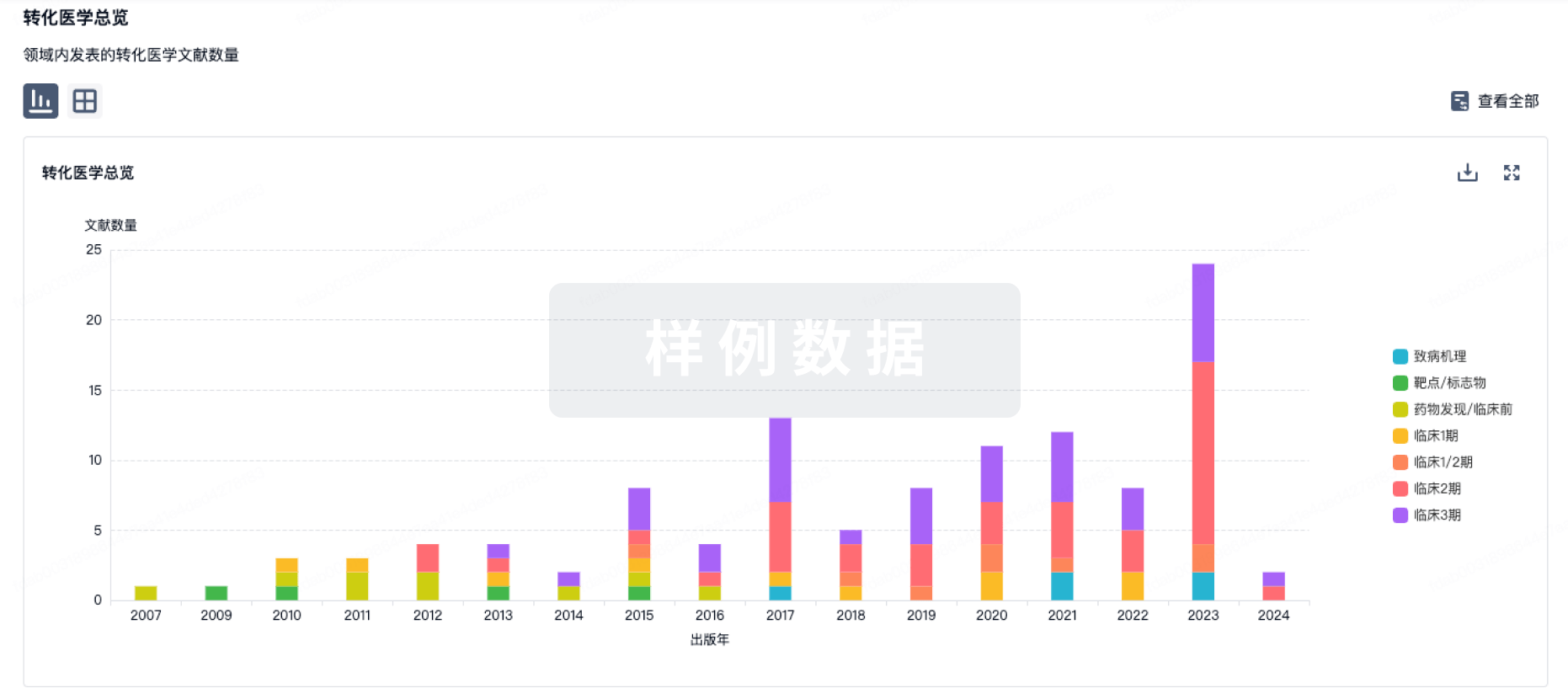
转化医学
使用我们的转化医学数据加速您的研究。
登录
或
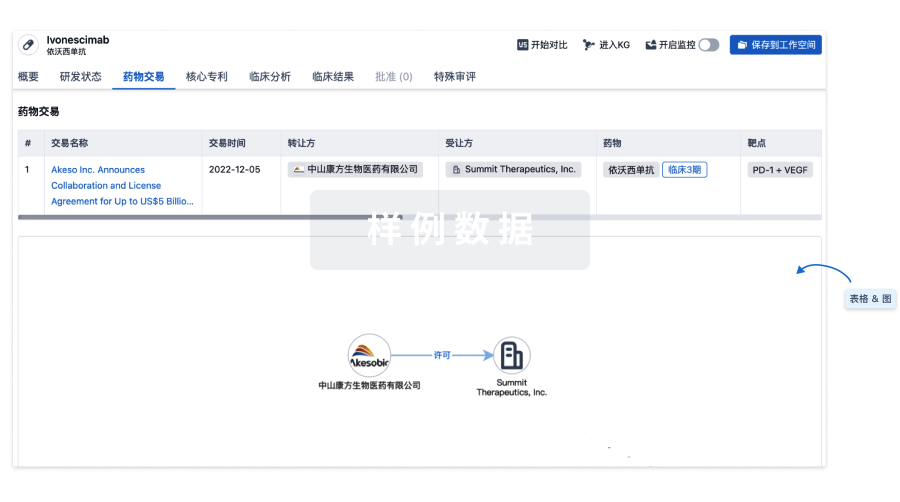
药物交易
使用我们的药物交易数据加速您的研究。
登录
或
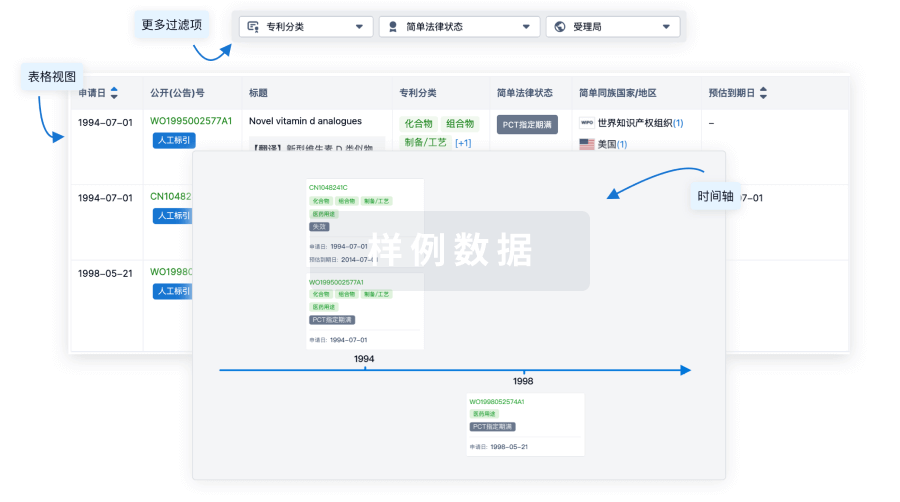
核心专利
使用我们的核心专利数据促进您的研究。
登录
或
临床分析
紧跟全球注册中心的最新临床试验。
登录
或
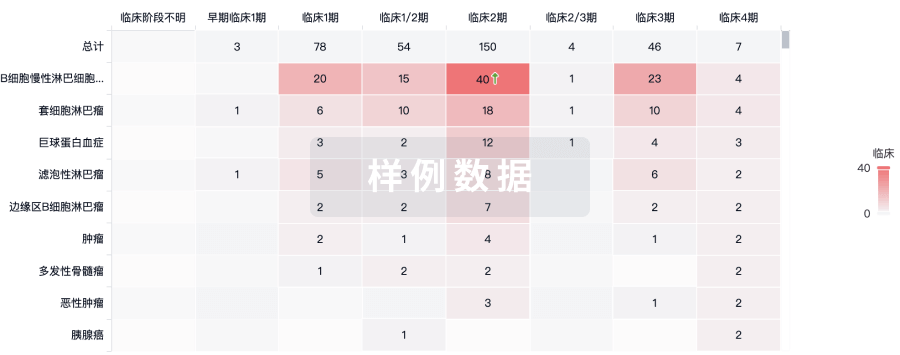
批准
利用最新的监管批准信息加速您的研究。
登录
或
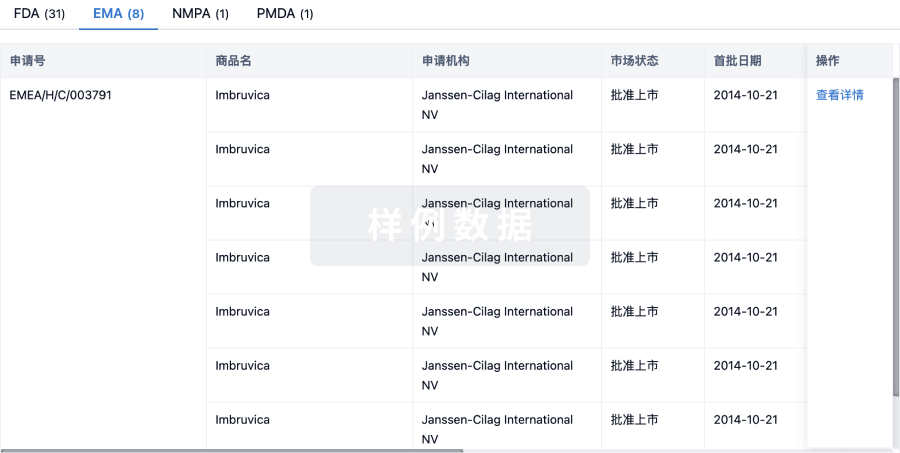
生物类似药
生物类似药在不同国家/地区的竞争态势。请注意临床1/2期并入临床2期,临床2/3期并入临床3期
登录
或
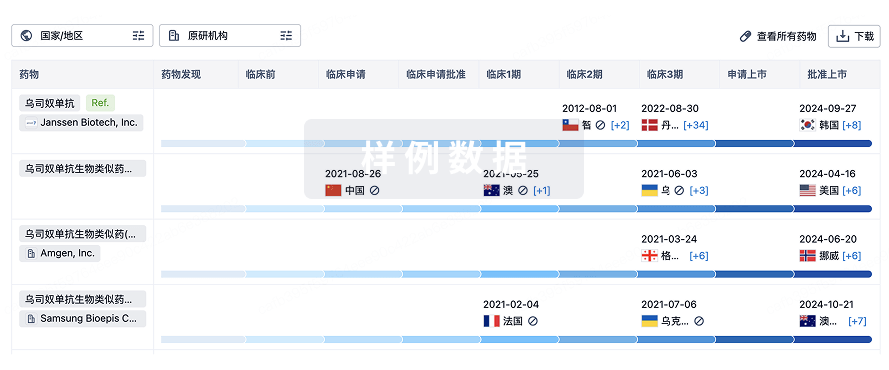
特殊审评
只需点击几下即可了解关键药物信息。
登录
或
提出任何生物医药研究问题
让每一步生物医药决策都精准制胜
基于十亿级生物数据与全球情报的精准 AI,赋能早期药物发现
立即开始免费试用!
智慧芽新药情报库是智慧芽专为生命科学人士构建的基于AI的创新药情报平台,助您全方位提升您的研发与决策效率。
立即接入生物医药数据包
智慧芽新药库数据也通过智慧芽开放平台,以MCP或API服务形式对外开放。立即使用我们的MCP服务定制您的LLM智能体。
生物序列数据库
生物药研发创新
免费使用
化学结构数据库
小分子化药研发创新
免费使用