预约演示
更新于:2026-08-06
UB-221
更新于:2026-08-06
概要
基本信息
原研机构 |
非在研机构 |
最高研发阶段临床2期 |
首次获批日期- |
最高研发阶段(中国)临床2期 |
特殊审评- |



登录后查看时间轴
关联
5
项与 UB-221 相关的临床试验NCT04175704
A Phase I, Randomized, Single-Blind, Placebo-Controlled, Single Ascending Dose Study to Assess the Safety, Tolerability, Pharmacokinetics, and Pharmacodynamics of UB-221 as an Add-on Therapy in Patients With Chronic Spontaneous Urticaria
CTR20233674
一项 II 期、多中心、随机、双盲、安慰剂对照、平行组研究,以评估 UB-221作为添加疗法在慢性自发性荨麻疹(CSU) 患者中的疗效,安全性,药代动力学和药效学
NCT04404023
A Phase I, Open-Label, Dose-Escalation Study to Evaluate the Safety, Tolerability, Pharmacokinetics, Pharmacodynamics and Immunogenicity of a Single Dose of UB-221 in Healthy Volunteers
100 项与 UB-221 相关的临床结果
登录后查看更多信息
100 项与 UB-221 相关的转化医学
登录后查看更多信息
100 项与 UB-221 相关的专利(医药)
登录后查看更多信息
5
项与 UB-221 相关的文献(医药)2025-11-01Ticks and Tick-Borne Diseases
UB-221, an antibody that neutralizes IgE and downregulates the CD23 receptor: a potential treatment for the alpha-gal syndrome
Letter
作者: Ashby, Charles R ; Tiwari, Amit K ; Reznik, Sandra E
2024-06-01Current opinion in allergy and clinical immunology
New biologics for food allergy
Review
作者: Sayantani B. Sindher ; Brent Anderson ; Jackson P. Schuetz
Purpose of review:
This review aims to explore role of emerging biologics, including ligelizumab, UB-221, dupilumab, and antialarmins, in food allergy management. With a focus on recent developments, we evaluate their promise in mitigating adverse events during oral immunotherapy (OIT), reducing allergic reactions, and addressing the limitations of current therapeutic options.
Recent findings:
Antiimmunoglobulin E mAbs, exemplified by omalizumab, demonstrate efficacy in desensitization and safety improvement during multiallergen OIT. Next-generation antibodies like ligelizumab and UB-221 exhibit enhanced potency and unique mechanisms, holding promise for food allergy treatment. Dupilumab, targeting IL-4 receptor alpha, presents potential benefits in decreasing allergen-specific IgE and modifying the atopic march. Exploration of antialarmins, specifically anti-IL-33 (etokimab) and anti-TSLP (tezepelumab), reveals encouraging results, with etokimab showing early success in peanut allergy trials.
Summary:
Biologics hold promising potential for food allergy treatment. Tailoring therapeutic approaches based on shared decision-making becomes pivotal. While omalizumab remains a significant option, next-generation anti-IgE antibodies and agents targeting alarmins exhibit unique strengths. Dupilumab, despite limited success as monotherapy, shows promise as an adjunct for OIT. Careful consideration of treatment goals, patient preferences, and the evolving landscape of biologics will shape future clinical practice, offering allergists an expanded toolbox for personalized food allergy management.
2022-08-01The Journal of clinical investigation
IgE-neutralizing UB-221 mAb, distinct from omalizumab and ligelizumab, exhibits CD23-mediated IgE downregulation and relieves urticaria symptoms
Article
作者: Ming-Syue Wu ; Chia-Yu Chu ; Ywan-Feng Li ; Je-Hung Kuo ; Cindy Hsu ; Chen-Han Lin ; Chang Yi Wang ; Yi-Jen Wang ; Be-Sheng Kuo ; Hong-Xuan Huang ; William Tseng ; Yaw-Jen Liu ; Shugene Lynn ; Chia-Yin Lin ; Meng-Chung Lung ; Annie Lai ; Yi-Ning Cheng ; Yueh-Feng Ho ; Yu-Yu Shiung ; Chao-Hung Li ; Chih-Hung Lee ; Heng-Kwei Chang ; Jiun-Bo Chen ; Fu-Hong Yang ; Techeng Chen ; Hsiao-Wen Su ; Jasper Yang ; Mei-June Liao ; Pei-Hua Tsai
Over the last 2 decades, omalizumab is the only anti-IgE antibody that has been approved for asthma and chronic spontaneous urticaria (CSU). Ligelizumab, a higher-affinity anti-IgE mAb and the only rival viable candidate in late-stage clinical trials, showed anti-CSU efficacy superior to that of omalizumab in phase IIb but not in phase III. This report features the antigenic-functional characteristics of UB-221, an anti-IgE mAb of a newer class that is distinct from omalizumab and ligelizumab. UB-221, in free form, bound abundantly to CD23-occupied IgE and, in oligomeric mAb-IgE complex forms, freely engaged CD23, while ligelizumab reacted limitedly and omalizumab stayed inert toward CD23; these observations are consistent with UB-221 outperforming ligelizumab and omalizumab in CD23-mediated downregulation of IgE production. UB-221 bound IgE with a strong affinity to prevent FcԑRI-mediated basophil activation and degranulation, exhibiting superior IgE-neutralizing activity to that of omalizumab. UB-221 and ligelizumab bound cellular IgE and effectively neutralized IgE in sera of patients with atopic dermatitis with equal strength, while omalizumab lagged behind. A single UB-221 dose administered to cynomolgus macaques and human IgE (ε, κ)-knockin mice could induce rapid, pronounced serum-IgE reduction. A single UB-221 dose administered to patients with CSU in a first-in-human trial exhibited durable disease symptom relief in parallel with a rapid reduction in serum free-IgE level.
100 项与 UB-221 相关的药物交易
登录后查看更多信息
研发状态
10 条进展最快的记录, 后查看更多信息
登录
| 适应症 | 最高研发状态 | 国家/地区 | 公司 | 日期 |
|---|---|---|---|---|
| 慢性荨麻疹 | 临床2期 | 中国台湾 | 2022-10-05 | |
| 食物过敏 | 临床申请 | 美国 | 2026-08-03 |
登录后查看更多信息
临床结果
临床结果
适应症
分期
评价
查看全部结果
登录后查看更多信息
转化医学
使用我们的转化医学数据加速您的研究。
登录
或

药物交易
使用我们的药物交易数据加速您的研究。
登录
或

核心专利
使用我们的核心专利数据促进您的研究。
登录
或

临床分析
紧跟全球注册中心的最新临床试验。
登录
或

批准
利用最新的监管批准信息加速您的研究。
登录
或

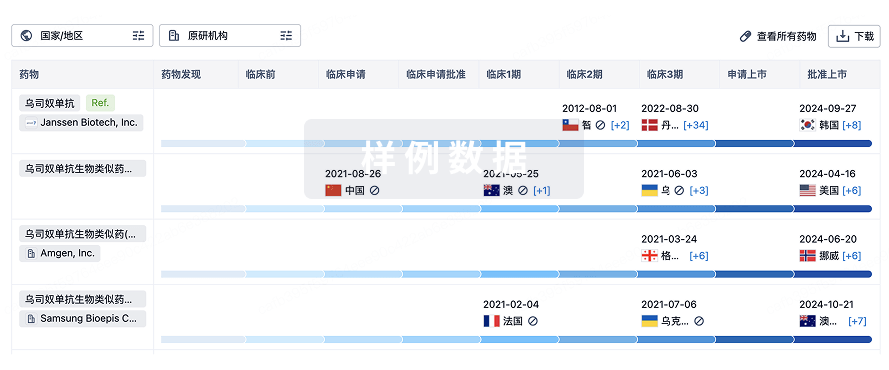
生物类似药
生物类似药在不同国家/地区的竞争态势。请注意临床1/2期并入临床2期,临床2/3期并入临床3期
登录
或
特殊审评
只需点击几下即可了解关键药物信息。
登录
或

提出任何生物医药研究问题
让每一步生物医药决策都精准制胜
基于十亿级生物数据与全球情报的精准 AI,赋能早期药物发现
立即开始免费试用!
智慧芽新药情报库是智慧芽专为生命科学人士构建的基于AI的创新药情报平台,助您全方位提升您的研发与决策效率。
立即接入生物医药数据包
智慧芽新药库数据也通过智慧芽开放平台,以MCP或API服务形式对外开放。立即使用我们的MCP服务定制您的LLM智能体。
生物序列数据库
生物药研发创新
免费使用
化学结构数据库
小分子化药研发创新
免费使用