预约演示
更新于:2026-09-19
MEDI-1814
更新于:2026-09-19
概要
基本信息
原研机构 |
在研机构 |
非在研机构 |
最高研发阶段临床1期 |
首次获批日期- |
最高研发阶段(中国)- |
特殊审评- |



登录后查看时间轴
结构/序列
Sequence Code 14216578CDR2-L
Sequence Code 24551760CDR1-L
Sequence Code 24551768CDR3-H
Sequence Code 24551794CDR3-L
Sequence Code 24551958CDR2-H
Sequence Code 24552035VL
Sequence Code 24552095VH
Sequence Code 24552096CDR1-H
关联
1
项与 MEDI-1814 相关的临床试验NCT02036645
A Randomised, Double-Blind, Placebo Controlled, Single and Multiple Ascending Dose Study to Assess the Safety, Tolerability, Pharmacokinetics and Pharmacodynamics of MEDI1814 in Subjects With Mild to Moderate Alzheimer's Disease.
100 项与 MEDI-1814 相关的临床结果
登录后查看更多信息
100 项与 MEDI-1814 相关的转化医学
登录后查看更多信息
100 项与 MEDI-1814 相关的专利(医药)
登录后查看更多信息
36
项与 MEDI-1814 相关的文献(医药)2026-01-20Nan fang yi ke da xue xue bao = Journal of Southern Medical University
[Sulforaphane reduces reactive astrocyte-mediated neuron apoptosis in vitro by inhibiting the MAPK/NF-κB signaling pathway in Aβ42 oligomer-activated astrocytes].
Article
作者: Zhang, Jiafa ; Zhang, Shufen ; Chen, Jiayi ; Yang, Canhong ; Lü, Tianming ; Huang, Tianrong
OBJECTIVES:
To explore the effects of sulforaphane (SFN) on Aβ42-activated U87 astrocyte-mediated apoptosis of SH-SY5Y neurons in vitro.
METHODS:
U87 cells treated with different concentrations of Aβ42, SFN or both were examined for changes in cell activity, IL-6 and TNF-α mRNA expression, release of IL-6 and TNF-α proteins, and expressions of p-p38, p-p65 and GFAP using CCK-8 assay, RT-qPCR, ELISA and Western blotting. SH-SY5Y neurons were co-cultured with U87 astrocytes treated with Aβ42 alone or in combination with SFN or SB203580 for 24 h, and the changes in Bax protein expression levels and viability of SH-SY5Y cells were examined. The effects of Aβ42, SFN, and their combination were also observed in astrocytes isolated from mouse brain tissues, and the indirect effects of astrocyte treatmentt on viability of the co-cultured primary neurons were assessed.
RESULTS:
The viability of U87 astrocytes increased significantly following treatment with 1.25 μmol/L Aβ42 but decreased after Aβ42 treatment above 5 μmol/L. SFN treatments for 24 h below 5 μmol/L did not significantly affect U87 cell viability. Aβ42 treatment significantly increased protein expressions of p-p38, p-p65 and GFAP, mRNA expression levels of IL-6 and TNF-α, and IL-6 and TNF-α levels in culture supernatant of U87 cells. SH-SY5Y cells co-cultured with Aβ42-treated U87 cells showed significantly increased protein expressions of Bax, and exhibited lowered viability following co-culture with 5 μmol/L Aβ42-treated U87 cells. The isolated mouse astrocytes showed lowered viability following Aβ42 treatment above 10 μmol/L, but SFN treatment below 5 μmol/L for 24 did not obviously affect the cell viability. The primary neurons co-cultured with Aβ42-treated mouse astrocytes showed significantly lower cell viability than those co-cultured with the astrocytes treated with Aβ+SFN or Aβ+SB203580.
CONCLUSIONS:
SFN attenuates astrocyte-mediated neuron apoptosis by inhibiting the MAPK/NF-κB signaling pathway in Aβ42 oligomer-activated astrocytes.
2025-12-01Alzheimers & Dementia
Distinct Roles of MMP‐9 and CX3CL1 on ptau217 and β‐Amyloid Levels in
APOE4
Carriers versus Noncarriers
Article
作者: Johnson, Kevin M ; Cole, Aleshia ; Zetterberg, Henrik ; Rivera-Rivera, Leonardo A ; Zylstra, Hannah ; Carlsson, Cynthia M ; Johnson, Aimee K ; Cronin, Kate ; Wilson, Rachael E ; Johnson, Sterling C ; Chapell, Richard ; Gleason, Carey E ; Auger, Anthony P ; Cardenas, Cecilia A ; Hulle, Carol A Van ; Deering, Olivia
Abstract:
Background:
Fraktaline, otherwise known as CX3CL1, is a chemokine that can act on microglia to promote the release of matrix metalloproteinases (MMPs). Additionally, CX3CL1 can upregulate MMP‐9 which has been associated with alterations in memory and vasculature remodeling. MMP‐9 has also been shown to interact with tau protein, as well as APP processing, and its levels are higher in
APOE4
carriers. Therefore, we examined the role of MMP‐9 in the CX3CL1‐CX3CR1 pathway in
APOE4
carriers (APOE+) compared to noncarriers (APOE‐), as well as its implication on tau and amyloid pathology.
Methods:
Cerebrospinal fluid samples were collected from 116 cognitively unimpaired veterans, aged 50‐76, participating in the Brain Amyloid and Vascular Effects of Eicosapentaenoic acid (BRAVE) study (NCT02719327). We designed a custom electrochemiluminescent assay to quantify MMP‐9 levels using the Meso Scale Discovery SQ120. A NULISAseq CNS Disease Panel was used to quantify CX3CL1, ptau217, Aβ40, Aβ42 and the Roche Cobas Analyzer measured total tau.
Results:
In APOE‐ individuals, CX3CL1 had a direct effect on ptau217 levels (B = 0.77, SE = 0.17,
p
< .001, 95% CI [0.42, 1.11], with a standardized effect of β=0.44) with no mediating role of MMP‐9 (β = –0.0006, BootSE = 0.01, 95% CI [–0.025, 0.021]). CX3CL1 positively correlated with ptau217 (
p
<.001), Aβ40 (
p
<.001) and Aβ42 (
p
<.001). We found a negative correlation between CX3CL1 and ptau217/total tau (
p
<.001), as well as ptau217/Aβ42 (
p
=.013). MMP‐9 did not correlate with Aβ40, Aβ42, Aβ42/Aβ40, ptau217, ptau217/total tau, or ptau217/Aβ42 (
p
>0.05). However, in APOE+ carriers, MMP‐9 played a significant mediating role in the pathway involving CX3CL1 on ptau217 (β = 0.46, 95% CI [0.10, 0.75]). Importantly, MMP‐9 had a positive correlation between ptau217 (
p
<.001), CX3CL1 (
p
<.001), Aβ40 (
p
<.001) and a negative relationship with Aβ42/Aβ40 (
p
=.013) and ptau217/total tau (
p
<.001).
Conclusion:
We propose that APOE+ carriers experience a dysregulated CX3CL1 signaling pathway that is mediated by MMP‐9 with implications on tau regulation. Specifically, MMP‐9 is recruited into the CX3CL1 signaling pathway to reduce ptau217 phosphorylation in APOE+ carriers. If replicated, targeting MMP‐9 could be beneficial in therapeutic interventions focusing on the reduction of ptau217 pathology in neurodegenerative disorders in those who are APOE+.
2025-12-01Alzheimers & Dementia
Comparison of plasma biomarkers measured on a fully automated instrument versus CSF biomarkers for detecting Alzheimer’s disease pathology
Article
作者: Warmenhoven, Noëlle ; Collij, Lyduine E ; Hansson, Oskar ; Janelidze, Shorena ; Blennow, Kaj ; Stomrud, Erik ; Tideman, Pontus ; Binette, Alexa Pichet ; Zetterberg, Henrik ; Mattsson-Carlgren, Niklas ; Ashton, Nicholas J ; Salvadó, Gemma ; Palmqvist, Sebastian ; Ossenkoppele, Rik
Abstract:
Background:
As fully automated instruments for plasma biomarkers for Alzheimer’s disease (AD) are being implemented in specialist clinics, many are questioning whether they can be used interchangeably with, or as substitutes for, gold‐standard cerebrospinal fluid (CSF) biomarkers. We aimed to compare fully automated Lumipulse plasma assays that are under FDA evaluation with FDA‐approved CSF assays.
Method:
We included patients with subjective cognitive decline, mild cognitive impairment, and dementia from the BioFINDER‐Memory Clinic (
n
=122), BioFINDER‐Primary Care (
n
=169) and ADNI (
n
=165) cohorts, in which plasma
p
‐tau217 and plasma Aβ42 were measured with Lumipulse assays (Table 1). Plasma biomarkers were compared with CSF Aβ42/Aβ40 (Lumipulse) in the BioFINDER cohorts and CSF
p
‐tau181/Aβ42 (Elecsys) in ADNI. Previously published one‐ and two‐cutoff approaches were used for the biomarkers. The two‐cutoff approach applies upper (positivity) and lower (negativity) cutoffs with intermediate cases being those with results in between the cutoffs (excluded in the analyses). The outcome was presence of AD pathology (visual read Aβ‐PET).
Result:
Plasma
p
‐tau217 identified AD pathology with AUCs of 0.95 (memory clinic), 0.89 (primary care) and 0.94 (ADNI). For
p
‐tau217/Aβ42, AUCs of 0.95 (memory clinic), 0.90 (primary care), and 0.92 (ADNI) were observed (Figure 1B,E,H). CSF performed similar in BioFINDER (AUCs 0.91–0.92; all
p
>0.304) and better in ADNI (AUC 0.98,
p
=0.032). When applying one cutoff, plasma
p
‐tau217 and
p
‐tau217/Aβ42 had higher accuracies than CSF Aβ42/Aβ40 in BioFINDER‐Memory Clinic (80‐91%, all
p
<0.024) (Figure 1A), while performances were similar in BioFINDER‐Primary Care (80‐83%, all
p
>0.488, Figure 1D) and ADNI (88‐92%, all
p
>0.152, Figure 1G). With two cutoffs, no significant differences between plasma
p
‐tau217 (92%) or plasma
p
‐tau217/Aβ42 (91%) and CSF biomarkers (89‐93%) were observed in BioFINDER‐Memory Clinic or ADNI (Figure 2A,G). In primary care, plasma
p
‐tau217 (86%), but not
p
‐tau217/Aβ42 (90%), had lower accuracy than CSF Aβ42/Aβ40 (92%,
p
=0.028; Figure 2E).
Conclusion:
Plasma
p
‐tau217 and
p
‐tau217/Aβ42 Lumipulse demonstrated similar or slightly inferior performance compared with FDA‐approved CSF tests for detecting AD pathology across three cohorts, including primary care. Since these plasma assays are under FDA‐review for AD diagnosis, the results are essential for validating their performance relative to CSF biomarkers. Additional comparisons will be presented at AAIC.
100 项与 MEDI-1814 相关的药物交易
登录后查看更多信息
研发状态
10 条进展最快的记录, 后查看更多信息
登录
| 适应症 | 最高研发状态 | 国家/地区 | 公司 | 日期 |
|---|---|---|---|---|
| 阿尔茨海默症 | 临床1期 | 美国 | 2014-02-04 |
登录后查看更多信息
临床结果
临床结果
适应症
分期
评价
查看全部结果
登录后查看更多信息
转化医学
使用我们的转化医学数据加速您的研究。
登录
或

药物交易
使用我们的药物交易数据加速您的研究。
登录
或

核心专利
使用我们的核心专利数据促进您的研究。
登录
或

临床分析
紧跟全球注册中心的最新临床试验。
登录
或

批准
利用最新的监管批准信息加速您的研究。
登录
或

生物类似药
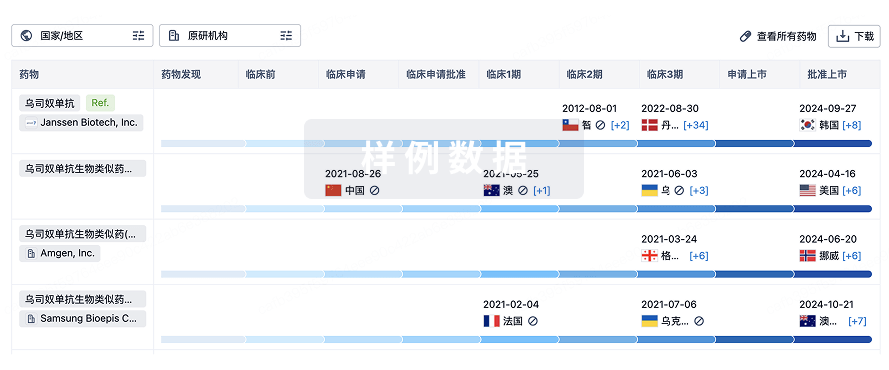
生物类似药在不同国家/地区的竞争态势。请注意临床1/2期并入临床2期,临床2/3期并入临床3期
登录
或
特殊审评
只需点击几下即可了解关键药物信息。
登录
或

提出任何生物医药研究问题
让每一步生物医药决策都精准制胜
基于十亿级生物数据与全球情报的精准 AI,赋能早期药物发现
立即开始免费试用!
智慧芽新药情报库是智慧芽专为生命科学人士构建的基于AI的创新药情报平台,助您全方位提升您的研发与决策效率。
立即接入生物医药数据包
智慧芽新药库数据也通过智慧芽开放平台,以MCP或API服务形式对外开放。立即使用我们的MCP服务定制您的LLM智能体。
生物序列数据库
生物药研发创新
免费使用
化学结构数据库
小分子化药研发创新
免费使用