预约演示
更新于:2026-08-22
SSGJ-612
更新于:2026-08-22
概要
基本信息
原研机构 |
非在研机构- |
最高研发阶段临床2期 |
首次获批日期- |
最高研发阶段(中国)临床2期 |
特殊审评- |


登录后查看时间轴
关联
4
项与 SSGJ-612 相关的临床试验NCT07757230
A Phase II Clinical Study of SSGJ-612 in Combination With a Human Epidermal Growth Factor Receptor 2 (HER2)-Targeted Antibody-Drug Conjugate (ADC) in Patients With Hormone Receptor (HR)-Positive, HER2-Low or HER2-Ultralow Expression Metastatic Breast Cancer
NCT07646626
A Phase II Study of SSGJ-705 Plus SSGJ-612 ± Chemotherapy in Advanced HER2-Expressing Solid Tumors
NCT07032298
Phase I Clinical Study on the Safety, Pharmacokinetics and Antitumor Activity of SSGJ-612 in Patients With Advanced Solid Tumors
100 项与 SSGJ-612 相关的临床结果
登录后查看更多信息
100 项与 SSGJ-612 相关的转化医学
登录后查看更多信息
100 项与 SSGJ-612 相关的专利(医药)
登录后查看更多信息
183
项与 SSGJ-612 相关的文献(医药)2026-05-01CPT-Pharmacometrics & Systems Pharmacology
Adaptive Dosing Trial Simulation Framework to Inform Dose Optimization: Case Study Using Longitudinal
PKPD
Models With
PF
‐06804103 Phase 1 Data in Participants With Human Epidermal Growth Factor Receptor 2 (
HER2
) Positive and Low Solid Tumors
Article
作者: Li, Jerry ; Zhou, Li ; Leung, Abraham C. F. ; Chen, Xiaoying ; Yin, Donghua
ABSTRACT:
Population models to identify optimal dosages typically include the evaluation of a drug's pharmacokinetics and the relationships with efficacy and safety. Dose modifications due to intolerable toxicities are frequently required for oncology therapeutics taken chronically and may impact antitumor activity and subsequent occurrences of adverse events. Model‐based simulations must account for the impact of dose modifications to provide meaningful predictions that capture the dynamic interplay between pharmacokinetics, safety, and efficacy. While static dose modification schedules may be incorporated into simulations, these pre‐determined scenarios are empiric and may not adequately capture the time‐dependent and stochastic nature of adverse events that lead to dose modifications. PF‐06804103 is an anti‐HER2 antibody‐drug conjugate that demonstrated dose‐dependent antitumor activity and safety events. PF‐06804103 appeared to have a narrow therapeutic window, which made it difficult to identify the optimal starting dosing regimen and dose modification schedule. Thus, quantitative modeling approaches were explored to better understand exposure‐response relationships. An adaptive clinical trial simulation framework consisting of pharmacokinetic, tumor dynamic, and repeated time‐to‐event peripheral neuropathy longitudinal models was developed to guide the dose optimization of PF‐06804103. This framework provides the advantage of accounting for adverse event‐driven dose modifications and their real‐time impact of safety on PK and efficacy, and can be adapted to other oncology therapeutics with time‐dependent and exposure‐related safety and efficacy profiles. The framework could be particularly beneficial to inform dose optimization, by integrating multi‐dimensional early clinical data to evaluate different dosage regimens and define the regimen with the best benefit/risk ratio for further investigation.
2026-01-01ChemMedChem
Antibody‐Directed Cancer Therapy Using Cubic‐Shaped Magnetic Nanoparticles for Combined Hyperthermia and Drug Release
Article
作者: Khot, V. M. ; Zahn, D. R. T. ; Selyshchev, O. ; Kedage, V. V. ; Salvan, G. ; Chougale, A. D. ; Rasabathina, L. ; Patil, P. B. ; Hellwig, O. ; Pawar, S. S.
Magnetic nanoparticles (MNPs) have emerged as a promising tool for cancer therapy, providing significant potential for multimodal cancer treatments that include chemotherapy, magnetic hyperthermia, and bioactive targeting. The physicochemical properties of MNPs, including size, surface chemistry, and magnetic properties, play a crucial role in determining their therapeutic effectiveness and overall performance in multimodal cancer therapy. The present study introduces a magnetic nanoformulation (
c
MNP‐mPEG‐Dox‐Ab) nanobioengineered for an integrated therapeutic approach. The cubic‐shaped MNPs (
c
MNP) are functionalized with a biocompatible polymer, mPEG‐NH
2
, to immobilize anti‐HER2 antibody and the anticancer drug doxorubicin. The nanoformulation exhibits a controlled drug release in response to pH and temperature stimuli. Notably, under an alternating magnetic field (AMF), 64% drug release is observed at an acidic pH, which mimics the tumor microenvironment. Cytotoxicity studies on the HCC1954 breast cancer cells reveal that the nanoformulation without an anti‐HER2 antibody induces 25% cell death, which increases to 52% upon conjugation with the anti‐HER2 antibody, confirming the bioactive targeting effect. Apoptosis studies demonstrate a significant increase in the apoptotic cell population under hyperthermic conditions relative to the physiological temperature. This study underscores the potential of
c
MNP‐mPEG‐Dox‐Ab nanoformulation to enhance the precision and therapeutic efficacy of multimodal cancer therapy through bioactive targeting.
2026-01-01Methods in molecular biology (Clifton, N.J.)
Transient Expression and Characterization of Antibodies and Antibody Fragments
Article
作者: Del Val, Greg ; Gauye, Florence ; Ollier, Romain ; Nevoltris, Damien
This chapter describes the cloning strategy, expression, purification, and characterization of immunoglobulin G (IgG) and corresponding antibody fragments, namely fragment antigen-binding (Fab) and single-chain variable fragment (scFv). The examples use anti-HER2 antibody, Trastuzumab, as a standard antibody. The first method details a cloning strategy that enables the easy and quick reformatting of standard human IgG1 into antibody fragments using Gibson assembly. This approach generates two plasmids that bear either light chain or heavy chain genes, under the control of the CMV promoter. The second method, and as an alternative design, presents a single vector approach carrying both light and heavy chain genes, where both genes are separated by an internal ribosome entry site (IRES). Finally, this chapter outlines the transient transfection process in Chinese hamster ovary (CHO) mammalian cells, followed by antibody purification and characterization steps for laboratory applications, highlighting key notes to achieve optimal results for IgGs, Fabs, and scFvs.
100 项与 SSGJ-612 相关的药物交易
登录后查看更多信息
研发状态
10 条进展最快的记录, 后查看更多信息
登录
| 适应症 | 最高研发状态 | 国家/地区 | 公司 | 日期 |
|---|---|---|---|---|
| HER2阳性转移性乳腺癌 | 临床2期 | 中国 | 2026-09-01 | |
| 局部晚期恶性实体瘤 | 临床2期 | 中国 | 2026-07-17 | |
| HER2阳性癌症 | 临床1期 | 中国 | 2021-10-27 | |
| HER2阳性实体瘤 | 临床1期 | 中国 | 2021-10-27 | |
| HR阳性/HER2阴性乳腺癌 | 临床申请批准 | 中国 | 2026-03-31 | |
| 晚期癌症 | 临床申请批准 | 中国 | 2025-06-12 | |
| 实体瘤 | 临床申请 | 中国 | 2021-02-25 |
登录后查看更多信息
临床结果
临床结果
适应症
分期
评价
查看全部结果
登录后查看更多信息
转化医学
使用我们的转化医学数据加速您的研究。
登录
或

药物交易
使用我们的药物交易数据加速您的研究。
登录
或

核心专利
使用我们的核心专利数据促进您的研究。
登录
或

临床分析
紧跟全球注册中心的最新临床试验。
登录
或

批准
利用最新的监管批准信息加速您的研究。
登录
或

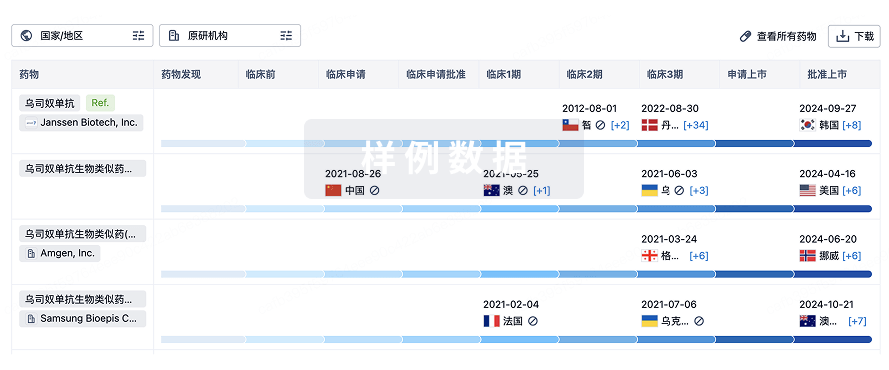
生物类似药
生物类似药在不同国家/地区的竞争态势。请注意临床1/2期并入临床2期,临床2/3期并入临床3期
登录
或
特殊审评
只需点击几下即可了解关键药物信息。
登录
或

提出任何生物医药研究问题
让每一步生物医药决策都精准制胜
基于十亿级生物数据与全球情报的精准 AI,赋能早期药物发现
立即开始免费试用!
智慧芽新药情报库是智慧芽专为生命科学人士构建的基于AI的创新药情报平台,助您全方位提升您的研发与决策效率。
立即接入生物医药数据包
智慧芽新药库数据也通过智慧芽开放平台,以MCP或API服务形式对外开放。立即使用我们的MCP服务定制您的LLM智能体。
生物序列数据库
生物药研发创新
免费使用
化学结构数据库
小分子化药研发创新
免费使用