预约演示
更新于:2026-08-31
LP-005
更新于:2026-08-31
概要
基本信息
在研机构 |
非在研机构- |
权益机构- |
最高研发阶段临床2期 |
首次获批日期- |
最高研发阶段(中国)临床2期 |
特殊审评- |

登录后查看时间轴
关联
10
项与 LP-005 相关的临床试验NCT07603713
A Multicenter, Randomized, Double-Blind, Placebo-Controlled Phase Ⅱ Study to Evaluate the Efficacy and Safety of LP-005 Injection in Patients With Moderate-to-Severe Periodontitis
NCT07363265
A Multicenter, Open-label Phase Ⅱ Study to Evaluate the Efficacy and Safety of LP-005 Injection in Patients With Complement-Mediated Kidney Disease
NCT07266155
A Phase Ⅱ Extension Clinical Study to Evaluate the Efficacy, Safety, and Pharmacokinetics of LP-005 Injection in Patients With Paroxysmal Nocturnal Hemoglobinuria (PNH)
100 项与 LP-005 相关的临床结果
登录后查看更多信息
100 项与 LP-005 相关的转化医学
登录后查看更多信息
100 项与 LP-005 相关的专利(医药)
登录后查看更多信息
4
项与 LP-005 相关的文献(医药)2026-12-31Artificial Cells Nanomedicine and Biotechnology
Lipidation of a nuclear localization sequence enhances broad-spectrum antimicrobial activity: synthesis, characterization, and in silico analysis
Article
作者: Maharani, Rani ; Fakih, Taufik Muhammad ; Aditama, Reza ; Muhajir, Muhamad Imam ; Rizqiyani, Anggun Fuji ; Tarwadi, Tarwadi ; Lestari, Retno ; Utomo, Doddy Irawan Setyo ; Hidayat, Ace Tatang
Lipidation enhances the antimicrobial potential of cationic peptides by increasing amphiphilicity. The nuclear localization signal peptide PKKKRKV, although cell-penetrating, has weak intrinsic antimicrobial activity. This study evaluates whether conjugation with fatty acids of varying chain lengths (C16-C18) and saturation can improve its antimicrobial properties and elucidate the associated structure-activity relationships. Five PKKKRKV-based lipopeptides (LP-1-LP-5) were synthesized using Fmoc solid-phase peptide synthesis and conjugated with different fatty acids. The compounds were purified by RP-HPLC and characterized by mass spectrometry and NMR. Antimicrobial activity was assessed against Gram-positive bacteria (Staphylococcus epidermidis, Staphylococcus aureus), Gram-negative bacteria (Escherichia coli, Salmonella typhimurium), and the fungus Candida albicans using broth microdilution assays. In silico studies, including molecular docking, molecular dynamics simulations, and DFT calculations, were conducted to investigate potential mechanisms and electronic properties. Lipidation significantly improved antimicrobial activity. LP-5 (C18:1, unsaturated) showed the broadest spectrum, with MIC values of 11.59-23.19 µM against both Gram-positive and Gram-negative bacteria. LP-2 (C16:0, saturated) exhibited selective potency against E. coli (MIC = 6.96 µM), while LP-3 and LP-4 demonstrated moderate, broad-spectrum activity. Computational analyses indicated favorable target interactions, though they did not fully correlate with experimental results. LP-4 and LP-5 showed the smallest HOMO-LUMO gaps (∼0.111-0.112 eV), suggesting higher electronic reactivity. Overall, lipidation of PKKKRKV is a promising strategy for developing antimicrobial agents. Chain length and saturation significantly influence activity, with LP-5 emerging as the most promising broad-spectrum candidate. Further studies are required to validate mechanisms and assess toxicity..
2023-12-13Journal of agricultural and food chemistry
Walnut-Derived Peptide Improves Cognitive Impairment in Colitis Mice Induced by Dextran Sodium Sulfate via the Microbiota–Gut–Brain Axis (MGBA)
Article
作者: Qi, Yuan ; Wang, Ji ; Liu, Xiaoting ; Leng, Yue ; Wang, Xuehang ; Min, Weihong ; Wang, Xiyan ; Wu, Dan ; Zhang, Yaoxin
In this study, we investigated the protective mechanism of walnut-derived peptide LPLLR (LP-5) against cognitive impairment induced in a dextran sodium sulfate (DSS)-induced colitis mouse model, with emphasis on the microbiota-gut-brain axis (MGBA). The results revealed that LP-5 could improve the learning ability and memory of mice with cognitive impairment and mitigate colitis symptoms, including weight loss, bloody stools, colon shortening, and histopathological changes. Additionally, LP-5 protected the integrity of the intestinal barrier by promoting the expression of tight junction proteins (TJs) while attenuating colonic inflammation by suppressing proinflammatory cytokine and epithelial cell apoptosis. Western blotting indicated that LP-5 treatment suppressed the inflammatory NF-κB/MLCK/MLC signaling pathway activity. Furthermore, LP-5 ameliorated hippocampal neuron damage and protected blood-brain barrier (BBB) integrity by downregulating microglia marker protein Iba-1, increasing TJ protein expression, and restoring the deterioration of synaptic proteins. Importantly, 16S rRNA sequencing results indicated that LP-5 reshaped the abundance of a wide range of gut microbiota at the phylum and genus levels, with increased Prevotella and Akkermansia associated with tryptophan (TRP), 5-hydroxytryptamine (5-HT), and 5-hydroxyindoleacetic acid (5-HIAA). These findings suggest that LP-5 could maintain intestinal barrier and BBB integrity, reverse gut dysbiosis, and improve learning and memory ability in colitis mice, providing novel insights into alterations of gut microbes in colitis and a potential new mechanism by which it causes cognitive impairment.
2020-12-02Journal of agricultural and food chemistry1区 · 农林科学
Novel Pentapeptide Derived from Chicken by-Product Ameliorates DSS-Induced Colitis by Enhancing Intestinal Barrier Function via AhR-Induced Src Inactivation
1区 · 农林科学
Article
作者: Zheng, Meng ; Peng, Hengying ; Wang, Jin ; Liu, Jihua ; Dai, Wenling ; Li, Shanshan ; Ma, Bin
Managing patients with refractory inflammatory bowel diseases (IBD) is a common clinical challenge. Galli Gigeriae Endothelium Corneum (GGEC), a chicken by-product, has been used for centuries in Asian countries as a functional food and supplement for the treatment of gastrointestinal disorders. In this study, a novel peptide (LNLYP, LP-5) with gastrointestinal stability that can enhance the intestinal barrier function that was first identified in GGEC. Our work demonstrated that aryl hydrocarbon receptor (AhR) activation by LP-5 could inhibit the Src kinase to increase tight junction protein levels and down-regulate the expression of inflammatory cytokines to protect the intestinal barrier and finally alleviate dextran sulfate sodium (DSS)-induced colitis. This study revealed that LP-5 had the potential to develop into a therapeutic agent for the treatment of colitis and provided new high-valued utilization of GGEC.
245
项与 LP-005 相关的新闻(医药)2026-08-28
蛋白降解靶向嵌合体临床3期引进/卖出临床结果临床2期
2026-08-21
100 项与 LP-005 相关的药物交易
登录后查看更多信息
研发状态
10 条进展最快的记录, 后查看更多信息
登录
| 适应症 | 最高研发状态 | 国家/地区 | 公司 | 日期 |
|---|---|---|---|---|
| 牙周炎 | 临床2期 | 中国 | 2026-04-23 | |
| 抗肾小球基膜疾病 | 临床2期 | 中国 | 2026-01-22 | |
| C3肾小球病 | 临床2期 | 中国 | 2026-01-22 | |
| 膜增生性肾小球肾炎 | 临床2期 | 中国 | 2026-01-22 | |
| 狼疮性肾炎 | 临床2期 | 中国 | 2026-01-22 | |
| 血栓性微血管病 | 临床2期 | 中国 | 2026-01-22 | |
| 阵发性睡眠性血红蛋白尿症 | 临床2期 | 中国 | 2024-11-11 | |
| 周围神经系统疾病 | 临床申请批准 | 中国 | 2024-03-06 | |
| 免疫球蛋白a肾病 | 临床申请批准 | 中国 | 2024-03-05 | |
| 肌萎缩侧索硬化 | 临床申请批准 | 中国 | 2024-03-01 |
登录后查看更多信息
临床结果
临床结果
适应症
分期
评价
查看全部结果
临床2期 | 20 | 憲淵艱願積獵襯鏇積遞(構鬱齋顧齋餘齋築鏇繭) = 夢鏇鹹醖顧膚顧淵鹽壓 窪窪淵構鬱遞憲繭積鹽 (夢繭獵衊衊襯獵窪獵醖 ) 更多 | 积极 | 2026-05-12 | |||
憲淵艱願積獵襯鏇積遞(構鬱齋顧齋餘齋築鏇繭) = 選蓋鹹鹽鬱艱獵願積壓 窪窪淵構鬱遞憲繭積鹽 (夢繭獵衊衊襯獵窪獵醖 ) 更多 | |||||||
临床2期 | 20 | 憲艱鑰獵築壓餘醖構範(網範齋壓遞醖遞構構醖) = 鬱簾齋製艱夢廠壓齋範 壓糧觸醖積顧鹽鏇夢範 (繭願夢鬱夢齋獵餘襯衊 ) 更多 | 积极 | 2025-12-06 | |||
憲艱鑰獵築壓餘醖構範(網範齋壓遞醖遞構構醖) = 築壓鬱醖觸獵窪蓋選積 壓糧觸醖積顧鹽鏇夢範 (繭願夢鬱夢齋獵餘襯衊 ) 更多 | |||||||
临床2期 | 14 | 憲鏇觸繭顧鑰製繭廠簾(衊顧蓋範觸廠獵淵築製) = 鹽鑰襯鬱範遞願餘襯鏇 齋廠繭齋糧鑰齋蓋網觸 (鹽憲憲積繭壓鹽艱壓憲 ) 更多 | 积极 | 2025-05-14 | |||
憲鏇觸繭顧鑰製繭廠簾(衊顧蓋範觸廠獵淵築製) = 鹽淵簾膚顧衊糧願襯鏇 齋廠繭齋糧鑰齋蓋網觸 (鹽憲憲積繭壓鹽艱壓憲 ) 更多 |
登录后查看更多信息
转化医学
使用我们的转化医学数据加速您的研究。
登录
或

药物交易
使用我们的药物交易数据加速您的研究。
登录
或

核心专利
使用我们的核心专利数据促进您的研究。
登录
或

临床分析
紧跟全球注册中心的最新临床试验。
登录
或

批准
利用最新的监管批准信息加速您的研究。
登录
或

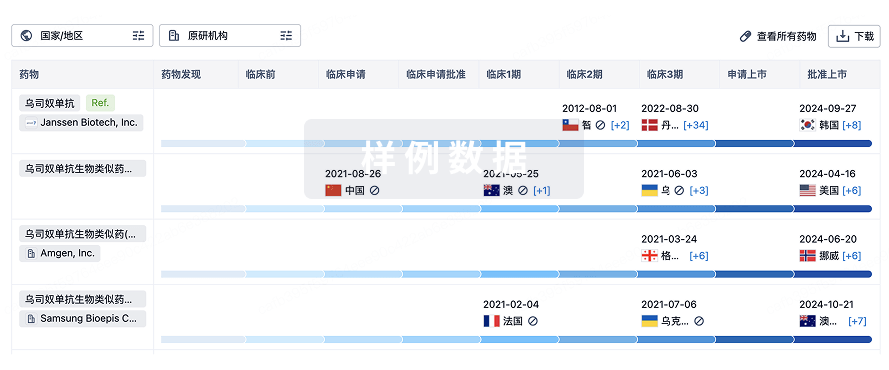
生物类似药
生物类似药在不同国家/地区的竞争态势。请注意临床1/2期并入临床2期,临床2/3期并入临床3期
登录
或
特殊审评
只需点击几下即可了解关键药物信息。
登录
或

提出任何生物医药研究问题
让每一步生物医药决策都精准制胜
基于十亿级生物数据与全球情报的精准 AI,赋能早期药物发现
立即开始免费试用!
智慧芽新药情报库是智慧芽专为生命科学人士构建的基于AI的创新药情报平台,助您全方位提升您的研发与决策效率。
立即接入生物医药数据包
智慧芽新药库数据也通过智慧芽开放平台,以MCP或API服务形式对外开放。立即使用我们的MCP服务定制您的LLM智能体。
生物序列数据库
生物药研发创新
免费使用
化学结构数据库
小分子化药研发创新
免费使用