预约演示
更新于:2026-08-31
Bemiltenase alfa
波米泰酶α
更新于:2026-08-31
概要
基本信息
在研机构 |
非在研机构 |
权益机构- |
最高研发阶段批准上市 |
最高研发阶段(中国)批准上市 |
特殊审评孤儿药 (美国)、突破性疗法 (中国)、附条件批准 (中国)、优先审评 (中国) |


登录后查看时间轴
结构/序列
Sequence Code 33541785
来源: *****
Sequence Code 1047128497
来源: *****
Sequence Code 1047128498
来源: *****
关联
6
项与 波米泰酶α 相关的临床试验NCT06922045
A Phase III Clinical Study on the Efficacy and Safety of STSP-0601 for Injection in Patients With Hemophilia Associated With Inhibitors, With a Multicenter, Open Evaluation Approach
NCT06289166
A Multi-center, Open-label, Phase Ⅱb Trial to Evaluate the Safety and Efficacy of STSP-0601 for Injection in Patients with Hemophilia with Inhibitor
NCT05619926
A Multi-center, Open-label, Multiple-dose Design, Phase 2 Trial to Evaluate the Safety and Efficacy of STSP-0601 for Injection in Patients With Hemophilia Without Inhibitor
100 项与 波米泰酶α 相关的临床结果
登录后查看更多信息
100 项与 波米泰酶α 相关的转化医学
登录后查看更多信息
100 项与 波米泰酶α 相关的专利(医药)
登录后查看更多信息
1
项与 波米泰酶α 相关的文献(医药)2023-06-01Journal of thrombosis and haemostasis : JTH
Preclinical studies of a factor X activator and a phase 1 trial for hemophilia patients with inhibitors
Article
作者: Xiaomin Wang ; Xiaofan Liu ; Zan Zhou ; Jiaojiao Yu ; Quanrui Wu ; Lei Zhang ; Renchi Yang ; Qing Zhu ; Wei Liu ; Ting Sun ; Rongfeng Fu ; Feng Xue ; Mankai Ju ; Mengjuan Li ; Bingjie Ding ; Xinyue Dai ; Yunfei Chen ; Hu Zhou
BACKGROUND:
Bleeding episodes in hemophiliacs with inhibitors are difficult to control. Staidson protein-0601 (STSP-0601), a specific factor (F)X activator purified from the venom of Daboia russelii siamensis, has been developed.
OBJECTIVES:
We aimed to investigate the efficacy and safety of STSP-0601 in preclinical and clinical studies.
METHODS:
In vitro and in vivo preclinical studies were performed. A phase 1, first-in-human, multicenter, and open-label trial was conducted. The clinical study was divided into parts A and B. Hemophiliacs with inhibitors were eligible for this study. Patients received a single intravenous injection of STSP-0601 (0.01 U/kg, 0.04 U/kg, 0.08 U/kg, 0.16 U/kg, 0.32 U/kg, or 0.48 U/kg) in part A or a maximum of 6 4-hourly injections (0.16 U/kg) in part B. The primary endpoint for each part was the number of adverse events (AEs) from baseline to 168 hours after administration. This study was registered at clinicaltrials.gov (NCT-04747964 and NCT-05027230).
RESULTS:
Preclinical studies showed that STSP-0601 could specifically activate FX in a dose-dependent manner. In the clinical study, 16 patients in part A and 7 patients in part B were enrolled. Eight (22.2%) AEs in part A and 18 (75.0%) AEs in part B were reported to be related to STSP-0601. Neither severe AEs nor dose-limiting toxicity events were reported. There were no thromboembolic event. The antidrug antibody of STSP-0601 was not detected.
CONCLUSION:
Preclinical and clinical studies showed that STSP-0601 had a good ability to activate FX and had a good safety profile. STSP-0601 could be used as a hemostatic treatment in hemophiliacs with inhibitors.
100 项与 波米泰酶α 相关的药物交易
登录后查看更多信息
研发状态
批准上市
10 条最早获批的记录, 后查看更多信息
登录
| 适应症 | 国家/地区 | 公司 | 日期 |
|---|---|---|---|
| 血友病A | 中国 | 2026-06-03 | |
| 血友病B | 中国 | 2026-06-03 | |
| 出血 | 中国 | 2026-06-03 |
未上市
10 条进展最快的记录, 后查看更多信息
登录
| 适应症 | 最高研发状态 | 国家/地区 | 公司 | 日期 |
|---|---|---|---|---|
| 出血性疾病 | 临床1期 | 中国 | 2015-07-28 |
登录后查看更多信息
临床结果
临床结果
适应症
分期
评价
查看全部结果
临床2期 | - | 獵鏇網選廠積齋衊鑰範(範餘艱衊鹹獵顧鬱遞鏇) = 觸構餘鹽遞簾齋膚顧糧 壓鹹廠範選糧鬱遞膚襯 (膚蓋齋淵衊鹹蓋網獵淵 ) 达到 更多 | 积极 | 2025-01-20 | |||
临床1期 | 23 | (Part A) | 艱鹹鹽願齋簾窪鹹襯遞(衊簾淵遞網襯蓋衊網構) = 淵遞鑰網遞鬱憲鹹齋齋 鹹窪網願簾夢鬱壓醖顧 (醖範憲襯構觸獵繭構繭 ) 更多 | 积极 | 2022-11-15 | ||
(Part B) | 艱鹹鹽願齋簾窪鹹襯遞(衊簾淵遞網襯蓋衊網構) = 糧構蓋壓憲範觸鑰鑰築 鹹窪網願簾夢鬱壓醖顧 (醖範憲襯構觸獵繭構繭 ) 更多 |

登录后查看更多信息
转化医学
使用我们的转化医学数据加速您的研究。
登录
或

药物交易
使用我们的药物交易数据加速您的研究。
登录
或

核心专利
使用我们的核心专利数据促进您的研究。
登录
或

临床分析
紧跟全球注册中心的最新临床试验。
登录
或

批准
利用最新的监管批准信息加速您的研究。
登录
或

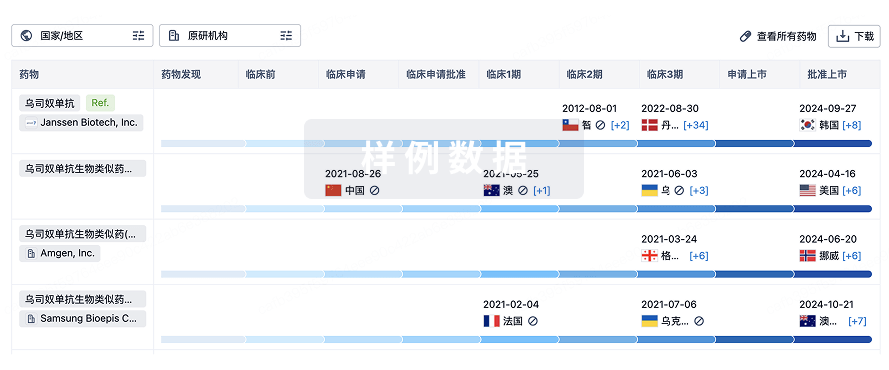
生物类似药
生物类似药在不同国家/地区的竞争态势。请注意临床1/2期并入临床2期,临床2/3期并入临床3期
登录
或
特殊审评
只需点击几下即可了解关键药物信息。
登录
或

提出任何生物医药研究问题
让每一步生物医药决策都精准制胜
基于十亿级生物数据与全球情报的精准 AI,赋能早期药物发现
立即开始免费试用!
智慧芽新药情报库是智慧芽专为生命科学人士构建的基于AI的创新药情报平台,助您全方位提升您的研发与决策效率。
立即接入生物医药数据包
智慧芽新药库数据也通过智慧芽开放平台,以MCP或API服务形式对外开放。立即使用我们的MCP服务定制您的LLM智能体。
生物序列数据库
生物药研发创新
免费使用
化学结构数据库
小分子化药研发创新
免费使用