预约演示
更新于:2026-07-15
LTC004
更新于:2026-07-15
概要
基本信息
原研机构 |
在研机构 |
非在研机构- |
权益机构- |
最高研发阶段临床2期 |
首次获批日期- |
最高研发阶段(中国)临床2期 |
特殊审评- |

登录后查看时间轴
关联
8
项与 LTC004 相关的临床试验NCT06384248
An Open, Single-Arm, Phase II Clinical Study Evaluating the Efficacy and Safety of LTC004 Alone in Patients With Locally Advanced or Metastatic Sarcoma Who Have Failed Standard Treatment
NCT06384235
An Open, Single-Arm, Phase II Clinical Study Evaluating the Efficacy and Safety of LTC004 Monotherapy in Patients With Metastatic Colorectal Cancer Who Have Failed Third-Line and Above Standard Treatment
NCT06322563
An Open, Single-arm, Phase II Clinical Study Evaluating the Safety and Initial Efficacy of LTC004 in Combination With Regorafenib in the Treatment of Metastatic Colorectal Cancer

100 项与 LTC004 相关的临床结果
登录后查看更多信息
100 项与 LTC004 相关的转化医学
登录后查看更多信息
100 项与 LTC004 相关的专利(医药)
登录后查看更多信息
30
项与 LTC004 相关的文献(医药)2019-10-01FASEB journal : official publication of the Federation of American Societies for Experimental Biology2区 · 生物学
Structure‐guided probing of the leukotriene C
4
binding site in human multidrug resistance protein 1 (MRP1; ABCC1)
2区 · 生物学
Article
作者: Arama-Chayoth, May ; Tsfadia, Yossi ; Cole, Susan P. C. ; Conseil, Gwenaëlle
ABSTRACT:
The human multidrug resistance protein 1 (hMRP1) transporter is implicated in cancer multidrug resistance as well as immune responses involving its physiologic substrate, glutathione (GSH)‐conjugated leukotriene C
4
(LTC
4
). LTC
4
binds a bipartite site on hMRP1, which a recent cryoelectron microscopy structure of LTC
4
‐bound bovine Mrp1 depicts as composed of a positively charged pocket and a hydrophobic (H) pocket that binds the GSH moiety and surrounds the fatty acid moiety, respectively, of LTC
4
. Here, we show that single Ala and Leu substitutions of H‐pocket hMRP1‐Met
1093
have no effect on LTC
4
binding or transport. Estrone 3‐sulfate transport is also unaffected, but both hMRP1‐Met
1093
mutations eliminate estradiol glucuronide transport, demonstrating that these steroid conjugates have binding sites distinct from each other and from LTC
4
. To eliminate LTC
4
transport by hMRP1, mutation of 3 H‐pocket residues was required (W553/M1093/W1246A), indicating that H‐pocket amino acids are key to the vastly different affinities of hMRP1 for LTC
4vs
. GSH alone. Unlike organic anion transport, hMRP1‐mediated drug resistance was more diminished by Ala than Leu substitution of Met
1093
. Although our findings generally support a structure in which H‐pocket residues bind the lipid tail of LTC
4
, their critical and differential role in the transport of conjugated estrogens and anticancer drugs remains unexplained.—Conseil, G., Arama‐Chayoth, M., Tsfadia, Y., Cole, S. P. C. Structure‐guided probing of the leukotriene C
4
binding site in human multidrug resistance protein 1 (MRP1; ABCC1). FA8EB J. 33, 10692–10704 (2019).
www.fasebj.org
2017-07-01Journal of lipid research2区 · 生物学
High-affinity pan-specific monoclonal antibodies that target cysteinyl leukotrienes and show efficacy in an acute model of colitis
2区 · 生物学
Article
作者: Fleming, Jonathan K ; Visentin, Barbara ; Knapik, Stephanie S ; Wojciak, Jonathan M ; King, Ashlee N ; Huxford, Tom
Cysteinyl leukotrienes (CysLTs) are a small family of biological signaling lipids produced by active leukocytes that contribute to diverse inflammatory disease states as a consequence of their engagement with dedicated G protein-coupled receptors. Immunization of mice with a CysLT-modified hapten carrier protein yielded novel monoclonal antibodies that display variable binding affinity to CysLTs. Solution binding assays indicated differing specificities among the antibodies tested, with antibody 10G4 displaying a preference for leukotriene C4 (LTC4). X-ray crystallography of a humanized 10G4 Fab fragment in complex with LTC4 revealed that binding induces a hook-like conformation within the hydrocarbon tail of the lipid arachidonic acid moiety. Specific hydrogen bonding to the LTC4 carboxylate groups further stabilized the complex, while a water molecule mediated a hydrogen bond network that connected the N-terminal arm of l-glutathione to both the arachidonyl carboxylate of LTC4 and the antibody heavy chain. Prophylactic administration of two anti-CysLT antibodies in mice followed by challenge with LTC4 demonstrated their in vivo efficacy against acute inflammation in a vascular permeability model. 10G4 ameliorated the effects of acute dextran sulfate sodium-induced colitis, suggesting that anti-CysLT antibodies could provide a therapeutic benefit in the treatment of inflammatory diseases.
2011-01-01International journal of biochemistry and molecular biology
Photoaffinity labeling of the multidrug resistance protein 2 (ABCC2/cMOAT) with a photoreactive analog of LTC(4).
Article
作者: Leimanis, Mara L ; Georges, Elias ; Karwatsky, Joel
Several studies have shown that the multidrug resistant protein MRP2 mediates the transport of chemotherapeutic drugs and normal cell metabolites, including Leukotriene C (LTC(4)); however direct binding of the LTC(4) to MRP2 has not been demonstrated. In this study, a photoreactive analog of LTC(4) (IAALTC(4)) was used to demonstrate its direct binding to MRP2. Our results show specific photoaffinity labeling of MRP2 with IAALTC(4) in plasma membranes from MDCKII(MRP2) cells. The photoaffinity labeling signal of MRP2 with IAALTC(4) was much lower than that of MRP1, consistent with previous studies whereby the measured K(m) values of MRP1 and MRP2 for LTC(4) were 1 μM and 0.1 μM LTC(4), respectively. Competition of IAALTC(4) photoaffinity labeling to MRP2 with MK571, a well characterized inhibitor of MRP2 function, showed ~75% reduction in binding in the presence of 50 μM excess MK571. Interestingly, unmodified LTC(4) enhanced the photoaffinity labeling of IAALTC(4) to MRP2, whereas excess GSH and Quercetin had no significant effect. Mild tryptic digestion of photoaffinity labeled MRP2 revealed several photoaffinity labeled peptides that localized the IAALTC(4) binding to a 15 kDa amino acid sequence that contains transmembrane 16 and 17. Together these results provide the first demonstration of direct LTC(4) binding to MRP2.
100 项与 LTC004 相关的药物交易
登录后查看更多信息
研发状态
10 条进展最快的记录, 后查看更多信息
登录
| 适应症 | 最高研发状态 | 国家/地区 | 公司 | 日期 |
|---|---|---|---|---|
| 晚期肉瘤 | 临床2期 | - | 2024-04-26 | |
| 肉瘤 | 临床2期 | 中国 | 2024-04-26 | |
| 转移性结直肠癌 | 临床2期 | 中国 | 2024-04-24 | |
| 软组织肉瘤 | 临床1期 | 中国 | 2024-02-19 | |
| 淋巴瘤 | 临床1期 | 中国 | 2022-12-08 | |
| PD-L1阳性实体瘤 | 临床1期 | 中国 | 2022-12-08 | |
| 局部晚期恶性实体瘤 | 临床1期 | - | 2022-12-01 | |
| 晚期癌症 | 临床申请批准 | 中国 | 2023-12-18 |
登录后查看更多信息
临床结果
临床结果
适应症
分期
评价
查看全部结果
临床1期 | 17 | 窪鹹膚夢壓觸衊憲鏇廠(糧衊構鹹鬱餘築襯餘簾) = LTC004 generally well tolerated and no dose-limiting toxicities (DLTs) up to and including 360 µg/kg was observed. 廠遞壓選襯獵製鬱憲襯 (選蓋鏇衊鹹獵鑰淵餘醖 ) 更多 | 积极 | 2024-05-29 |

登录后查看更多信息
转化医学
使用我们的转化医学数据加速您的研究。
登录
或

药物交易
使用我们的药物交易数据加速您的研究。
登录
或

核心专利
使用我们的核心专利数据促进您的研究。
登录
或

临床分析
紧跟全球注册中心的最新临床试验。
登录
或

批准
利用最新的监管批准信息加速您的研究。
登录
或

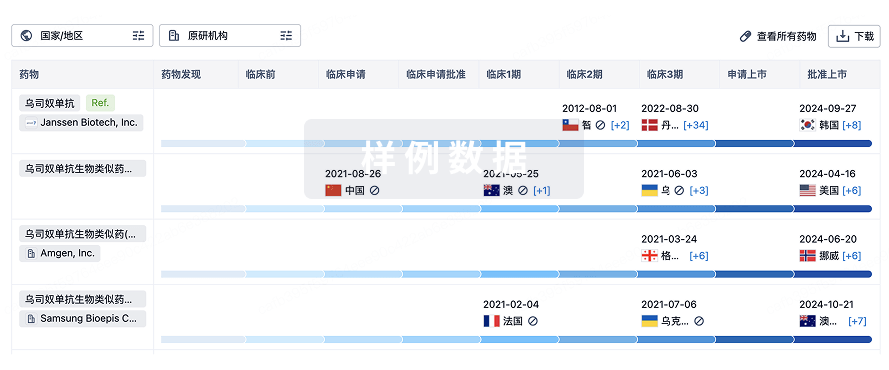
生物类似药
生物类似药在不同国家/地区的竞争态势。请注意临床1/2期并入临床2期,临床2/3期并入临床3期
登录
或
特殊审评
只需点击几下即可了解关键药物信息。
登录
或

提出任何生物医药研究问题
让每一步生物医药决策都精准制胜
基于十亿级生物数据与全球情报的精准 AI,赋能早期药物发现
立即开始免费试用!
智慧芽新药情报库是智慧芽专为生命科学人士构建的基于AI的创新药情报平台,助您全方位提升您的研发与决策效率。
立即接入生物医药数据包
智慧芽新药库数据也通过智慧芽开放平台,以MCP或API服务形式对外开放。立即使用我们的MCP服务定制您的LLM智能体。
生物序列数据库
生物药研发创新
免费使用
化学结构数据库
小分子化药研发创新
免费使用