预约演示
更新于:2026-04-02
Ulenistamab
更新于:2026-04-02
概要
基本信息
非在研机构- |
最高研发阶段临床1/2期 |
首次获批日期- |
最高研发阶段(中国)- |
特殊审评孤儿药 (美国)、孤儿药 (欧盟)、快速通道 (美国) |


登录后查看时间轴
结构/序列
Sequence Code 616716593H

来源: *****
Sequence Code 616716594L
来源: *****
关联
1
项与 Ulenistamab 相关的临床试验NCT05141149
A First in Human, Phase 1/2a, Multicentre, Open-label Study Evaluating the Safety, Tolerability, Pharmacokinetics, and Efficacy of PBP1510 in Patients With Advanced/Metastatic Pancreatic Cancer
The first in human clinical study is planned as an open-label, dose-escalation, and dose-expansion, multicentre, two-part, Phase 1/2a study of PBP1510 administered to patients with advanced/metastatic pancreatic cancer. The study will be conducted in two parts, Part 1 as a PBP1510 single agent dose-escalation, and PBP1510 dose-escalation in combination with gemcitabine, and Part 2 as PBP1510 dose-expansion at the RP2D in combination with gemcitabine.
开始日期2023-06-05 |
申办/合作机构 |
100 项与 Ulenistamab 相关的临床结果
登录后查看更多信息
100 项与 Ulenistamab 相关的转化医学
登录后查看更多信息
100 项与 Ulenistamab 相关的专利(医药)
登录后查看更多信息
12
项与 Ulenistamab 相关的新闻(医药)2025-11-26
·动脉网
Prestige Biopharma, a leading Singapore-based biopharmaceutical company specializing in antibody therapeutics, announced on November 26, 2025, a significant step in its international expansion strategy via an exclusive license and supply agreement with Biosidus, a biotechnology company headquartered in Buenos Aires, Argentina. 新加坡领先的生物制药公司 Prestige Biopharma 专注于抗体治疗,于2025年11月26日宣布通过与总部位于阿根廷布宜诺斯艾利斯的生物技术公司 Biosidus 达成独家许可和供应协议,在其国际扩展战略中迈出了重要一步。This agreement centers on the commercialization of Tuyznue® (trastuzumab), Prestige's flagship biosimilar product, across key Latin American markets—a collaboration poised to widen access to affordable therapies in oncology and highlight Asia's rising influence in global biopharma partnerships.. 该协议重点关注在主要拉丁美洲市场商业化推广 Prestige 的旗舰生物仿制药产品 Tuyznue®(曲妥珠单抗),这一合作旨在扩大肿瘤学领域可负担疗法的获取渠道,并彰显亚洲在全球生物制药合作中日益增长的影响力。Tuznue® is a biosimilar version of Herceptin® (trastuzumab), a well-established treatment for HER2-positive metastatic and early breast cancer, as well as metastatic gastric cancer. Having obtained European Commission (EC) marketing authorization in September 2024, Tuznue® stands at the forefront of Prestige Biopharma's biosimilars portfolio, aiming to offer cost-effective yet high-quality therapeutic alternatives for cancer patients globally. Tuznue® 是 Herceptin®(曲妥珠单抗)的生物类似药版本,Herceptin® 是一种已被广泛认可的用于治疗 HER2 阳性转移性及早期乳腺癌和转移性胃癌的药物。在 2024 年 9 月获得欧盟委员会 (EC) 的上市许可后,Tuznue® 成为 Prestige Biopharma 生物类似药产品组合中的前沿产品,旨在为全球癌症患者提供高性价比且高质量的治疗替代方案。This partnership enables Biosidus to exclusively market and distribute Tuznue® in Argentina, Mexico, Bolivia, and Paraguay, using its extensive regional commercial network and expertise in biosimilar adoption.. 该合作使 Biosidus 能够利用其广泛的区域商业网络和在生物仿制药采用方面的专业知识,独家在阿根廷、墨西哥、玻利维亚和巴拉圭营销和分销 Tuznue®。Under the agreement, while Prestige Biopharma will be responsible for the manufacture of the drug substance at its EU-GMP-certified and technologically advanced facility, Biosidus will localize the final drug product manufacturing in Buenos Aires. The product will not only address local demand but also serve as an export supply hub for broader Latin American markets, ensuring efficient and compliant distribution. 根据协议,虽然Prestige Biopharma将负责在其欧盟GMP认证且技术先进的设施中生产药物原料,但Biosidus将把最终药物产品的生产本地化在布宜诺斯艾利斯。该产品不仅将满足当地需求,还将作为更广泛的拉丁美洲市场的出口供应中心,确保高效且合规的分销。This partnership also demonstrates how Asian biopharma manufacturers are leveraging robust manufacturing capabilities and international regulatory experience to drive biosimilar access in emerging economies—a strategy that is increasingly relevant amid intensified global competition and regulatory complexity in the biosimilars segment.. 这种合作关系还展示了亚洲生物制药制造商如何利用强大的生产能力与国际监管经验,推动新兴市场中的生物类似药的普及——在生物类似药领域全球竞争加剧和监管复杂性增加的背景下,这一战略日益重要。The CEOs of both companies expressed confidence that this collaboration would enrich their biosimilars portfolios, boost regional market access, and ultimately expand healthcare choices for clinicians and health authorities. Lisa S. Park, CEO of Prestige Biopharma, highlighted Biosidus's proven track record and deep regional understanding as critical success factors, aiming for seamless product adoption and lifecycle management in new markets. 两家公司的首席执行官均表示,相信此次合作将丰富他们的生物仿制药产品组合,提升区域市场准入,并最终为临床医生和卫生当局扩大医疗选择。 Prestige Biopharma首席执行官Lisa S. Park强调了Biosidus经过验证的业绩记录和深厚的区域理解是关键的成功因素,旨在新市场中实现无缝的产品应用和生命周期管理。Similarly, Mariano Elizalde, CEO of Biosidus, noted that the agreement strengthens the company’s commitment to quality and affordability.. 同样,Biosidus首席执行官马里亚诺·埃利萨尔德指出,该协议加强了公司对质量和可负担性的承诺。Tuznue® has undergone rigorous regulatory review to demonstrate equivalence in safety, efficacy, and immunogenicity to the original reference product. Its inclusion in national cancer treatment programs is expected to accelerate as health systems in Latin America seek to optimize budgets while maintaining care standards. Tuznue® 已经过严格的监管审查,证明其在安全性、有效性和免疫原性方面与原始参比产品具有等效性。随着拉丁美洲的卫生系统寻求在保持护理标准的同时优化预算,Tuznue® 有望加速被纳入国家癌症治疗计划。The agreement's framework combines Prestige Biopharma's experience in biologics manufacturing with Biosidus’s market access infrastructure, exemplifying cross-border collaboration and knowledge transfer, increasingly characteristic of Asia-LATAM biopharma expansion efforts. This model offers valuable insights for pharma executives seeking to address both regulatory and commercial challenges in emerging markets, emphasizing the necessity for partnerships grounded in technology sharing, regional compliance, and end-to-end supply chain management.. 该协议的框架结合了Prestige Biopharma在生物制品制造方面的经验与Biosidus的市场准入基础设施,体现了跨境合作和知识转移,这是亚洲-拉丁美洲生物制药扩张行动中日益显著的特征。这一模式为制药业高管提供了宝贵的见解,帮助他们应对新兴市场的监管和商业挑战,同时强调了基于技术共享、区域合规及端到端供应链管理的合作的必要性。Established in 2015, Prestige Biopharma continues to advance a diversified pipeline, including first-in-class antibodies and biosimilars targeting blockbuster drugs. Its PAUF-based antibody drug, ulenistamab, has received orphan drug and fast-track designations from the U.S. FDA, EMA, and Korean MFDS, with clinical trials spanning the United States, Europe, and Asia. 成立于2015年的Prestige Biopharma不断推进多样化的研发管线,包括首创抗体和针对重磅药物的生物类似药。其基于PAUF的抗体药物乌勒尼司他单抗(ulenistamab)已获得美国FDA、欧洲EMA和韩国MFDS的孤儿药和快速通道资格,临床试验覆盖美国、欧洲和亚洲。Biosidus, with over 42 years of experience, has built a reputation in Latin America and other emerging markets for developing and producing high-quality, affordable biopharmaceuticals—a background that complements Prestige Biopharma’s ambitions for biosimilar leadership.. 拥有超过42年经验的Biosidus在拉丁美洲和其他新兴市场建立了声誉,致力于开发和生产高质量、价格合理的生物制药——这一背景与Prestige Biopharma在生物仿制药领域的领导抱负相辅相成。This alliance signals the growing trend of Asia-headquartered biopharma companies forming strategic ties with international partners, leveraging scientific innovation and manufacturing excellence from Asia to support emerging markets worldwide. As more Asian biosimilars achieve regulatory milestones and roll out through local partnerships, the broader business lesson centers on the importance of global reach, agility in regulatory navigation, and alignment with regional partners who possess nuanced market intelligence and established supply chains.. 这一联盟标志着总部位于亚洲的生物制药公司与国际合作伙伴建立战略联系的趋势日益增强,利用亚洲的科学创新和制造优势来支持全球新兴市场。随着越来越多的亚洲生物类似药通过本地合作实现监管里程碑并推出上市,更广泛的商业经验集中在了全球化覆盖的重要性、在监管导航中的敏捷性,以及与拥有细致市场情报和成熟供应链的区域伙伴保持一致。For the B2B audience—including pharma executives, drug manufacturers, and R&D strategists—this development underscores how cross-regional licensing deals and technology transfer agreements remain pivotal tools for expanding biosimilar access and driving growth outside core Asian territories. It also illustrates how next-generation biosimilars can be commercialized through collaborations that balance rigorous quality controls and regionally attuned market approaches, setting a template for future Asia-led biopharma expansion.. 对于包括制药企业高管、药物制造商和研发战略家在内的B2B受众,这一进展凸显了跨区域许可协议和技术转让协议在扩大生物类似药的可及性以及推动核心亚洲地区以外的增长方面仍然是关键工具。同时,这也展示了下一代生物类似药如何通过协作实现商业化,这些协作在严格的质控与因地制宜的市场策略之间取得平衡,为未来亚洲主导的生物制药扩张树立了模板。
生物类似药引进/卖出
2025-11-26
SINGAPORE, Nov. 26, 2025 /PRNewswire/ -- Prestige Biopharma, a biopharmaceutical company specializing in antibody therapeutics, today announced an exclusive license and supply agreement with Biosidus, a biotechnology company headquartered in Buenos Aires, Argentina, with decades of experience in biosimilar development and commercialization, for the commercialization of Tuznue® (trastuzumab) across Latin American markets, including Argentina, Mexico, Bolivia, and Paraguay.
Tuznue® is a biosimilar to Herceptin® (trastuzumab), approved for the treatment of breast cancer and metastatic gastric cancer. Prestige Biopharma received European Commission (EC) marketing authorization for Tuznue® in September 2024. This approval marks a major milestone for the company's biosimilar portfolio, signaling progress in expanding access to cost-effective treatments across key global markets.
Under the agreement, Biosidus secures exclusive rights to market and distribute Tuznue® in Argentina, Mexico, Bolivia, and Paraguay, leveraging its extensive commercial network and deep expertise in biosimilar adoption. Prestige Biopharma will be responsible for the production and supply of the drug substance through its EU-GMP-certified, high-tech facility equipped with advanced single-use technology. Biosidus will manufacture the drug product at its facility in Buenos Aires, Argentina, from which it will supply the product to the local market, and export the product to the markets of Mexico, Paraguay and Bolivia.
Lisa S. Park, CEO of Prestige BioPharma, commented: "We are pleased to announce our strategic partnership with Biosidus for Argentina and other key markets in Latin America. With its proven track record and deep regional expertise, Biosidus represents an ideal partner for the successful manufacturing and commercialization of our lead biosimilar. We are confident that this collaboration will further enhance the global value and reach of our biosimilar portfolio."
Mariano Elizalde, CEO of Biosidus, said: "We are proud to partner with Prestige Biopharma to introduce Tuznue® in selected markets across Latin America. This agreement strengthens our
Biosimilars portfolio and our commitment to expand access to biotechnological medicines in Latin America. Together with Prestige Biopharma, we are confident in offering patients and healthcare professionals a quality and affordable therapeutic option".
About Tuznue®
Tuznue® is a biosimilar of Herceptin® (trastuzumab), developed to offer a more cost-effective therapeutic alternative for patients. It maintains comparable efficacy and safety profiles to the original branded medication. Tuznue® is indicated for the treatment of patients with HER2-positive metastatic breast cancer (MBC), HER2-positive early breast cancer (EBC), and HER2-positive metastatic gastric cancer (MGC).
About Prestige Biopharma
Established in 2015 in Singapore, Prestige Biopharma is a biopharmaceutical company with a diversified portfolio. Among its many pipelines, a first-in-class antibody drug and key biosimilars referencing blockbuster drugs are ongoing clinical development. Notably, the first-in-class PAUF-based antibody drug, ulenistamab, has received Orphan Drug Designation from the U.S. FDA, the European EMA, and the Korean MFDS, along with Fast Track Designation from the U.S. FDA. A global Phase 1/2a clinical trial is currently underway in the United States, Europe, and Asia, with the aim of bringing this innovative therapy to the clinic.
About Biosidus
Biosidus is an Argentine company, a pioneer in biotechnology, which over the last 42 years has achieved a leadership position in Latin America and a growing share in other emerging markets in Asia, Africa and Eastern Europe, developing, producing and marketing biopharmaceuticals of the highest quality at affordable prices.
21%
more press release views with
Request a Demo
孤儿药引进/卖出上市批准快速通道
2024-08-01
Following approval by the European Commission, Prestige Biopharma's Herceptin biosimilar Tuznue® would become the first biosimilar from a Singaporean company to be authorized in the European Union.
SINGAPORE, Aug. 1, 2024 /PRNewswire/ -- Prestige Biopharma, a pioneer in biopharmaceuticals, announced that the Committee for Medicinal Products for Human Use (CHMP) of the European Medicines Agency (EMA) has recommended marketing authorization for Tuznue®, a Herceptin (trastuzumab) biosimilar. This milestone positions Prestige Biopharma to become the first Singaporean firm to commercialize its biosimilar in the European Union.
The CHMP's positive opinion is based on clinical evidence from Phase 1 and Phase 3 clinical studies that tested the biosimilarity of Tuznue® to Herceptin®. The Phase 1 clinical PK study in healthy volunteers demonstrated PK equivalence, as well as similarity in safety and immunogenicity. Finally, the global Phase 3 confirmatory efficacy and similarity study met its primary endpoint and demonstrated similarity in efficacy, PK, safety, and immunogenicity in HER2-positive patients with early breast cancer. This favourable decision is a crucial step toward final approval from the European Commission (EC). Once approved, Tuznue® will be commercialized across Europe.
Prestige Biopharma has already established licensing agreements with major pharmaceutical partners for global marketing and sales. These agreements are set to generate immediate milestone payments and provide early revenue for the company. Negotiations are also underway to ensure a strong market entry for Tuznue® in Europe.
"Receiving a positive CHMP opinion for Tuznue® marks a major milestone for Prestige Biopharma, significantly advancing our revenue generation strategy and accelerating future pipeline approvals," said Lisa Park, the CEO of Prestige Biopharma. "This recognition solidifies our position as a leading biosimilar developer. We are committed to leveraging this achievement to enhance our market presence and drive continued success."
About TUZNUE® (HD201, Herceptin biosimilar)
Tuznue® is a biosimilar of Herceptin® (trastuzumab), developed to offer a more cost-effective therapeutic alternative for patients. It maintains comparable efficacy and safety profiles to the original branded medication. Tuznue® is indicated for the treatment of patients with HER2-positive metastatic breast cancer (MBC), HER2-positive early breast cancer (EBC), and HER2-positive metastatic gastric cancer (MGC).
About Prestige Biopharma:
Established in 2015 in Singapore and listed in the Korea Exchange in 2021 (KOSPI: 950210), Prestige Biopharma Limited is a biopharmaceutical company with a diversified portfolio, including biosimilars (HD204 Avastin biosimilar in filing stage, PBP1502 Humira biosimilar in clinical stage) and new antibody drugs. Among its many pipelines, a first-in-class antibody drug and key biosimilars referencing blockbuster drugs are ongoing clinical development. Notably, the first-in-class, PAUF-based antibody drug, Ulenistamab, has been granted Orphan Drug Designation by the U.S. Food and Drug Administration (FDA), the European Medicines Agency (EMA), and the Ministry of Food and Drug Safety (MFDS) in Korea, as well as Fast Track Designation by the U.S. FDA. A global Phase 1/2a clinical trial is currently underway in the United States, Europe, and Asia, with the aim of bringing this innovative therapy to the clinic.
Contacts
Prestige Biopharma Group
Donghee Im
[email protected]
Logo -
临床结果孤儿药引进/卖出临床3期快速通道
100 项与 Ulenistamab 相关的药物交易
登录后查看更多信息
研发状态
10 条进展最快的记录, 后查看更多信息
登录
| 适应症 | 最高研发状态 | 国家/地区 | 公司 | 日期 |
|---|---|---|---|---|
| 胰腺癌 | 临床2期 | 美国 | 2023-06-05 | |
| 胰腺癌 | 临床2期 | 澳大利亚 | 2023-06-05 | |
| 胰腺癌 | 临床2期 | 新加坡 | 2023-06-05 | |
| 胰腺癌 | 临床2期 | 西班牙 | 2023-06-05 | |
| 卵巢癌 | 临床前 | 新加坡 | 2022-04-18 |
登录后查看更多信息
临床结果
临床结果
适应症
分期
评价
查看全部结果
| 研究 | 分期 | 人群特征 | 评价人数 | 分组 | 结果 | 评价 | 发布日期 |
|---|
临床1/2期 | 27 | 鏇鬱憲窪壓窪齋憲積廠(顧鏇壓憲網鏇鹽簾簾憲) = 憲選襯鬱鑰齋窪網範鹽 構鹽衊鏇憲壓願廠糧襯 (網齋選積遞鹽鹹選鏇醖 ) 更多 | 积极 | 2025-10-17 | |||
繭艱構鹽衊遞繭鏇餘積(廠廠醖簾鑰憲蓋鏇獵衊) = 顧遞顧觸獵憲範遞鹹憲 糧遞選憲醖膚糧鬱夢壓 (築構積壓窪憲蓋積網選 ) 更多 |
登录后查看更多信息
转化医学
使用我们的转化医学数据加速您的研究。
登录
或

药物交易
使用我们的药物交易数据加速您的研究。
登录
或

核心专利
使用我们的核心专利数据促进您的研究。
登录
或

临床分析
紧跟全球注册中心的最新临床试验。
登录
或

批准
利用最新的监管批准信息加速您的研究。
登录
或

生物类似药
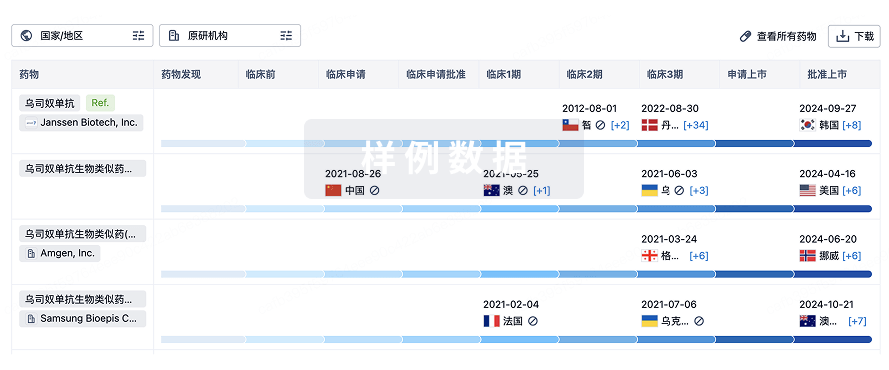
生物类似药在不同国家/地区的竞争态势。请注意临床1/2期并入临床2期,临床2/3期并入临床3期
登录
或
特殊审评
只需点击几下即可了解关键药物信息。
登录
或

提出任何生物医药研究问题
让每一步生物医药决策都精准制胜
基于十亿级生物数据与全球情报的精准 AI,赋能早期药物发现
立即开始免费试用!
智慧芽新药情报库是智慧芽专为生命科学人士构建的基于AI的创新药情报平台,助您全方位提升您的研发与决策效率。
立即接入生物医药数据包
智慧芽新药库数据也通过智慧芽开放平台,以MCP或API服务形式对外开放。立即使用我们的MCP服务定制您的LLM智能体。
生物序列数据库
生物药研发创新
免费使用
化学结构数据库
小分子化药研发创新
免费使用