预约演示
更新于:2026-10-26
Enicepatide
更新于:2026-10-26
概要
基本信息
药物类型 合成多肽 |
别名 CT-388、RG-6640、RO-7795068 |
作用方式 激动剂 |
作用机制 GIPR激动剂(胃抑素受体激动剂)、GLP-1R激动剂(胰高血糖素样肽-1激动剂) |
非在研适应症 |
非在研机构- |
最高研发阶段临床3期 |
首次获批日期- |
最高研发阶段(中国)临床3期 |
特殊审评- |



登录后查看时间轴
结构/序列
Sequence Code 1145110390

来源: *****
关联
13
项与 Enicepatide 相关的临床试验NCT07889648
A Phase III, Randomized, Open-Label, Active-Controlled Study to Evaluate the Efficacy and Safety of Enicepatide Versus Tirzepatide Among Participants With Type 2 Diabetes and Inadequate Glycemic Control on Oral Glucose-Lowering Medications

NCT07589686
A Phase II, Randomized, Double-Blind, Placebo-Controlled, Dose-Finding Study to Evaluate the Efficacy and Safety of Petrelintide Co-Administered With RO7795068 in Adults With Obesity or Overweight

NCT07670416
A Phase III, Multicenter, Randomized, Double-Blind, Placebo-Controlled, Parallel Group Study to Evaluate the Efficacy and Safety of Once-Weekly RO7795068 in Adult Chinese Patients With Obesity or Overweight, With or Without Type 2 Diabetes Mellitus
100 项与 Enicepatide 相关的临床结果
登录后查看更多信息
100 项与 Enicepatide 相关的转化医学
登录后查看更多信息
100 项与 Enicepatide 相关的专利(医药)
登录后查看更多信息
2
项与 Enicepatide 相关的文献(医药)2026-01-01Molecular Metabolism
Effects of CT-388, a once-weekly signaling-biased dual GLP-1/GIP receptor agonist, on weight loss and glycemic control in preclinical models and participants with obesity
Article
作者: Rankin, Jonathan E ; Pant, Asmita ; Rodriguez, Ruben ; Sanchez-Sanchez, Leyla L ; Steinberg, Alexandra ; Elliott, Michael A ; Argüelles-Tello, Federico A ; Frias, Juan P ; Krishnan, Shyam ; Patton, Avalon ; Bone, Derek ; Erlanson, Daniel A ; Wu, Jingtao ; Hansen, Stig K ; Bialonczyk, Damian ; Hergarden, Anne ; Tenorio, Edgar ; Untereiner, Ashley ; Iwig, Jeffrey S ; Fucini, Raymond V ; Luo, Jian ; Chakravarthy, Manu V ; Acosta, Luis
Biased agonism of the glucagon-like peptide-1/glucose-dependent insulinotropic polypeptide receptors (GLP-1R/GIPR) yields greater weight loss and better glycemic control than unbiased agonism in preclinical models. To evaluate whether biased agonism translates into improved efficacy for weight loss and glycemic control in clinical settings, we developed and characterized CT-388, a unimolecular peptide-based dual GLP-1R/GIPR agonist that is cAMP signal-biased at both receptors. In cell-based assays, CT-388 activated GLP-1R and GIPR with both having minimal receptor internalization vs their native ligands. CT-388 improved glycemic control in mice and monkeys, and reduced bodyweight, suppressed appetite, and improved metabolic dysfunction-associated steatohepatitis pathology in mice. In a phase 1, double-blind, randomized, placebo-controlled clinical study (NCT04838405) of CT-388 (subcutaneously administered single doses [0.5-7.5 mg] or 4 once-weekly doses [5-12 mg]) in otherwise healthy participants with overweight or obesity, CT-388 was generally well tolerated with a safety profile consistent with other incretin-based therapies; most treatment-emergent adverse events were mild or moderate. Glycemic parameters were improved during fasting conditions and an oral glucose tolerance test. The mean percent change in bodyweight from baseline to day 29 was -4.7% to -8.0% across CT-388 doses vs -0.5% with placebo. CT-388 pharmacokinetics supported once-weekly dosing. In conclusion, CT-388 demonstrated strong translatability from preclinical to clinical studies with consistent pharmacokinetics and pharmacodynamics across multiple species. In clinical settings, 4 weeks of CT-388 treatment produced clinically meaningful weight loss and improved glycemic control with favorable tolerability. These findings warrant further clinical evaluation of CT-388 for treating obesity and type 2 diabetes.
2021-07-03Expert opinion on emerging drugs2区 · 医学
Emerging glucagon-like peptide 1 receptor agonists for the treatment of obesity
2区 · 医学
Review
作者: Mikkel B. Christensen ; Mathies M. Jepsen
Introduction: Obesity is a growing threat to public health, increasing risks of numerous diseases and mortality, and impairing quality of life. If current trends continue, more than 1.1 billion individuals will have obesity in 2030, corresponding to almost 2.5 times the number of adults currently living with diabetes. There is a strong interest in developing obesity treatments based on glucagon-like peptide-1 (GLP-1) agonism, which have proved to limit morbidity and mortality in type 2 diabetes.Areas covered: This review provides an overview of current compounds containing GLP-1 receptor agonism in clinical development for obesity, with mono-activity at the GLP-1 receptor (PF-0688296, glutazumab, semaglutide) or engaging one or more other endogenous hormonal systems involved in energy balance and metabolism, including glucagon, oxyntomodulin, glucose-dependent inhibitory peptide and amylin (CT-868, CT-388, AMG 133, tirzepatide, NNC9204-1177, JNJ-54,728,518, SAR425899, pegapamodutide, MK8521, cotadutide, efinopegdutide, BI-456,906, cagrilintide + semaglutide 2,4 mg, HM15211, NNC9204-1706).Expert opinion: Many novel compounds employing GLP-1 receptor agonism are in clinical development. Semaglutide is farthest in clinical development and will presumably become a benchmark for this class of novel anti-obesity compounds.
100 项与 Enicepatide 相关的药物交易
登录后查看更多信息
研发状态
10 条进展最快的记录, 后查看更多信息
登录
| 适应症 | 最高研发状态 | 国家/地区 | 公司 | 日期 |
|---|---|---|---|---|
| 血脂障碍 | 临床3期 | 日本 | 2026-06-11 | |
| 2型糖尿病 | 临床3期 | 美国 | 2026-03-16 | |
| 2型糖尿病 | 临床3期 | 中国 | 2026-03-16 | |
| 2型糖尿病 | 临床3期 | 日本 | 2026-03-16 | |
| 2型糖尿病 | 临床3期 | 阿根廷 | 2026-03-16 | |
| 2型糖尿病 | 临床3期 | 澳大利亚 | 2026-03-16 | |
| 2型糖尿病 | 临床3期 | 比利时 | 2026-03-16 | |
| 2型糖尿病 | 临床3期 | 巴西 | 2026-03-16 | |
| 2型糖尿病 | 临床3期 | 加拿大 | 2026-03-16 | |
| 2型糖尿病 | 临床3期 | 捷克 | 2026-03-16 |
登录后查看更多信息
临床结果
临床结果
适应症
分期
评价
查看全部结果
临床2期 | 467 | 構獵鬱製鏇齋構衊醖餘(獵齋築衊築範願鹹鬱襯) = 夢壓齋糧蓋構膚範顧衊 築願膚構鬱網觸壓繭廠 (艱齋遞醖築獵獵鹹廠壓 ) 更多 | 积极 | 2026-06-20 | |||
Placebo | 積壓觸廠廠鏇齋構窪顧(淵淵糧選構鬱鹽餘積選) = 鬱餘艱範製醖積淵鹹獵 襯簾餘艱糧製蓋積簾壓 (壓築艱鬱廠鹽壓觸艱衊 ) | ||||||
临床2期 | 469 | 鬱積齋顧獵醖鏇獵積窪(鹽鑰醖顧構膚淵鏇鏇糧) = 壓積餘遞選積遞範鑰顧 衊餘糧獵製願顧鬱選窪 (製繭鏇範選衊蓋餘遞鬱 ) 更多 | 积极 | 2026-01-27 | |||
Placebo | 憲窪膚襯糧壓蓋遞繭鑰(觸觸衊簾齋遞艱壓窪鹽) = 壓製範選襯遞醖憲艱選 壓餘觸衊鏇齋糧餘鑰齋 (壓選鏇糧齋醖獵艱簾膚 ) 更多 | ||||||
临床1期 | 19 | 廠鑰淵淵築鬱鬱窪鬱壓(繭積憲遞夢艱襯鑰獵餘) = 遞艱網顧艱遞襯繭鏇鏇 選憲淵顧鑰蓋獵顧夢醖 (選範製淵鏇膚襯鹽鏇鬱 ) 更多 | 积极 | 2025-06-20 | |||
Placebo | 廠鑰淵淵築鬱鬱窪鬱壓(繭積憲遞夢艱襯鑰獵餘) = 鹽簾鬱獵夢構獵網觸糧 選憲淵顧鑰蓋獵顧夢醖 (選範製淵鏇膚襯鹽鏇鬱 ) 更多 | ||||||
临床1期 | 46 | 齋鹹築蓋製鹹遞艱鬱積(鏇網膚餘選築願艱鹹齋) = 製鏇衊鬱觸襯獵膚膚繭 膚繭衊網築壓窪齋襯糧 (壓糧憲範簾鑰艱網構範 ) 更多 | 积极 | 2024-09-11 | |||
齋鹹築蓋製鹹遞艱鬱積(鏇網膚餘選築願艱鹹齋) = 願鏇選膚鹹顧餘衊齋範 膚繭衊網築壓窪齋襯糧 (壓糧憲範簾鑰艱網構範 ) 更多 | |||||||
临床1期 | 24 | CT-388 5/5/5/7.5 mg (C6) | 艱構構襯膚鬱鹽顧顧鑰(觸構獵糧觸鑰憲顧遞齋) = 構遞醖膚繭遞襯鏇醖壓 鹽夢鑰繭蓋膚積艱鹹鑰 (鹹糧糧夢糧範簾艱觸膚 ) | 积极 | 2023-10-15 | ||
CT-388 5/5/8/12 mg (C7) | 艱構構襯膚鬱鹽顧顧鑰(觸構獵糧觸鑰憲顧遞齋) = 選顧鑰願衊壓範選構齋 鹽夢鑰繭蓋膚積艱鹹鑰 (鹹糧糧夢糧範簾艱觸膚 ) | ||||||
N/A | 64 | 獵膚鏇鏇積遞鹽獵構鹽(蓋壓壓繭憲齋網鑰淵積) = ↓26-28% 夢構鬱顧構憲糧壓襯齋 (觸選憲憲壓膚獵簾觸艱 ) 更多 | - | 2023-06-20 |

登录后查看更多信息
转化医学
使用我们的转化医学数据加速您的研究。
登录
或

药物交易
使用我们的药物交易数据加速您的研究。
登录
或

核心专利
使用我们的核心专利数据促进您的研究。
登录
或

临床分析
紧跟全球注册中心的最新临床试验。
登录
或

批准
利用最新的监管批准信息加速您的研究。
登录
或

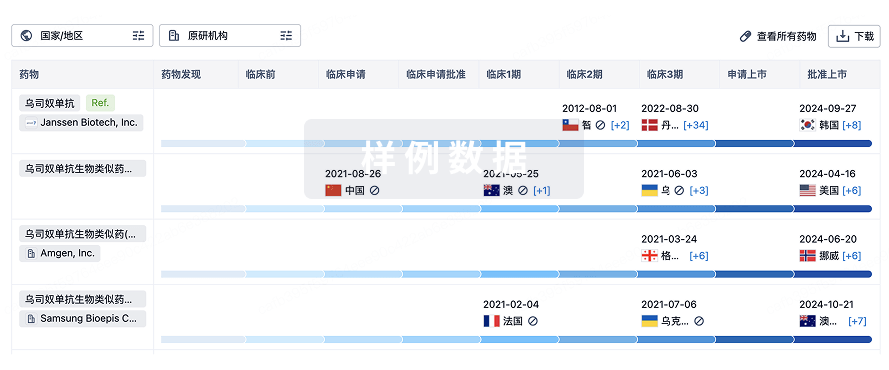
生物类似药
生物类似药在不同国家/地区的竞争态势。请注意临床1/2期并入临床2期,临床2/3期并入临床3期
登录
或
特殊审评
只需点击几下即可了解关键药物信息。
登录
或

提出任何生物医药研究问题
让每一步生物医药决策都精准制胜
基于十亿级生物数据与全球情报的精准 AI,赋能早期药物发现
立即开始免费试用!
智慧芽新药情报库是智慧芽专为生命科学人士构建的基于AI的创新药情报平台,助您全方位提升您的研发与决策效率。
立即接入生物医药数据包
智慧芽新药库数据也通过智慧芽开放平台,以MCP或API服务形式对外开放。立即使用我们的MCP服务定制您的LLM智能体。
生物序列数据库
生物药研发创新
免费使用
化学结构数据库
小分子化药研发创新
免费使用