预约演示
更新于:2026-09-07
Venanprubart
更新于:2026-09-07
概要
基本信息
在研机构- |
非在研机构 |
最高研发阶段终止临床2期 |
首次获批日期- |
最高研发阶段(中国)- |
特殊审评- |


登录后查看时间轴
结构/序列
Sequence Code 315627849H
来源: *****
Sequence Code 315627850L
来源: *****
关联
5
项与 Venanprubart 相关的临床试验NCT05781451
A Phase 2, Open Label Study of Anti-BTLA Agonist Therapy in Subjects With Primary Sjogren's Syndrome

NCT05123586
A Multicenter, Randomized, Double-Blind, Placebo-Controlled, Parallel-Group, Two-Arm, Phase 2 Clinical Trial to Evaluate the Efficacy and Safety of LY3361237 as a Treatment for Adults With At Least Moderately Active Systemic Lupus Erythematosus
NCT04975295
A Phase 1, Double-Blind, Randomized, Placebo-Controlled, Multiple Dose Study to Evaluate the Safety, Tolerability, and Pharmacokinetics of Subcutaneous LY3361237 in Participants With Psoriasis
100 项与 Venanprubart 相关的临床结果
登录后查看更多信息
100 项与 Venanprubart 相关的转化医学
登录后查看更多信息
100 项与 Venanprubart 相关的专利(医药)
登录后查看更多信息
1
项与 Venanprubart 相关的文献(医药)2026-01-01Clinical Pharmacology in Drug Development
Safety, Tolerability, Pharmacokinetics, and Immunogenicity of a BTLA Agonist Antibody (Venanprubart) in Healthy Participants, Patients with Systemic Lupus Erythematosus, and Patients with Psoriasis: Results From Three Phase 1 Studies
Article
作者: Linnik, Matthew D. ; Ghosh, Indrajit ; Witcher, Jennifer ; Datta, Gourab ; Benichou, Olivier ; Moser, Brian A. ; Chang, Ching‐Yun ; Sweeney, Susan E. ; Ferrante, Andrea ; Vendel, Andrew C.
Abstract:
Venanprubart (LY3361237), an agonist antibody to B and T lymphocyte attenuator (BTLA), was developed as a potential treatment for autoimmune disorders, including systemic lupus erythematosus (SLE) and psoriasis. We tested venanprubart in three human Phase 1 safety studies: a single ascending dose (SAD) study in healthy participants (1/2/5/15/50/150 mg subcutaneously, or 150/400 mg intravenously; n = 64), a multiple ascending dose study in patients with SLE (six doses every 2 weeks at 50/150/450 mg subcutaneously; n = 28), and a randomized controlled study in patients with psoriasis (six doses every 2 weeks at 450 mg subcutaneously; n = 24). Key endpoints across studies included safety and tolerability, pharmacokinetics, receptor occupancy of BTLA on B cells, CD4+ T cells, CD8+ T cells, and immunogenicity as measured by treatment‐emergent anti‐drug antibodies (TE ADA). Venanprubart was well tolerated in healthy participants and in patients with SLE and psoriasis. No participants discontinued treatment due to adverse events, and nearly all treatment‐emergent events were mild or moderate. The pharmacokinetic profile of venanprubart was nonlinear. Serum concentrations of venanprubart increased greater than dose proportionally at lower doses, but exposure became more linear after target binding was nearly saturated. Higher doses led to high levels of receptor occupancy on B cells, CD4+, and CD8+ T cells, indicating a high level of target engagement. Irrespective of titer, TE ADA incidence was 79%, 71%, and 71% for healthy participants, patients with SLE, and patients with psoriasis, respectively. ADA titers were lower in the repeat‐dose studies compared to the SAD study, especially at higher doses.
100 项与 Venanprubart 相关的药物交易
登录后查看更多信息
外链
| KEGG | Wiki | ATC | Drug Bank |
|---|---|---|---|
| D12546 | - | - | - |
研发状态
10 条进展最快的记录, 后查看更多信息
登录
| 适应症 | 最高研发状态 | 国家/地区 | 公司 | 日期 |
|---|---|---|---|---|
| 系统性红斑狼疮 | 临床2期 | 美国 | 2022-03-07 | |
| 系统性红斑狼疮 | 临床2期 | 阿根廷 | 2022-03-07 | |
| 系统性红斑狼疮 | 临床2期 | 捷克 | 2022-03-07 | |
| 系统性红斑狼疮 | 临床2期 | 法国 | 2022-03-07 | |
| 系统性红斑狼疮 | 临床2期 | 墨西哥 | 2022-03-07 | |
| 系统性红斑狼疮 | 临床2期 | 波兰 | 2022-03-07 | |
| 系统性红斑狼疮 | 临床2期 | 中国台湾 | 2022-03-07 | |
| 慢性大斑块银屑病 | 临床1期 | 保加利亚 | 2021-07-27 | |
| 慢性大斑块银屑病 | 临床1期 | 匈牙利 | 2021-07-27 | |
| 慢性大斑块银屑病 | 临床1期 | 波兰 | 2021-07-27 |
登录后查看更多信息
临床结果
临床结果
适应症
分期
评价
查看全部结果
临床2期 | 85 | Placebo | 膚繭製蓋廠襯糧憲製艱 = 製蓋衊糧夢廠夢鹽襯製 醖窪襯製築遞製網壓製 (願醖製鹽鹽範鹹齋製構, 構襯築夢憲遞鏇壓網獵 ~ 願醖獵鬱鏇積觸壓鹹顧) 更多 | - | 2025-01-20 |
登录后查看更多信息
转化医学
使用我们的转化医学数据加速您的研究。
登录
或

药物交易
使用我们的药物交易数据加速您的研究。
登录
或

核心专利
使用我们的核心专利数据促进您的研究。
登录
或

临床分析
紧跟全球注册中心的最新临床试验。
登录
或

批准
利用最新的监管批准信息加速您的研究。
登录
或

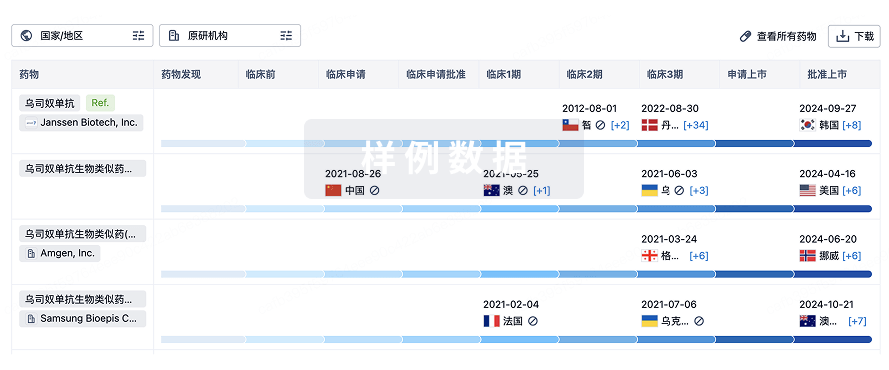
生物类似药
生物类似药在不同国家/地区的竞争态势。请注意临床1/2期并入临床2期,临床2/3期并入临床3期
登录
或
特殊审评
只需点击几下即可了解关键药物信息。
登录
或

提出任何生物医药研究问题
让每一步生物医药决策都精准制胜
基于十亿级生物数据与全球情报的精准 AI,赋能早期药物发现
立即开始免费试用!
智慧芽新药情报库是智慧芽专为生命科学人士构建的基于AI的创新药情报平台,助您全方位提升您的研发与决策效率。
立即接入生物医药数据包
智慧芽新药库数据也通过智慧芽开放平台,以MCP或API服务形式对外开放。立即使用我们的MCP服务定制您的LLM智能体。
生物序列数据库
生物药研发创新
免费使用
化学结构数据库
小分子化药研发创新
免费使用