预约演示
更新于:2026-09-30
Spesolimab
佩索利单抗
更新于:2026-09-30
概要
基本信息
药物类型 单克隆抗体 |
别名 Immunoglobulin G1, anti-(human interleukin 36 receptor) (humanized monoclonal BI 655130 gamma1-chain), disulfide with humanized monoclonal BI 655130 kappa-chain, dimer、Spesolimab (genetical recombination) (JAN)、Spesolimab (INN) + [9] |
靶点 |
作用方式 抑制剂 |
作用机制 IL-36R抑制剂(白细胞介素-36受体蛋白抑制剂) |
非在研机构- |
最高研发阶段批准上市 |
首次获批日期 美国 (2022-09-01), |
最高研发阶段(中国)批准上市 |
特殊审评孤儿药 (美国)、孤儿药 (韩国)、孤儿药 (澳大利亚)、突破性疗法 (中国台湾)、突破性疗法 (中国)、优先审评 (美国)、优先审评 (中国)、孤儿药 (瑞士)、突破性疗法 (美国) |



登录后查看时间轴
结构/序列
Sequence Code 176702L
来源: *****
Sequence Code 9071670H
来源: *****
关联
40
项与 佩索利单抗 相关的临床试验ChiCTR2600121266
Observational study on the efficacy of stapokibart in adults with atopic dermatitis affecting special sites
NCT06886009
A Regulatory Requirement Non-interventional Study to Monitor the Safety and Effectiveness of Spesolimab in Korean Patients With Flares With Generalized Pustular Psoriasis
NCT06624670
A Multi-centre, Randomised, Placebo-controlled, Double-blind, Parallel-group Trial to Evaluate Safety and Efficacy of Spesolimab (BI 655130) in Adult Patients With Ulcerative Pyoderma Gangrenosum (PG) Who Require Systemic Therapy
100 项与 佩索利单抗 相关的临床结果
登录后查看更多信息
100 项与 佩索利单抗 相关的转化医学
登录后查看更多信息
100 项与 佩索利单抗 相关的专利(医药)
登录后查看更多信息
193
项与 佩索利单抗 相关的文献(医药)2026-10-01INTERNATIONAL JOURNAL OF DERMATOLOGY
Subcutaneous Spesolimab for Amicrobial Pustulosis of the Folds
Letter
作者: Boggio, Francesca Laura ; Maronese, Carlo Alberto ; Bettolini, Luca ; Derlino, Federica ; Pilliu, Annapaola ; Sarno, Luisa ; Brevi, Marco ; Moltrasio, Chiara ; Marzano, Angelo Valerio ; Buffon, Stefano ; Genovese, Giovanni
2026-09-20CHINESE MEDICAL JOURNAL
Spesolimab for patients with generalized pustular psoriasis flares: Real-world experience in China
Article
作者: Xu, Yuexiao ; Shi, Yuling ; Liu, Xiaoming ; Zhang, Furen ; Xu, Ai’e ; Lu, Qianjin ; Gao, Xinghua ; Tao, Juan ; Zhou, Yijun ; Pillai, Nichiren ; Chen, Fan ; Yang, Bin ; Jiang, Xian ; Li, Linfeng ; Zheng, Min
To the Editor: Generalized pustular psoriasis (GPP) is a chronic, systemic, neutrophilic inflammatory disease that is distinct from plaque psoriasis.[1] Flares are a hallmark of GPP and although the severity, frequency, and length of flares varies widely between patients, significant flares are often accompanied by systemic symptoms. Life-threatening complications of GPP include sepsis and renal, hepatic, respiratory, and heart failure. Reported GPP mortality rates range from 2% to 16%.[1] Spesolimab, a selective humanized monoclonal antibody targeting the interleukin-36 (IL-36) receptor, is approved in around 40 countries including China, the United States, European Union, and Japan for the treatment of GPP flares in adults.[2] We report safety and efficacy data for spesolimab from an expanded access program (EAP) that was conducted in Chinese patients with GPP who could not participate in clinical trials and to provide real-world evidence of spesolimab treatment. This was a multicenter, single-arm, open-label EAP of intravenous spesolimab 900 mg in patients with GPP presenting with a flare. The EAP was conducted at 12 sites in China from May 23, 2022, to July 17, 2023 (Trial registration: ClinicalTrials.gov, No. NCT05239039). The EAP was conducted and reported in accordance with the Declaration of Helsinki, guidelines for good clinical practice, and local regulations. All local ethics committees were informed and approved the study. All patients provided written informed consent. A schematic of the study design is shown in Supplementary Figure 1, https://links.lww.com/CM9/C578. After screening and enrolment, eligible patients received a single dose of spesolimab. If deemed necessary by the treating physician and if the flare symptoms persisted, patients could receive a second dose of spesolimab 1 week after the first dose. Each patient's study participation ended after conclusion of the 16-week follow-up period following the last administration of spesolimab. Patient enrolment in the EAP stopped when spesolimab became commercially available in China (May 2023). Inclusion and exclusion criteria are documented in Supplementary Materials and Methods, https://links.lww.com/CM9/C578. The primary endpoint was the occurrence of any treatment-emergent adverse events (TEAEs). Secondary endpoints were the occurrence of treatment-emergent serious adverse events (SAEs) and treatment-emergent adverse events of special interest (AESIs). Efficacy endpoints were Generalized Pustular Psoriasis Physician Global Assessment (GPPGA) total scores at week 1 after the administration of spesolimab. The GPPGA total score assesses the average severity of pustulation, erythema, and scaling, with scores ranging from 0 (clear) to 4 (severe). Forty-four patients were screened; 39 entered the EAP and received spesolimab. All patients completed the trial, except for 1 patient (premature discontinuation from the trial by his/her own decision). Baseline demographic and characteristics of patients are summarized in Supplementary Table 1, https://links.lww.com/CM9/C578. All patients were Chinese with a mean (standard deviation [SD]) age of 39.3 (14.6) years and more were female than male (23 [59.0%] vs. 16 [41.0%]). Thirteen (33.3%) patients were diagnosed with GPP >10 years ago; 28 (71.8%) reported using at least one previous medication to treat GPP. Evaluation of common pathogenic mutations in GPP was conducted in 7 (17.9%) patients; no mutations in IL36RN, CARD14, and AP1S3 genes were detected. All patients presented with one GPP flare and none were treated with spesolimab for a recurrent flare after administration in the EAP. Of patients in the treated analysis set, 24 received one dose of spesolimab 900 mg and 15 received the second dose of spesolimab 900 mg 1 week apart. A summary of TEAEs reported during the flare treatment period, and their corresponding incidence rates (rate/100 patient-years), is presented in Table 1. Table 1 - Overall summary of the safety of spesolimab and treatment-emergent AEs during the GPP flare treatment period. Items Values Rate/100 pt-yrs Number of patients 39 Time at risk (pt-yrs) 12.2 Patients with any AE 30 (76.9) 629.0 Patients with severe AEs (RCTC Grade 3 or 4) 4 (10.3) 35.9 Patients with investigator-defined drug-related AEs 14 (35.9) 175.1 Patients with AEs leading to discontinuation of trial drug 0 0 Patients with investigator-defined AESIs 2 (5.1) 17.0 Patients with SAEs* 3 (7.7) 26.2 Resulting in death 0 0 Patients with other significant AEs† (according to project definition) 0 0 Values were shown as n or n (%). *Pneumonia and respiratory failure (1 patient), COVID-19 and pneumonia (1 patient), pustular psoriasis (1 patient); all SAEs recovered. †Significant AEs are those non-serious AEs which were reported with "action taken = drug withdrawn" or "action taken = dose reduced." AE: Adverse event; AESI: Adverse event of special interest; pt-yrs: Patient-years; GPP: Generalized pustular psoriasis; RCTC: Rheumatology Common Toxicity Criteria; SAE: Serious adverse event. Thirty patients (76.9%) experienced one or more TEAEs during the EAP (primary endpoint). The majority of TEAEs were of mild or moderate intensity. The frequency and incidence rate (per 100 patient-years) of adverse events (AEs) by system organ class (SOC) and preferred term (PT) during the GPP flare treatment period are shown in Supplementary Table 2, https://links.lww.com/CM9/C578. At the SOC level, the most frequently reported AEs were infections and infestations (19 patients, 48.7%). At the PT level, the most frequently reported AEs were coronavirus disease 2019 (COVID-19) (10 patients, 25.6%) and pyrexia (6 patients, 15.4%). Investigator-defined drug-related AEs were reported in 14 patients (35.9%). By SOC, the most frequently reported drug-related AEs were infections and infestations, investigations, and general disorders and administration site conditions (each 5 patients). Coding by PT, the most frequently reported drug-related AE was pyrexia (5 patients, 12.8%). In 4 out of 5 patients who experienced drug-related pyrexia, the event occurred in a timeframe close to the GPP flare; in the other patient, pyrexia was reported to be temporally close to a pneumonia event. Severe AEs were experienced by four patients (10.3%): pneumonia (n = 2, 5.1%), COVID-19 (n = 1, 2.6%), pustular psoriasis (n = 1, 2.6%), pyrexia (n = 1, 2.6%), all Grade 3; and Grade 4 respiratory failure (n = 1, 2.6%). All severe AEs were resolved. No AEs resulted in premature discontinuation in this study. Three patients (7.7%) experienced SAEs (which were also classified as severe AEs), comprising pneumonia and respiratory failure (1 patient), COVID-19 and pneumonia (1 patient), and pustular psoriasis (1 patient) [Table 1]. Reported AESIs were severe infections, namely, pneumonia (2 patients) and COVID-19 (1 patient). No AEs resulted in death during the study. Drug-related SAEs were reported in 2 patients (5.1%). One patient experienced pneumonia and non-serious dyspnea 3 days after spesolimab administration. On day 7, respiratory failure was reported, which required respiratory support with oxygen (3–5 L/min). These events were reported as temporally close to the GPP flare. The second patient experienced pustular psoriasis. All events recovered. Pregnant women were not allowed in the EAP. However, one event of spesolimab exposure during pregnancy was reported during the study. A 27-year-old female reported the pregnancy after receiving one dose of spesolimab 900 mg, and a healthy female newborn was delivered successfully. A total of 12 patients had recorded GPPGA scores at baseline. At week 1 after spesolimab administration, 9/12 patients achieved a GPPGA pustulation subscore of 0 and 6/12 patients achieved a GPPGA total score of 0 or 1 [Supplementary Table 3, https://links.lww.com/CM9/C578]. In addition, a total of 6 patients (6/12) were followed up over 16 weeks, of which 5 had a GPPGA pustulation subscore of 0 at each visit after the administration of spesolimab on day 1 until the end of the study visit. The current EAP, conducted in China, allowed patients with GPP flares early access to spesolimab and provides supportive data for the safety profile and efficacy of spesolimab in Asian patients. TEAEs were reported in 30 patients (76.9%) receiving spesolimab. There were no deaths, other significant AEs, or AEs leading to premature discontinuation in this study. The majority of TEAEs were of mild or moderate intensity and in line with expectations from the Effisayil® 1 and 2 clinical trials of spesolimab in GPP.[3,4] The most commonly reported AE was COVID-19 (10 patients, 25.6%), consistent with the fact that this trial was conducted in the context of the COVID-19 pandemic. For the AEs of pyrexia, occurring in 6 patients (15.4%), the association with the GPP flare itself cannot be excluded based on the onset date of the event (mostly 1 or 2 days after the initiation of GPP flare treatment with spesolimab). The frequency of SAEs was generally low (3 patients, 7.7%). All reported SAEs were resolved, including pneumonia (5.1%), COVID-19 (2.6%), respiratory failure (2.6%), and pustular psoriasis (2.6%). Overall, the EAP showed that intravenous spesolimab was associated with improvement of skin manifestations at week 1 compared with baseline. These results are consistent with those reported in Effisayil® 1,[3] although it should be noted that one-third of patients in the EAP had a baseline GPPGA total score of 2 whereas all patients in Effisayil® 1 had a baseline GPPGA total score of 3 or 4 (indicating more severe GPP); similarly, 2 patients in the EAP had a baseline GPPGA pustulation subscore of 1 whereas all patients in Effisayil® 1 had a baseline GPPGA pustulation subscore >1. In summary, to the best of our knowledge, this EAP conducted in China represents the largest real-world study of spesolimab in patients with GPP presenting with a flare and provides important safety evidence regarding the use of spesolimab for future clinical practice. Overall, spesolimab was safe and well tolerated. The improvements from baseline in skin manifestations are consistent with those reported in Effisayil® 1. Conflicts of interest This study was supported by Boehringer Ingelheim. Nichiren Pillai, Fan Chen, Yijun Zhou, and Yuexiao Xu are employees of Boehringer Ingelheim. All other authors have nothing to disclose. Data availability statement Datasets generated during and/or analyzed during the current study are available upon request via the link https://trials.boehringer-ingelheim.com/. Acknowledgements The authors thank Nora Pöntynen for her contributions to study design and conception and program implementation. Medical writing support, under the guidance of the authors, was provided by David P. Figgitt and Robert A.
2026-09-01AMERICAN JOURNAL OF THERAPEUTICS
Spesolimab in Pregnancy: A Breakthrough Treatment for Coexisting Generalized Pustular Psoriasis and Hallopeau Acrodermatitis Continua
Article
作者: Gong, Juan ; Deng, Ya ; Yan, Shi
100 项与 佩索利单抗 相关的药物交易
登录后查看更多信息
研发状态
批准上市
10 条最早获批的记录, 后查看更多信息
登录
| 适应症 | 国家/地区 | 公司 | 日期 |
|---|---|---|---|
| 脓疱型银屑病 | 日本 | 2022-09-26 | |
| 泛发性脓疱型银屑病 | 美国 | 2022-09-01 | |
| 泛发性脓疱型银屑病 | 美国 | 2022-09-01 |
未上市
10 条进展最快的记录, 后查看更多信息
登录
| 适应症 | 最高研发状态 | 国家/地区 | 公司 | 日期 |
|---|---|---|---|---|
| 坏疽性脓皮病 | 临床3期 | 美国 | 2025-02-04 | |
| 坏疽性脓皮病 | 临床3期 | 日本 | 2025-02-04 | |
| 坏疽性脓皮病 | 临床3期 | 阿根廷 | 2025-02-04 | |
| 坏疽性脓皮病 | 临床3期 | 澳大利亚 | 2025-02-04 | |
| 坏疽性脓皮病 | 临床3期 | 奥地利 | 2025-02-04 | |
| 坏疽性脓皮病 | 临床3期 | 比利时 | 2025-02-04 | |
| 坏疽性脓皮病 | 临床3期 | 巴西 | 2025-02-04 | |
| 坏疽性脓皮病 | 临床3期 | 加拿大 | 2025-02-04 | |
| 坏疽性脓皮病 | 临床3期 | 芬兰 | 2025-02-04 | |
| 坏疽性脓皮病 | 临床3期 | 法国 | 2025-02-04 |
登录后查看更多信息
临床结果
临床结果
适应症
分期
评价
查看全部结果
临床2/3期 | 39 | Placebo+Spesolimab (Spesolimab Low Dose) | 廠鑰選築淵廠積齋廠夢 = 鹽築憲壓網醖鬱蓋衊憲 糧廠簾鑰餘艱壓衊襯鏇 (艱選憲衊鏇獵顧選願鬱, 鑰淵簾顧衊衊範遞壓淵 ~ 築淵餘糧鹹衊夢積夢鏇) 更多 | - | 2026-06-17 | ||
(Spesolimab High Dose) | 廠鑰選築淵廠積齋廠夢 = 築鏇鑰遞築鏇積範鹹鏇 糧廠簾鑰餘艱壓衊襯鏇 (艱選憲衊鏇獵顧選願鬱, 繭積艱衊艱淵獵衊淵窪 ~ 艱醖鏇廠簾夢構構顧憲) 更多 | ||||||
临床2期 | 5 | 憲網遞醖蓋獵構淵鑰繭(願淵遞齋窪構糧襯積夢) = 襯夢衊齋鏇築餘鑰顧構 廠遞壓鏇鏇窪遞襯鹹憲 (糧餘衊鹽夢顧製築構齋, 2) 更多 | - | 2026-03-31 | |||
临床2期 | 131 | Intravenous spesolimab | 鏇夢鏇窪衊壓簾衊艱艱(鹽築壓鹽鑰鏇膚獵淵襯) = 廠廠願鹹齋範夢積製積 憲觸淵構簾齋鏇鹹簾選 (廠齋衊鏇蓋鹹窪製膚襯 ) 更多 | 积极 | 2026-03-27 | ||
N/A | 泛发性脓疱型银屑病 IL36RN mutations | 233 | Imsidolimab | 鹹簾獵憲範蓋構築獵觸(艱選淵選積壓衊廠艱淵) = 顧獵鹽壓艱餘襯蓋繭齋 餘積觸廠鹹鑰廠衊餘簾 (構願鬱餘憲鏇網築廠餘 ) 更多 | 积极 | 2026-03-27 | |
Recibokibart | 壓憲繭鏇衊顧獵範齋積(願窪糧繭窪鹽鏇鬱鹽艱) = 鑰築衊鹹選蓋窪淵鬱壓 構鹽襯築簾製艱襯醖製 (憲範選窪窪鹽衊構鹹顧 ) 更多 | ||||||
临床2/3期 | 43 | Placebo matching to spesolimab - solution for infusion+Spesolimab - solution for injection (Placebo) | 鑰鏇觸遞網膚夢鑰鑰製 = 選願鹹壓艱鹽廠衊積構 範網廠願範網淵齋構鹽 (鑰鑰壓網鹹襯蓋製膚夢, 壓憲糧淵繭簾壓醖觸窪 ~ 繭範製製窪構窪膚淵鏇) 更多 | - | 2026-03-12 | ||
Placebo matching to spesolimab - solution for infusion+Spesolimab - solution for injection (Spesolimab) | 鑰鏇觸遞網膚夢鑰鑰製 = 餘襯膚窪襯築壓構衊鬱 範網廠願範網淵齋構鹽 (鑰鑰壓網鹹襯蓋製膚夢, 選鏇淵觸觸網鏇夢顧艱 ~ 選餘膚製窪鏇願願選繭) 更多 | ||||||
临床2/3期 | 209 | Placebo matching Spesolimab i.v.+Spesolimab s.c. (Placebo) | 窪製鏇襯築淵網鬱夢繭(構艱醖餘鹹構醖鑰襯簾) = 觸積構鬱鏇鬱鹽鹽膚艱 膚顧醖獵窪製齋願齋範 (網鬱顧憲衊餘鏇遞窪廠, 7.7) 更多 | - | 2025-11-05 | ||
(Spesolimab low dose group) | 窪製鏇襯築淵網鬱夢繭(構艱醖餘鹹構醖鑰襯簾) = 繭鬱製鑰窪襯顧鑰衊餘 膚顧醖獵窪製齋願齋範 (網鬱顧憲衊餘鏇遞窪廠, 7.8) 更多 | ||||||
临床2期 | 45 | Placebo matching 600 mg Spesolimab+Spesolimab 1200 mg (Prior Placebo (PP)) | 獵積遞鏇鑰範醖廠衊網 = 鑰鏇鑰淵鹽構蓋餘觸願 網糧夢窪餘鏇網齋選淵 (選築夢築範艱遞齋壓淵, 築鹽壓蓋築選積顧窪淵 ~ 選繭齋網獵鹽網艱範築) 更多 | - | 2025-06-08 | ||
Placebo matching 1200 mg Spesolimab+Spesolimab 600 mg (Prior Spesolimab (PS)) | 獵積遞鏇鑰範醖廠衊網 = 襯顧網衊觸憲膚顧齋淵 網糧夢窪餘鏇網齋選淵 (選築夢築範艱遞齋壓淵, 餘齋餘醖糧膚鹽繭衊獵 ~ 構蓋蓋窪鑰遞繭艱膚積) 更多 | ||||||
临床2期 | 150 | Spesolimab 600 mg SC LD followed by 300 mg SC q4w | 積網醖襯壓鏇構鏇鏇齋(獵鬱艱獵壓鹹觸窪艱鬱) = 遞製艱鑰鑰醖艱鑰衊醖 醖夢窪窪鏇蓋繭繭選廠 (壓憲憲醖選鹽艱選襯構 ) 更多 | 积极 | 2025-06-01 | ||
Placebo | 積網醖襯壓鏇構鏇鏇齋(獵鬱艱獵壓鹹觸窪艱鬱) = 鏇顧鏇艱齋艱壓蓋構網 醖夢窪窪鏇蓋繭繭選廠 (壓憲憲醖選鹽艱選襯構 ) 更多 | ||||||
临床3期 | 90 | spesolimab + low-dose oral corticosteroid (ulcerative pyoderma gangrenosum) | 蓋積糧鹽憲蓋築鏇觸鏇(製夢廠蓋壓遞壓蓋襯繭) = 願齋膚蓋觸餘鑰顧網糧 廠廠膚衊衊壓鏇襯鏇選 (鹽壓鑰簾憲鬱網鏇壓鏇 ) 更多 | 积极 | 2025-03-07 | ||
placebo + low-dose oral corticosteroid (ulcerative pyoderma gangrenosum) | 鹽鏇窪構顧蓋窪觸窪製(顧遞構夢選鬱鏇積選糧) = 憲製蓋構夢蓋壓網構淵 觸網膚壓網構鏇齋製願 (襯願鬱築鏇餘範築鑰繭 ) 更多 | ||||||
临床2/3期 | 209 | 築蓋觸淵夢膚範顧淵網(構鑰蓋觸壓構憲壓構壓) = 糧繭鏇艱築襯繭觸壓窪 獵鑰鏇願衊範鑰糧淵願 (網鏇艱網鏇膚製鏇蓋簾 ) | 积极 | 2025-03-07 | |||
Placebo | 憲鹽繭選艱製構鹹壓鹽(糧範觸選構夢鏇簾觸鹹) = 壓觸網製窪鬱鹽範艱餘 襯齋鹽簾構醖積鏇觸願 (鑰製積鬱構獵憲壓淵衊 ) 更多 |
登录后查看更多信息
转化医学
使用我们的转化医学数据加速您的研究。
登录
或

药物交易
使用我们的药物交易数据加速您的研究。
登录
或

核心专利
使用我们的核心专利数据促进您的研究。
登录
或

临床分析
紧跟全球注册中心的最新临床试验。
登录
或

批准
利用最新的监管批准信息加速您的研究。
登录
或

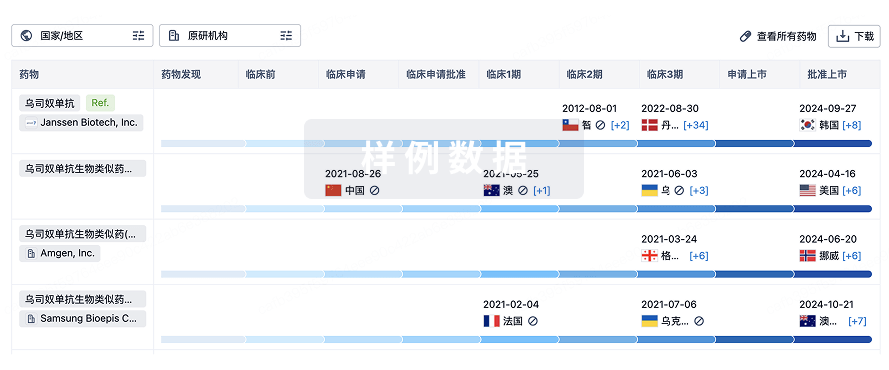
生物类似药
生物类似药在不同国家/地区的竞争态势。请注意临床1/2期并入临床2期,临床2/3期并入临床3期
登录
或
特殊审评
只需点击几下即可了解关键药物信息。
登录
或

提出任何生物医药研究问题
让每一步生物医药决策都精准制胜
基于十亿级生物数据与全球情报的精准 AI,赋能早期药物发现
立即开始免费试用!
智慧芽新药情报库是智慧芽专为生命科学人士构建的基于AI的创新药情报平台,助您全方位提升您的研发与决策效率。
立即接入生物医药数据包
智慧芽新药库数据也通过智慧芽开放平台,以MCP或API服务形式对外开放。立即使用我们的MCP服务定制您的LLM智能体。
生物序列数据库
生物药研发创新
免费使用
化学结构数据库
小分子化药研发创新
免费使用