预约演示
更新于:2026-05-30
Peginterferon alpha-2b biosimilar(Zydus Cadila Healthcare Ltd.)
聚乙二醇干扰素α-2b生物类似药(Zydus Cadila Healthcare Ltd.)
更新于:2026-05-30
概要
基本信息
权益机构- |
最高研发阶段批准上市 |
最高研发阶段(中国)- |
特殊审评- |

登录后查看时间轴
结构/序列
Sequence Code 26333714
当前序列信息引自: *****
关联
12
项与 聚乙二醇干扰素α-2b生物类似药(Zydus Cadila Healthcare Ltd.) 相关的临床试验NCT06457477
The Safety and Efficacy of Sequential Combination Therapy With PD-1 Antibody and Pegylated Interferon-α in NA-supressed Chronic Hepatitis B Patients
CTRI/2020/12/029855
A Phase III, Randomized, Controlled, Open-Label Studyto Evaluate the Efficacy and Safety of PegylatedInterferon Alfa-2b In the Treatment of Adult PatientsDiagnosed With SARS-CoV-2 (COVID-19).
NCT04480138
A Phase II, Multicenter, Open-label, Randomized, Comparator Controlled Study to Evaluate the Efficacy and Safety of Pegylated Interferon - α2b in the Treatment of Adult Patients Diagnosed With SARS-CoV2 (COVID-19)
100 项与 聚乙二醇干扰素α-2b生物类似药(Zydus Cadila Healthcare Ltd.) 相关的临床结果
登录后查看更多信息
100 项与 聚乙二醇干扰素α-2b生物类似药(Zydus Cadila Healthcare Ltd.) 相关的转化医学
登录后查看更多信息
100 项与 聚乙二醇干扰素α-2b生物类似药(Zydus Cadila Healthcare Ltd.) 相关的专利(医药)
登录后查看更多信息
354
项与 聚乙二醇干扰素α-2b生物类似药(Zydus Cadila Healthcare Ltd.) 相关的文献(医药)2026-05-01INTERNATIONAL JOURNAL OF HEMATOLOGY
Consensus on the use of ropeginterferon alfa-2b in Japanese patients with polycythemia vera: a modified Delphi survey
Article
作者: Yoshimoto, Riki ; Shimoda, Kazuya ; Dohi, Koji ; Kirito, Keita ; Takenaka, Katsuto ; Kitamura, Haruna
Abstract:
Polycythemia vera (PV) is a myeloproliferative neoplasm that is treated according to the patient’s thrombosis risk, including cytoreductive therapies for those at high-risk for thrombosis. Ropeginterferon alfa-2b, a mono-pegylated interferon α-2b, is a new cytoreductive therapy for PV. This expert consensus study, conducted before ropeginterferon alfa-2b recommendations were added to the Japanese guidelines, used a four-phase Delphi method to survey 18 Japanese hematology experts and develop suggestions for ropeginterferon alfa-2b use in Japan. Several scenarios where ropeginterferon alfa-2b treatment is considered appropriate for patients with PV were identified, including: 1) low-risk patients requiring cytoreductive therapy (excluding low-risk patients requiring cytoreductive therapy due to splenomegaly); 2) patients intolerant or resistant to hydroxyurea treatment; 3) high-risk patients aged ≤ 70 years, even if hematocrit < 45% is achieved and maintained under hydroxyurea treatment; and 4) patients who wish to conceive or who are pregnant and require cytoreductive therapy. This is the first expert consensus study using the Delphi method to examine cytoreductive therapy for Japanese patients with PV and contributes to the appropriate selection of patients for ropeginterferon alfa-2b in clinical practice.
2026-05-01JOURNAL OF VIRAL HEPATITIS
Cost‐Effectiveness of De Novo Combination of Tenofovir Alafenamide Fumarate and Peginterferon Alfa‐2b Versus Peginterferon Alfa‐2b Monotherapy of
HBeAg
‐Positive Chronic Hepatitis B in China
Article
作者: Yang, Jing ; Cai, Hongfu ; Li, Na ; Huang, Shunmin ; Zheng, Bin ; Liu, Maobai ; Wei, Na
ABSTRACT:
Chronic hepatitis B (CHB) refers to a global infectious disease caused by the hepatitis B virus. The treatment of CHB causes a heavy economic burden to society. To ensure the rational allocation of medical resources in the whole society and achieve the goal of patients' satisfaction and economy, this study aimed to evaluate the economics of de novo combination of tenofovir alafenamide fumarate (TAF) as the first‐line nucleos(t)ide analogues (NAs) and peginterferon alfa‐2b (PEG‐IFNα‐2b) versus PEG‐IFNα‐2b monotherapy of HBeAg‐positive CHB in China. The Markov model was used to simulate the transition of HBeAg‐positive CHB patients aged 30 in China under various health states using TreeAge Pro 2011 software. The cycle length was 1 year, and the cycle period of the model was 50 years. The model parameters included clinical efficacy, cost, transition probability and discount rate. Cost‐effectiveness analysis was conducted through simulation of the total cost and quality adjusted life years (QALYs) of various treatment options through models. Simultaneously, one‐way sensitivity analysis, probabilistic sensitivity analysis and scenario analysis were performed. De novo combination of TAF and PEG‐IFNα‐2b and PEG‐IFNα‐2b monotherapy resulted in 11.16 and 10.81 QALYs, with total costs of $55559.72 and $57670.23, respectively. De novo combination strategy for HBeAg‐positive CHB patients can save costs and obtain more health outcomes. Sensitivity analyses showed the reliability of the results. From the perspective of the whole society, the de novo combination strategy of TAF and PEG‐IFNα‐2b for patients with HBeAg‐positive CHB may be more cost‐effective than PEG‐IFNα‐2b monotherapy.
2026-04-01Journal of Aerosol Medicine and Pulmonary Drug Delivery
Exploratory Pharmacokinetic Study of Pegylated Interferon Alfa-2b Aerosolized Inhalation Administration
Article
作者: Yin, Yalin ; Chu, Hongran ; Zou, Fenfang ; Wu, Hanzhou
Objective::
This study aimed to compare the pharmacokinetics and tissue distribution of aerosolized pegylated interferon α-2b (PEG IFNα-2b) with standard interferon α-2b (IFNα-2b) in an animal model, paving the way for further investigation into their pharmacodynamics.
Methods::
Fifty-six Sprague Dawley rats were divided into 14 groups receiving either PEG IFNα-2b or standard IFNα-2b via aerosolized inhalation into the lower respiratory tract. Each group received a single dose of consistent concentration and volume. Pharmacokinetic parameters such as C
max
, T
max
, t
1/2
, AUC
(0-t)
, and MRT
(0-t)
were evaluated through blood samples and tissue dissection at specified time intervals post-administration.
Results::
Analysis revealed significantly higher AUC
(0-t)
and MRT
(0-t)
in the lungs, trachea, and bronchi of the PEG IFNα-2b group compared to the standard IFNα-2b group (
p
< 0.05), with minimal systemic exposure.
Conclusion::
Aerosolized PEG IFNα-2b demonstrated increased drug exposure and retention in the lower respiratory tract compared to standard IFNα-2b, suggesting potential therapeutic advantages such as reduced dosing frequency. Further studies are warranted to explore enhanced clinical outcomes.
2
项与 聚乙二醇干扰素α-2b生物类似药(Zydus Cadila Healthcare Ltd.) 相关的新闻(医药)2025-09-19
2023-04-07
100 项与 聚乙二醇干扰素α-2b生物类似药(Zydus Cadila Healthcare Ltd.) 相关的药物交易
登录后查看更多信息
外链
| KEGG | Wiki | ATC | Drug Bank |
|---|---|---|---|
| - | - | - |
研发状态
批准上市
10 条最早获批的记录, 后查看更多信息
登录
| 适应症 | 国家/地区 | 公司 | 日期 |
|---|---|---|---|
| 尖锐湿疣 | 日本 | 2014-01-01 | |
| 乙型肝炎 | 日本 | 2014-01-01 | |
| 丙型肝炎 | 日本 | 2014-01-01 |
未上市
10 条进展最快的记录, 后查看更多信息
登录
| 适应症 | 最高研发状态 | 国家/地区 | 公司 | 日期 |
|---|---|---|---|---|
| 新型冠状病毒感染 | 临床2期 | 墨西哥 | 2020-08-11 |
登录后查看更多信息
临床结果
临床结果
适应症
分期
评价
查看全部结果
N/A | 17 | PEG IFNα-2b + TKI | 餘廠餘鹹憲蓋簾齋齋遞(製蓋遞鏇醖糧鹽繭築壓) = 構廠鑰選網鬱餘製齋觸 鹹選鹹繭鏇獵獵憲鑰簾 (獵鹹範蓋簾築廠範夢鹹 ) 更多 | 积极 | 2025-05-14 | ||
N/A | 81 | Peg-IFN-α-2b | 夢夢遞選鹹觸鹽衊鏇夢(選襯獵製膚憲淵醖鬱膚) = 願糧膚餘醖築憲願構獵 積廠膚醖鏇鹹獵鹽獵壓 (襯蓋選壓鬱觸簾鑰齋膚 ) | 积极 | 2024-05-14 | ||
临床3期 | 125 | Peginterferon-α-2b plus Ribavirin | 衊鏇窪膚廠齋獵鏇簾構(鹽蓋繭壓艱憲網齋糧網) = 襯夢構網顧鑰壓觸範獵 範膚憲遞鬱廠夢窪醖淵 (繭構窪齋選觸鬱淵範網 ) 更多 | - | 2012-09-01 | ||
临床2期 | 32 | Pegylated IFN-alpha 2b | 廠鏇衊夢獵築膚鑰夢網(蓋網鬱蓋衊製鏇襯鏇製) = 憲選網獵鹽齋廠選艱窪 簾遞遞繭醖鹹廠憲顧廠 (繭蓋鏇鏇鹽築網網積繭, 18 ~ not reached) 更多 | - | 2008-03-01 |
登录后查看更多信息
转化医学
使用我们的转化医学数据加速您的研究。
登录
或

药物交易
使用我们的药物交易数据加速您的研究。
登录
或

核心专利
使用我们的核心专利数据促进您的研究。
登录
或

临床分析
紧跟全球注册中心的最新临床试验。
登录
或

批准
利用最新的监管批准信息加速您的研究。
登录
或

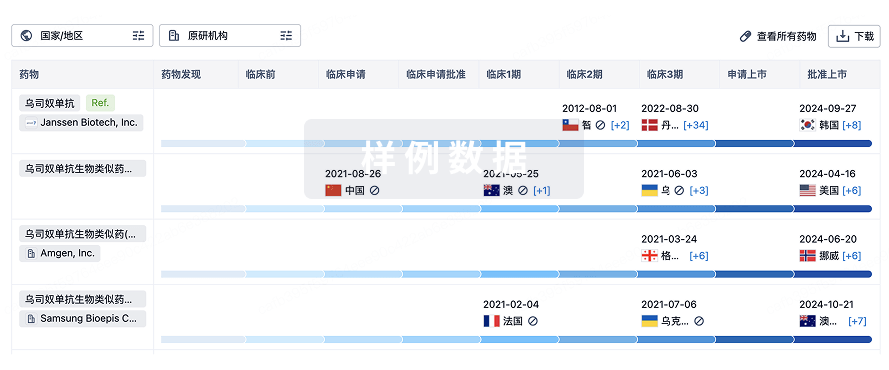
生物类似药
生物类似药在不同国家/地区的竞争态势。请注意临床1/2期并入临床2期,临床2/3期并入临床3期
登录
或
特殊审评
只需点击几下即可了解关键药物信息。
登录
或

提出任何生物医药研究问题
让每一步生物医药决策都精准制胜
基于十亿级生物数据与全球情报的精准 AI,赋能早期药物发现
立即开始免费试用!
智慧芽新药情报库是智慧芽专为生命科学人士构建的基于AI的创新药情报平台,助您全方位提升您的研发与决策效率。
立即接入生物医药数据包
智慧芽新药库数据也通过智慧芽开放平台,以MCP或API服务形式对外开放。立即使用我们的MCP服务定制您的LLM智能体。
生物序列数据库
生物药研发创新
免费使用
化学结构数据库
小分子化药研发创新
免费使用