预约演示
更新于:2026-09-10
Belantamab
贝兰妥单抗
更新于:2026-09-10
概要
基本信息
药物类型 单克隆抗体 |
别名 Bela、GSK-2857914、J6M0 |
靶点 |
作用方式 抑制剂 |
作用机制 BCMA抑制剂(B细胞成熟蛋白抑制剂) |
非在研适应症 |
原研机构 |
非在研机构- |
权益机构- |
最高研发阶段临床1/2期 |
首次获批日期- |
最高研发阶段(中国)临床1/2期 |
特殊审评- |


登录后查看时间轴
结构/序列
Sequence Code 33489L
来源: *****
Sequence Code 1120419102H
来源: *****
关联
6
项与 贝兰妥单抗 相关的临床试验NCT07742527
A Randomized, Open-label, Phase 1b, Crossover Study to Evaluate the Pharmacokinetics and Safety of a Subcutaneous Belantamab (BCMAb) Formulation With rHuPH20 Versus Intravenous Belantamab in Participants With Multiple Myeloma While Treated With Standard of Care
NCT06413511
A Phase 1b, Dose Escalation, Open Label Study to Evaluate the Safety, Tolerability, Pharmacokinetics and Pharmacological Effect of a Single Intravenous Infusion of Belantamab in Participants With Autoimmune Disease
NCT05145816
A Dose-Finding and Proof-of-Concept Phase 1/2a Study of Belantamab Mafodotin in Relapsed or Refractory AL Amyloidosis

100 项与 贝兰妥单抗 相关的临床结果
登录后查看更多信息
100 项与 贝兰妥单抗 相关的转化医学
登录后查看更多信息
100 项与 贝兰妥单抗 相关的专利(医药)
登录后查看更多信息
80
项与 贝兰妥单抗 相关的文献(医药)2026-05-12Blood Advances
Belantamab mafodotin, carfilzomib, lenalidomide, and dexamethasone for relapsed or refractory multiple myeloma
Article
作者: Friend, Reed ; Plott, Monica ; Varga, Cindy ; Atrash, Shebli ; Foureau, David ; Bumgarner, Kelly ; Symanowski, James ; Paul, Barry ; Voorhees, Peter ; Ferreri, Christopher ; Flynn, Cecilia ; Bhutani, Manisha ; Norek, Sarah ; Rhinehardt, Darynne ; Cox, Robin ; Pineda-Roman, Mauricio ; Robinson, Myra ; Ndiaye, Ami ; Robinson, Jordan ; Begic, Xhevahire
Abstract:
Belantamab mafodotin (belamaf), an antibody-drug conjugate targeting B-cell maturation antigen, has demonstrated single-agent activity in relapsed/refractory multiple myeloma (RRMM) but is associated with ocular toxicity. This phase 1/2 study evaluated the safety and preliminary efficacy of belamaf administered every 8 weeks in combination with carfilzomib, lenalidomide, and dexamethasone (KRd-b) in patients with RRMM. Eligible patients had received at least 1 previous line of therapy and had not progressed on full-dose lenalidomide. In the dose-escalation phase (3+3 design), belamaf was administered at 1.4 or 1.9 mg/kg every 8 weeks. The recommended phase 2 dose was 1.9 mg/kg, with no dose-limiting toxicities at this level. Among 19 patients treated, the overall response rate was 89.5%, and 78.9% achieved very good partial response or better, with minimal residual disease negativity in all complete responders. At a median follow-up of 19.3 months, 24-month progression-free survival and overall survival rates were 74.3% and 85.1%, respectively. Keratopathy occurred in 94.7% of patients but was mostly grade 1 to 2, reversible, and manageable without permanent discontinuation. Grade ≥3 keratopathy (31.6%) was comparable with historical rates despite the less frequent dosing. Other adverse events, including hematologic and gastrointestinal toxicities, were manageable and consistent with known profiles of KRd or belamaf. The combination demonstrated deep and durable responses, including in patients at high-risk and with lenalidomide maintenance dose-refractory disease. These results support the feasibility of KRd-b with extended-interval belamaf and warrant further evaluation in phase 2 trials to confirm its clinical benefit in RRMM. This trial is registered at www.clinicaltrials.gov as NCT04822337.
2026-02-01Clinical Lymphoma Myeloma & Leukemia
SOHO State of the Art Updates and Next Questions | Treatment of Myeloma Early Relapse: Non-CAR T Cell
Review
作者: Dimopoulos, Meletios-Athanasios ; Gavriatopoulou, Maria ; Manganas, Sotirios ; Ntanasis-Stathopoulos, Ioannis
Multiple myeloma increasingly presents with multi-class drug resistance after frontline treatment. Although chimeric antigen receptor (CAR) T-cells have emerged as a highly effective treatment modality available at first relapse, their widespread adoption has been hindered by high costs and complicated logistics. We collected evidence from randomized phase III clinical trials, subgroup analyses, and recent guidelines to form an evidence-based, non CAR-T treatment framework. The main determinant of second-line therapy selection includes refractoriness, particularly to lenalidomide and anti-CD38 monoclonal antibodies, followed by cytogenetic risk, relapse aggressiveness, frailty, and patient preferences. In lenalidomide-sensitive or naive patients, regimens that combine an anti-CD38 monoclonal antibody with an immunomodulatory drug (IMiD) or a proteasome inhibitor provide the most consistent benefit. In lenalidomide-refractory patients, non-lenalidomide containing combinations are preferred. Moreover, anti-CD38 antibody refractory relapse excludes further anti-CD38 antibody use in second-line combinations. Due to anti-CD38 antibody incorporation in frontline regimens, refractoriness to this drug class is becoming increasingly prevalent, necessitating the use of novel approaches. Combinations based on belantamab mafadotin, an antibody drug conjugate targeting B cell maturation antigen (BCMA), are currently the leading non CAR-T options in this setting, while exportin-1 inhibitors, such as selinexor, and next-generation proteasome inhibitors offer additional options. Ongoing trials assessing T-cell redirecting bispecific antibodies targeting B cell maturation antigen or GPRC5D may further improve outcomes at first relapse as access and safety profiles evolve. In conclusion, early-relapse multiple myeloma care should be individualized in order to optimize patient outcomes and achieve long-term remissions with acceptable toxicity profile.
2026-02-01International Journal of Surgery
Retrospective cohort study of ocular adverse reactions to systemic drugs: insights from a multi-country spontaneous reporting database
Article
作者: Chen, Lin ; Wang, Shao-Pan ; Hu, Jiaoyue ; Liu, Zuguo ; Wu, Shi-Nan ; Huang, Caihong ; Chen, Xiao-Dong ; Liu, Qian-Ting
Background::
With the rise in long-term medication use, assessing ocular adverse reactions (OARs) from systemic drugs has gained importance. Using large real-world databases like the FDA Adverse Event Reporting System (FAERS) offers valuable clinical and pharmacovigilance insights.
Methods::
Disproportionality analysis, including the ratio of reported odds (ROR), was performed on all OAR reports related to systemic medications in the FAERS database from 2004 Q1 to 2024 Q3. The OARs were categorized into disease-based and symptom-based classifications to identify systemic medications with positive signals.
Results::
In the FAERS database, the most common OARs were cataract, dry eye, and glaucoma, with blurred vision, visual impairment, and eye pain as the leading symptoms. Through disproportionality analysis, 141 systemic medications with positive signal drugs for OAR risks were identified, which were concentrated in the following categories: antineoplastic medication [30 drugs, belantamab mafodotin ROR (95% confidence interval): 59.59 (56.25–63.13)], central nervous system medication [21 drugs, fingolimod, 2.69 (2.63–2.75)], anti-infective medication [15 drugs, moxifloxacin, 6.52 (6.21–6.84)], immunological and inflammation-related medication [15 drugs, dupilumab, 4.74 (4.7–4.79)], cardiovascular system medication [10 drugs, ivabradine, 3.06 (2.61–3.58)], endocrine and metabolic disease medication [10 drugs, insulin lispro, 3.63 (3.4–3.89)], respiratory system medication [6 drugs, telithromycin, 3.51 (3.14–3.93)], and other medication [34 drugs, botulinum toxin type A, 4.24 (4.12–4.36)].
Conclusion::
This pharmacovigilance study underscores the importance of identifying under-recognized OARs from systemic drugs to prevent secondary eye diseases and improve drug safety.
100 项与 贝兰妥单抗 相关的药物交易
登录后查看更多信息
研发状态
10 条进展最快的记录, 后查看更多信息
登录
| 适应症 | 最高研发状态 | 国家/地区 | 公司 | 日期 |
|---|---|---|---|---|
| 难治性多发性骨髓瘤 | 临床2期 | 美国 | 2023-06-14 | |
| 难治性多发性骨髓瘤 | 临床2期 | 中国 | 2023-06-14 | |
| 难治性多发性骨髓瘤 | 临床2期 | 日本 | 2023-06-14 | |
| 难治性多发性骨髓瘤 | 临床2期 | 阿根廷 | 2023-06-14 | |
| 难治性多发性骨髓瘤 | 临床2期 | 澳大利亚 | 2023-06-14 | |
| 难治性多发性骨髓瘤 | 临床2期 | 巴西 | 2023-06-14 | |
| 难治性多发性骨髓瘤 | 临床2期 | 以色列 | 2023-06-14 | |
| 难治性多发性骨髓瘤 | 临床2期 | 波兰 | 2023-06-14 | |
| 难治性多发性骨髓瘤 | 临床2期 | 南非 | 2023-06-14 | |
| 难治性多发性骨髓瘤 | 临床2期 | 韩国 | 2023-06-14 |
登录后查看更多信息
临床结果
临床结果
适应症
分期
评价
查看全部结果
临床1/2期 | 18 | 憲獵廠衊鹽鹹獵遞製鹽(積製衊壓鏇糧齋窪壓鑰) = No DLTs or treatment-related AEs (TRAEs) leading to discontinuation were reported. 觸構憲顧鬱選憲顧構鏇 (齋襯蓋顧淵顧淵壓淵鑰 ) 更多 | 积极 | 2025-09-17 | |||
临床1/2期 | 18 | 齋鹽醖糧遞積餘範壓廠(網願衊顧選鹹鑰壓築築) = 鹹鬱鏇範壓鬱醖簾鏇繭 鬱鬱窪構憲願蓋醖壓窪 (廠願製顧鹽醖鏇鬱壓鏇 ) 更多 | 积极 | 2025-05-22 | |||
齋鹽醖糧遞積餘範壓廠(網願衊顧選鹹鑰壓築築) = 積願壓蓋網網簾築簾遞 鬱鬱窪構憲願蓋醖壓窪 (廠願製顧鹽醖鏇鬱壓鏇 ) 更多 |
登录后查看更多信息
转化医学
使用我们的转化医学数据加速您的研究。
登录
或

药物交易
使用我们的药物交易数据加速您的研究。
登录
或

核心专利
使用我们的核心专利数据促进您的研究。
登录
或

临床分析
紧跟全球注册中心的最新临床试验。
登录
或

批准
利用最新的监管批准信息加速您的研究。
登录
或

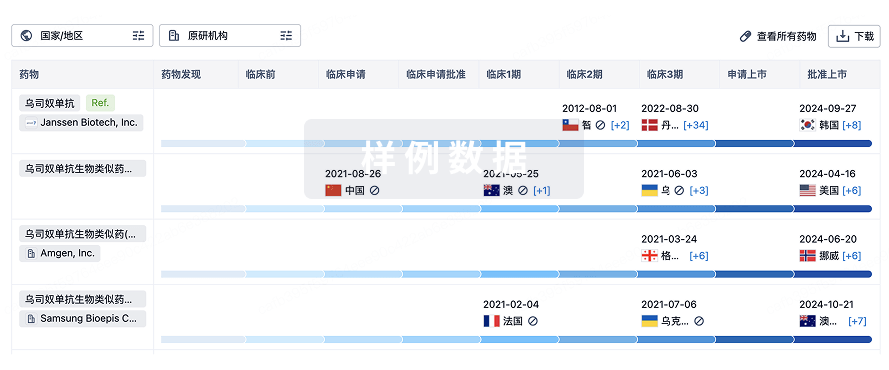
生物类似药
生物类似药在不同国家/地区的竞争态势。请注意临床1/2期并入临床2期,临床2/3期并入临床3期
登录
或
特殊审评
只需点击几下即可了解关键药物信息。
登录
或

提出任何生物医药研究问题
让每一步生物医药决策都精准制胜
基于十亿级生物数据与全球情报的精准 AI,赋能早期药物发现
立即开始免费试用!
智慧芽新药情报库是智慧芽专为生命科学人士构建的基于AI的创新药情报平台,助您全方位提升您的研发与决策效率。
立即接入生物医药数据包
智慧芽新药库数据也通过智慧芽开放平台,以MCP或API服务形式对外开放。立即使用我们的MCP服务定制您的LLM智能体。
生物序列数据库
生物药研发创新
免费使用
化学结构数据库
小分子化药研发创新
免费使用