预约演示
更新于:2026-01-17
PI3Kγ inhibitor(Yangze River Pharmaceutical)
PI3Kγ抑制剂(扬子江药业)
更新于:2026-01-17
概要
基本信息
在研机构 |
非在研机构- |
权益机构- |
最高研发阶段临床前 |
首次获批日期- |
最高研发阶段(中国)临床前 |
特殊审评- |


关联
100 项与 PI3Kγ抑制剂(扬子江药业) 相关的临床结果
登录后查看更多信息
100 项与 PI3Kγ抑制剂(扬子江药业) 相关的转化医学
登录后查看更多信息
100 项与 PI3Kγ抑制剂(扬子江药业) 相关的专利(医药)
登录后查看更多信息
91
项与 PI3Kγ抑制剂(扬子江药业) 相关的文献(医药)2026-12-31·CANCER BIOLOGY & THERAPY
PI3Kγ inhibition drives M1 macrophage differentiation and synergizes with PD-L1 blockade to improve survival in poorly immunogenic head and neck squamous cell carcinoma
Article
作者: Oghumu, Steve ; Lamenza, Felipe F. ; Mo, Xiaokui ; Roth, Peyton ; Ryan, Nathan M. ; Anderson, Kelvin ; Jordanides, Pete P. ; Jagadeesha, Sushmitha ; Kehres, Reegan ; Siddiqui, Arham ; Pracha, Sherefuddin H. ; Shrestha, Suvekshya ; Bopp, Anna R. ; Upadhaya, Puja
BACKGROUND:
Head and neck squamous cell carcinoma (HNSCC) is the sixth most common cancer globally with high mortality rates, highlighting the urgent need for novel therapeutic strategies. We investigated the efficacy of combining phosphoinositide 3-kinase gamma (PI3Kγ) inhibition with programmed death-ligand 1 (PD-L1) blockade in a poorly immunogenic HNSCC model.
MATERIALS AND METHODS:
Mouse bone marrow-derived macrophages (BMDMs) were differentiated and polarized in the presence or absence of the PI3Kγ inhibitor IPI-549 or culture supernatants from MOC2 cells treated with or without IPI-549. MOC2 cells were orthotopically injected into C57BL/6 mice, and treated with anti-PD-L1, IPI-549, combined anti-PD-L1 and IPI-549 or vehicle control. Tumor burden, survival, and immunological responses were evaluated.
RESULTS AND CONCLUSION:
Dual inhibition of PI3Kγ (using IPI-549) and PD-L1 demonstrated nearly significant reduction in primary tumor burden and significantly increased survival compared to single or control treatments. PI3Kγ inhibition promoted macrophage differentiation toward an antitumoral M1 phenotype. In the bone marrow, dual therapy significantly increased MHC-II expression across various myeloid cell subsets and effectively normalized myelopoiesis. Notably, combination therapy increased CD8+ T-cell infiltration into tumors while decreasing T-cell exhaustion marker (LAG-3, CTLA-4, and TIM-3) and protumoral cytokine (IL-4). Combined PI3Kγ and PD-L1 inhibition offers a promising strategy for treating poorly immunogenic HNSCC by simultaneously targeting multiple immunosuppressive mechanisms. These findings provide a strong rationale for combining PI3Kγ and PD-L1 inhibitors as a therapeutic strategy for poorly immunogenic HNSCC, potentially improving clinical outcomes for patients.
2025-11-01·EUROPEAN JOURNAL OF PHARMACOLOGY
Selective PI3Kγ inhibition attenuates chemotherapy-induced intestinal mucositis without compromising the anticancer properties of irinotecan
Article
作者: Lima-Júnior, Roberto César Pereira ; Nobre, Lívia Maria Soares ; Silva, Raiza Lima ; Pereira, Anamaria Falcão ; Cajado, Aurilene Gomes ; Alencar, Nylane Maria Nunes ; Lopes, Marina Helena ; Ferreira, Luana Maria Moura ; Wong, Deysi Viviana Tenazoa ; Alves, Ana Paula Negreiros Nunes ; Quispe, Celia Choquenaira ; Rangel, Gisele Fátima Pinheiro ; Paguada, Ana Lizeth Padilha ; Quintela, Lízias Claudia Sampaio ; Ferreira, Kayanny Queiroz ; Silva, Jussara Matyelle Rodrigues
Irinotecan-based anticancer therapy induces intestinal mucositis, increasing the risk of sepsis and patient death. The phosphoinositide 3-kinases (PI3K) are involved in cancer and inflammatory diseases, but their role in intestinal mucositis remains unknown. C57BL/6 male mice received vehicle (1 % DMSO, 10 ml/kg, p.o.), irinotecan alone or in combination with AS-605240 (a PI3Kγ inhibitor, 10 mg/kg, p.o.) or GSK2269557 (a PI3Kδ inhibitor, 3 mg/kg, p.o.). Histopathology, inflammatory markers, and diarrhea were assessed to evaluate mucositis. The antitumor effect was evaluated in mice inoculated with the Mc-38 colorectal cancer cell line. PI3Kγ inhibition attenuated irinotecan-induced intestinal injury, as evidenced by improved villus/crypt ratio. PI3Kγ inhibition also caused milder neutrophil accumulation, reduced expression of Tlr2, Tlr4, and Tlr9, and decreased levels of interleukin-1β and -6, as well as attenuated immunofluorescence for F4/80, a macrophage marker, and the regulatory T cell transcription factor FOXP3 (P < 0.05 vs. irinotecan). Additionally, AS-605240 prevented goblet cell loss and attenuated diarrhea. Moreover, PI3Kγ inhibition combined with irinotecan showed no synergistic anticancer effects. In contrast, PI3Kδ blockade did not prevent the development of mucositis but rather enhanced neutrophil accumulation in the intestine. PI3Kγ inhibition attenuates chemotherapy-associated intestinal mucositis without compromising the anticancer efficacy of irinotecan. However, selective inhibition of PI3Kδ exacerbates the inflammatory response and tissue damage.
2025-08-01·MOLECULAR DIVERSITY
Enhancing PI3Kγ inhibitor discovery: a machine learning-based virtual screening approach integrating pharmacophores, docking, and molecular descriptors
Article
作者: Yu, Li ; Zhu, Jingyu ; Chen, Yun ; Jin, Jian ; Jia, Lei ; Cai, Yanfei ; Xu, Lei
PI3Kγ is a lipid kinase that is expressed primarily in leukocytes and plays a significant role in tumors, inflammation, and autoimmune diseases. Consequently, considerable attention has been given to the development of pharmacological inhibitors of PI3Kγ. Recently, machine learning-based virtual screening approaches have been increasingly applied in new drug discovery research, potentially providing innovative strategies for the development of PI3Kγ inhibitors. Thus, in this study, we developed a naïve Bayesian classification (NBC) model that integrates molecular descriptors, molecular fingerprints, molecular docking, and pharmacophore models for virtual screening of the PI3Kγ protein. The validation results indicated that the optimal model demonstrated significant potential for differentiating between active and inactive compounds, as well as a reliable ability to identify true PI3Kγ inhibitors with defined biological activity. Additionally, the optimal NBC model provided favorable and unfavorable fragments for PI3Kγ inhibitors, which will help guide the design and discovery of novel PI3Kγ inhibitors. Finally, the optimal NBC model was employed to perform virtual screening on the ChEMBL database, resulting in the identification of several compounds with high potential as PI3Kγ inhibitors. We anticipate that the developed machine learning-based virtual screening approach will offer valuable insights and guidance for the development of novel PI3Kγ inhibitors.
13
项与 PI3Kγ抑制剂(扬子江药业) 相关的新闻(医药)2025-12-28
·有驾
PI3K与癌症治疗
PI3K信号通路的重要性
PI3K,作为一种关键的胞内磷脂酰肌醇激酶,与Src和RAS等癌基因产物紧密相关。该信号通路在人类癌症中频繁被激活,甚至牵涉到约半数恶性肿瘤的发病机制。众多研究揭示,PI3K信号通路的过度活跃会显著推动肿瘤的进展、提升肿瘤微血管密度,以及增强癌细胞的趋化性和侵袭性。因此,PI3K已成为治疗多种恶性肿瘤的关键靶点,涵盖乳腺癌和滤泡性淋巴瘤等众多疾病。尽管如此,针对PI3K的选择性抑制剂研发仍面临诸多挑战,尤其是毒性问题,这在一定程度上限制了其临床应用。尽管如此,全球范围内已经批准了五款PI3K抑制剂,为癌症治疗带来了新的希望。
PI3K抑制剂的种类与挑战
泛PI3K抑制剂
泛PI3K抑制剂,作为三磷酸腺苷(ATP)的竞争性抑制剂,能够同时阻断所有四种I类亚型,从而为限制癌细胞增殖和存活提供了有效手段(见图2)。但这类抑制剂往往缺乏选择性,可能导致整个通路受到非选择性抑制,进而引发严重的不良反应。
Wortmannin和LY294002是第一代泛PI3K抑制剂的代表。尽管LY294002在选择性和稳定性方面仍存在诸多不足,其在50μM的浓度下对PI3Kα、β、γ和δ四种亚型的活性展现出了显著的抑制作用。相比之下,buparisib克服了一些限制,是一种口服生物可利用的I类泛PI3K抑制剂,能够有效地抑制PI3Kα、β、γ和δ亚型。
PI3K异构体选择性抑制剂
针对特定PI3K亚型的抑制剂,提高了安全性和效率。PI3Kα选择性抑制剂包括Serabelisib和Inavolisib,它们在体外研究中对细胞增殖和凋亡有显著的阻断效果。其中,Serabelisib能有效阻断细胞增殖和凋亡,而Inavolisib通过阻碍突变的PI3K信号通路和细胞活力,导致突变p110α蛋白降解。
PI3Kβ选择性抑制剂的目标是针对其在抗血栓及抗肿瘤治疗中的特性。TGX-221及其r-异构体TGX-221-R显示出对PI3Kβ的选择性抑制活性。GSK2636771和SAR260301也在临床试验中取得了一定的进展。
PI3Kγ选择性抑制剂在炎症、呼吸和代谢疾病以及癌症等疾病的治疗中有了显著的发现。喹唑啉-噻唑烷衍生物AS605240和三唑吡啶衍生物CZC24832都是有效的选择性PI3Kγ抑制剂。
PI3Kδ选择性抑制剂在血液系统恶性肿瘤和免疫疾病的治疗中展现出潜力。Idelalisib是首个有效的口服选择性抑制剂,对B细胞、T淋巴细胞、肥大细胞及中性粒细胞的PI3K/PKB/mTOR信号通路至关重要。
双重PI3K抑制剂及应用
双重PI3K抑制剂如Pictilisib在临床试验中展现潜力,为不同癌症提供新治疗选择。在PI3K异构体双重抑制剂中,口服活性Pictilisib和Duvelisib(IPI-145)能够有效抑制两种PI3K异构体,显示出明确的临床应用前景。
研究进展与临床试验
目前,PI3K抑制剂在临床试验中取得进展,新药研发聚焦于提高安全性和有效性。全球范围内,已有五款PI3K抑制剂获得批准,它们分别是吉利德的idelalisib、拜耳的copanlisib(Zydelig)等,为患者带来了新的治疗选择。
新药研发正致力于优化药代动力学特征和毒性特点,以期提供更为安全有效的临床用药方案。正处于临床阶段的多种泛PI3K抑制剂,正在为癌症治疗提供更多选择。
临床结果临床终止
2025-12-15
今天推送的是发表于《Nature Reviews Drug Discovery》的一篇文章,这篇文献的标题为《Integrating QSAR modelling and deep learning in drug discovery: the emergence of deep QSAR》。该文献聚焦深度定量构效关系(deep QSAR) 这一新兴领域 —— 即QSAR建模与深度学习的融合应用。
——研究背景——
起源背景:QSAR建模由Hansch等人于1962年提出,通过量化化学结构与生物活性 / 理化性质的关联,成为计算机辅助药物发现(CADD)的核心工具;2012年 Kaggle 默克分子活性挑战赛首次将深度学习应用于QSAR,2015年首篇相关论文发表后,“deep QSAR” 领域逐步兴起。
发展驱动力:大数据(分子数据库指数级扩张)、计算能力提升(GPU 等硬件发展)及深度学习技术的突破,推动传统QSAR向deep QSAR演进。
——深度QSAR建模基础——
核心区别:传统QSAR依赖人工设计的显式分子描述符(1D-4D),而 deep QSAR以 “分子嵌入” 替代,在高维潜空间中同步完成分子表征学习与性质预测,无需单独的描述符工程。
模型构建:可通过人工经验或进化算法、神经架构搜索设计模型;常用 “百万级无标记分子预训练(如ChEMBL数据库+下游任务微调” 的模式。
核心优势:通过知识迁移更高效处理多目标优化任务,但性能依赖目标间活性相关性。
关键考量:需解决超大数据集的规模化自动整理(如KNIME工作流)、严格的外部验证、模型适用域评估及预测置信度量化(如保形预测方法)等问题。
图1.传统与深度QSAR模型的对比。
——深度QSAR与生成式建模——
1)生成式分子设计
方法分类:规则基方法(基于分子构建块和虚拟反应规则)与无规则基方法(通过深度学习从潜空间采样分子,如GAN、VAE、图神经网络等架构)。
核心流程:分子生成后通过外部QSAR模型评分、强化学习 / 迁移学习优化,或利用生成模型内在概率筛选,部分设计已获实验验证(如RORγ 反向激动剂,IC₅₀ 370 nM;PI3Kγ 抑制剂,Ki 63 nM)。2)合成规划中的深度学习
合成策略:正向合成(从构建块逐步生成目标分子,如DOGS工具)与逆向合成(从目标分子推导前体,分模板基工具如 AiZynthFinder、无模板基方法如序列转换模型)。
关键工具:合成可及性评分(SAscore、SCScore)、反应动力学 / 热力学预测(基于反应浓缩图)、反应条件(溶剂、催化剂)预测模型(准确率达69.6%)。
自动化潜力:可与deep QSAR 整合,构建 “设计-合成-测试-分析” 闭环的自动化药物发现平台。
图2.生成分子设计。
——基于结构筛选中的深度QSAR——
技术演进:从2006年 “渐进式对接”(利用QSAR预测docking得分,加速小规模筛选)发展为 “深度对接(deep docking)”,结合深度学习与2D指纹描述符,适配百亿级分子库筛选。
核心优势:大幅降低计算成本,如用60个CPU核心和4个GPU核心完成14亿分子的SARS-CoV-2 Mpro靶点筛选,效率提升100倍以上。
关键进展:共识对接(整合多软件结果)实现全自动命中化合物筛选(如40亿分子库筛选命中率达13%-23%);多药理学建模通过多任务学习预测分子对多靶点作用(如KinomeX平台实现激酶组-wide 活性预测)。
图3.深潜对接的工作流程。
——展望——
化学空间扩展:“按需合成” 库(如ZINC22含370亿分子)规模持续扩大,deep QSAR为超大规模虚拟筛选提供可行方案,开源工具(如 VirtualFlow)推动技术民主化。
计算效率与精度提升:原子神经网络势(NNPs)如ANI模型,以力场级成本实现量子力学级精度,加速配体结合自由能计算;AIMNet 模型可通过少量数据迁移预测多种分子性质。
量子计算赋能:有望突破量子力学计算瓶颈,优化分子模拟、QSAR描述符设计及机器学习效率,已在靶点发现、生成式建模等场景开展探索。
应用落地:加速早期药物发现,如Exscientia的AI设计药物12个月进入I期临床,Insilico Medicine30个月完成抗纤维化候选药物研发,为新发传染病(如 COVID-19)药物研发提供支撑。
图4.利用深度学习潜力增强的分子模拟,用于配体结合亲和力的计算。
参考文献:
Tropsha A, Isayev O, Varnek A, et al. Integrating QSAR modelling and deep learning in drug discovery: the emergence of deep QSAR[J]. Nature Reviews Drug Discovery, 2024, 23(2): 141-155.
—————————————————————————————————
点击左下角的"阅读原文"即可查看原文章。
2025-12-04
·百度百家
生物制药行业动态一览:创新药物临床试验申请受理情况。聚焦生物制药领域,我们为您追踪最新动态,了解企业资讯。聚焦生物制药领域,我们为您提供一个交流与分享的平台,让您随时了解生物企业的最新信息。通过分析6篇原创内容,深入剖析生物制药行业动态。
❒ 创新药物临床试验受理
聚焦生物制药领域,我们为您追踪行业动态,深入剖析热点话题,并提供一个交流与分享的平台,让您随时了解生物企业最新信息。
❒ 盐酸曲恩汀片进展
Orphalan研发的盐酸曲恩汀片在2022年9月21日已顺利通过国家药品监督管理局药品审评中心(CDE)的上市许可申请受理环节。作为一种螯合剂,曲恩汀专为结合和清除体内铜而设计,是肝豆状核变性的有效治疗药物。自1982年获得FDA批准以来,该药已成为那些无法耐受青霉胺治疗患者的优选,其副作用也相对较轻。肝豆状核变性,又称威尔逊氏病,是一种常染色体隐性遗传病,由ATP7B基因突变引起体内铜离子转运障碍,导致铜在肝脏、神经系统等多处蓄积,引发一系列临床症状。发病者年龄跨度大,从婴儿到老年人都有报道。
❒ OMTX705研究进展
OMTX705在临床前研究中显示出对多种癌症的显著疗效,包括肺癌、乳腺癌和肝癌等。其独特的作用机制和良好的安全性,使得OMTX705有望成为未来癌症治疗的新选择。
❒ TQB2102药物特性
TQB2102注射用溶液,作为一款备受瞩目的候选药物,目前正处于临床研究的关键阶段。TQB2102是一种创新的氘代HER2双抗ADC,其独特之处在于能够特异性结合HER2表达细胞上的HER2的ECD4表位和ECD2表位。通过第一抗原结合片段(scFv)与第二抗原结合片段(Fab)的巧妙设计,TQB2102展现出了对HER2的高亲和力。此外,正大天晴药业集团通过采用氘代技术,成功规避了原研药的专利问题,为患者带来了更多的治疗选择。
❒ LEO 152020临床试验
据悉,LEO 152020是一款口服H4R拮抗剂,专为治疗特应性皮炎而设计。该药物的研究权在2018年8月由JW Pharmaceutical授权给LEO Pharma。多项研究显示,在健康成人中进行的单剂量和重复剂量研究均观察到良好的安全性和耐受性。目前,LEO 152020在美国和欧盟均处于II期临床阶段,正在进行一项随机、三盲、安慰剂对照、多中心的临床试验,旨在评估其治疗中度至重度AD成人的疗效。试验的主要终点是观察湿疹面积和严重程度指数(EASI)从基线到第16周的变化;同时,还将评估患者报告的症状,如瘙痒和失眠。
❒ 南京征祥药物研究
ZX-4081是一种高选择性的PI3Kγ抑制剂,以其独特的抗肿瘤机理脱颖而出。它通过激活肿瘤微环境中的CD8+T细胞并促进巨噬细胞向M1(抗肿瘤)表型转化,从而有效抑制肿瘤的生长和转移。值得一提的是,PI3Kγ的抑制还能帮助克服免疫检查点抑制剂的耐药性。因此,当ZX-4081与PD-1/L1、CTLA4等免疫检查点抑制剂联合使用时,有望为那些对PD1和CTLA4类抑制剂产生耐药性的患者带来新的治疗希望。目前,ZX-4081在美国已进入临床1期,成为全球第二个进入此阶段的PI3Kγ抑制剂。
❒ 重庆精准生物细胞制剂
C-13-60是一种旨在突破实体瘤微环境的CAR-T细胞制剂,其推测靶点为CEA。该制剂在官网数据中显示,其适应症广泛,涵盖结直肠癌、肾癌及食管癌。近期研究显示,CEA-CAR-T技术有望通过高压递送机制提升渗透性,进而增强抗肿瘤活性。
❒ 标新生物GT919开发
GT919是一款靶向IKZF1/3的分子胶降解剂,专为恶性血液肿瘤治疗而设计。标新生物,这家成立于2020年2月的生物医药公司,专注于研发口服蛋白降解小分子药物。自2021年3月正式运营以来,公司已建立起包括人工智能虚拟筛选、体外药效筛选、药代动力学、蛋白质组学以及肿瘤动物药效模型在内的完备药物研发体系。其独特的分子胶降解剂(GLUE)和双机制降解剂(GLUETAC)开发平台,为公司带来了差异化的技术路线和发展战略。
100 项与 PI3Kγ抑制剂(扬子江药业) 相关的药物交易
登录后查看更多信息
研发状态
10 条进展最快的记录, 后查看更多信息
登录
| 适应症 | 最高研发状态 | 国家/地区 | 公司 | 日期 |
|---|---|---|---|---|
| 炎症 | 临床前 | 中国 | 2024-03-07 | |
| 代谢性疾病 | 临床前 | 中国 | 2024-03-07 | |
| 肿瘤 | 临床前 | 中国 | 2024-03-07 |
登录后查看更多信息
临床结果
临床结果
适应症
分期
评价
查看全部结果
| 研究 | 分期 | 人群特征 | 评价人数 | 分组 | 结果 | 评价 | 发布日期 |
|---|
No Data | |||||||
登录后查看更多信息
转化医学
使用我们的转化医学数据加速您的研究。
登录
或
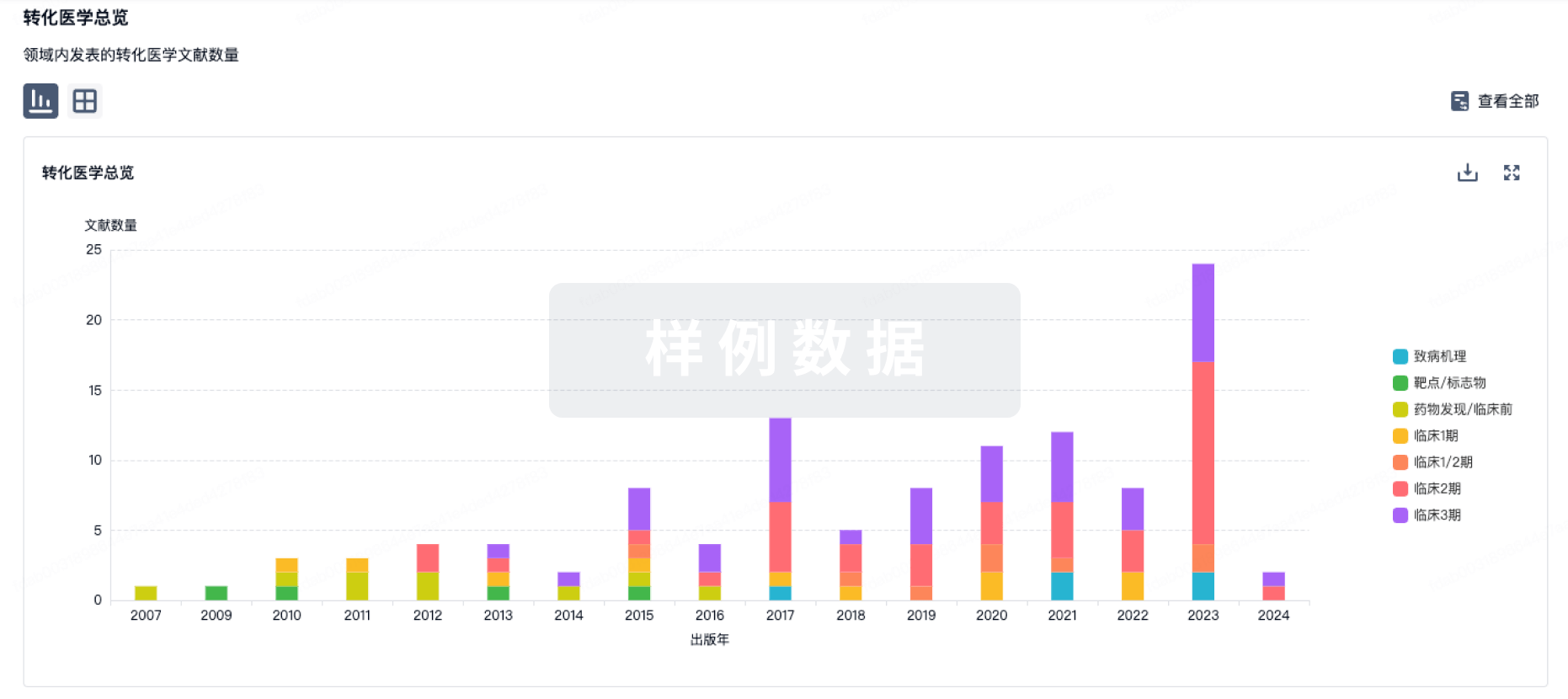
药物交易
使用我们的药物交易数据加速您的研究。
登录
或
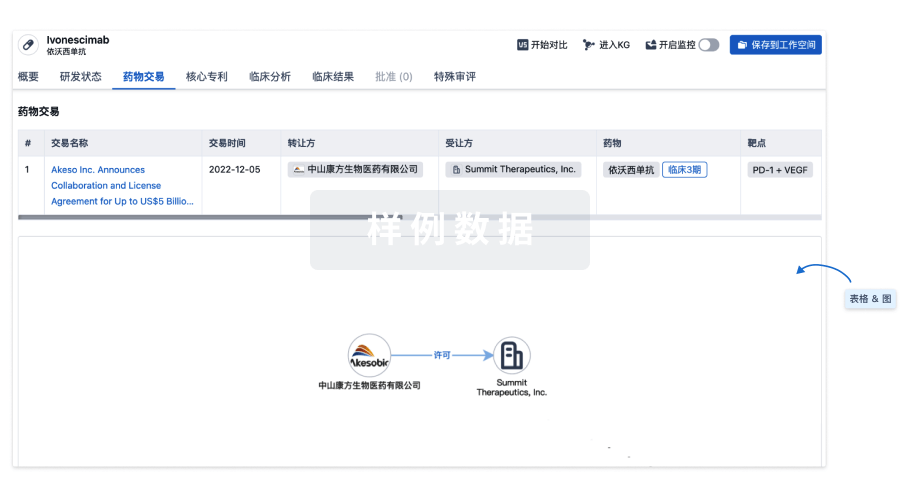
核心专利
使用我们的核心专利数据促进您的研究。
登录
或
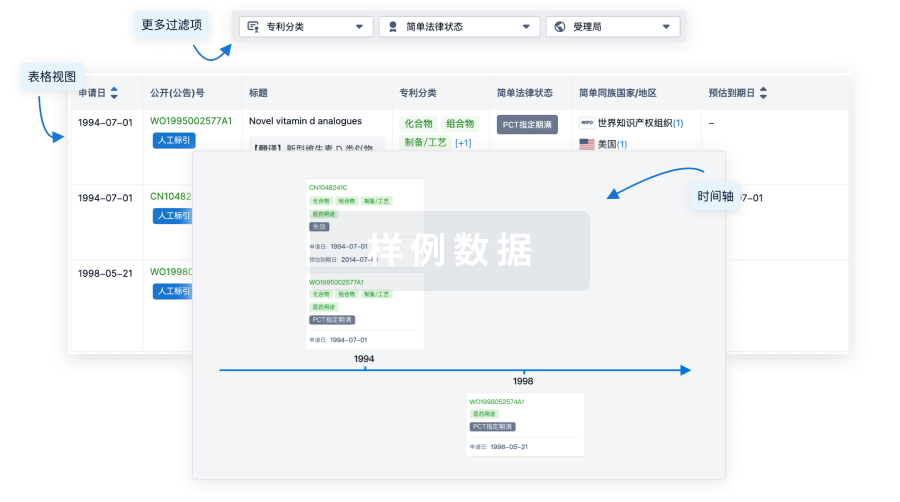
临床分析
紧跟全球注册中心的最新临床试验。
登录
或
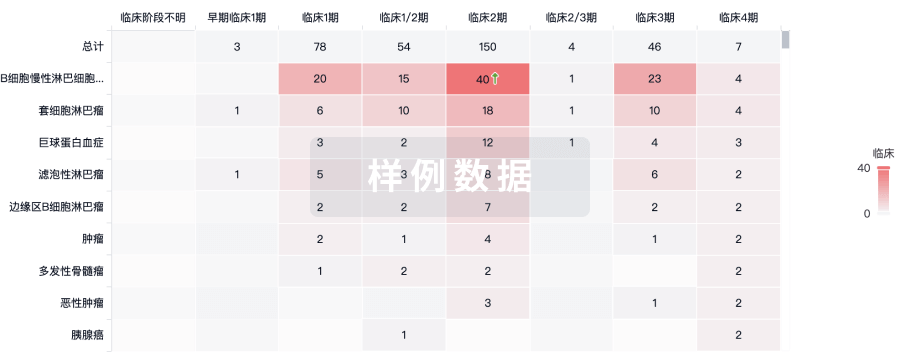
批准
利用最新的监管批准信息加速您的研究。
登录
或
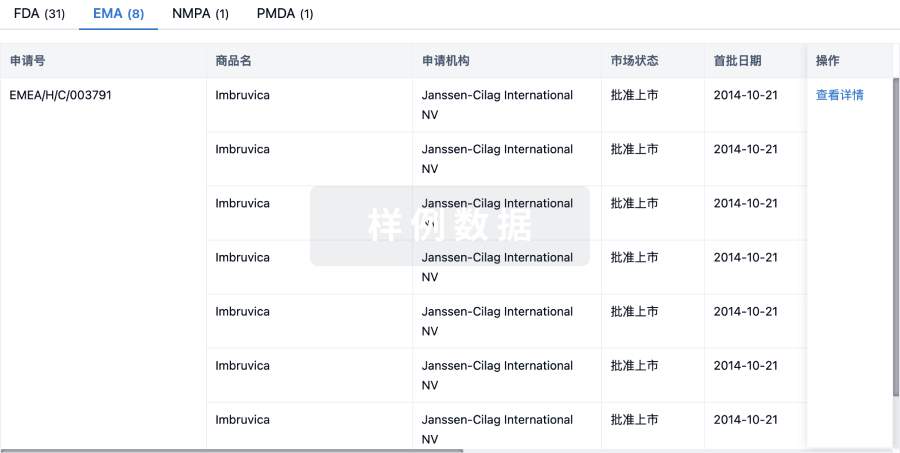
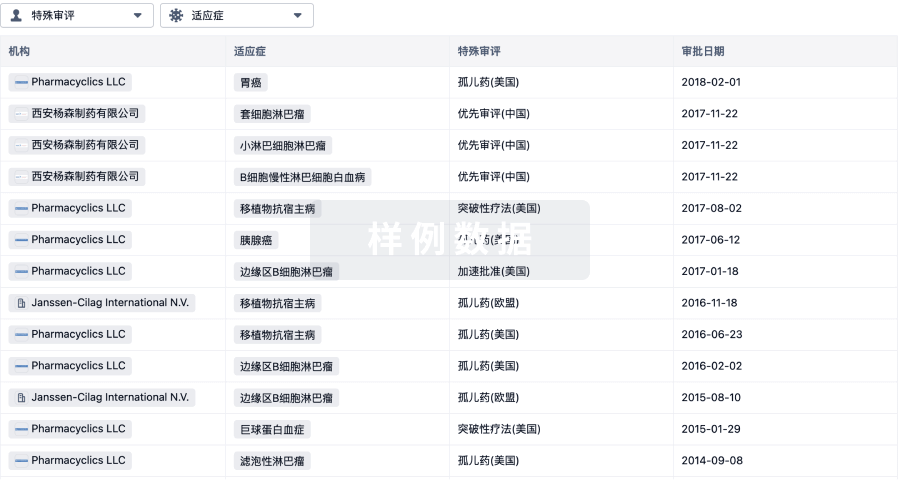
特殊审评
只需点击几下即可了解关键药物信息。
登录
或
提出任何生物医药研究问题
让每一步生物医药决策都精准制胜
基于十亿级生物数据与全球情报的精准 AI,赋能早期药物发现
立即开始免费试用!
智慧芽新药情报库是智慧芽专为生命科学人士构建的基于AI的创新药情报平台,助您全方位提升您的研发与决策效率。
立即接入生物医药数据包
智慧芽新药库数据也通过智慧芽开放平台,以MCP或API服务形式对外开放。立即使用我们的MCP服务定制您的LLM智能体。
生物序列数据库
生物药研发创新
免费使用
化学结构数据库
小分子化药研发创新
免费使用