预约演示
更新于:2026-04-02
Ecleralimab
更新于:2026-04-02
概要
基本信息
在研机构 |
权益机构- |
最高研发阶段临床2期 |
首次获批日期- |
最高研发阶段(中国)- |
特殊审评- |


登录后查看时间轴
结构/序列
Sequence Code 13223996L
来源: *****
Sequence Code 13223998H
来源: *****
关联
4
项与 Ecleralimab 相关的临床试验NCT04882124
A 12-week Randomized, participant-and Investigator-blinded, Placebo-controlled, Parallel Group Study to Explore the Efficacy, Pharmacodynamics, Safety, and Pharmacokinetics of Two Doses of Inhaled CSJ117 in Adults With Chronic Obstructive Pulmonary Disease (COPD)
NCT04946318
A 24-week, Multicenter, Randomized, Double-blind, Parallel-arm, Placebo-controlled Extension Study to Assess the Safety of CSJ117, When Added to Existing Standard of Care Asthma Therapy in Patients ≥18 Years of Age
NCT04410523
A 12-week, Multicenter, Randomized, Double-blind, Parallel-arm, Placebo-controlled Study to Assess the Efficacy and Safety of CSJ117, When Added to Existing Asthma Therapy in Patients ≥ 18 Years of Age With Severe Uncontrolled Asthma.
100 项与 Ecleralimab 相关的临床结果
登录后查看更多信息
100 项与 Ecleralimab 相关的转化医学
登录后查看更多信息
100 项与 Ecleralimab 相关的专利(医药)
登录后查看更多信息
4
项与 Ecleralimab 相关的文献(医药)2024-01-02Expert opinion on investigational drugs
Investigational thymic stromal lymphopoietin inhibitors for the treatment of asthma: a systematic review
Review
作者: Bettin, Federica Roberta ; D’Auria, Maria ; Rogliani, Paola ; Calzetta, Luigino ; Manzetti, Gian Marco
INTRODUCTION:
Severe asthma patients often remain uncontrolled despite high-intensity therapies. Biological therapies targeting thymic stromal lymphopoietin (TSLP), a key player in asthma pathogenesis, have emerged as potential options. Currently, the only TSLP inhibitor approved for the treatment of severe asthma is the immunoglobulin G (IgG) 2λ anti-TSLP monoclonal antibody (mAb) tezepelumab.
AREAS COVERED:
This systematic review assesses the efficacy and safety of investigational TSLP inhibitors across different stages of development for asthma treatment.
EXPERT OPINION:
TSLP contributes to airway inflammation, making it a pivotal therapeutic target. Ecleralimab, an inhaled antibody fragment antigen binding, shows promising evidence in enhancing efficacy and reducing systemic adverse events. SAR443765, with its NANOBODY® formulation and bispecific inhibition of TSLP and IL-13, offers improved tissue penetration and efficacy. The mAB TQC2731 exhibits high in vitro bioactivity, and the strength of the mAb UPB-101 is to act against the TSLP receptor. Some studies include mild and moderate asthma patients, suggesting the potential for extending biological therapy to non-severe patients. This systematic review highlights the potential of TSLP inhibitors as valuable additions to asthma treatment, even in milder forms of the disease. Future research and cost-reduction efforts are needed to expanding access to these promising therapies.
2023-03-01The European respiratory journal
Inhaled anti-TSLP antibody fragment, ecleralimab, blocks responses to allergen in mild asthma
Article
作者: Jones, Ieuan ; Watz, Henrik ; Kornmann, Oliver ; O'Byrne, Paul M ; Hohlfeld, Jens M ; Davis, Beth E ; Leigh, Richard ; Cabanski, Maciej ; Pertel, Peter E ; Korn, Stephanie ; Jain, Monish ; Mayers, Irvin ; Lecot, Jean R ; Cockcroft, Donald W ; Grant, Sarah S ; Boulet, Louis-Philippe ; FitzGerald, J Mark ; Cao, Hui ; Gauvreau, Gail M
Background:
Thymic stromal lymphopoietin (TSLP) is a key upstream regulator driving allergic inflammatory responses. We evaluated the efficacy and safety of ecleralimab, a potent inhaled neutralising antibody fragment against human TSLP, using allergen inhalation challenge (AIC) in subjects with mild atopic asthma.
Methods:
This was a 12-week, randomised, double-blind, placebo-controlled, parallel-design, multicentre allergen bronchoprovocation study conducted at 10 centres across Canada and Germany. Subjects aged 18–60 years with stable mild atopic asthma were randomised (1:1) to receive 4 mg once-daily inhaled ecleralimab or placebo. Primary end-points were the allergen-induced change in forced expiratory volume in 1 s (FEV1) during the late asthmatic response (LAR) measured by area under the curve (AUC3–7h) and maximum percentage decrease (LAR%) on day 84, and the safety of ecleralimab. Allergen-induced early asthmatic response (EAR), sputum eosinophils and fractional exhaled nitric oxide (FENO) were secondary and exploratory end-points.
Results:
28 subjects were randomised to ecleralimab (n=15) or placebo (n=13). On day 84, ecleralimab significantly attenuated LAR AUC3–7hby 64% (p=0.008), LAR% by 48% (p=0.029), and allergen-induced sputum eosinophils by 64% at 7 h (p=0.011) and by 52% at 24 h (p=0.047) post-challenge. Ecleralimab also numerically reduced EAR AUC0–2h(p=0.097) and EAR% (p=0.105).FENOlevels were significantly reduced from baseline throughout the study (p<0.05), except at 24 h post-allergen (day 43 and day 85). Overall, ecleralimab was safe and well tolerated.
Conclusion:
Ecleralimab significantly attenuated allergen-induced bronchoconstriction and airway inflammation, and was safe in subjects with mild atopic asthma.
2023-02-01Pulmonary pharmacology & therapeutics
Development of an inhaled anti-TSLP therapy for asthma
Review
作者: Altman, Pablo ; Panettieri, Reynold A ; O'Byrne, Paul M ; Taube, Christian ; Brindicci, Caterina ; Fleming, Margaret
Thymic stromal lymphopoietin (TSLP), an epithelial cell-derived cytokine, acts as a key mediator in airway inflammation and modulates the function of multiple cell types, including dendritic cells and group 2 innate lymphoid cells. TSLP plays a role in asthma pathogenesis as an upstream cytokine, and data suggest that TSLP blockade with the anti-TSLP monoclonal antibody, tezepelumab, could be efficacious in a broad asthma population. Currently approved asthma biologic therapies target allergic or eosinophilic disease and require phenotyping; therefore, an unmet need exists for a therapy that can address Type 2 (T2)-high and T2-low inflammation in asthma. All currently approved biologic treatments are delivered intravenously or subcutaneously; an inhaled therapy route that allows direct targeting of the lung with reduced systemic impact may offer advantages. Currently in development, ecleralimab (CSJ117) represents the first inhaled anti-TSLP antibody fragment that binds soluble TSLP and prevents TSLP receptor activation, thereby inhibiting further inflammatory signalling cascades. This anti-TSLP antibody fragment is being developed for patients with severe uncontrolled asthma despite standard of care inhaled therapy. A Phase IIa proof of concept study, using allergen bronchoprovocation as a model for asthma exacerbations, found that ecleralimab was well-tolerated and reduced allergen-induced bronchoconstriction in adult patients with mild asthma. These results suggest ecleralimab may be a promising, new therapeutic class for asthma treatment.
100 项与 Ecleralimab 相关的药物交易
登录后查看更多信息
研发状态
10 条进展最快的记录, 后查看更多信息
登录
| 适应症 | 最高研发状态 | 国家/地区 | 公司 | 日期 |
|---|---|---|---|---|
| 慢性阻塞性肺疾病 | 临床2期 | 美国 | 2021-09-24 | |
| 慢性阻塞性肺疾病 | 临床2期 | 日本 | 2021-09-24 | |
| 慢性阻塞性肺疾病 | 临床2期 | 澳大利亚 | 2021-09-24 | |
| 慢性阻塞性肺疾病 | 临床2期 | 加拿大 | 2021-09-24 | |
| 慢性阻塞性肺疾病 | 临床2期 | 捷克 | 2021-09-24 | |
| 慢性阻塞性肺疾病 | 临床2期 | 匈牙利 | 2021-09-24 | |
| 哮喘 | 临床2期 | 美国 | 2020-09-09 | |
| 哮喘 | 临床2期 | 日本 | 2020-09-09 | |
| 哮喘 | 临床2期 | 阿根廷 | 2020-09-09 | |
| 哮喘 | 临床2期 | 比利时 | 2020-09-09 |
登录后查看更多信息
临床结果
临床结果
转化医学
使用我们的转化医学数据加速您的研究。
登录
或

药物交易
使用我们的药物交易数据加速您的研究。
登录
或

核心专利
使用我们的核心专利数据促进您的研究。
登录
或

临床分析
紧跟全球注册中心的最新临床试验。
登录
或

批准
利用最新的监管批准信息加速您的研究。
登录
或

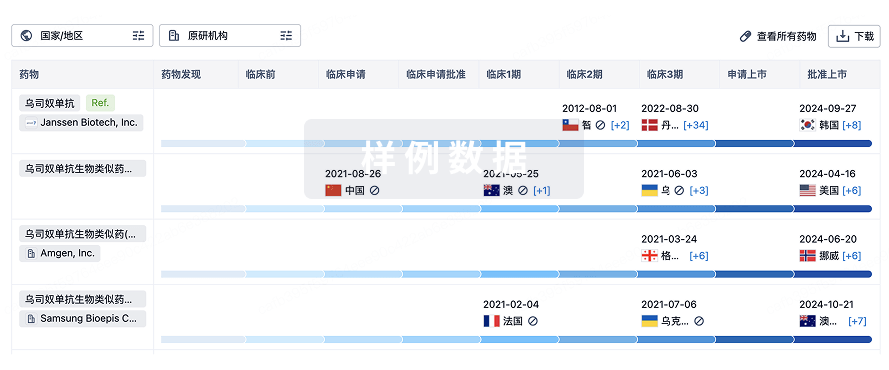
生物类似药
生物类似药在不同国家/地区的竞争态势。请注意临床1/2期并入临床2期,临床2/3期并入临床3期
登录
或
特殊审评
只需点击几下即可了解关键药物信息。
登录
或

提出任何生物医药研究问题
让每一步生物医药决策都精准制胜
基于十亿级生物数据与全球情报的精准 AI,赋能早期药物发现
立即开始免费试用!
智慧芽新药情报库是智慧芽专为生命科学人士构建的基于AI的创新药情报平台,助您全方位提升您的研发与决策效率。
立即接入生物医药数据包
智慧芽新药库数据也通过智慧芽开放平台,以MCP或API服务形式对外开放。立即使用我们的MCP服务定制您的LLM智能体。
生物序列数据库
生物药研发创新
免费使用
化学结构数据库
小分子化药研发创新
免费使用