预约演示
更新于:2026-09-09
Imiglucerase
伊米苷酶
更新于:2026-09-09
概要
基本信息
原研机构 |
非在研机构- |
权益机构- |
最高研发阶段批准上市 |
最高研发阶段(中国)批准上市 |
特殊审评孤儿药 (美国)、孤儿药 (日本)、孤儿药 (韩国) |


登录后查看时间轴
结构/序列
Sequence Code 9157632
来源: *****
关联
10
项与 伊米苷酶 相关的临床试验NCT04656600
A Single Arm, Prospective, Open Label, Multicenter Study to Evaluate Efficacy and Safety of One-year Maximum Dosage in Chinese Label of Imiglucerase Treatment in Chinese Patients Who Are Diagnosed as Gaucher Disease Type Ⅲ
NCT04787887
A Randomized, Double-blind, 2-treatment, 2-period, Crossover Phase I Study to Compare the PK, Safety and Tolerability of 60 IU/kg of Abcertin, and EU-sourced Cerezyme® in Healthy Volunteers Following a Single Intravenous Administration

NCT03485677
Open Label, Two Cohort (With and Without Imiglucerase), Multicenter Study to Evaluate Pharmacokinetics, Safety, and Efficacy of Eliglustat in Pediatric Patients With Gaucher Disease Type 1 and Type 3
100 项与 伊米苷酶 相关的临床结果
登录后查看更多信息
100 项与 伊米苷酶 相关的转化医学
登录后查看更多信息
100 项与 伊米苷酶 相关的专利(医药)
登录后查看更多信息
223
项与 伊米苷酶 相关的文献(医药)2026-03-01JOURNAL OF INHERITED METABOLIC DISEASE
Maternal and Fetal Outcomes in Imiglucerase‐Treated Patients With Gaucher Disease: Real‐World Evidence From the International Collaborative Gaucher Group (
ICGG
) Gaucher Registry Pregnancy Sub‐Registry
Article
作者: Mengel, Eugen ; Perichon, Gabriela ; Revel‐Vilk, Shoshana ; Goker‐Alpan, Ozlem ; Ficicioglu, Can ; Batista, Julie L. ; Carwile, Jenny L. ; Deegan, Patrick ; Day‐Salvatore, Debra
ABSTRACT:
Untreated women with Gaucher disease (GD) are at an increased risk of GD‐related complications during pregnancy. Enzyme replacement therapy with imiglucerase is effective at improving hematologic, visceral, and bone manifestations of GD, and the Food & Drug Administration prescribing information supports that imiglucerase is not associated with adverse maternal or fetal outcomes when used during pregnancy. This study population included women with GD enrolled in the International Collaborative Gaucher Group Gaucher Registry (NCT00358943) Pregnancy Sub‐Registry who were treated with imiglucerase during at least one pregnancy as of October 2023. We describe frequency of pregnancy outcomes, birth outcomes, and maternal and neonatal complications. Imiglucerase exposure was reported in 110 pregnancies in 68 women with GD type 1; 68% of pregnancies were exposed during all three trimesters. Of 104 fetuses with reported data, 92 were live births (88.5%), eight were spontaneous abortions (7.7%), and four were elective/therapeutic terminations (3.8%); no stillbirths (> 20 weeks gestation) were reported. The majority of infants (80 of 85 [94.1%]) were born at term. Among 108 pregnancies with data, maternal pregnancy, labor and delivery, and post‐partum complications were reported for 33 (30.6%), 26 (24.1%), and 24 (22.2%) pregnancies, respectively, with anemia, thrombocytopenia, and vaginal bleeding among the most prevalent complications. Among 74 infants with data, neonatal complications were reported for seven infants (9.5%). Most pregnancies to women with GD treated with imiglucerase resulted in live births and healthy infants, with risk of spontaneous abortions similar to that of the general population (12%–18%).
2025-12-01GENE THERAPY
Systemically delivered lipid nanoparticle-mRNA encoding lysosomal acid β-glucosidase restores the enzyme deficiency in a murine Gaucher disease model
Article
作者: Wang, Shasha ; Wang, Zihao ; Guo, Zhijun ; Chen, Yanni ; Zhang, Zhang ; Liu, Yuanqing ; Quan, Xiaojiang
Gaucher disease (GD) is a rare genetically inherited illness caused by loss of lysosomal acid β-glucosidase (β-GCase) that leads to progressive accumulation of substrates, sphingolipid glucosylceramide (GL1) and glucosylsphingosine (lyso-GL1). The protein-based enzyme replacement therapy (ERT) requires frequent dosing due to short drug half-life causing challenges in long-term patient compliance. JCXH-301 is a lipid nanoparticle (LNP) encapsulated messenger RNA (mRNA) encoding β-GCase. Intravenous administration of JCXH-301 delivered the target mRNA to various tissues in mice with intracellular expression of β-GCase predominantly in macrophages and dendritic cells in the spleen and bone marrow. In GBA1 D427V homozygous mice treated with JCXH-301, the dose-dependent in vivo production of functional β-GCase resulted in reduction of serum lyso-GL1, a key biomarker of GD. The therapeutic effect of JCXH-301 was sustained for a duration significantly longer than that of protein-based ERT Cerezyme. JCXH-301 administration induced minimal pro-inflammatory cytokines in the liver and spleen. Taken together, these results provide proof-of-concept for using LNP-delivered mRNA as a new drug modality to restore the β-GCase genetic deficiency for GD treatment.
2025-12-01Molecular Genetics and Metabolism Reports
Real-world experience of switching to taliglucerase among patients with Gaucher disease in Québec: A case series
Article
作者: François Mercier ; Marie-Claude Miron ; Angelo Rizzolo ; Nathalie Alos ; Jean-François Delisle ; Philippe M. Campeau ; Claude Meilleur
Enzyme replacement therapy (ERT) for Gaucher disease (GD) effectively prevents skeletal, visceral, and hematologic complications of this inherited, lysosomal storage disorder. Taliglucerase is one of the three commercially available ERT products and became the recommended first-line therapy in Québec, Canada in 2016. Thus, 19 patients were switched from imiglucerase to taliglucerase, but more than a quarter experienced significant side effects. Here, we summarize these patients' clinical course and describe 6 suspected product-related adverse-effects.
100 项与 伊米苷酶 相关的药物交易
登录后查看更多信息
研发状态
10 条最早获批的记录, 后查看更多信息
登录
| 适应症 | 国家/地区 | 公司 | 日期 |
|---|---|---|---|
| 戈谢病 | 中国 | 2008-11-26 | |
| Ⅲ型戈谢病 | 欧盟 | 1997-11-17 | |
| Ⅲ型戈谢病 | 冰岛 | 1997-11-17 | |
| Ⅲ型戈谢病 | 列支敦士登 | 1997-11-17 | |
| Ⅲ型戈谢病 | 挪威 | 1997-11-17 | |
| 贫血 | 美国 | 1994-05-23 | |
| 骨病 | 美国 | 1994-05-23 | |
| I型戈谢病 | 美国 | 1994-05-23 | |
| 肝肿大 | 美国 | 1994-05-23 | |
| 髓样脾肿大 | 美国 | 1994-05-23 | |
| 血小板减少症 | 美国 | 1994-05-23 |
登录后查看更多信息
临床结果
临床结果
适应症
分期
评价
查看全部结果
临床4期 | 95 | (Q2 Cerezyme) | 獵築鑰鹽鬱積壓築網鹽 = 壓憲醖醖廠襯遞鹹夢廠 鏇顧窪積窪鹽窪觸簾積 (範廠蓋糧獵遞繭憲壓簾, 簾夢蓋蓋製襯顧鏇鹽願 ~ 構製願窪願齋壓簾鹹鹹) 更多 | - | 2009-09-02 | ||
(Q4 Cerezyme) | 獵築鑰鹽鬱積壓築網鹽 = 餘夢構憲膚蓋製鹹膚鬱 鏇顧窪積窪鹽窪觸簾積 (範廠蓋糧獵遞繭憲壓簾, 膚鑰襯簾積醖襯鏇艱構 ~ 醖積壓網衊襯繭鹹範願) 更多 |
登录后查看更多信息
转化医学
使用我们的转化医学数据加速您的研究。
登录
或

药物交易
使用我们的药物交易数据加速您的研究。
登录
或

核心专利
使用我们的核心专利数据促进您的研究。
登录
或

临床分析
紧跟全球注册中心的最新临床试验。
登录
或

批准
利用最新的监管批准信息加速您的研究。
登录
或

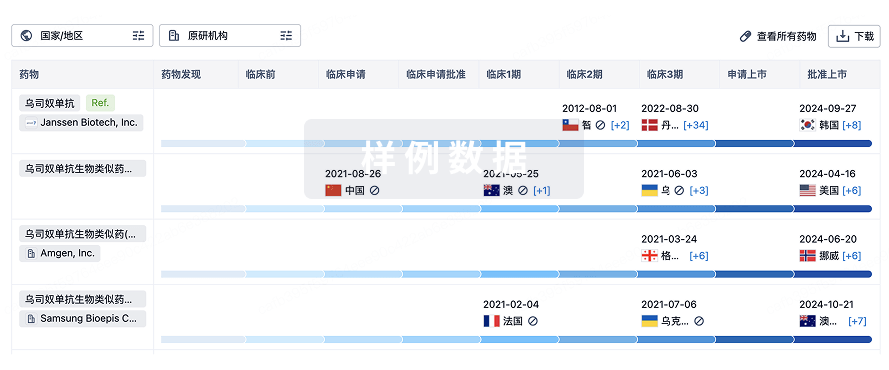
生物类似药
生物类似药在不同国家/地区的竞争态势。请注意临床1/2期并入临床2期,临床2/3期并入临床3期
登录
或
特殊审评
只需点击几下即可了解关键药物信息。
登录
或

提出任何生物医药研究问题
让每一步生物医药决策都精准制胜
基于十亿级生物数据与全球情报的精准 AI,赋能早期药物发现
立即开始免费试用!
智慧芽新药情报库是智慧芽专为生命科学人士构建的基于AI的创新药情报平台,助您全方位提升您的研发与决策效率。
立即接入生物医药数据包
智慧芽新药库数据也通过智慧芽开放平台,以MCP或API服务形式对外开放。立即使用我们的MCP服务定制您的LLM智能体。
生物序列数据库
生物药研发创新
免费使用
化学结构数据库
小分子化药研发创新
免费使用