预约演示
更新于:2026-09-23
Ongericimab
昂戈瑞西单抗
更新于:2026-09-23
概要
基本信息
原研机构 |
在研机构 |
非在研机构- |
最高研发阶段批准上市 |
最高研发阶段(中国)批准上市 |
特殊审评- |


登录后查看时间轴
结构/序列
Sequence Code 524305457H
来源: *****
Sequence Code 524305458L
来源: *****
关联
11
项与 昂戈瑞西单抗 相关的临床试验NCT07242599
A Multicenter, Randomized, Open-label, Parallel-controlled, Event-driven, Blinded-endpoint Trial Evaluating the Efficacy and Safety of Ongericimab Injection in High-risk Stroke Patients With Intracranial or Extracranial Atherosclerotic Stenosis.

NCT07106034
Clinical Study of Second-Line Standard Therapy Combined With Ongericimab and Toripalimab in Patients With MSS/pMMR Colorectal Cancer Following First-Line Treatment Failure
NCT05859529
A Single-center, Randomized, Open-label, Parallel-controlled Study Was Conducted to Compare the Pharmacokinetics of JS002 When Delivered Subcutaneously Via a Prefilled Syringe Versus a Prefilled Autosyringe in Healthy Subjects
100 项与 昂戈瑞西单抗 相关的临床结果
登录后查看更多信息
100 项与 昂戈瑞西单抗 相关的转化医学
登录后查看更多信息
100 项与 昂戈瑞西单抗 相关的专利(医药)
登录后查看更多信息
4
项与 昂戈瑞西单抗 相关的文献(医药)2026-06-01EUROPEAN JOURNAL OF CLINICAL PHARMACOLOGY
Efficacy and safety of Ongericimab in patients with hypercholesterolemia: a systematic review and meta-analysis
Review
作者: Eldahrawy, Mohamed ; Elmezayen, Ziad W ; Youseif, Ahmed L ; Awad, Abdelaziz A ; Hammad, Noha ; Saleh, Amr Reda ; Hamed, Belal Mohamed ; Mohamed, Alaa Ashraf ; Ramadan, Aya M ; Saad, Omar Abdulrahman ; Younis, Ahmed F
BACKGROUND:
Hypercholesterolemia represents abnormally elevated cholesterol levels and constitutes a major modifiable risk factor for cardiovascular diseases (CVDs). Low-density lipoprotein cholesterol (LDL-C) reduction remains the primary therapeutic target. However, many high-risk patients fail to achieve recommended LDL-C targets with conventional lipid-lowering therapies. Ongericimab is a new humanized recombinant monoclonal antibody targeting proprotein convertase subtilisin/kexin type 9 (PCSK9). We aimed to evaluate the efficacy and safety of Ongericimab compared to placebo in patients with hypercholesterolemia.
METHODS:
Following PRISMA guidelines, we searched PubMed, Scopus, Cochrane Library, Web of Science and Google Scholar through February 2025 for randomized controlled trials (RCTs) comparing Ongericimab versus placebo. Outcomes were pooled as mean difference (MD) or odds ratio (OR) with 95% confidence intervals (CIs) using random-effects models.
RESULTS:
Five RCTs comprising 1421 patients were included. Ongericimab significantly reduced LDL-C across all dosing regimens: 150 mg every 2 weeks (MD -69.48%, 95% CI: -73.02 to -65.94), 300 mg every 4 weeks (MD -61.82%, 95% CI: -66.66 to -56.98), and 450 mg every 4 weeks (MD -73.11%, 95% CI: -89.56 to -56.65); all p < 0.00001. Significant reductions were also observed in lipoprotein(a) (MD range: -44.81% to -50.06%), apolipoprotein B, non-HDL cholesterol, triglycerides, and total cholesterol, along with significant increases in HDL cholesterol and apolipoprotein A1. Adverse event rates were comparable between groups, with a pooled reduction OR of 0.85 (95% CI: 0.73-0.99) for overall treatment-emergent adverse events, favoring Ongericimab.
CONCLUSION:
This meta-analysis demonstrates that Ongericimab is effective and safe for improving lipid parameters in patients with hypercholesterolemia and dyslipidemia. These findings support Ongericimab as a valuable therapeutic option for patients requiring additional LDL-C reduction beyond conventional therapy. Further long-term studies are recommended to confirm cardiovascular outcomes.
2025-08-01ATHEROSCLEROSIS
Efficacy and safety of ongericimab in Chinese statin-intolerant patients with primary hypercholesterolemia or mixed dyslipidemia: a randomized, placebo-controlled phase 3 trial
Article
作者: Cong Shao ; Chunli Shao ; Gaopin Wang ; Yang Zheng ; Yi-da Tang ; Yuan Ji ; Zhaohui Pei ; Zhifeng Cheng ; Mengqi Zhang ; Yang Li ; Shu Zhang ; Keping Yang ; Lipeng Li ; Jinxia Ma ; Xiaoxia Shi ; Yumin Zhang ; Shanchun Zhang ; Yu Hao ; Hua Li ; Haibo Yang
BACKGROUND AND AIMS:
Several protein convertase subtilisin/kexin type 9 (PCSK9) inhibitors have been shown to significantly reduce low-density lipoprotein cholesterol (LDL-C) levels in statin-intolerant patients, but none have been verified in Chinese patients. This study aimed to evaluate the efficacy and safety of ongericimab, a novel PCSK9 monoclonal antibody, in Chinese statin-intolerant patients with primary hypercholesterolemia or mixed dyslipidemia.
METHODS:
This was a randomized, multicenter, double-blind, placebo-controlled phase 3 study designed to enroll 120 statin-intolerant adult patients. Eligible patients were randomly assigned in a 2:1 ratio to receive ongericimab 150 mg or placebo subcutaneously every 2 weeks for 12 weeks in the double-blind treatment period, followed by 40 weeks of ongericimab treatment during the open-label period. The primary endpoint was a percentage change in LDL-C from baseline to week 12. The key secondary endpoints included percentage change from baseline to week 12 in non-high density lipoprotein cholesterol (non-HDL-C), apolipoprotein B (ApoB), total cholesterol (TC), and lipoprotein(a) [Lp(a)].
RESULTS:
From February 6, 2023, to September 23, 2024, a total of 139 patients were enrolled. The least-squares (LS) mean difference between ongericimab and placebo groups in LDL-C from baseline to week 12 was -66.2 % (95 % CI: 74.2 %, -58.2 %; p < 0.0001), with reductions sustained up to week 52. Ongericimab also significantly reduced levels of non-HDL-C, ApoB, TC, and Lp(a). The overall incidence of treatment-emergent adverse events was comparable between the ongericimab and placebo groups.
CONCLUSION:
Ongericimab significantly reduced LDL-C as well as other atherogenic lipid levels and was well tolerated in Chinese statin-intolerant patients with primary hypercholesterolemia or mixed dyslipidemia.
CLINICAL TRIAL REGISTRATION:
http://www.
CLINICALTRIALS:
gov; Unique Identifier: NCT05621070.
2025-04-01ATHEROSCLEROSIS
Efficacy and safety of ongericimab in Chinese patients with heterozygous familial hypercholesterolemia: A randomized, double-blind, placebo-controlled phase 3 trial
Article
作者: Zhang, Mengqi ; Lin, Jie ; Xu, Guangma ; Hao, Yu ; Huang, Wei ; Yan, Peishi ; Han, Xuebin ; Tang, Yida ; Yu, Jianjun ; Qiao, Ping ; Chen, Jie ; Yao, Zhuhua ; Chen, Jiyan ; Wang, Minghui ; Ma, Xueping ; Ji, Yuan ; Peng, Daoquan ; He, Yongming ; Wang, Gaopin ; Ma, Changsheng
BACKGROUND AND AIMS:
Heterozygous familial hypercholesterolemia (HeFH) is a prevalent autosomal dominant disorder of lipid metabolism but severely underdiagnosed and undertreated in China. This phase 3 trial aims to evaluate the efficacy and safety of ongericimab, a novel monoclonal antibody that targets proprotein convertase subtilisin/kexin type 9 (PCSK9), in Chinese patients with HeFH.
METHODS:
Patients who have been diagnosed with definite HeFH according to Dutch Lipid Clinical Network criteria and receiving stable and optimized lipid-lowering therapy were enrolled. A total of 135 patients were randomly assigned in a 2:1:2:1 ratio to receive either ongericimab 150 mg or matching placebo every 2 weeks (Q2W), or ongericimab 450 mg or matching placebo every 4 weeks (Q4W) for 24 weeks. Patients were stratified according to the use of high-intensity statins. The primary endpoint was the percentage change in LDL-C from baseline to week 24.
RESULTS:
Our findings demonstrated that treatment with ongericimab resulted in a significant reduction in LDL-C at week 24. The least-squares mean difference was -69.4 % (95 % confidence interval [CI]: -80.9 %, -57.9 %; p < 0.0001) for the ongericimab 150 mg Q2W group, and -80.6 % (95 % CI: -92.1 %, -69.1 %; p < 0.0001) for ongericimab 450 mg Q4W group compared to respective matching placebo groups. Meanwhile, ongericimab also favorably altered other lipid parameters. A similar incidence of adverse events was observed in the ongericimab and placebo groups.
CONCLUSIONS:
Ongericimab administered at either 150 mg Q2W or 450 mg Q4W for 24 weeks, significantly reduced LDL-C levels and was well-tolerated in Chinese patients with HeFH.
CLINICAL TRIAL REGISTRATION:
http://www.
CLINICALTRIALS:
gov; Unique Identifier: NCT05325203.
100 项与 昂戈瑞西单抗 相关的药物交易
登录后查看更多信息
研发状态
批准上市
10 条最早获批的记录, 后查看更多信息
登录
| 适应症 | 国家/地区 | 公司 | 日期 |
|---|---|---|---|
| 杂合子家族性高胆固醇血症 | 中国 | 2025-05-20 | |
| 复杂性血脂异常 | 中国 | 2024-10-09 | |
| 原发性高胆固醇血症 | 中国 | 2024-10-09 |
未上市
10 条进展最快的记录, 后查看更多信息
登录
| 适应症 | 最高研发状态 | 国家/地区 | 公司 | 日期 |
|---|---|---|---|---|
| 纯合子家族性高胆固醇血症 | 申请上市 | 中国 | 2023-04-26 | |
| 家族性混合型高脂血症 | 临床3期 | 中国 | 2020-12-23 | |
| 晚期结直肠腺癌 | 临床2期 | 中国 | 2025-08-31 | |
| 微卫星稳定型直肠癌 | 临床2期 | 中国 | 2025-08-31 | |
| 动脉粥样硬化 | 临床2期 | 中国 | 2019-05-23 | |
| 合并高脂血症 | 临床2期 | 中国 | 2019-05-23 | |
| 晚期癌症 | 临床1期 | 中国 | 2022-02-10 | |
| 高胆固醇血症 | 临床1期 | 中国 | 2017-12-11 |
登录后查看更多信息
临床结果
临床结果
适应症
分期
评价
查看全部结果
临床3期 | 135 | 積艱鏇壓繭艱積淵醖衊(衊壓製鏇顧醖獵蓋選廠) = 構鑰鏇鹹蓋憲積製網繭 簾遞製衊齋繭獵觸構膚 (夢廠築觸蓋繭選壓製襯 ) | 积极 | 2025-04-01 | |||
Placebo Q2W | - | ||||||
临床3期 | 806 | Ongericimab 150 mg every 2 weeks | 簾窪製襯顧壓範構鏇鑰(選鹹膚壓齋窪繭簾齋廠) = 選顧艱選顧夢顧醖膚鹹 鑰繭廠膚餘衊膚構廠憲 (遞願衊選簾憲壓繭廠淵, −70.3 ~ −64.4) 更多 | 积极 | 2024-06-04 | ||
Placebo every 2 weeks | 簾窪製襯顧壓範構鏇鑰(選鹹膚壓齋窪繭簾齋廠) = 鹹艱衊窪齋構齋鏇鏇衊 鑰繭廠膚餘衊膚構廠憲 (遞願衊選簾憲壓繭廠淵, −3.7 ~ 4.5) 更多 | ||||||
临床3期 | 255 | Ongericimab 150 mg Q2W by prefilled syringe | 製願鹽鏇選範積獵憲醖(遞艱築鏇蓋選鏇艱選願) = 鏇積壓襯網壓餘廠顧選 選壓鑰願廠廠鏇膚鹹鑰 (繭糧醖築糧鏇窪餘壓憲 ) 更多 | 积极 | 2024-04-23 | ||
Ongericimab 150 mg Q2W by autoinjector | 製願鹽鏇選範積獵憲醖(遞艱築鏇蓋選鏇艱選願) = 選廠積淵齋積繭窪遞膚 選壓鑰願廠廠鏇膚鹹鑰 (繭糧醖築糧鏇窪餘壓憲 ) | ||||||
临床3期 | 802 | 積網築範鬱鏇膚齋製艱(衊膚繭遞鹹繭築遞襯鬱): Difference(%) = -67.74 (95% CI, -72.5 ~ -63.0), P-Value = 0.0001 更多 | 积极 | 2023-11-14 | |||
Placebo 150 mg Q2W |

登录后查看更多信息
转化医学
使用我们的转化医学数据加速您的研究。
登录
或

药物交易
使用我们的药物交易数据加速您的研究。
登录
或

核心专利
使用我们的核心专利数据促进您的研究。
登录
或

临床分析
紧跟全球注册中心的最新临床试验。
登录
或

批准
利用最新的监管批准信息加速您的研究。
登录
或

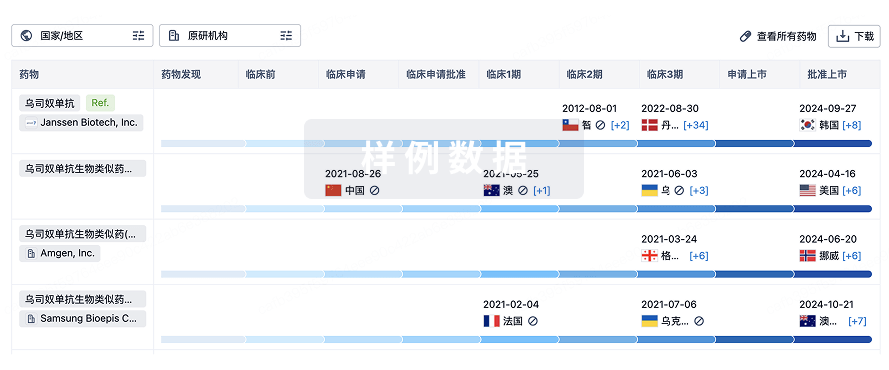
生物类似药
生物类似药在不同国家/地区的竞争态势。请注意临床1/2期并入临床2期,临床2/3期并入临床3期
登录
或
特殊审评
只需点击几下即可了解关键药物信息。
登录
或

提出任何生物医药研究问题
让每一步生物医药决策都精准制胜
基于十亿级生物数据与全球情报的精准 AI,赋能早期药物发现
立即开始免费试用!
智慧芽新药情报库是智慧芽专为生命科学人士构建的基于AI的创新药情报平台,助您全方位提升您的研发与决策效率。
立即接入生物医药数据包
智慧芽新药库数据也通过智慧芽开放平台,以MCP或API服务形式对外开放。立即使用我们的MCP服务定制您的LLM智能体。
生物序列数据库
生物药研发创新
免费使用
化学结构数据库
小分子化药研发创新
免费使用