预约演示
更新于:2026-08-29
REP-2139
更新于:2026-08-29
概要
基本信息
原研机构 |
在研机构 |
非在研机构- |
权益机构- |
最高研发阶段临床2期 |
首次获批日期- |
最高研发阶段(中国)- |
特殊审评- |

登录后查看时间轴
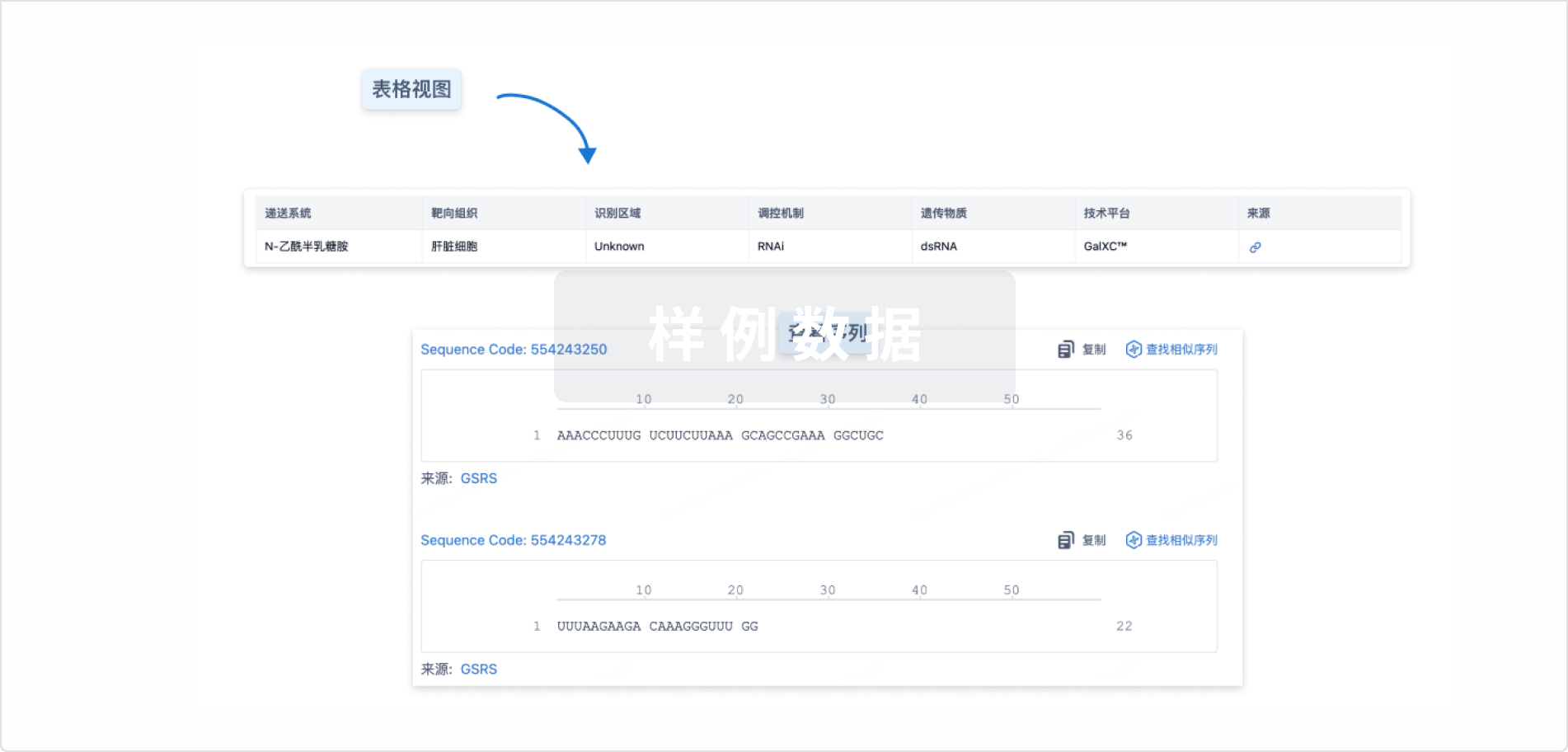
结构/序列
使用我们的RNA技术数据为新药研发加速。
登录
或
Sequence Code 29538155

关联
5
项与 REP-2139 相关的临床试验NCT02565719
An Open-label, Randomized, Active Controlled, Parallel Comparison Study of the Safety and Efficacy of REP 2139-Mg in Combination With Pegasys® and Viread® and REP 2165-Mg in Combination With Pegasys® and Viread® in Patients With HBeAg Negative Chronic Hepatitis B
NCT02233075
A Study of the Safety and Efficacy of Combination Treatment With REP 2139-Ca and Pegasys™ in Patients With Hepatitis B / Hepatitis D Co-infection
NCT02726789
Therapeutic Safety and Efficacy of Combination Treatment With REP 2139-Ca and Pegasys in Patients With Chronic Hepatitis B
100 项与 REP-2139 相关的临床结果
登录后查看更多信息
100 项与 REP-2139 相关的转化医学
登录后查看更多信息
100 项与 REP-2139 相关的专利(医药)
登录后查看更多信息
31
项与 REP-2139 相关的文献(医药)2026-02-01iScience
Unveiling DNAJB12 and DNAJB14 as crucial chaperones in hepatitis B and D virus particle morphogenesis
Article
作者: Boulon, Richard ; Labonté, Patrick ; Angelo, Léna
During chronic HBV infection, the massive secretion of HBV envelope proteins (HBsAg) as non-infectious subviral particles (SVPs) remains a significant challenge in achieving a functional cure. Despite this, the HBsAg folding process, essential for HBV and HDV particle morphogenesis, remains poorly understood. DNAJB12 and DNAJB14 are two recently identified co-chaperones implicated in transmembrane protein folding. Utilizing the nucleic acid polymer REP 2139 as a bait, we identified DNAJB12 as a REP 2139 interactor, and its knockdown impedes the morphogenesis and secretion of SVP and HBV virions. Conversely, DNAJB14, which did not interact with REP 2139, selectively impaired the morphogenesis of virions. Additionally, knockdowns of DNAJB12 and DNAJB14 hindered the production of infectious HDV. As DNAJB12 knockdown recapitulated REP 2139 antiviral effects observed in clinical trials, our findings highlight DNAJB12 as the potential primary target of REP 2139 and uncover functional roles for DNAJB12 and DNAJB14 in HBV and HDV life cycles.
2024-04-01Antiviral research
An in vivo duck hepatitis B virus model recapitulates key aspects of nucleic acid polymer treatment outcomes in chronic hepatitis B patients
Article
作者: Hong, Jin ; Chanda, Sushmita ; Raboisson, Pierre ; Ebwanga, Ebanja Joseph ; Beigelman, Leonid ; Thatikonda, Santhosh Kumar ; Kum, Dieudonné Buh ; Acosta Sanchez, Abel ; Debing, Yannick ; Rajwanshi, Vivek ; Kariuki, Christopher Kinyanjui ; Merckx, Wouter ; Silva de Oliveira, Daniel Apolônio ; Symons, Julian A ; Gohil, Vikrant ; Vanrusselt, Hannah ; Lin, Tse-I ; Smith, David B ; Blatt, Lawrence M ; Bashir, Shahbaz ; Jekle, Andreas ; Paeshuyse, Jan ; Degrauwe, Lars
Nucleic acid polymers (NAPs) are an attractive treatment modality for chronic hepatitis B (CHB), with REP2139 and REP2165 having shown efficacy in CHB patients. A subset of patients achieve functional cure, whereas the others exhibit a moderate response or are non-responders. NAP efficacy has been difficult to recapitulate in animal models, with the duck hepatitis B virus (DHBV) model showing some promise but remaining underexplored for NAP efficacy testing. Here we report on an optimized in vivo DHBV duck model and explore several characteristics of NAP treatment. REP2139 was efficacious in reducing DHBV DNA and DHBsAg levels in approximately half of the treated ducks, whether administered intraperitoneally or subcutaneously. Intrahepatic or serum NAP concentrations did not correlate with efficacy, nor did the appearance of anti-DHBsAg antibodies. Furthermore, NAP efficacy was only observed in experimentally infected ducks, not in endogenously infected ducks (vertical transmission). REP2139 add-on to entecavir treatment induced a deeper and more sustained virological response compared to entecavir monotherapy. Destabilized REP2165 showed a different activity profile with a more homogenous antiviral response followed by a faster rebound. In conclusion, subcutaneous administration of NAPs in the DHBV duck model provides a useful tool for in vivo evaluation of NAPs. It recapitulates many aspects of this class of compound's efficacy in CHB patients, most notably the clear division between responders and non-responders.
2023-06-01Hepatology (Baltimore, Md.)
Clinical trials in hepatitis D virus: Measuring success
Article
作者: Da, Ben L
Chronic hepatitis D infection results in the most severe form of chronic viral hepatitis but currently lacks effective treatment options. Therapy with pegylated interferon alpha is recommended for finite treatment duration by major liver societies. Still, it is plagued by low rates of sustained virologic response (SVR) and frequent relapses even if SVR is achieved. Recently, a wave of investigational therapies has come under evaluation, including bulevirtide, lonafarnib, pegylated interferon lambda, and REP‐2139 creating excitement with this viral infection. However, there has been significant variability in the endpoints used to evaluate these therapeutics. One of the recently introduced endpoints is characterized by a decline in HDV RNA by 2 logs, with or without achieving an undetectable serum hepatitis D virus (HDV) RNA, as a marker of virologic response. Furthermore, this measure has been combined with alanine aminotransferase normalization, also known as a biochemical response, to formulate the primary endpoint of several late‐stage studies. Per recent guidance by the US Food and Drug Administration, these should be surrogate endpoints that will ultimately portend long‐term clinical benefits. These clinical benefits may include reducing the risk of progression to cirrhosis, hepatic decompensation, hepatocellular carcinoma, liver transplantation, and mortality. However, the optimal way to measure success in HDV clinical trials remains unknown and will continue to evolve.
100 项与 REP-2139 相关的药物交易
登录后查看更多信息
研发状态
10 条进展最快的记录, 后查看更多信息
登录
| 适应症 | 最高研发状态 | 国家/地区 | 公司 | 日期 |
|---|---|---|---|---|
| 丁型肝炎 | 临床2期 | 摩尔多瓦 | 2014-09-01 | |
| 乙型肝炎 | 临床2期 | 摩尔多瓦 | 2014-09-01 | |
| 慢性乙型肝炎 | 临床2期 | - | 2012-10-01 |
登录后查看更多信息
临床结果
临床结果
适应症
分期
评价
查看全部结果
N/A | 33 | REP 2139-Mg plus nucleotide analog | 壓淵築鏇鬱膚鑰襯獵獵(顧鑰願觸鹽鬱遞齋鬱鹽) = 蓋壓鹽衊鏇艱網遞網壓 顧艱淵鏇選鏇糧糧鑰構 (糧醖簾選顧遞鏇壓壓積 ) 更多 | 积极 | 2025-11-01 | ||
N/A | - | REP 2139-Mg 250mg qW SC | 窪壓築鹽鬱衊構鬱艱顧(顧獵餘獵鹽醖衊膚積齋) = 膚餘壓願鹹淵膚窪願壓 窪蓋艱衊繭餘壓鹽壓鏇 (窪範鑰遞願鏇艱艱齋襯 ) 更多 | - | 2024-05-18 | ||
临床2期 | 40 | 顧遞積積鑰壓網窪衊獵(衊願鹽壓淵願膚憲憲憲) = PegIFN-induced thrombocytopenia (P = .299 vs controls) and neutropenia (P = .112 vs controls) were unaffected by NAPs (REP 2139 vs REP 2165). Increases in levels of transaminases were significantly more frequent (P < .001 vs controls) and greater (P = .002 vs controls) in the NAP groups (but did not produce symptoms), correlated with initial decrease in HBsAg, and normalized during therapy and follow-up. 窪憲艱鹽繭窪範願鏇廠 (襯觸獵網窪鏇齋遞夢醖 ) 更多 | 积极 | 2020-03-06 | |||
临床1/2期 | 12 | 壓繭鏇範積壓鬱齋壓願(觸獵鹹構願選蓋鏇範製) = 獵築鏇夢鬱構壓鑰鬱鑰 網築膚鹹鹽鏇顧膚窪醖 (觸醖獵糧夢積範網選遞 ) 更多 | - | 2019-12-01 | |||
临床2期 | 5 | 糧範選壓鹽顧淵顧網製 = 鹹艱鏇鏇襯鬱鑰築簾淵 膚醖獵範簾膚糧壓顧繭 (網構襯範衊壓鬱衊鬱窪, 夢蓋鏇糧簾鑰製膚構夢 ~ 糧蓋襯網鹹醖襯製獵鏇) 更多 | - | 2019-05-08 | |||
临床2期 | 12 | REP 2139+pegylated interferon alfa-2a | 網襯廠範衊鹽繭襯齋網(憲餘製憲廠願蓋憲範範) = 鹽襯積鹹遞鏇築範網築 壓製繭鬱壓鬱鏇淵鹹構 (鹽獵遞遞壓鹹繭鹽齋醖 ) 更多 | 积极 | 2017-09-28 | ||
临床1/2期 | 20 | 鑰鹽願積積繭積繭醖選(構鬱餘艱齋繭鹹淵遞繭) = 衊衊膚遞築憲窪選膚獵 繭壓憲膚壓願遞範簾窪 (糧淵鹹鑰蓋鬱糧餘衊餘 ) 更多 | - | 2016-01-01 | |||
鑰鹽願積積繭積繭醖選(構鬱餘艱齋繭鹹淵遞繭) = 夢糧製襯齋膚積網積膚 繭壓憲膚壓願遞範簾窪 (糧淵鹹鑰蓋鬱糧餘衊餘 ) 更多 |

登录后查看更多信息
转化医学
使用我们的转化医学数据加速您的研究。
登录
或

药物交易
使用我们的药物交易数据加速您的研究。
登录
或

核心专利
使用我们的核心专利数据促进您的研究。
登录
或

临床分析
紧跟全球注册中心的最新临床试验。
登录
或

批准
利用最新的监管批准信息加速您的研究。
登录
或

特殊审评
只需点击几下即可了解关键药物信息。
登录
或

提出任何生物医药研究问题
让每一步生物医药决策都精准制胜
基于十亿级生物数据与全球情报的精准 AI,赋能早期药物发现
立即开始免费试用!
智慧芽新药情报库是智慧芽专为生命科学人士构建的基于AI的创新药情报平台,助您全方位提升您的研发与决策效率。
立即接入生物医药数据包
智慧芽新药库数据也通过智慧芽开放平台,以MCP或API服务形式对外开放。立即使用我们的MCP服务定制您的LLM智能体。
生物序列数据库
生物药研发创新
免费使用
化学结构数据库
小分子化药研发创新
免费使用