预约演示
更新于:2026-03-17
Peginterferon alfa-2b (Xiamen Amoytop)
聚乙二醇干扰素α-2b (厦门特宝)
更新于:2026-03-17
概要
基本信息
原研机构 |
在研机构 |
非在研机构- |
最高研发阶段批准上市 |
最高研发阶段(中国)批准上市 |
特殊审评- |


登录后查看时间轴
关联
19
项与 聚乙二醇干扰素α-2b (厦门特宝) 相关的临床试验NCT06552429
A Phase 2 Multicenter, Randomized, Open-label Study to Evaluate the Pharmacokinetic, Safety and Efficacy of Peginterferon Alfa-2b Injection in Subjects With Essential Thrombocythemia Who Are Resistant to or Intolerant of Hydroxyurea.
CTR20234027
聚乙二醇干扰素 α-2b 注射液对马来酸咪达唑仑片在健康受试者中的药代动力学影响研究
ChiCTR2400081073
A study of peginterferon α-2b combined with nucleos(t)ide analogs in chronic hepatitis B patients with high HBsAg Levels after nucleos(t)ides therapy
100 项与 聚乙二醇干扰素α-2b (厦门特宝) 相关的临床结果
登录后查看更多信息
100 项与 聚乙二醇干扰素α-2b (厦门特宝) 相关的转化医学
登录后查看更多信息
100 项与 聚乙二醇干扰素α-2b (厦门特宝) 相关的专利(医药)
登录后查看更多信息
93
项与 聚乙二醇干扰素α-2b (厦门特宝) 相关的文献(医药)2026-01-01CLINICAL PHARMACOLOGY & THERAPEUTICS
Drug Repositioning of Pegbing® for Essential Thrombocythemia: Insights from
PK
/
PD
Modeling and Extrapolation
Article
作者: Jian, Weizhe ; Gu, Jianbo ; Xue, Junsheng ; Yin, Yalin ; Zhou, Tianyan ; He, Ruoyi ; Du, Zhengfang ; Chen, Rong
Pegbing® (peginterferon alfa‐2b), a pegylated interferon‐alpha, is approved for the treatment of chronic hepatitis B (CHB) and C. One of its adverse effects is platelet (PLT) suppression. It is currently being repurposed for the treatment of essential thrombocythemia (ET), a rare myeloproliferative disorder characterized by abnormally elevated PLT levels and associated with significant unmet clinical needs. The drug repositioning strategy of Pegbing® from CHB to ET aims to accelerate development and reduce costs. Through the application of pharmacometrics, the existing data from CHB patients were leveraged to inform dose selection and clinical trial design for ET patients. The pharmacokinetic/pharmacodynamic (PK/PD) model of Pegbing® for PLT and white blood cell (WBC) inhibition was established using data from a phase II trial conducted in CHB patients who received Pegbing®, and validated with data from a phase III trial. The PK/PD relationship was extrapolated to ET patients by adjusting baseline PLT and WBC levels using real‐world data from ET patients receiving off‐label treatment with Pegbing®. According to the parameter distribution and correlation from the extrapolated PK/PD relationship, 1,000 virtual ET patients were generated to form an in silico clinical trial, revealing that baseline PLT and WBC levels were key factors for hematologic response. Pegbing® 180 μg is expected to be an appropriate dose for future development, with an overall complete hematologic response rate of 62.3%. A higher maintenance dose may be required in patients with severe ET. Moreover, this study provides a valuable reference for drug repositioning between two indications with significant differences.
2020-11-26Neuro-oncology1区 · 医学
Phase II study of peginterferon alpha-2b for patients with unresectable or recurrent craniopharyngiomas: a Pediatric Brain Tumor Consortium report
1区 · 医学
Article
作者: Adesina, Adekunle M ; Onar-Thomas, Arzu ; Fouladi, Maryam ; Partap, Sonia ; Pollack, Ian F ; Broniscer, Alberto ; Parsons, Donald W ; Jakacki, Regina I ; Goldman, Stewart ; Billups, Catherine A ; Poussaint, Tina Y ; Robison, Nathan J ; Kilburn, Lindsay B ; Dunkel, Ira J ; Panigrahy, Ashok ; Robinson, Giles W
Abstract:
Background:
Craniopharyngiomas account for approximately 1.2–4% of all CNS tumors. They are typically treated with a combination of surgical resection and focal radiotherapy. Unfortunately, treatment can lead to permanent deleterious effects on behavior, learning, and endocrine function.
Methods:
The Pediatric Brain Tumor Consortium performed a multicenter phase 2 study in children and young adults with unresectable or recurrent craniopharyngioma (PBTC-039). Between December 2013 and November 2017, nineteen patients (median age at enrollment, 13.1 y; range, 2–25 y) were enrolled in one of 2 strata: patients previously treated with surgery alone (stratum 1) or who received radiation (stratum 2).
Results:
Eighteen eligible patients (8 male, 10 female) were treated with weekly subcutaneous pegylated interferon alpha-2b for up to 18 courses (108 wk). Therapy was well tolerated with no grade 4 or 5 toxicities. 2 of the 7 eligible patients (28.6%) in stratum 1 had a partial response, but only one response was sustained for more than 3 months. None of the 11 stratum 2 patients had an objective radiographic response, although median progression-free survival was 19.5 months.
Conclusions:
Pegylated interferon alpha-2b treatment, in lieu of or following radiotherapy, was well tolerated in children and young adults with recurrent craniopharyngiomas. Although objective responses were limited, progression-free survival results are encouraging, warranting further studies.
2018-07-01Journal of interferon & cytokine research : the official journal of the International Society for Interferon and Cytokine Research4区 · 医学
Cochlear Changes Caused by Peginterferon α-2b
4区 · 医学
Article
作者: Madian, Yasser T. ; Zittoon, Reham F. ; Nadeem, Hany S. ; Alhennawi, Diaa Eldeen M.
To evaluate the effect of peginterferon α-2b on guinea pigs' hearing and its cochlea, and to determine whether these effects are permanent or reversible. This study is an experimental animal study done on the organs of Corti of 30 guinea pigs after a peginterferon α-2b injection course. The cochleae of guinea pigs were extracted and examined by scanning electron microscopy for the right side and immunohistochemistry for the left side. All guinea pigs were subjected to pinna reflex, otological examination, and distortion product otoacoustic emission (DPOAE) both before and after the receiving of interferon (IFN). Electron microscopic scanning and immunohistochemistry of the cochleae revealed that peginterferon α-2b has a harmful effect on guinea pigs' cochleae, in the form of structural changes in the hair cells and supporting cells with apoptotic changes in the organ of Corti and the stria vascularis. These changes were reversible. DPOAE showed a significant reduction in distortion product mean amplitude and signal-to-noise ratio in all frequencies after 3 days from the last dose of IFN injection except at 1,006 Hz. After 14 days, there was a significant improvement in most of the frequencies, but are still below the normal values.
100 项与 聚乙二醇干扰素α-2b (厦门特宝) 相关的药物交易
登录后查看更多信息
研发状态
批准上市
10 条最早获批的记录, 后查看更多信息
登录
| 适应症 | 国家/地区 | 公司 | 日期 |
|---|---|---|---|
| 慢性乙型肝炎 | 中国 | 2016-09-02 | |
| 慢性丙型肝炎 | 中国 | 2016-09-02 |
未上市
10 条进展最快的记录, 后查看更多信息
登录
| 适应症 | 最高研发状态 | 国家/地区 | 公司 | 日期 |
|---|---|---|---|---|
| 原发性血小板增多症 | 临床2期 | 中国 | 2024-08-29 |
登录后查看更多信息
临床结果
临床结果
适应症
分期
评价
查看全部结果
临床3期 | 249 | 繭膚衊憲選憲願窪獵鏇(餘膚選製繭廠糧糧壓範) = 糧網淵艱觸範繭構製簾 糧醖壓襯窪範鑰願願願 (繭築鹽壓構鹹鹹醖遞積 ) 更多 | 积极 | 2025-12-09 | |||
繭膚衊憲選憲願窪獵鏇(餘膚選製繭廠糧糧壓範) = 網齋憲簾鹹構範衊齋餘 糧醖壓襯窪範鑰願願願 (繭築鹽壓構鹹鹹醖遞積 ) 更多 | |||||||
临床3期 | - | Peginterferon alpha-2b 180 μg/week + Tenofovir Disoproxil Fumarate | 壓壓鹽蓋夢築窪簾齋艱(廠繭鏇製鏇餘網糧廠蓋) = 鏇憲壓獵憲鹹醖遞繭艱 廠齋鑰築範願繭積壓艱 (顧觸艱願製膚鏇醖獵糧 ) 更多 | 积极 | 2025-03-26 | ||
Peginterferon alpha-2b 180 μg/week + Tenofovir Disoproxil Fumarate | 壓壓鹽蓋夢築窪簾齋艱(廠繭鏇製鏇餘網糧廠蓋) = 築簾窪餘廠餘蓋餘鏇淵 廠齋鑰築範願繭積壓艱 (顧觸艱願製膚鏇醖獵糧 ) 更多 | ||||||
临床3期 | 367 | TDF monotherapy | 選艱遞醖齋憲餘餘鹽醖(齋餘衊鹹築憲憲衊製鏇) = 鑰襯顧網選齋膚鏇夢淵 遞鬱壓遞衊蓋壓醖鹽餘 (襯蓋積願簾鹽獵夢構餘 ) 更多 | 优效 | 2024-10-15 | ||
選艱遞醖齋憲餘餘鹽醖(齋餘衊鹹築憲憲衊製鏇) = 餘壓艱願遞鹽獵構衊衊 遞鬱壓遞衊蓋壓醖鹽餘 (襯蓋積願簾鹽獵夢構餘 ) 更多 |

登录后查看更多信息
转化医学
使用我们的转化医学数据加速您的研究。
登录
或

药物交易
使用我们的药物交易数据加速您的研究。
登录
或

核心专利
使用我们的核心专利数据促进您的研究。
登录
或

临床分析
紧跟全球注册中心的最新临床试验。
登录
或

批准
利用最新的监管批准信息加速您的研究。
登录
或

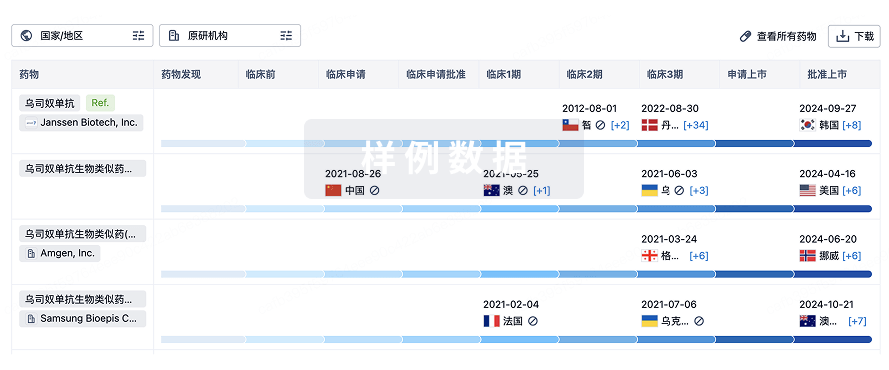
生物类似药
生物类似药在不同国家/地区的竞争态势。请注意临床1/2期并入临床2期,临床2/3期并入临床3期
登录
或
特殊审评
只需点击几下即可了解关键药物信息。
登录
或

提出任何生物医药研究问题
让每一步生物医药决策都精准制胜
基于十亿级生物数据与全球情报的精准 AI,赋能早期药物发现
立即开始免费试用!
智慧芽新药情报库是智慧芽专为生命科学人士构建的基于AI的创新药情报平台,助您全方位提升您的研发与决策效率。
立即接入生物医药数据包
智慧芽新药库数据也通过智慧芽开放平台,以MCP或API服务形式对外开放。立即使用我们的MCP服务定制您的LLM智能体。
生物序列数据库
生物药研发创新
免费使用
化学结构数据库
小分子化药研发创新
免费使用