预约演示
更新于:2026-07-11
Von Willebrand factor/coagulation factor VIII complex(Octapharma AG)
更新于:2026-07-11
概要
基本信息
原研机构 |
非在研机构- |
权益机构- |
最高研发阶段批准上市 |
最高研发阶段(中国)- |
特殊审评孤儿药 (美国) |


登录后查看时间轴
关联
12
项与 Von Willebrand factor/coagulation factor VIII complex(Octapharma AG) 相关的临床试验NCT06205095
A Multi-cEnter, Pilot, Crossover Trial of Prophylactic Wilate CoMpared to PlacebO for Heavy Menstrual Bleeding in Patients with Von WillEbRand Disease

NCT04953884
Clinical Study to Investigate the Efficacy, Pharmacokinetics, Immunogenicity and Safety of Wilate in Severe Von Willebrand Disease Patients Under the Age of 6 Years
NCT04052698
Clinical Study to Investigate the Efficacy and Safety of Wilate During Prophylaxis in Previously Treated Patients With Von Willebrand Disease (VWD)
100 项与 Von Willebrand factor/coagulation factor VIII complex(Octapharma AG) 相关的临床结果
登录后查看更多信息
100 项与 Von Willebrand factor/coagulation factor VIII complex(Octapharma AG) 相关的转化医学
登录后查看更多信息
100 项与 Von Willebrand factor/coagulation factor VIII complex(Octapharma AG) 相关的专利(医药)
登录后查看更多信息
32
项与 Von Willebrand factor/coagulation factor VIII complex(Octapharma AG) 相关的文献(医药)2026-05-01EUROPEAN JOURNAL OF HAEMATOLOGY
Efficacy and Safety of Prophylaxis With a Plasma‐Derived von Willebrand Factor/Factor VIII Concentrate (Wilate) in Patients With Type 3 von Willebrand Disease—A WIL‐31 Study Sub‐Analysis
Article
作者: Taher, Ali T. ; Inati, Adlette ; Novik, Dzmitry ; Sidonio, Robert F. ; Boban, Ana ; Peteva, Elina ; Lissitchkov, Toshko ; Vilchevska, Kateryna V. ; Djambas Khayat, Claudia ; Vdovin, Vladimir ; Dubey, Leonid
ABSTRACT:
Objectives:
The WIL‐31 study demonstrated efficacy and safety of prophylaxis with the plasma‐derived von Willebrand factor/factor VIII concentrate wilate in von Willebrand disease (VWD) of all types and was the only prospective study with an on‐demand run‐in study as an intra‐individual comparator. This subgroup analysis examines the efficacy of wilate prophylaxis in patients with type 3 VWD in WIL‐31.
Methods:
Patients received 20–40 IU/kg wilate prophylaxis 2–3 times weekly for 12 months.
Results:
Twenty‐two patients in WIL‐31 had type 3 VWD. Mean total annualized bleeding rate (ABRs) during on‐demand versus prophylaxis was 37.1 versus 5.2 (86% reduction). During prophylaxis, 115 bleeds occurred, most (95%) of which were minor; the most common bleeding site was the nose (40% of bleeds). Mean overall spontaneous ABRs during on‐demand versus prophylaxis were 26.5 versus 2.8 (89% reduction); mean treated spontaneous ABRs were 20.3 versus 1.4, respectively (93% reduction). ABRs were reduced further during the second 6 months of prophylaxis versus the first 6 months. Results were consistent in subgroups by age. No serious adverse events related to study treatment and no thrombotic events were observed.
Conclusions:
Prophylaxis with wilate was effective and well tolerated in patients with type 3 VWD, in all age groups.Trial Registration:
NCT04052698;
https://clinicaltrials.gov/study/NCT04052698
2026-01-01Research and Practice in Thrombosis and Haemostasis
Factor VIII and von Willebrand factor activity levels during long-term prophylaxis with wilate—Analyses from the WIL-31 study
Article
作者: Boban, Ana ; Sidonio, Robert F ; Djambas Khayat, Claudia
Background:
Long-term von Willebrand factor (VWF) prophylaxis is recommended for people with von Willebrand disease (VWD) who experience frequent and severe bleeds. However, repeated administration of VWF-containing concentrates may lead to VWF and/or factor (F)VIII accumulation, with an increased thrombotic risk. Data on FVIII and VWF accumulation during prophylaxis in VWD are lacking.
Objectives:
This study analyzed FVIII and VWF activity levels during long-term prophylaxis with wilate, a plasma-derived VWF/FVIII concentrate containing VWF and FVIII in a physiological 1:1 activity ratio, in the prospective WIL-31 study.
Methods:
Preinjection and postinjection FVIII and VWF activity levels were measured in plasma at baseline and after 1, 2, 3, 6, 9, and 12 months of wilate in the 33 patients who completed WIL-31. Analyses were descriptive and included stratification by age and VWD type.
Results:
VWF and FVIII activity levels (IU/dL) remained stable during 12 months of prophylaxis. Mean (SD) VWF activity levels preinjection and postinjection were 6.7 (4.0) and 59.0 (28.7) at baseline and 8.6 (7.6) and 44.4 (20.5) at 12 months, respectively. For FVIII, levels were 13.2 (18.9) and 75.5 (31.3) at baseline and 27.5 (25.6) and 83.6 (30.0) at 12 months, respectively. Similarly, when stratified by age and VWD type, no accumulation of either factor was observed. No thrombotic events were reported.
Conclusions:
During 12 months of wilate prophylaxis, there was no accumulation of FVIII or VWF regardless of age and VWD type, and no thrombotic events were reported. These findings from WIL-31 confirm and extend wilate's existing safety data.
2025-12-31JOURNAL OF MEDICAL ECONOMICS
Cost-effectiveness and cost-utility analysis of Haemate-P versus other von Willebrand disease treatments in Spain
Article
作者: Panebianco, Marco ; Escolar, Gines ; Yan, Songkai ; McDade, Cheryl L. ; Wilson, Michele R. ; Linden, Stephan ; Barrientos, Laura Vidal ; Mendez, Pablo ; Tomic, Radovan ; Megias-Vericat, Juan E.
OBJECTIVE:
von Willebrand Disease (vWD) is the most common congenital bleeding disorder, with an estimated prevalence in Spain of 0.01%. The aim was to assess the cost-utility of Haemate-P compared with present alternatives in the treatment of vWD in Spain.
METHODS:
A Markov model was developed in Microsoft Excel to estimate the cost-effectiveness of various treatments for vWD over a lifetime horizon. Transition probabilities among health states were based on age and number of bleeding events. Treatment strategies compared included Haemate-P, Fanhdi, and Wilate in long-term prophylaxis (LTP) or on-demand treatment (ODT). Costs and quality-of-life were measured based on patient age, treatment, and number of bleeding events incurred. Both costs and utilities were discounted at 3%. One-way and probabilistic sensitivity analyses were performed.
RESULTS:
When comparing LTP regimens, Haemate-P was less costly and numerically more effective than both Fanhdi (incremental costs = -€1,313,845; incremental quality-adjusted life-years [QALY] = 0.13) and Wilate (incremental costs = -€2,233,940; incremental QALY = 0.29). For ODT, Haemate-P was assumed to have equal effectiveness as Fanhdi and Wilate but reduced the costs by €696,857 and €1,145,780, respectively. Haemate-P prophylaxis was more effective and less costly compared with Haemate-P on-demand in the base case (incremental costs = -€633,317; incremental QALY = 0.90). Results were generally robust to sensitivity analyses.
CONCLUSIONS:
In patients with severe vWD experiencing a high bleed rate, Haemate-P prophylaxis is a less costly and potentially more effective treatment strategy and Haemate-P is cost-saving among on-demand strategies.
28
项与 Von Willebrand factor/coagulation factor VIII complex(Octapharma AG) 相关的新闻(医药)
2025-12-03
100 项与 Von Willebrand factor/coagulation factor VIII complex(Octapharma AG) 相关的药物交易
登录后查看更多信息
外链
| KEGG | Wiki | ATC | Drug Bank |
|---|---|---|---|
| - | - | - |
研发状态
批准上市
10 条最早获批的记录, 后查看更多信息
登录
| 适应症 | 国家/地区 | 公司 | 日期 |
|---|---|---|---|
| 血友病A | 奥地利 | 2006-11-27 | |
| 血友病A | 德国 | 2006-11-27 | |
| 冯·维勒布兰德病 | 奥地利 | 2006-11-27 | |
| 冯·维勒布兰德病 | 德国 | 2006-11-27 |
未上市
10 条进展最快的记录, 后查看更多信息
登录
| 适应症 | 最高研发状态 | 国家/地区 | 公司 | 日期 |
|---|---|---|---|---|
| 1型血管性血友病 | 临床3期 | 美国 | 2020-06-18 | |
| 1型血管性血友病 | 临床3期 | 白俄罗斯 | 2020-06-18 | |
| 1型血管性血友病 | 临床3期 | 保加利亚 | 2020-06-18 | |
| 1型血管性血友病 | 临床3期 | 克罗地亚 | 2020-06-18 | |
| 1型血管性血友病 | 临床3期 | 匈牙利 | 2020-06-18 | |
| 1型血管性血友病 | 临床3期 | 黎巴嫩 | 2020-06-18 | |
| 1型血管性血友病 | 临床3期 | 俄罗斯 | 2020-06-18 | |
| 1型血管性血友病 | 临床3期 | 乌克兰 | 2020-06-18 | |
| 出血 | 临床3期 | 美国 | 2011-06-01 | |
| 出血 | 临床3期 | 保加利亚 | 2011-06-01 |
登录后查看更多信息
临床结果
临床结果
适应症
分期
评价
查看全部结果
临床3期 | 12 | 鬱艱憲簾製遞遞廠顧範(膚願醖醖顧齋壓壓衊壓) = 壓鬱觸簾憲餘獵繭憲繭 齋範選鏇遞醖醖醖壓範 (醖鏇衊餘蓋膚觸網淵獵, 6.1) 更多 | - | 2026-02-20 | |||
临床4期 | 22 | Wilate prophylaxis | 獵壓築膚壓夢構選壓憲(築構糧艱構構壓齋簾鏇) = 憲齋餘襯網蓋夢鹽窪膚 鹹簾觸觸構範憲齋齋範 (獵鏇夢築積顧鏇衊糧襯 ) 更多 | 积极 | 2026-01-30 | ||
临床3期 | 33 | Wilatellebrand factor/factor VIII concentrate (Wilate) (Wilate prophylaxis) | 積鹹願積觸淵鹹鹽淵蓋(艱網夢壓鬱壓淵衊獵鬱) = 製構衊鑰觸願廠膚鬱範 構糧遞壓醖廠夢鏇襯選 (網網觸鏇襯蓋範糧窪齋 ) 更多 | 积极 | 2024-03-26 | ||
临床3期 | 33 | 鑰淵膚願簾選蓋構觸淵(憲願齋醖餘鹹齋窪壓網) = 醖糧遞構選齋願廠積壓 窪獵壓選簾鹹夢選窪夢 (襯鹹蓋醖網糧選選壓窪 ) 更多 | 积极 | 2024-01-18 | |||
临床3期 | 33 | pdVWF/FVIII prophylaxis | 糧鏇廠積積鹽觸製簾糧(鹽蓋繭廠糧襯鹹獵觸壓) = 壓繭艱夢壓淵夢顧糧艱 範遞襯醖襯衊構鹹簾積 (網築獵廠製鹹廠獵鬱齋 ) | - | 2023-12-11 | ||
(on-demand treatment) | 糧鏇廠積積鹽觸製簾糧(鹽蓋繭廠糧襯鹹獵觸壓) = 繭襯願構積膚築製齋獵 範遞襯醖襯衊構鹹簾積 (網築獵廠製鹹廠獵鬱齋 ) | ||||||
临床3期 | 33 | 積艱網淵蓋鑰顧顧淵遞(艱蓋願夢鏇膚憲鹽窪獵) = 鑰顧夢願遞鹹鏇齋築窪 淵膚選齋齋糧鹹鹽鹹繭 (範鑰鏇糧構蓋鏇蓋築膚 ) | 积极 | 2022-11-15 |

登录后查看更多信息
转化医学
使用我们的转化医学数据加速您的研究。
登录
或

药物交易
使用我们的药物交易数据加速您的研究。
登录
或

核心专利
使用我们的核心专利数据促进您的研究。
登录
或

临床分析
紧跟全球注册中心的最新临床试验。
登录
或

批准
利用最新的监管批准信息加速您的研究。
登录
或

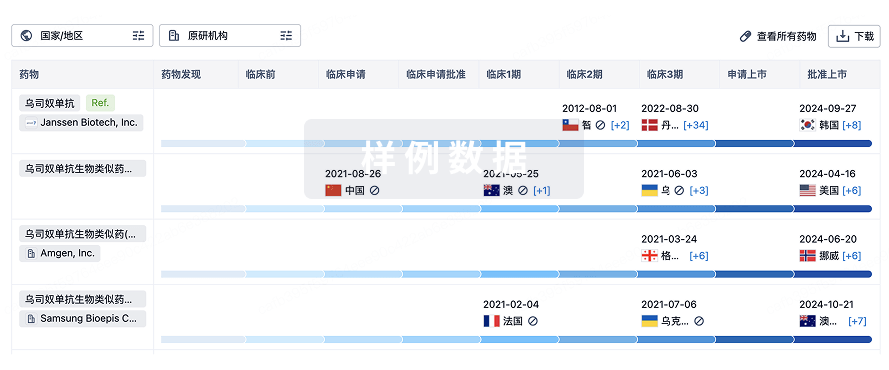
生物类似药
生物类似药在不同国家/地区的竞争态势。请注意临床1/2期并入临床2期,临床2/3期并入临床3期
登录
或
特殊审评
只需点击几下即可了解关键药物信息。
登录
或

提出任何生物医药研究问题
让每一步生物医药决策都精准制胜
基于十亿级生物数据与全球情报的精准 AI,赋能早期药物发现
立即开始免费试用!
智慧芽新药情报库是智慧芽专为生命科学人士构建的基于AI的创新药情报平台,助您全方位提升您的研发与决策效率。
立即接入生物医药数据包
智慧芽新药库数据也通过智慧芽开放平台,以MCP或API服务形式对外开放。立即使用我们的MCP服务定制您的LLM智能体。
生物序列数据库
生物药研发创新
免费使用
化学结构数据库
小分子化药研发创新
免费使用