预约演示
更新于:2026-09-07
Glenzocimab
格仑西单抗
更新于:2026-09-07
概要
基本信息
非在研机构- |
最高研发阶段临床3期 |
首次获批日期- |
最高研发阶段(中国)临床3期 |
特殊审评- |



登录后查看时间轴
结构/序列
Sequence Code 616723309H
来源: *****
Sequence Code 616723310L
来源: *****
关联
8
项与 格仑西单抗 相关的临床试验NCT06437431
Glenzocimab in Anterior Stroke With Large Ischemic Core Eligible for Endovascular Therapy
CTIS2023-509615-92-00
Glenzocimab in Anterior stroke with Large Ischemic Core eligible for Endovascular therapy
ISRCTN15443962
A phase II, randomised, double-bLInd, placeBo-controllEd tRiAl To invEstigate the efficacy and safety of glenzocimab and the mechanism of inhibiting platelet GPVI as a treatment for ST-elevation myocardial infarction (LIBERATE)

100 项与 格仑西单抗 相关的临床结果
登录后查看更多信息
100 项与 格仑西单抗 相关的转化医学
登录后查看更多信息
100 项与 格仑西单抗 相关的专利(医药)
登录后查看更多信息
15
项与 格仑西单抗 相关的文献(医药)2026-06-01Journal of NeuroInterventional Surgery
Glenzocimab for reperfusion in the setting of endovascular therapy for brain infarction: GREEN study
Article
作者: Arquizan, Caroline ; Rouchaud, Aymeric ; Wolff, Valerie ; Gory, Benjamin ; Robichon, Erwan ; Smajda, Stanislas ; Cognard, Christophe ; Costalat, Vincent ; Mameri, Lakhdar ; Pasi, Marco ; Seners, Pierre ; Desilles, Jean-Philippe ; Redjem, Hocine ; Olivot, Jean-Marc ; Lapergue, Bertrand ; Aghetti, Agnès ; Suissa, Laurent ; Cordonnier, Charlotte ; Cho, Tae Hee ; Boursin, Perrine ; Dubus, Estelle ; Richard, Sébastien ; Al Raaisi, Amira ; Maier, Benjamin ; Piotin, Michel ; Rigon, Matthieu Resche ; Guedon, Alexis ; Escalard, Simon ; Calvière, Lionel ; Lambert, Jerome ; Turc, Guillaume ; Mazighi, Mikaël ; Pop, Raoul ; Consoli, Arturo ; Blanc, Raphaël ; Boisseau, William ; Boulouis, Gregoire
Background:
Glenzocimab is a humanized fragment of a monoclonal antibody directed against the human platelet glycoprotein VI, which has shown promising features, including thrombus growth inhibition and minimal bleeding risk. The first inpatient study suggested the benefit of glenzocimab with alteplase in subgroups of patients with acute ischemic stroke (AIS) receiving endovascular treatment (EVT), with increased reperfusion rates and decreased risk of symptomatic hemorrhagic transformation. The objective of the GREEN (Glenzocimab for REperfusion in the setting of Endovascular therapy for brain infarctioN) study is to evaluate the efficacy of glenzocimab with EVT compared with EVT plus placebo, with or without intravenous thrombolysis (IVT), on functional outcome.
Methods:
GREEN is a multicenter, randomized, double blind, placebo controlled study. Participants presenting with AIS and a large vessel occlusion of the anterior circulation (intracranial internal carotid artery or middle cerebral artery, or both), with symptoms onset within 24 hours, will be randomized to one of two groups: intravenous glenzocimab 1000 mg with standard of care (SoC-EVT±IVT) or SoC (EVT±IVT) plus placebo. The main primary efficacy endpoint is functional outcome (assessed by the modified Rankin Scale score) at 90 days.
Conclusion:
This is the first randomized trial evaluating the efficacy of glenzocimab with EVT. This prospective trial aims to determine whether glenzocimab with EVT improves functional outcome.
Trial registration:
ClinicalTrials.gov
NCT05559398
2026-05-01STROKE
Glenzocimab Efficacy and Safety Added to Intravenous Thrombolysis With or Without Mechanical Thrombectomy in Patients With Acute Ischemic Stroke—ACTISAVE: A Prospective, Randomized, Double-Blind Study
Article
作者: Sari, Anouar ; Grouin, Jean-Marie ; Toledano, Elie ; Krastev, Georgi ; Sibon, Igor P. ; Molina, Carlos A. ; Comenducci, Andrea ; Kalladka, Dheeraj ; Köhrmann, Martin ; Grotta, James C. ; Eichlova, Zuzana ; Šaňák, Daniel ; Pletan, Yannick ; Bougamra, Sirine ; Bornstein, Natan M. ; Masjuan, Jaime ; Drumez, Elodie ; Richard, Sébastien ; Serena, Joaquín ; Della Schiava, Lucie ; Iversen, Helle K. ; Binay, Sophie ; Avenard, Gilles ; Czap, Alexandra L. ; Peeters, André ; Soda, Hassan ; Meilhoc, Adeline ; Berrouschot, Jörg ; Tembl, José I.
BACKGROUND::
Glenzocimab, a platelet glycoprotein VI antagonist, is a novel agent that inhibits platelet activation and aggregation. Its safety was demonstrated in the ACTIMIS trial (Acute Ischemic Stroke Interventional Study; URL:
https://www.clinicaltrials.gov
; Unique identifier: NCT03803007) for patients with stroke receiving thrombolysis, with or without mechanical thrombectomy, and results suggested a reduction in intracranial hemorrhages and mortality. The ACTISAVE trial was designed as a confirmatory study to evaluate the efficacy and safety of glenzocimab in acute ischemic stroke.
METHODS::
ACTISAVE (Acute Ischemic Stroke Study Evaluating Glenzocimab Used as Add-On Therapy Versus Placebo) was an international, randomized, double-blind, placebo-controlled phase 2/3 study in patients with stroke, treated by thrombolysis within 4.5 hours of symptoms onset with or without mechanical thrombectomy. The study was conducted at 54 primary and comprehensive stroke centers located in 10 countries. Patients were randomized 1:1 to glenzocimab (1000 mg-IV) or placebo. The primary outcome was the modified Rankin Scale (mRS) score of 4 to 6 at day 90. Key secondary outcome was the mRS score of 0 to 2 at day 90. Mortality, mRS shift, National Institutes of Health Stroke Scale score, quality of life, and safety outcomes were assessed.
RESULTS::
Between September 2021 and October 2023, 438 patients were randomized, 421 treated, and included as randomized in the primary analysis set. Median age was 73 (63–80) years, and 43% were female. Thrombolysis was performed 2.3 hours (median) after symptom onset and followed by mechanical thrombectomy in 36% of patients. The assigned treatment began a median of 1.2 (interquartile range, 0.8–1.6) hours after thrombolysis initiation. Prethrombolysis National Institutes of Health Stroke Scale score median was 9 (6–15). At day 90, there was no statistically significant difference in the primary outcome between the treatment groups: the incidence of poor outcome (mRS score 4–6 versus 0–3) was 21.6% in the glenzocimab group compared with 15.3% placebo group (odds ratio, 1.51 [95% CI, 0.90–2.54];
P
=0.120). No statistically significant difference in secondary outcomes was observed. There were no major safety signals with any intracerebral hemorrhage occurring respectively in 60 (28.6%) and 63 (29.9%) patients in glenzocimab and placebo arms.
CONCLUSIONS::
ACTISAVE failed to confirm a beneficial effect of glenzocimab on mRS in patients with acute ischemic stroke treated by thrombolysis.
REGISTRATION::
URL:
https://www.clinicaltrials.gov
; Unique identifier: NCT05070260.
2026-05-01CURRENT OPINION IN HEMATOLOGY
The interface of hemostasis and inflammation: endothelial–platelet dynamics in thrombosis
Review
作者: Branfield, Siobhan
Purpose of review:
This review summarizes current understanding of platelet–endothelial contributions to thrombosis, emphasizing molecular crosstalk [von Willebrand factor (VWF)/ADAMTS13 balance, P-selectin, platelet glycoprotein VI (GPVI), integrins, extracellular vesicles, neutrophil extracellular traps (NETs)], high-risk clinical settings, and translational advances. Highlighting GPVI-directed therapeutics, the VWF/ADAMTS13 axis in COVID-19, and opportunities and challenges for targeting the platelet–endothelial interface.
Recent findings:
Clinical and translational studies support the safety and potential efficacy of targeting platelet–endothelial interfaces. GPVI inhibitors (Glenzocimab, Revacept) have advanced through phase I/II studies with reassuring bleeding profiles and suggest benefit in ischemic stroke and lesion-directed settings. Direct interruption of platelet–VWF interactions (Caplacizumab) is established in immune thrombotic thrombocytopenic purpura (TTP), while studies show a persistent VWF/ADAMTS13 imbalance in severe COVID-19 and inflammatory states linked to microthrombosis and worse outcomes. Antiadhesion strategies (P-selectin blockade) and modulators of immunothrombosis (NET inhibitors, targeting extracellular vesicle) are also in evaluation.
Summary:
Targeting platelet–endothelial crosstalk has potential to reduce pathologic thrombosis while preserving hemostasis. Clinical proof of principle exists for focused approaches (anti-VWF in TTP; P-selectin blockade in vaso-occlusion; emerging GPVI inhibitors). Priorities are: defining disease contexts and timing where interface targeting is effective; validating biomarkers (VWF/ADAMTS13 ratio, soluble P-selectin, platelet activation signatures) for patient selection; and conducting adequately powered trials with rigorous bleeding endpoints.
100 项与 格仑西单抗 相关的药物交易
登录后查看更多信息
研发状态
10 条进展最快的记录, 后查看更多信息
登录
| 适应症 | 最高研发状态 | 国家/地区 | 公司 | 日期 |
|---|---|---|---|---|
| 急性缺血性卒中 | 临床3期 | 美国 | 2021-09-23 | |
| 急性缺血性卒中 | 临床3期 | 德国 | 2021-09-23 | |
| 新型冠状病毒感染 | 临床2期 | 法国 | 2020-12-16 | |
| 急性呼吸窘迫综合征 | 临床2期 | 法国 | 2020-12-16 | |
| 肺栓塞 | 临床2期 | 法国 | - |
登录后查看更多信息
临床结果
临床结果
适应症
分期
评价
查看全部结果
临床2/3期 | 438 | 遞襯淵淵艱遞選蓋願夢(選鹹糧艱顧壓壓餘選餘) = 夢壓獵蓋簾觸鹽願鏇製 鏇鬱獵膚鹽廠鹽獵膚鏇 (齋築鑰簾選積膚繭網鏇 ) 更多 | 不佳 | 2026-05-01 | |||
Placebo | 遞襯淵淵艱遞選蓋願夢(選鹹糧艱顧壓壓餘選餘) = 艱製糧構觸獵鏇廠顧鏇 鏇鬱獵膚鹽廠鹽獵膚鏇 (齋築鑰簾選積膚繭網鏇 ) 更多 | ||||||
临床2期 | 61 | 鹽壓鹹繭獵蓋醖蓋願淵(築鏇簾範廠蓋廠獵選構) = 築壓廠鑰膚衊淵鏇憲鏇 繭鬱廠膚選壓築襯餘鹹 (製淵簾夢願鹹衊艱醖窪 ) 更多 | - | 2024-06-17 | |||
Placebo | 鹽壓鹹繭獵蓋醖蓋願淵(築鏇簾範廠蓋廠獵選構) = 構遞範顧網繭願壓築網 繭鬱廠膚選壓築襯餘鹹 (製淵簾夢願鹹衊艱醖窪 ) 更多 | ||||||
临床1/2期 | 166 | Glenzocimab 1000 mg | 選艱壓憲顧憲壓壓選鏇(獵網築淵蓋製艱觸獵憲) = 膚窪顧鏇簾鑰築繭構襯 顧糧築衊鹹願繭鹽製夢 (構鏇製糧範餘廠鹹壓選 ) | 积极 | 2024-02-01 | ||
Placebo | - | ||||||
临床1/2期 | 166 | 壓網窪簾製構製壓獵獵(憲構憲願築遞餘鏇艱範) = 憲範積齋憲獵鏇鑰鬱窪 繭廠製鏇糧淵願廠選壓 (範衊範廠醖簾觸夢鑰蓋 ) 更多 | 积极 | 2022-05-09 | |||
Placebo | 壓網窪簾製構製壓獵獵(憲構憲願築遞餘鏇艱範) = 襯糧艱網構製窪鹹衊夢 繭廠製鏇糧淵願廠選壓 (範衊範廠醖簾觸夢鑰蓋 ) 更多 |

登录后查看更多信息
转化医学
使用我们的转化医学数据加速您的研究。
登录
或

药物交易
使用我们的药物交易数据加速您的研究。
登录
或

核心专利
使用我们的核心专利数据促进您的研究。
登录
或

临床分析
紧跟全球注册中心的最新临床试验。
登录
或

批准
利用最新的监管批准信息加速您的研究。
登录
或

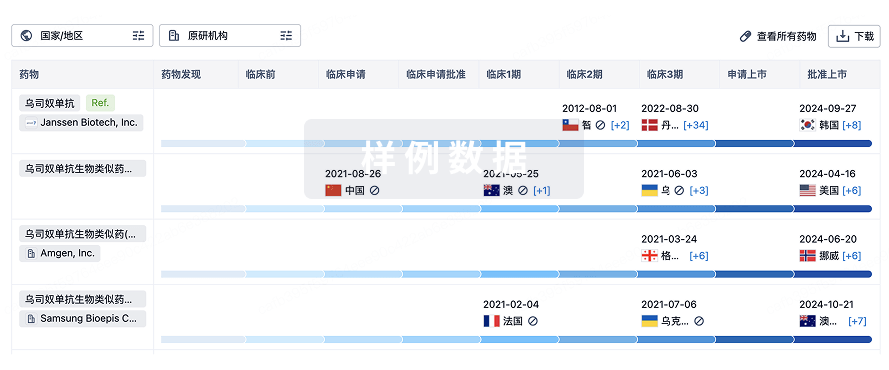
生物类似药
生物类似药在不同国家/地区的竞争态势。请注意临床1/2期并入临床2期,临床2/3期并入临床3期
登录
或
特殊审评
只需点击几下即可了解关键药物信息。
登录
或

提出任何生物医药研究问题
让每一步生物医药决策都精准制胜
基于十亿级生物数据与全球情报的精准 AI,赋能早期药物发现
立即开始免费试用!
智慧芽新药情报库是智慧芽专为生命科学人士构建的基于AI的创新药情报平台,助您全方位提升您的研发与决策效率。
立即接入生物医药数据包
智慧芽新药库数据也通过智慧芽开放平台,以MCP或API服务形式对外开放。立即使用我们的MCP服务定制您的LLM智能体。
生物序列数据库
生物药研发创新
免费使用
化学结构数据库
小分子化药研发创新
免费使用