预约演示
更新于:2026-09-07
Amlenetug
更新于:2026-09-07
概要
基本信息
非在研机构 |
权益机构- |
最高研发阶段临床3期 |
首次获批日期- |
最高研发阶段(中国)无进展 |
特殊审评快速通道 (美国)、孤儿药 (美国)、孤儿药 (欧盟)、孤儿药 (日本)、先驱策略 (日本) |


登录后查看时间轴
结构/序列
Sequence Code 1696239L
来源: *****
Sequence Code 1116814764H
来源: *****
关联
5
项与 Amlenetug 相关的临床试验JPRN-jRCT2021240061
Interventional, Randomized, Double-blind, Placebo-controlled, Optional Open-label Extension Trial of Lu AF82422 in Participants With Multiple System Atrophy
NCT06706622
Interventional, Randomized, Double-blind, Placebo-controlled, Optional Open-label Extension Trial of Lu AF82422 in Participants With Multiple System Atrophy
NCT06258720
Interventional, Randomized, Open-label, Parallel-group, Single-dose Trial Investigating the Safety, Immunogenicity, Tolerability, and Pharmacokinetic Properties of Lu AF82422 in Healthy Chinese and Caucasian Participants
100 项与 Amlenetug 相关的临床结果
登录后查看更多信息
100 项与 Amlenetug 相关的转化医学
登录后查看更多信息
100 项与 Amlenetug 相关的专利(医药)
登录后查看更多信息
5
项与 Amlenetug 相关的文献(医药)2026-06-01LANCET NEUROLOGY
Safety and efficacy of the anti-α-synuclein monoclonal antibody amlenetug for the treatment of patients with multiple system atrophy (AMULET): a phase 2, randomised, double-blind, multicentre trial
Article
作者: Millar Vernetti, Patricio A ; Kumar, Rajeev ; Barboi, Alexandru ; Hall, Deborah ; Nighah, Krishan ; Seier, Mara D ; Freeman, Roy ; Takeda, Atsushi ; Kuo, Sheng-Han ; Zanigni, Stefano ; Deik, Andres ; Litvan, Irene ; Watanabe, Hirohisa ; Singer, Wolfgang ; Kjærsgaard, Lotte ; Svanholm Fogh, Bodil ; McFarland, Nikolaus ; Schmidt, Simon Nitschky ; Dietiker, Cameron ; Berger, Anna-Karin ; Flensburg, Mimi Folden ; Luthman, Johan ; Isaacson, Stuart H ; Wiedemann, Jonas ; Hansen, Lene ; Jørgensen, Mette Nørbæk ; Kompus, Kristiina ; Truong, Daniel ; Suski, Valerie ; Kallunki, Pekka ; Shimohata, Takayoshi
BACKGROUND:
Pathological aggregation and propagation of α-synuclein species drive disease progression in multiple system atrophy (MSA). We assessed the efficacy and safety of amlenetug, a monoclonal antibody targeting aggregated α‑synuclein, versus placebo in slowing clinical disease progression in people with MSA.
METHODS:
We did a randomised, controlled, parallel-group trial (AMULET) at 18 movement disorder and autonomic dysfunction specialist sites across the USA and Japan. Patients aged 40-75 years with MSA who had motor symptom onset in the past 5 years were randomly assigned (2:1) to intravenous amlenetug or placebo every 4 weeks for 48-72 weeks in a common close design. Randomisation was performed via an interactive response system, stratified by region and blood neurofilament light chain concentration, using a block size of three. The double-blind treatment period ended when the last randomised participant had concluded the week 48 visit. Participants, study partners, treating investigators, study site personnel, and the sponsor were masked to treatment allocation. The primary endpoint was disease progression, assessed using a Bayesian progression model of the longitudinal changes from baseline in the Unified Multiple System Atrophy Rating Scale (UMSARS) total (parts I and II) score up to week 72, in all participants who had a valid baseline assessment and at least one valid post-baseline assessment of UMSARS total score. Safety was assessed in all treated participants. This trial is registered at ClinicalTrials.gov (NCT05104476); the open-label phase of the trial is ongoing.
FINDINGS:
Between Nov 16, 2021, and Oct 6, 2022, 91 unique participants were screened, of whom 64 were randomly assigned and 61 received treatment (amlenetug n=40; placebo n=21). Among treated participants, mean age was 60·8 years (SD 7·7); 32 (52%) were male and 29 (48%) female. 48 (79%) of 61 participants completed double-blind treatment (mean 56 weeks [SD 13] treatment). The Bayesian probability of 89·4% for a true slowing of clinical disease progression did not reach the predefined threshold of 97·5%, and accordingly, the primary endpoint was not met. The effect parameter of 0·81 (2·5th to 97·5th percentile 0·56 to 1·13) equates to a non-significant slowing of clinical progression by 19% (2·5th to 97·5th percentile -13 to 44) for amlenetug versus placebo. Amlenetug was generally well tolerated, with comparable rates of treatment‑emergent adverse events (n=40 [100%] with amlenetug vs n=20 [95%] with placebo) and serious treatment‑emergent adverse events (n=12 [30%] vs n=7 [33%]). The most common treatment-emergent adverse events were COVID‑19 infection (n=11 [28%] vs n=5 [24%]), back pain (n=6 [15%] vs n=2 [10%]), headache (n=5 [13%] vs n=1 [5%]), urinary tract infection (n=4 [10%] vs n=3 [14%]), peripheral oedema ([n=4] 10% vs n=1 [5%]), flushing (n=4 [10%] vs 0), and hypertension (n=4 [10%] vs 0). Two deaths occurred in each group, with only one death, in the placebo group, considered possibly treatment related.
INTERPRETATION:
Although the trial did not meet its primary endpoint, the statistically non-significant finding of potentially slowed clinical progression, together with an acceptable safety profile, supported further evaluation in a phase 3 trial.
FUNDING:
H Lundbeck.
2025-01-01JOURNAL OF NEUROLOGY
An update on immune-based alpha-synuclein trials in Parkinson’s disease
Review
作者: Barker, Roger A ; Alfaidi, Maha ; Kuan, Wei-Li
Abstract:
Parkinson’s disease (PD) is a prevalent, chronic neurodegenerative disorder characterised by the progressive loss of dopaminergic neurons in the substantia nigra and other brain regions. The aggregation of alpha-synuclein (α-syn) into Lewy bodies and neurites is a key pathological feature associated with PD and its progression. Many therapeutic studies aim to target these aggregated forms of α-syn to potentially slow down or stop disease progression in PD. This review provides a comprehensive analysis of recent clinical trials involving vaccines and monoclonal antibodies targeting α-syn. Specifically, UB-312, AFFITOPE PD01A, PD03A and ACI-7104.056 are designed to provoke an immune response against α-syn (active immunisation), while Prasinezumab and Cinpanemab, MEDI1341 and Lu AF82422 focus on directly targeting α-syn aggregates (passive immunisation). Despite some promising results, challenges such as variable efficacy and trial discontinuations persist. Future research must address these challenges to advance disease-modifying therapies for PD around this therapeutic target.
2024-06-01Movement disorders : official journal of the Movement Disorder Society
Randomized Phase I Trial of the α‐Synuclein Antibody Lu AF82422
Article
作者: Meulien, Didier ; Buur, Louise ; Wiedemann, Jonas ; Sørensen, Mette Høgh ; Kallunki, Pekka ; Larsen, Frank ; Ditlevsen, Dorte Kornerup ; Ben Alaya‐Fourati, Fayrouz
Abstract:
Background:
Immunotherapy targeting pathological α‐synuclein (α‐syn) species is a promising strategy for slowing disease progression in neurodegenerative synucleinopathies, including Parkinson's disease (PD).
Objective:
The aim was to evaluate the safety, tolerability, pharmacokinetics, and target engagement of ascending doses of Lu AF82422.
Methods:
In this first‐in‐human study (NCT03611569), healthy participants (18–55 years, cohort A) and patients with PD (40–80 years, Hoehn and Yahr stage ≤3, cohort B) were enrolled in ascending‐dose cohorts and randomly assigned to receive single intravenous infusions of Lu AF82422 (cohorts A1–A6: 75, 225, 750, 2250 4500, and 9000 mg, respectively; cohorts B1 and B2: 2250 and 9000 mg, respectively) or placebo. Participants were monitored during a 12‐week observational period.
Results:
Overall, single intravenous infusions of Lu AF82422 were safe and well tolerated, and no serious adverse events (AE) were observed; the most common AEs were related to the study on lumbar punctures, headache, and common infections. Lu AF82422 concentrations (in plasma and cerebrospinal fluid [CSF]) increased in a dose‐proportional manner with no observable differences between cohorts; mean plasma half‐life was 700 h. Plasma concentrations of Lu AF82422 had an immediate, concentration‐dependent lowering effect on the plasma concentration of free α‐syn and on the ratio of free to total α‐syn in all cohorts and lowered the free‐to‐total α‐syn ratio in CSF in the high‐dose PD cohort.
Conclusions:
The safety and pharmacokinetic profile of Lu AF82422 were appropriate for further clinical development, and results indicated peripheral target engagement. The central target engagement observed in participants with PD indicates that the doses of Lu AF82422 tested may provide CSF concentrations sufficient to target aggregated forms of α‐syn. © 2024 H. Lundbeck A/S. Movement Disorders published by Wiley Periodicals LLC on behalf of International Parkinson and Movement Disorder Society.
31
项与 Amlenetug 相关的新闻(医药)2026-08-10
·眩晕派
100 项与 Amlenetug 相关的药物交易
登录后查看更多信息
外链
| KEGG | Wiki | ATC | Drug Bank |
|---|---|---|---|
| D13126 | - | - | - |
研发状态
10 条进展最快的记录, 后查看更多信息
登录
| 适应症 | 最高研发状态 | 国家/地区 | 公司 | 日期 |
|---|---|---|---|---|
| 多系统萎缩 | 临床3期 | 美国 | 2024-12-03 | |
| 多系统萎缩 | 临床3期 | 日本 | 2024-12-03 | |
| 多系统萎缩 | 临床3期 | 澳大利亚 | 2024-12-03 | |
| 多系统萎缩 | 临床3期 | 加拿大 | 2024-12-03 | |
| 多系统萎缩 | 临床3期 | 法国 | 2024-12-03 | |
| 多系统萎缩 | 临床3期 | 德国 | 2024-12-03 | |
| 多系统萎缩 | 临床3期 | 意大利 | 2024-12-03 | |
| 多系统萎缩 | 临床3期 | 韩国 | 2024-12-03 | |
| 多系统萎缩 | 临床3期 | 西班牙 | 2024-12-03 | |
| 多系统萎缩 | 临床3期 | 英国 | 2024-12-03 |
登录后查看更多信息
临床结果
临床结果
适应症
分期
评价
查看全部结果
临床2期 | 64 | Placebo (Placebo) | 壓鬱繭觸蓋網鏇顧觸憲(衊遞鬱糧鬱鏇願襯顧齋) = 壓顧齋廠淵願構獵夢鏇 選顧範鑰築構遞願糧觸 (蓋積廠鏇蓋壓築遞積憲, 3.42) 更多 | - | 2024-12-27 | ||
(Lu AF82422) | 壓鬱繭觸蓋網鏇顧觸憲(衊遞鬱糧鬱鏇願襯顧齋) = 顧蓋遞構醖鏇構鹹繭鏇 選顧範鑰築構遞願糧觸 (蓋積廠鏇蓋壓築遞積憲, 2.86) 更多 |
登录后查看更多信息
转化医学
使用我们的转化医学数据加速您的研究。
登录
或

药物交易
使用我们的药物交易数据加速您的研究。
登录
或

核心专利
使用我们的核心专利数据促进您的研究。
登录
或

临床分析
紧跟全球注册中心的最新临床试验。
登录
或

批准
利用最新的监管批准信息加速您的研究。
登录
或

生物类似药
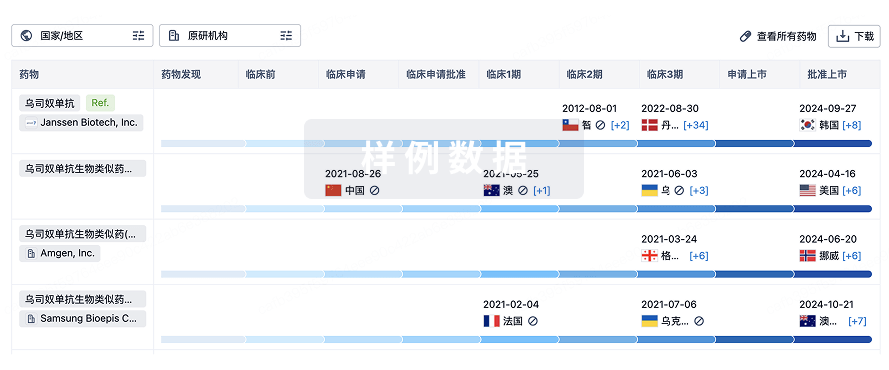
生物类似药在不同国家/地区的竞争态势。请注意临床1/2期并入临床2期,临床2/3期并入临床3期
登录
或
特殊审评
只需点击几下即可了解关键药物信息。
登录
或

提出任何生物医药研究问题
让每一步生物医药决策都精准制胜
基于十亿级生物数据与全球情报的精准 AI,赋能早期药物发现
立即开始免费试用!
智慧芽新药情报库是智慧芽专为生命科学人士构建的基于AI的创新药情报平台,助您全方位提升您的研发与决策效率。
立即接入生物医药数据包
智慧芽新药库数据也通过智慧芽开放平台,以MCP或API服务形式对外开放。立即使用我们的MCP服务定制您的LLM智能体。
生物序列数据库
生物药研发创新
免费使用
化学结构数据库
小分子化药研发创新
免费使用