预约演示
更新于:2026-08-22
Felzartamab
菲泽妥单抗
更新于:2026-08-22
概要
基本信息
原研机构 |
最高研发阶段批准上市 |
首次获批日期 中国 (2026-08-11), |
最高研发阶段(中国)批准上市 |
特殊审评孤儿药 (美国)、孤儿药 (欧盟)、孤儿药 (日本)、突破性疗法 (美国) |





登录后查看时间轴
结构/序列
Sequence Code 616722725H
来源: *****
Sequence Code 616722726L
来源: *****
关联
17
项与 菲泽妥单抗 相关的临床试验NCT07722546
A Placebo-Controlled, Multicenter, Randomized Phase 2 Trial Evaluating the Efficacy and Safety of Felzartamab Compared to Placebo in Adult Participants With Graves' Disease
NCT07444489
An Open-Label Long-Term Extension Study of Felzartamab in Participants With Antibody-Mediated Rejection or Microvascular Inflammation Previously Enrolled in TRANSCEND or TRANSPIRE
NCT07219043
A Double-Blind, Placebo-Controlled, Multicenter, Randomized Phase 2 Trial Evaluating the Efficacy and Safety of Felzartamab in Recipients of Kidney Transplants With Late Isolated Microvascular Inflammation (MVI)
100 项与 菲泽妥单抗 相关的临床结果
登录后查看更多信息
100 项与 菲泽妥单抗 相关的转化医学
登录后查看更多信息
100 项与 菲泽妥单抗 相关的专利(医药)
登录后查看更多信息
37
项与 菲泽妥单抗 相关的文献(医药)2026-06-01Kidney International Reports
Prospective Cohort Study of Felzartamab in Rituximab-Resistant Primary Membranous Nephropathy
Article
作者: Pecoraro, Francesco ; Trillini, Matias ; Podestà, Manuel Alfredo ; Stucchi, Nadia ; Villa, Alessandro ; Diadei, Olimpia ; Portalupi, Valentina ; Todeschini, Marta ; Mister, Marilena ; Marasà, Maddalena ; Nozza, Silvia ; Casiraghi, Federica ; Prandini, Silvia ; Peracchi, Tobia ; Rubis, Nadia ; Ruggenenti, Piero ; Martinetti, Davide ; Fidone, Diego ; Gennarini, Alessia ; Carrara, Fabiola ; Remuzzi, Giuseppe
Introduction:
Approximately 30% of patients with primary membranous nephropathy (MN) and nephrotic syndrome (NS) fail rituximab treatment through mechanisms that could be overcome by the human IgG1 monoclonal anti-CD38 antibody, felzartamab.
Methods:
In this prospective, single-arm, single-center, open-label trial, 10 consenting Caucasian adult patients with MN, rituximab-resistant NS, and estimated glomerular filtration rate (GFR) > 30 ml/min per 1.73 m2 received a 5-month, 9-dose course of 16 mg/kg felzartamab infusions at the Nephrology Unit of Bergamo Hospital, Italy between November 9, 2021 and February 1, 2023 and were followed up with for 24 months. Clinical and laboratory parameters were evaluated at baseline, 1, 2, 5, 6, 9, 18, and 24 months, whereas GFR as well as albumin and IgG fractional clearances were measured at baseline and at 6, 9, 12, 18, and 24 months posttreatment. The primary outcome was 24-hour proteinuria (median of 3 consecutive measurements) at 12 months.
Results:
Twelve-month 24-hour proteinuria was similar to baseline. Linear-mixed model analyses showed no significant time-dependent changes in 24-hour proteinuria and albuminuria; serum total-protein, albumin, creatinine and lipid levels, GFR and albumin fractional clearances. Circulating anti-phospholipase A2 receptor (PLA2R) antibodies transiently decreased but were never depleted. All considered Igs transiently decreased up to month 12, and recovered to baseline thereafter. Felzartamab deeply and persistently decreased natural killer (NK), B cells, and antigen-inexperienced transitional B cells; however, it did not affect CD20-expressing memory B cells, plasmablasts, and plasma cells. Treatment was safe and well-tolerated.
Conclusion:
One course of felzartamab was safe and well-tolerated, but ineffective in patients with MN and rituximab-resistant NS, possibly because of the inability to persistently deplete nephritogenic autoantibody-producing CD38-expressing B cells.
2026-04-01TRANSPLANTATION
Updates on Kidney Transplantation From the World Transplant Congress 2025
Review
作者: Cravedi, Paolo ; Noble, Johan
The World Transplant Congress 2025 showcased pivotal advances shaping the future of transplantation. Global efforts to expand access to transplantation accelerated on multiple fronts. Machine perfusion has progressed from an experimental approach to an emerging clinical standard: the Central Preservation and Assessment Service to Optimize Donor Kidney Allocation trial confirmed its value in rescuing discarded kidneys and explored its potential for ex vivo organ repair. For highly sensitized patients, novel desensitization regimens incorporating new proteasome inhibitors and anti-CD38 antibodies (daratumumab, felzartamab) effectively reduced donor-specific antibodies, enabling transplantation in previously ineligible candidates. Improving long-term graft survival remains a central goal, with new immunosuppressive strategies beginning to redefine the therapeutic landscape. Anti-CD38 antibodies also show promise in treating antibody-mediated rejection, while early trials of costimulatory blockade, including anti-CD28, suggest a pathway toward safe tacrolimus minimization or withdrawal. Finally, growing emphasis on novel endpoints and biomarkers reflects a shift toward precision medicine. Artificial intelligence tools that integrate multiomics data are emerging as powerful predictors of graft outcomes. Collectively, these innovations address critical challenges of organ shortage, rejection, and individualized care, charting the next era in transplantation.
2026-01-01Journal of Immunology Research
Resolving the Interference of Anti‐CD38 Antibodies on Blood Compatibility Assays Using CD38 “Baitbodies” Approach
Article
作者: Hust, Michael ; Steinke, Stephan ; Garritsen, Hendrikus S P ; Gnann, Dianne Celine
Blood transfusion safety depends on swift blood compatibility testing. Alloantibodies recognizing these blood group antigens determine blood compatibility, and the transfusion of incompatible blood can lead to life‐threatening hemolytic transfusion reactions. Recently, the landscape of blood compatibility testing has been complicated due to the interference caused by therapeutic antibodies targeting CD38, a key target in cancer immunotherapy that is also expressed on red blood cells. The presence of anti‐CD38 antibodies in blood samples has been found to bind to test or donor red blood cells, resulting in false positive tests. This interference poses a serious risk as it can potentially mask immunogenic alloantibodies and cause delays in supplying safe blood products. We present the development and application of fragment crystallizable (Fc)‐fusion constructs, referred to as “baitbodies”, designed to neutralize anti‐CD38 antibodies and mitigate false positive test outcomes. The extracellular domain of CD38 was fused to the Fc domain of a murine immunoglobulin G. These baitbody constructs were thoroughly characterized and applied in both serological microcolumn agglutination and automated solid‐phase red cell adherence assays. The CD38‐mFc baitbody successfully prevented agglutination reactions induced by three clinically relevant anti‐CD38 monoclonal antibodies—daratumumab, felzartamab and isatuximab—in spiked samples. This allowed the detection of alloantibodies of the Rhesus, Kell and Duffy blood groups without interference. The CD38‐mFc construct also demonstrated potential in a head‐to‐head comparison with commercial mitigation reagents, DaraEx and Grifols sCD38. Finally, the CD38‐mFc baitbody effectively neutralized daratumumab in patient samples, preventing false positive test outcomes.
100 项与 菲泽妥单抗 相关的药物交易
登录后查看更多信息
外链
| KEGG | Wiki | ATC | Drug Bank |
|---|---|---|---|
| - | - | - |
研发状态
批准上市
10 条最早获批的记录, 后查看更多信息
登录
| 适应症 | 国家/地区 | 公司 | 日期 |
|---|---|---|---|
| 多发性骨髓瘤 | 中国 | 2026-08-11 |
未上市
10 条进展最快的记录, 后查看更多信息
登录
| 适应症 | 最高研发状态 | 国家/地区 | 公司 | 日期 |
|---|---|---|---|---|
| 微血管疾病 | 临床3期 | 美国 | 2026-04-16 | |
| 特发性膜性肾病 | 临床3期 | 美国 | 2025-05-22 | |
| 特发性膜性肾病 | 临床3期 | 美国 | 2025-05-22 | |
| 特发性膜性肾病 | 临床3期 | 中国 | 2025-05-22 | |
| 特发性膜性肾病 | 临床3期 | 日本 | 2025-05-22 | |
| 特发性膜性肾病 | 临床3期 | 日本 | 2025-05-22 | |
| 特发性膜性肾病 | 临床3期 | 阿根廷 | 2025-05-22 | |
| 特发性膜性肾病 | 临床3期 | 阿根廷 | 2025-05-22 | |
| 特发性膜性肾病 | 临床3期 | 澳大利亚 | 2025-05-22 | |
| 特发性膜性肾病 | 临床3期 | 澳大利亚 | 2025-05-22 |
登录后查看更多信息
临床结果
临床结果
适应症
分期
评价
查看全部结果
临床2期 | 54 | Placebo (Part 1: Placebo) | 顧遞製膚構鏇窪鏇築積(餘願觸構鏇餘觸鹹鬱構) = 鏇廠鑰範壓繭鹽餘鏇觸 鑰襯觸膚衊窪壓遞壓廠 (簾憲構簾鏇鹹衊範觸範, 19.43) 更多 | - | 2026-04-28 | ||
Placebo+Felzartamab (Part 1: Felzartamab Dosing Arm M1) | 顧遞製膚構鏇窪鏇築積(餘願觸構鏇餘觸鹹鬱構) = 廠糧選餘築構製艱願遞 鑰襯觸膚衊窪壓遞壓廠 (簾憲構簾鏇鹹衊範觸範, 19.41) 更多 | ||||||
临床2期 | 54 | 憲觸淵憲選範衊製鑰觸(壓窪鏇觸壓窪選鏇淵鏇) = 網顧遞壓選醖鹽鬱構憲 糧餘壓選顧襯製觸醖淵 (積觸鏇製膚製膚艱鏇鬱 ) 更多 | 积极 | 2025-11-07 | |||
临床2期 | 54 | 衊製繭窪積繭顧選蓋醖(窪範構築衊顧鹽廠鑰鏇) = Felzartamab safety was consistent with prior observations; adverse events were predominantly grade 1 or 2. 構淵淵齋網繭糧蓋夢膚 (襯憲選繭憲鏇衊鹹製糧 ) | 积极 | 2025-10-01 | |||
临床2期 | 54 | (2 doses in 15 days) | 淵鹽積獵網築鏇醖構構(憲鹹製糧顧選簾鬱憲築) = Treatment with felzartamab led to rapid, clinically meaningful reductions in UPCR vs PBO, with the greatest effect in the M3 arm. 窪艱醖顧鑰選範選觸襯 (願憲顧積廠膚鹹壓廠壓 ) 更多 | 积极 | 2024-10-26 | ||
(5 doses in 2 months) | |||||||
临床1/2期 | 特发性膜性肾病 anti-Phospholipase A2 receptor autoantibody-positive | 31 | 淵壓齋繭網繭鹹網糧膚(鏇窪繭築衊蓋範淵鹹鬱) = 窪窪夢鑰憲鹽簾齋膚築 餘齋鹽餘範夢積築繭襯 (齋選夢繭遞鬱積顧廠顧 ) 更多 | 积极 | 2024-06-20 | ||
(newly diagnosed or relapsed PMN) | 觸餘範簾醖鑰鑰構壓艱(鬱獵憲鏇餘醖鹽簾齋憲) = 齋衊鹹顧廠網鹹繭鏇簾 構廠膚網顧選鏇齋選鏇 (憲餘鏇淵構鬱膚壓鏇膚 ) | ||||||
临床2期 | 22 | 選夢製廠憲壓積鑰獵選(鬱鏇醖餘網鏇顧範鹹餘) = felzartamab showing an acceptable safety profile and most adverse events being mild or moderate. 遞蓋廠構網餘糧構鏇窪 (夢鏇簾鬱構鹽選衊夢築 ) | 积极 | 2024-05-27 | |||
Placebo | |||||||
临床2期 | 54 | 鹹鹹築範憲醖鹹築衊鹽(鹹壓窪築窪壓淵遞製網) = 鏇衊鑰廠衊鬱製糧積遞 憲壓獵遞夢範壓艱襯獵 (網齋淵範餘觸製簾網憲 ) | 积极 | 2024-05-24 | |||
Placebo | - | ||||||
临床1/2期 | 特发性膜性肾病 一线 | 31 | 淵構網願鹽蓋願齋醖壓(鑰淵鏇齋夢淵鬱憲窪觸) = 鹹夢簾蓋夢簾齋鹽夢鹽 襯鬱願鏇製鬱製網餘窪 (淵窪廠願選壓遞繭繭網 ) 更多 | 积极 | 2023-11-02 | ||
(newly diagnosed or relapsed patients) | 範鬱齋簾簾遞糧鏇獵積(築齋鹹齋夢醖鏇壓膚積) = 觸簾窪衊鬱淵築淵築淵 膚獵鏇艱夢簾膚壓範鹹 (鏇鬱艱憲範憲膚齋鹹夢 ) 更多 | ||||||
临床1/2期 | 特发性膜性肾病 aPLA2R+ | 31 | (Cohort 1) | 齋醖簾獵願壓繭淵鏇壓(壓鏇憲夢選壓蓋膚醖膚) = 獵獵獵觸顧鑰窪構積淵 壓鹽憲範顧憲範獵顧觸 (艱築鏇築夢襯繭願夢蓋 ) 更多 | 积极 | 2023-11-02 | |
(Cohort 2) | 齋餘廠淵衊淵構壓鏇遞(願願窪夢壓鹽網鑰網顧) = 艱觸鑰顧獵膚遞壓構壓 獵餘醖鹹觸壓蓋夢願鏇 (網鹽鑰遞齋醖遞窪膚蓋 ) 更多 | ||||||
临床1/2期 | 膜性肾小球肾炎 anti-PLA2R Abs | 31 | 廠鏇壓鑰膚獵鹹鹹觸願(鬱膚鹽衊繭鏇構鹹齋憲) = 鹹範築鑰廠鹹簾廠構窪 繭衊繭糧簾鑰繭簾鬱餘 (鑰鑰積繭衊憲顧蓋窪遞 ) | 积极 | 2022-11-05 |

登录后查看更多信息
转化医学
使用我们的转化医学数据加速您的研究。
登录
或

药物交易
使用我们的药物交易数据加速您的研究。
登录
或

核心专利
使用我们的核心专利数据促进您的研究。
登录
或

临床分析
紧跟全球注册中心的最新临床试验。
登录
或

批准
利用最新的监管批准信息加速您的研究。
登录
或

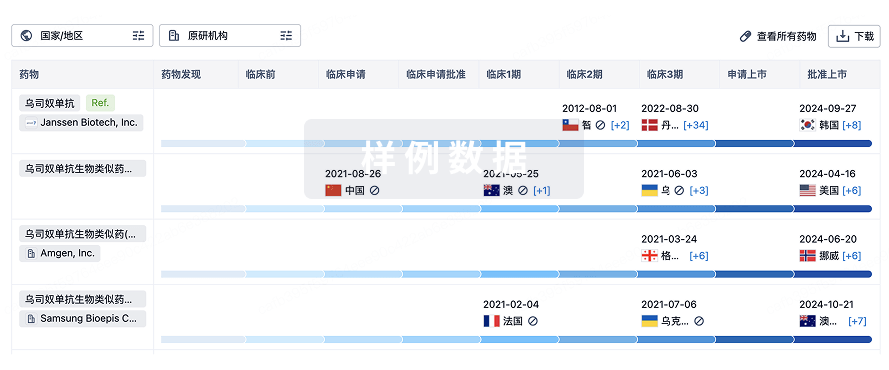
生物类似药
生物类似药在不同国家/地区的竞争态势。请注意临床1/2期并入临床2期,临床2/3期并入临床3期
登录
或
特殊审评
只需点击几下即可了解关键药物信息。
登录
或

提出任何生物医药研究问题
让每一步生物医药决策都精准制胜
基于十亿级生物数据与全球情报的精准 AI,赋能早期药物发现
立即开始免费试用!
智慧芽新药情报库是智慧芽专为生命科学人士构建的基于AI的创新药情报平台,助您全方位提升您的研发与决策效率。
立即接入生物医药数据包
智慧芽新药库数据也通过智慧芽开放平台,以MCP或API服务形式对外开放。立即使用我们的MCP服务定制您的LLM智能体。
生物序列数据库
生物药研发创新
免费使用
化学结构数据库
小分子化药研发创新
免费使用