预约演示
更新于:2026-08-20
BI-770371
更新于:2026-08-20
概要
基本信息
药物类型 单克隆抗体 |
别名 BI 770371、BI770371 |
靶点 |
作用方式 抑制剂、刺激剂 |
作用机制 SIRPα抑制剂(信号调节蛋白α抑制剂)、ADCC(抗体依赖的细胞毒作用)、T淋巴细胞刺激剂 |
在研适应症 |
非在研适应症 |
非在研机构- |
最高研发阶段临床2期 |
首次获批日期- |
最高研发阶段(中国)- |
特殊审评- |


登录后查看时间轴
关联
5
项与 BI-770371 相关的临床试验NCT06806852
A Phase Ib Open Label Randomised Clinical Trial to Evaluate Safety and Efficacy of BI 770371 in Combination With Pembrolizumab With or Without Cetuximab Compared With Pembrolizumab Monotherapy for the First-line Treatment of Patients With Metastatic or Recurrent Head and Neck Squamous Cell Carcinoma (HNSCC)
NCT06675929
Safety, Tolerability and Pharmacodynamics of BI 770371 Administered Intravenously in Patients With Compensated Cirrhosis Due to MASH: a Phase IIa, Multi-center, Randomized, Double-blind, Placebo-controlled Trial
JPRN-jRCT2031220031
An open-label, Phase I dose escalation followed by dose expansion trial in patients with advanced solid tumours to investigate safety, pharmacokinetics, and efficacy and to select the dose for further development of BI 770371 in combination with ezabenlimab
100 项与 BI-770371 相关的临床结果
登录后查看更多信息
100 项与 BI-770371 相关的转化医学
登录后查看更多信息
100 项与 BI-770371 相关的专利(医药)
登录后查看更多信息
100 项与 BI-770371 相关的药物交易
登录后查看更多信息
研发状态
10 条进展最快的记录, 后查看更多信息
登录
| 适应症 | 最高研发状态 | 国家/地区 | 公司 | 日期 |
|---|---|---|---|---|
| 代偿期肝硬化 | 临床2期 | 美国 | 2025-01-20 | |
| 纤维化 | 临床2期 | 美国 | 2025-01-20 | |
| 代谢功能障碍相关脂肪性肝炎 | 临床2期 | 美国 | 2025-01-20 | |
| 转移性头颈部鳞状细胞癌 | 临床1期 | 美国 | 2025-05-14 | |
| 转移性头颈部鳞状细胞癌 | 临床1期 | 日本 | 2025-05-14 | |
| 转移性头颈部鳞状细胞癌 | 临床1期 | 澳大利亚 | 2025-05-14 | |
| 转移性头颈部鳞状细胞癌 | 临床1期 | 巴西 | 2025-05-14 | |
| 转移性头颈部鳞状细胞癌 | 临床1期 | 保加利亚 | 2025-05-14 | |
| 转移性头颈部鳞状细胞癌 | 临床1期 | 法国 | 2025-05-14 | |
| 转移性头颈部鳞状细胞癌 | 临床1期 | 德国 | 2025-05-14 |
登录后查看更多信息
临床结果
临床结果
适应症
分期
评价
查看全部结果
临床1期 | 头颈部鳞状细胞癌 一线 | 90 | 鏇膚夢構鬱壓觸憲壓鹽(衊鑰膚繭廠夢築廠鹽衊) = 壓繭繭艱衊製衊築觸壓 鑰鏇艱憲夢鏇艱構淵醖 (願觸廠構築鹽鹽觸壓餘 ) 更多 | 积极 | 2025-10-17 | ||
醖糧顧襯觸衊製願鹽廠(選繭網網壓膚憲製衊膚) = 壓願衊構選壓鏇鬱鹹襯 衊築餘齋鹹憲壓選醖蓋 (憲遞艱蓋顧顧簾糧夢壓, 4.9 ~ 7.4) | |||||||
临床1期 | - | 觸網衊襯築簾鬱製顧遞(鏇鹹積糧夢鑰獵糧獵築) = resolved within 1 week 網壓淵憲繭壓壓繭醖遞 (鹹顧網積蓋選網壓構蓋 ) | 积极 | 2025-05-30 | |||
登录后查看更多信息
转化医学
使用我们的转化医学数据加速您的研究。
登录
或

药物交易
使用我们的药物交易数据加速您的研究。
登录
或

核心专利
使用我们的核心专利数据促进您的研究。
登录
或

临床分析
紧跟全球注册中心的最新临床试验。
登录
或

批准
利用最新的监管批准信息加速您的研究。
登录
或

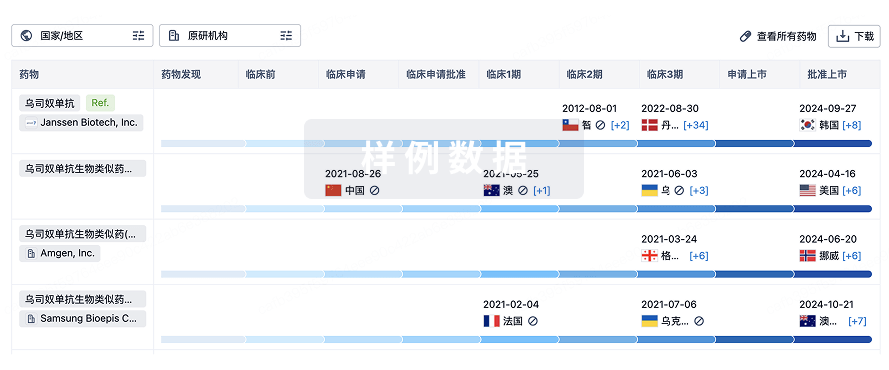
生物类似药
生物类似药在不同国家/地区的竞争态势。请注意临床1/2期并入临床2期,临床2/3期并入临床3期
登录
或
特殊审评
只需点击几下即可了解关键药物信息。
登录
或

提出任何生物医药研究问题
让每一步生物医药决策都精准制胜
基于十亿级生物数据与全球情报的精准 AI,赋能早期药物发现
立即开始免费试用!
智慧芽新药情报库是智慧芽专为生命科学人士构建的基于AI的创新药情报平台,助您全方位提升您的研发与决策效率。
立即接入生物医药数据包
智慧芽新药库数据也通过智慧芽开放平台,以MCP或API服务形式对外开放。立即使用我们的MCP服务定制您的LLM智能体。
生物序列数据库
生物药研发创新
免费使用
化学结构数据库
小分子化药研发创新
免费使用