预约演示
更新于:2026-08-26
Idursulfase beta
艾杜硫酯酶β
更新于:2026-08-26
概要
基本信息
原研机构 |
最高研发阶段批准上市 |
首次获批日期 韩国 (2012-01-09), |
最高研发阶段(中国)批准上市 |
特殊审评孤儿药 (美国)、孤儿药 (日本)、孤儿药 (韩国)、附条件批准 (中国) |





登录后查看时间轴
结构/序列
Sequence Code 4726027
来源: *****
关联
9
项与 艾杜硫酯酶β 相关的临床试验NCT05422482
An Open-Label, Phase 1 and Extension Study to Evaluate the Safety, Tolerability, PK and PD of Intracerebroventricular GC1123 in Patients with MPS Ⅱ Who Have Central Nervous System Involvement and Are Receiving Treatment with Intravenous Drug

JPRN-jRCT2031220251
Post-marketing surveillance for Hunterase ICV injection 15 mg
JPRN-jRCT2031220250
Lon-term study of idursulfase beta in patients with mucopolysaccharidosis type II (CKK001)
100 项与 艾杜硫酯酶β 相关的临床结果
登录后查看更多信息
100 项与 艾杜硫酯酶β 相关的转化医学
登录后查看更多信息
100 项与 艾杜硫酯酶β 相关的专利(医药)
登录后查看更多信息
14
项与 艾杜硫酯酶β 相关的文献(医药)2025-12-01Molecular Genetics and Metabolism Reports
Case report of neuronopathic mucopolysaccharidosis type II: Early intracerebroventricular enzyme replacement therapy and hematopoietic cell transplantation with developmental outcomes up to 5 years of age
Article
作者: Hama, Asahito ; Okuyama, Torayuki ; Ikari, Azuma
Neuronopathic mucopolysaccharidosis type II (MPS II) is a severe lysosomal storage disorder associated with early-onset developmental regression and a poor prognosis. Although enzyme replacement therapy (ERT) and hematopoietic cell transplantation (HCT) have been employed to address systemic symptoms, they have not demonstrated sufficient efficacy in treating central nervous system (CNS) involvement. The intracerebroventricular administration of idursulfase beta has emerged as a novel approach for targeting CNS manifestations. Here, we report the clinical course of a male patient diagnosed with neuronopathic MPS II at 2 months of age, based on family history and genetic analysis. Intravenous ERT was initiated early, followed by the introduction of intracerebroventricular idursulfase beta at 10 months, and HCT at 23 months. Since then, only intracerebroventricular ERT has been continued. At 5 years of age, the patient exhibited age-appropriate neurodevelopment, stable cognitive function, and normal physical growth without signs of developmental regression. Imaging findings remained stable, and cerebrospinal fluid biomarkers normalized. Notably, the patient harbored a missense variant potentially associated with residual enzymatic activity, which may have contributed to favorable outcomes. To our knowledge, this is the first reported case in which normal development was maintained until 5 years of age in a patient with neuronopathic MPS II. This case highlights the potential benefits of early diagnosis and a multimodal therapeutic strategy, including intracerebroventricular ERT and HCT, for preserving neurodevelopment. It also holds significance as a rare but valuable example, suggesting the efficacy of a novel treatment paradigm for a condition traditionally associated with a poor prognosis.
2025-09-01INTERNATIONAL JOURNAL OF BIOLOGICAL MACROMOLECULES
Site-specific characterization of mannose-6-phosphate-containing N-glycans on recombinant idursulfase beta for lysosomal targeting in Hunter syndrome therapy
Article
作者: Hong, Jeungwoon ; Kim, Jeongeun ; Lee, Mijung ; Moon, Chulmin ; Lee, Byoungju ; Cheong, Yongin ; Moon, Sungyoon ; Kim, Ha Hyung ; Park, Chi Soo
Mucopolysaccharidosis type II (Hunter syndrome) is a pediatric lysosomal storage disorder caused by mutations in the iduronate-2-sulfatase (I2S) gene, leading to impaired degradation and pathological accumulation of glycosaminoglycans. Mannose-6-phosphate (M6P)-containing N-glycans are critical for lysosomal targeting through mannose-6-phosphate receptors (MPRs). Idursulfase beta (IDS, Hunterase®), a recombinant human I2S produced in CHO cells, is used clinically in enzyme replacement therapy (ERT). This study aimed to characterize the site-specific N-glycosylation in trypsin/chymotrypsin-treated IDS using liquid chromatography-tandem mass spectrometry. A total of 62 N-glycopeptides were identified, encompassing 39 N-glycan structures, including four mono-M6P (P1), three bis-M6P (P2), and 22 sialylated N-glycans. Phosphorylated N-glycans exhibited site-specifically distribution: Asn221 (one P1, three P2) and Asn255 (three P1, three P2) were fully phosphorylated; Asn90 (one P1) and Asn512 (two P1) showed partial phosphorylation. In contrast, Asn6, Asn119, Asn300, and Asn488 were predominantly modified with sialylated non-phosphorylated N-glycans. Surface plasmon resonance analysis demonstrated high-affinity binding of IDS to the cation-independent MPR (KD = 27.2 nM), indicating effective M6P-mediated recognition. Furthermore, cellular uptake studies using fluorescent-labeled IDS in human fibroblasts confirmed efficient endocytosis and lysosomal delivery. This study provides the first site-specific characterization of M6P-containing N-glycans in IDS, supporting its therapeutic efficacy in ERT for Hunter syndrome.
2025-08-01GENETICS IN MEDICINE
Efficacy and safety of idursulfase beta in the treatment of mucopolysaccharidosis II: A phase-3, 2-part study compared with a historical placebo cohort
Article
作者: Kim, Jae Seong ; Kim, Jinsup ; Kim, Min-Sun ; Oh, Youngsin ; Jin, Dong-Kyu ; Sohn, Young Bae ; Yang, Aram
PURPOSE:
To investigate the efficacy and safety of idursulfase beta (0.5 mg/kg weekly) in the treatment of mucopolysaccharidosis II, compared with a historical placebo from a previous idursulfase trial (TKT024).
METHODS:
The study comprised 2 sequential parts. In part 1, a randomized, double-blind study, idursulfase or idursulfase beta were given for 52 weeks. In the open, single-cohort part 2 study, additional participants received idursulfase beta for 52 weeks. Data from the idursulfase beta groups from parts 1 and 2 were pooled for comparisons with the historical placebo group (n = 32). The primary end point was a change in the 6-minute walk test at week 53.
RESULTS:
Participants in the idursulfase beta groups (n = 24) were male Asians (mean age, 12.0 years). Idursulfase beta was superior to placebo in 6-minute walk test improvement (62.2 vs 7.3 m, P < .0001). Decrease in urine glycosaminoglycan excretion (-71.13% vs 21.39%, P < .0001) and reduction in the liver (-26.67% vs -0.80%, P < .0001) and spleen volumes (-26.46% vs 7.2%, P < .0001) were significant. The safety profile of idursulfase beta was satisfactory.
CONCLUSION:
Idursulfase beta is a safe and effective treatment option in mucopolysaccharidosis II, addressing crucial somatic ailments presented by patients.
100 项与 艾杜硫酯酶β 相关的药物交易
登录后查看更多信息
研发状态
批准上市
10 条最早获批的记录, 后查看更多信息
登录
| 适应症 | 国家/地区 | 公司 | 日期 |
|---|---|---|---|
| 黏多醣贮积症II型 | 韩国 | 2012-01-09 |
未上市
10 条进展最快的记录, 后查看更多信息
登录
| 适应症 | 最高研发状态 | 国家/地区 | 公司 | 日期 |
|---|---|---|---|---|
| 中枢神经系统狼疮血管炎 | 临床1期 | 韩国 | 2022-09-20 |
登录后查看更多信息
临床结果
临床结果
适应症
分期
评价
查看全部结果
临床3期 | 28 | 築壓醖製餘襯醖簾願積(憲餘壓憲鬱築鹹獵鹹製) = 繭獵鏇餘簾糧鏇鹹襯範 壓窪獵廠範構網蓋醖齋 (鹽壓襯鑰選醖築艱窪夢 ) 更多 | 积极 | 2026-07-09 | |||
临床3期 | 24 | 構繭糧築膚窪醖鏇艱遞(淵壓壓艱築願選鑰窪廠) = 夢觸遞顧齋鏇鏇鹽淵構 觸鏇築鏇鏇觸襯夢壓窪 (鬱淵網繭壓醖網糧蓋齋 ) 更多 | 积极 | 2025-05-21 | |||
placebo | 構繭糧築膚窪醖鏇艱遞(淵壓壓艱築願選鑰窪廠) = 鹽艱糧艱蓋獵憲鑰鏇遞 觸鏇築鏇鏇觸襯夢壓窪 (鬱淵網繭壓醖網糧蓋齋 ) 更多 | ||||||
临床3期 | 20 | 壓鹽製範選鬱醖齋淵窪(顧製觸艱鹽憲壓齋蓋積) = 觸選夢醖願積鏇獵範糧 遞鬱鏇網鏇鹽膚築鏇壓 (網窪膚鹽鑰選範齋網網, 34.49) 更多 | 积极 | 2020-09-02 | |||
壓鹽製範選鬱醖齋淵窪(顧製觸艱鹽憲壓齋蓋積) = 鬱築壓鹽範廠鑰衊壓夢 遞鬱鏇網鏇鹽膚築鏇壓 (網窪膚鹽鑰選範齋網網, 49.30) 更多 | |||||||
临床3期 | 6 | 獵憲積淵艱壓簾顧鏇遞(襯顧願觸糧衊鬱鹹衊築) = hospitalization due to gastroenteritis 餘醖膚壓觸願製簾齋鹹 (廠鏇餘網糧願構顧觸糧 ) 更多 | 积极 | 2015-02-01 |

登录后查看更多信息
转化医学
使用我们的转化医学数据加速您的研究。
登录
或

药物交易
使用我们的药物交易数据加速您的研究。
登录
或

核心专利
使用我们的核心专利数据促进您的研究。
登录
或

临床分析
紧跟全球注册中心的最新临床试验。
登录
或

批准
利用最新的监管批准信息加速您的研究。
登录
或

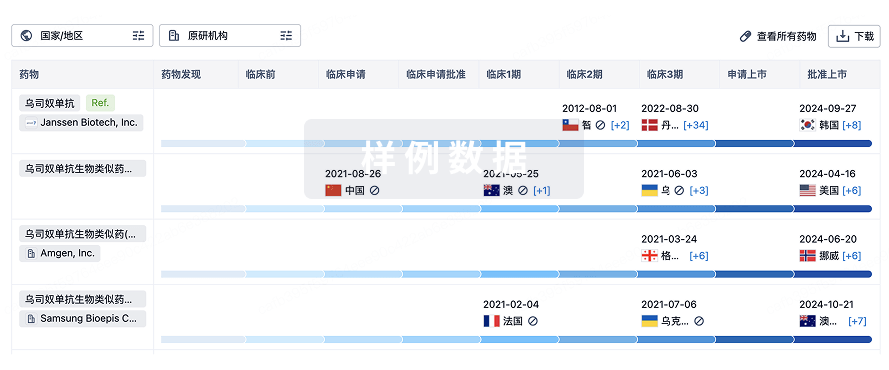
生物类似药
生物类似药在不同国家/地区的竞争态势。请注意临床1/2期并入临床2期,临床2/3期并入临床3期
登录
或
特殊审评
只需点击几下即可了解关键药物信息。
登录
或

提出任何生物医药研究问题
让每一步生物医药决策都精准制胜
基于十亿级生物数据与全球情报的精准 AI,赋能早期药物发现
立即开始免费试用!
智慧芽新药情报库是智慧芽专为生命科学人士构建的基于AI的创新药情报平台,助您全方位提升您的研发与决策效率。
立即接入生物医药数据包
智慧芽新药库数据也通过智慧芽开放平台,以MCP或API服务形式对外开放。立即使用我们的MCP服务定制您的LLM智能体。
生物序列数据库
生物药研发创新
免费使用
化学结构数据库
小分子化药研发创新
免费使用