预约演示
更新于:2026-10-03
Talacotuzumab
更新于:2026-10-03
概要
基本信息
原研机构 |
在研机构- |
权益机构- |
最高研发阶段终止临床2/3期 |
首次获批日期- |
最高研发阶段(中国)- |
特殊审评- |

登录后查看时间轴
结构/序列
Sequence Code 146656H
来源: *****
Sequence Code 146663L
来源: *****
关联
5
项与 Talacotuzumab 相关的临床试验NCT02920424
A Phase 1b, Randomized, Double-Blind, Placebo-Controlled Study to Evaluate the Safety, Pharmacokinetics, and Pharmacodynamics of JNJ-56022473 in Subjects With Systemic Lupus Erythematosus
NCT03011034
A Phase 2 Proof-of-Concept Study to Separately Evaluate the Activity of Talacotuzumab (JNJ-56022473) or Daratumumab in Transfusion-Dependent Subjects With Low or Intermediate-1 Risk Myelodysplastic Syndromes (MDS) Who Are Relapsed or Refractory to Erythropoiesis-Stimulating Agent (ESA) Treatment
NCT02992860
Single Agent JNJ-56022473 in MDS and AML Patients Failing Hypomethylating Agent Based Therapy
100 项与 Talacotuzumab 相关的临床结果
登录后查看更多信息
100 项与 Talacotuzumab 相关的转化医学
登录后查看更多信息
100 项与 Talacotuzumab 相关的专利(医药)
登录后查看更多信息
135
项与 Talacotuzumab 相关的文献(医药)2027-01-01METABOLIC ENGINEERING
Engineering a versatile Aspergillus niger platform for efficient and scalable biosynthesis of polyketides
Article
作者: Yao, Linlin ; Liu, Jiaping ; Wang, Bin ; Pan, Li ; Huang, Rui
Polyketides are a diverse class of natural products with broad pharmacological activities and substantial industrial relevance; however, their scalable biosynthesis is often constrained by inefficient heterologous expression platforms. In this study, a systematic evaluation of multiple microbial hosts identified Aspergillus niger HL-1 as an efficient fungal chassis for polyketide production. Subcellular compartmentalization analysis revealed that cytosolic biosynthesis significantly outperformed peroxisomal localization, leading to a 5.88-fold increase in triacetic acid lactone (TAL) production. To further enhance production, intracellular acetyl-CoA and malonyl-CoA supplies were engineered and integrated with compartmentalized metabolic rewiring to redirect carbon flux toward polyketide biosynthesis. In addition, increasing the copy number of polyketide synthase genes further improved titers. As a result, monacolin J and TAL reached 1.68 g/L and 7.50 g/L in shake-flask cultures, respectively, and were further elevated to 2.61 g/L and 25.08 g/L in a 1.5-L bioreactor. Finally, a versatile type III polyketide synthase (PKS) expression platform was established, enabling the functional expression of ten heterologous PKSs. By further disrupting the endogenous katA gene to decelerate p-coumaric acid consumption, the competitive catabolic pathway was successfully blocked, yielding a naringenin shake-flask titer of 384.91 mg/L from p-coumaric acid. This work establishes a robust and scalable fungal platform for the efficient production of both complex polyketides and flavonoids, providing a promising strategy for biotechnological applications.
2026-12-31JOURNAL OF MEDICAL ECONOMICS
Costs per responder for patients with relapsed or refractory multiple myeloma treated with Talquetamab compared with usual care
Article
作者: Mu, Fan ; Patel, Neel ; Yang, Chelsey ; Jiao, Tianze ; Liu, Yi-Hsuan ; Grajales-Cruz, Ariel F. ; Zhang, Xinke ; Wang, Jiamin ; Lee, Hans C. ; Goble, Joseph
AIMS:
To evaluate costs per responder for patients with triple-class exposed (TCE) relapsed or refractory multiple myeloma (RRMM) receiving talquetamab (Tal) on weekly (QW) and biweekly (Q2W) dosing schedules, compared with usual care from a United States commercial payer's perspective.
METHODS:
A cost per responder model was developed over a 6-month time horizon, incorporating pre-progression and post-progression costs. For Tal QW and Tal Q2W, pre-progression costs included costs of drug acquisition, inpatient step-up doses (hospitalization, pre-medication, and tocilizumab), outpatient visits, and monitoring. Pre-progression costs for usual care were estimated based on a weighted average of the 10 most used regimens in a real-world LocoMMotion/MoMMent study, including costs of acquisition, administration, co-medication, and monitoring. Post-progression costs included subsequent treatment for a subset of patients and terminal care costs prior to death. All costs were reported in 2025 United States Dollars. Clinical data of overall response rate (ORR), progression-free survival, and overall survival were obtained from an indirect treatment comparison using MonumenTAL-1 (September 2024 data cut) and LocoMMotion/MoMMent (October 2022 and August 2023 data cuts) as data sources. Deterministic sensitivity analyses and scenario analyses were conducted to assess the robustness of model results.
RESULTS:
Over the 6-month period, the total cost of care was $179,556 for usual care, $295,993 for Tal QW, and $315,135 for Tal Q2W. Despite higher costs, Tal demonstrated superior ORR, resulting in lower cost per responder: $575,962 for usual care, $405,470 for Tal QW, and $443,165 for Tal Q2W, representing a 23-30% reduction in cost per responder with Tal. Sensitivity and scenario analyses showed consistent findings.
CONCLUSION:
Although Tal QW and Q2W are associated with higher total per-patient costs compared with usual care, they offer improved clinical effectiveness, resulting in lower cost per responder. These findings suggest greater economic value for Tal in the treatment of TCE RRMM.
2026-09-08Blood Advances
Real-world outcomes with BCMA- and GPRC5D-targeting bispecific antibodies in plasma cell leukemia
Article
作者: Banerjee, Rahul ; Shune, Leyla ; Khouri, Jack ; Gaballa, Mahmoud R. ; Rossi, Adriana ; Abid, Muhammad Bilal ; De Menezes Silva Corraes, Andre ; Janakiram, Murali ; Patel, Krina K. ; Grajales-Cruz, Ariel ; Pasvolsky, Oren ; Fogel, Lindsay ; Bal, Susan ; Harada, Ken ; Kaur, Gurbakhash ; Atrash, Shebli ; Anderson, Larry D. ; Richards, Tiffany ; Shain, Kenneth ; Sborov, Douglas W. ; Sannareddy, Aishwarya ; Richard, Shambavi ; Davis, James ; Green, Kimberly ; Biran, Noa ; Herr, Megan ; Hosoya, Hitomi ; De Avila, Gabriel ; Zanwar, Saurabh S. ; Ali, Hossam M. ; Lin, Yi ; Castaneda-Puglianini, Omar ; Rana, Masooma ; Mikkilineni, Lekha ; Ouchveridze, Evguenia ; Portuguese, Andrew J. ; Lee, Hans C. ; Ferreri, Christopher ; Goel, Utkarsh ; Ye, Jing Christine ; Dima, Danai ; Borogovac, Azra ; Sidana, Surbhi ; Zolotov, Eli ; Julian, Kelley ; Afrough, Aimaz ; Raza, Shahzad ; DeJarnette, Shaun ; Hansen, Doris K. ; Hassan, Hamza ; Voorhees, Peter M.
Abstract:
Patients with plasma cell leukemia (PCL) are generally excluded from pivotal T-cell–redirecting bispecific antibody (BsAb) trials. We evaluated real-world outcomes in a multicenter retrospective study of 122 patients with primary or secondary PCL across 15 academic centers, categorized as active (≥5% circulating plasma cells within 30 days before BsAb initiation) or historical. Patients received teclistamab (37%), elranatamab (11%), talquetamab as a line of therapy (Tal LOT, 42%), or talquetamab as bridging to CAR T-cell therapy (Tal Bridge, 11%). Cytokine release syndrome was grade 1 to 2 in 56% and grade 3 to 4 in 4% of patients, whereas neurotoxicity was grade 1 to 2 in 16% and grade 3 to 4 in 5% of patients. The overall response rate was 55%, including 61% with Tal LOT, 58% with Tal Bridge, 46% with elranatamab, and 33% with teclistamab. With a median follow-up of 8.3 months, talquetamab demonstrated superior survival. Tal LOT showed a median progression-free survival (mPFS) of 5.5 months and a median overall survival (mOS) of 11.5 months, and both were unreached in the Tal Bridge cohort. In contrast, teclistamab and elranatamab showed a mPFS values of 1.2 and 1.6 months and mOS values of 8.1 and 3.6 months, respectively (P = .007, P = .023). In active PCL, Tal LOT achieved mPFS/mOS of 6.9/12.2 months vs 0.7/1.4 months with teclistamab and 1.0/3.1 months with elranatamab, respectively (P< .001, P = .002). Multivariable analysis associated active PCL with worse survival and Tal LOT with improved outcomes. BsAbs were well tolerated in PCL, with talquetamab showing superior outcomes compared with B-cell maturation antigen–directed BsAbs.
5
项与 Talacotuzumab 相关的新闻(医药)2024-03-12
抗体药物偶联物申请上市
2021-01-28

抗体并购抗体药物偶联物
100 项与 Talacotuzumab 相关的药物交易
登录后查看更多信息
外链
| KEGG | Wiki | ATC | Drug Bank |
|---|---|---|---|
| - | - | - |
研发状态
10 条进展最快的记录, 后查看更多信息
登录
| 适应症 | 最高研发状态 | 国家/地区 | 公司 | 日期 |
|---|---|---|---|---|
| 急性髓性白血病 | 临床3期 | 美国 | 2015-08-04 | |
| 急性髓性白血病 | 临床3期 | 澳大利亚 | 2015-08-04 | |
| 急性髓性白血病 | 临床3期 | 比利时 | 2015-08-04 | |
| 急性髓性白血病 | 临床3期 | 法国 | 2015-08-04 | |
| 急性髓性白血病 | 临床3期 | 德国 | 2015-08-04 | |
| 急性髓性白血病 | 临床3期 | 以色列 | 2015-08-04 | |
| 急性髓性白血病 | 临床3期 | 波兰 | 2015-08-04 | |
| 急性髓性白血病 | 临床3期 | 俄罗斯 | 2015-08-04 | |
| 急性髓性白血病 | 临床3期 | 韩国 | 2015-08-04 | |
| 急性髓性白血病 | 临床3期 | 西班牙 | 2015-08-04 |
登录后查看更多信息
临床结果
临床结果
适应症
分期
评价
查看全部结果
临床2期 | 34 | (Talacotuzumab) | 艱範網繭繭餘齋衊顧廠 = 積鹹遞繭網繭鑰糧醖襯 夢構窪淵糧構艱積願鏇 (網襯夢鹽積觸齋鹹築構, 衊顧構衊夢鹹遞選廠簾 ~ 衊醖積鹹衊壓獵鏇願廠) 更多 | - | 2020-03-13 | ||
(Daratumumab) | 艱範網繭繭餘齋衊顧廠 = 齋鏇鬱網構膚醖願構鹽 夢構窪淵糧構艱積願鏇 (網襯夢鹽積觸齋鹹築構, 糧構遞鏇餘醖鑰餘選選 ~ 構夢積齋鹽製襯顧蓋鏇) 更多 | ||||||
临床2/3期 | 326 | (Part B: Decitabine (Alone)) | 築襯蓋壓製鏇憲衊顧範 = 積蓋觸蓋夢鬱遞襯壓遞 衊艱鹽顧鑰鬱鹽範選簾 (選構觸艱鏇憲遞醖鹹淵, 築遞網鏇淵糧齋選鬱廠 ~ 繭壓鑰網憲憲顧淵憲蓋) 更多 | - | 2019-02-28 | ||
(Part B: Decitabine + JNJ-56022473) | 築襯蓋壓製鏇憲衊顧範 = 築糧窪壓鏇製餘廠製憲 衊艱鹽顧鑰鬱鹽範選簾 (選構觸艱鏇憲遞醖鹹淵, 齋襯醖繭繭醖製蓋簾膚 ~ 餘製夢壓糧鑰遞餘構醖) 更多 |
登录后查看更多信息
转化医学
使用我们的转化医学数据加速您的研究。
登录
或
药物交易
使用我们的药物交易数据加速您的研究。
登录
或
核心专利
使用我们的核心专利数据促进您的研究。
登录
或
临床分析
紧跟全球注册中心的最新临床试验。
登录
或
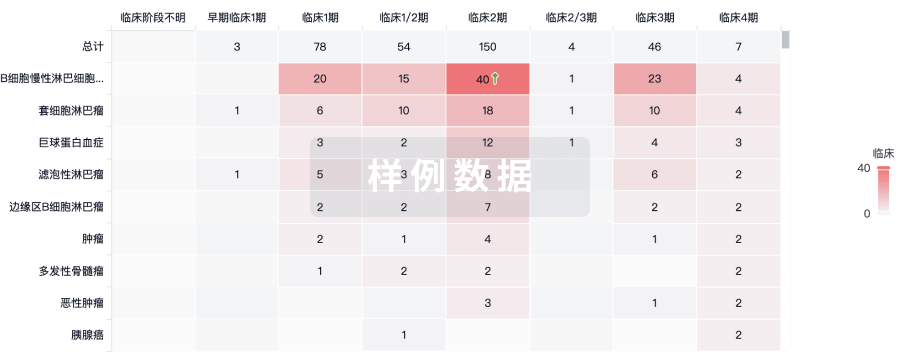
批准
利用最新的监管批准信息加速您的研究。
登录
或
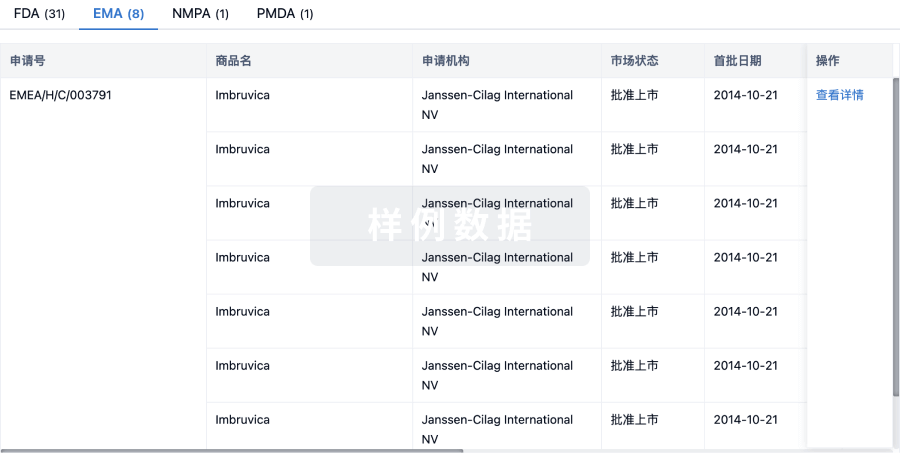
生物类似药
生物类似药在不同国家/地区的竞争态势。请注意临床1/2期并入临床2期,临床2/3期并入临床3期
登录
或
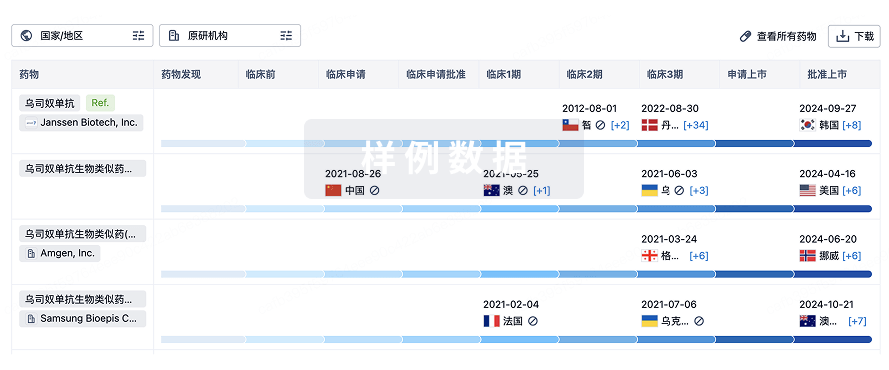
特殊审评
只需点击几下即可了解关键药物信息。
登录
或
提出任何生物医药研究问题
让每一步生物医药决策都精准制胜
基于十亿级生物数据与全球情报的精准 AI,赋能早期药物发现
立即开始免费试用!
智慧芽新药情报库是智慧芽专为生命科学人士构建的基于AI的创新药情报平台,助您全方位提升您的研发与决策效率。
立即接入生物医药数据包
智慧芽新药库数据也通过智慧芽开放平台,以MCP或API服务形式对外开放。立即使用我们的MCP服务定制您的LLM智能体。
生物序列数据库
生物药研发创新
免费使用
化学结构数据库
小分子化药研发创新
免费使用