预约演示
更新于:2026-09-23
Beijing Hexin Xunming Pharmaceutical Technology Co., Ltd.
更新于:2026-09-23
概览
标签
肿瘤
其他疾病
放射与诊断药物
小分子化药
诊断用放射药物
疾病领域得分
一眼洞穿机构专注的疾病领域

技术平台
公司药物应用最多的技术
靶点
公司最常开发的靶点
关联
靶点 |
作用机制 |
在研机构 |
原研机构 |
在研适应症 |
非在研适应症 |
最高研发阶段 |
首次获批国家/地区 |
首次获批日期 |
靶点 |
作用机制 |
在研机构 |
原研机构 |
在研适应症 |
非在研适应症 |
最高研发阶段 |
首次获批国家/地区 |
首次获批日期 |
靶点 |
作用机制 |
在研机构 |
原研机构 |
在研适应症 |
非在研适应症 |
最高研发阶段 |
首次获批国家/地区 |
首次获批日期 |

CTR20260647
评价68Ga-HX01注射液用于不同类型软组织肉瘤PET/CT显像的肿瘤摄取特点、生物分布及安全性的前瞻性、单臂、多中心Ⅱ期临床试验
CTR20254596
评估177Lu-HX02注射液在晚期恶性实体瘤患者中的安全性、耐受性、辐射剂量学、药代动力学以及初步有效性的I期临床试验
ChiCTR2600116425
A Phase I Clinical Trial to Evaluate the Safety, Tolerability, Radiation Dosimetry, Pharmacokinetics, and Preliminary Efficacy of ¹⁷⁷Lu-HX02 Injection in Patients with Advanced Malignant Solid Tumors

100 项与 北京核欣迅明医药科技有限公司 相关的临床结果
登录后查看更多信息
登录后查看更多信息
2026-04-27Chemical & biomedical imaging
Design, Synthesis, and Evaluation of OncoFAP Derivatives with the Albumin Binder as Novel Antitumor Radiopharmaceuticals
Article
作者: Yang, Biao ; Lin, Zhaoguo ; Hu, Wenzhu ; Zeng, Dexing ; Chen, Yinfei ; Shan, Changyu ; Gai, Yongkang ; Zhou, Tianyi ; Lan, Xiaoli ; Liu, Yingzhou ; An, Rui ; Feng, Yuan
Fibroblast activation protein (FAP), a type II transmembrane serine protease, is selectively and highly expressed on the membranes of cancer-associated fibroblasts within the stroma of various epithelial-derived malignancies. In recent years, numerous quinoline-based small organic radioligands targeting FAP, such as OncoFAP, have been developed and clinically utilized for the diagnosis of both primary and metastatic tumors. However, despite their selective accumulation, conventional FAP ligands often suffer from a relatively short half-life in tumors, limiting their efficacy in radionuclide therapy. In this study, we leveraged the structure of UAMC-1110, which was known for its high affinity for FAP, and modified it by adding functional chemical groups (unnatural amino acid, linkers, and albumin binders) to improve its pharmacokinetic and pharmacodynamic properties, thereby enhancing tumor targeting and prolonging tumor retention. Among the synthesized derivatives, XH03-11 emerged as a standout candidate due to its excellent in vitro characteristics, superior in vivo biodistribution profile, and demonstrated therapeutic efficacy in tumor-bearing mice.
2025-07-01European Journal of Nuclear Medicine and Molecular Imaging
Head-to-head evaluation of [18F]FDG PET/CT and [68Ga]Ga-HX01 PET/MR in sarcoma patients
Article
作者: Gai, Yongkang ; Hu, Fan ; Zhang, Xiao ; Xiu, Linfeng ; Lan, Xiaoli ; Ye, Ting ; Ruan, Weiwei ; Chen, Jing ; Fan, Li
PURPOSE:
Tumor-associated neovasculature and energy metabolism reprogramming serve as critical indicators of tumor proliferation, progression, invasion, and metastasis. This study conducted a head-to-head clinical investigation and comparison of [18F]FDG and [68Ga]Ga-HX01 PET by reflecting neovasculature and glucose metabolism in sarcoma patients, respectively.
METHODS:
We reviewed the imaging data of sarcoma patients who underwent [68Ga]Ga-HX01 PET/MR and [18F]FDG PET/CT from June 29, 2022, to December 21, 2023. The two imaging modalities were performed on two separate days within one week of each other. A cohort of 21 patients with an average age of 45.81 ± 19.99 years were enrolled. The location, number and PET characteristics of all lesions were collected. The relationships between the two tracers were evaluated.
RESULTS:
Among the 21 patients, 4 underwent imaging for initial disease staging, while the remaining 17 were imaged to detect recurrences. Patient-based analysis revealed that [68Ga]Ga-HX01 PET/MR diagnostic performance was equivalent to [18F]FDG PET/CT in lesion detection (P = 1.0). The SUVmax value of [68Ga]Ga-HX01 (4.64 ± 1.90) was significantly lower than that of [18F]FDG (9.43 ± 6.17, P = 0.002) across all patients. In terms of lesion-based analysis, [68Ga]Ga-HX01 identified two additional lesions compared to [18F]FDG, though this difference was not statistically significant (94 vs. 92, P = 0.678). The SUVmax value for all lesions with [68Ga]Ga-HX01 (3.47 ± 1.68) was also lower than that with [18F]FDG (5.82 ± 4.81, P = 0.003). Notably, [68Ga]Ga-HX01 was preferred in patients receiving hematopoietic cytokines.
CONCLUSION:
[68Ga]Ga-HX01 PET offers comparable diagnostic efficacy to [18F]FDG PET/CT in sarcoma, with potential advantages in specific clinical scenarios. Larger cohorts are needed to validate these findings.
CLINICAL TRIAL REGISTRATION:
NCT05490849 and NCT06416774.
2025-06-01EUROPEAN JOURNAL OF MEDICINAL CHEMISTRY
Preparation and evaluation of a novel albumin-binding heterodimer therapeutic radiopharmaceutical with remarkable tumor accumulation and retention
Article
作者: Yang, Biao ; Hu, Mengyan ; Qin, Chunxia ; Lan, Xiaoli ; Shan, Changyu ; Gai, Yongkang ; Lin, Zhaoguo ; An, Rui ; Zeng, Dexing
The intricate heterogeneity exhibited across diverse tumor types and the inconsistent expression levels of a specific receptor within tumors make it difficult for single-targeting radiotracers to meet clinical needs. The combination of "dual-targeting" and "albumin-binding" strategies can overcome it and effectively improve tumor uptake and retention of radiopharmaceuticals, thereby enhancing the effect of tumor theranostics. In this study, an albumin binder-conjugated heterodimeric precursor L21 targeting integrin αvβ3 and CD13 was successfully developed and labeled with 68Ga and 177Lu to evaluate therapeutic potential in BxPC-3 xenograft mice. In vitro, [68Ga]Ga-L21 and [177Lu]Lu-L21 exhibited excellent radiochemical stability in phosphate buffered saline (PBS) or fetal bovine serum (FBS) at 37 °C for 5 h. Compared to [68Ga]Ga-L00 without albumin binder, the introduction of albumin binder did not substantially alter the water solubility of [68Ga]Ga-L21, but substantially increased its affinity for serum albumin in FBS. In vivo, [68Ga]Ga-L21 showed significantly higher tumor uptake and longer tumor retention time than [68Ga]Ga-L00 (0.70 ± 0.06 standardized uptake value [SUV] vs. 0.33 ± 0.02 SUV at 3 h, P = 0.0004). [177Lu]Lu-L21 exhibited excellent tumor uptake, tumor-to-nontumor ratios and tumor retention, with tumor uptake keeping 2.79 ± 0.30 percentage of injected radioactive dose per gram of tissue (%ID/g) even at 96 h post-injection. Biodistribution results of [177Lu]Lu-L21 were consistent with SPECT imaging, demonstrating that [177Lu]Lu-L21 is a promising radiopharmaceutical for tumor radionuclide therapy.
100 项与 北京核欣迅明医药科技有限公司 相关的药物交易
登录后查看更多信息
100 项与 北京核欣迅明医药科技有限公司 相关的转化医学
登录后查看更多信息
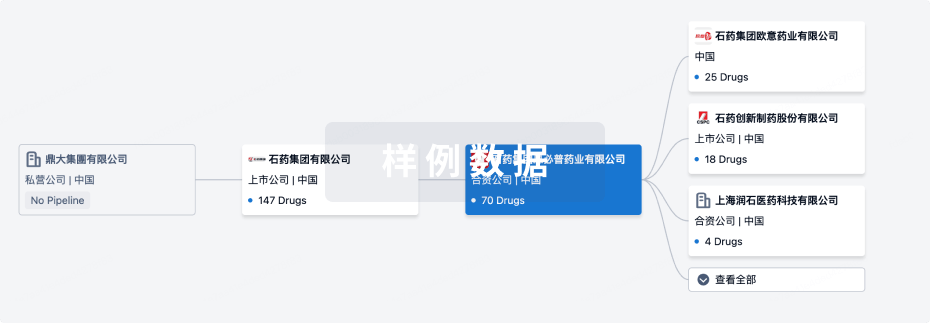
组织架构
使用我们的机构树数据加速您的研究。
登录
或
管线布局
2026年09月26日管线快照
管线布局中药物为当前组织机构及其子机构作为药物机构进行统计,早期临床1期并入临床1期,临床1/2期并入临床2期,临床2/3期并入临床3期
药物发现
3
2
临床前
临床1期
1
1
临床2期
登录后查看更多信息
当前项目
登录后查看更多信息
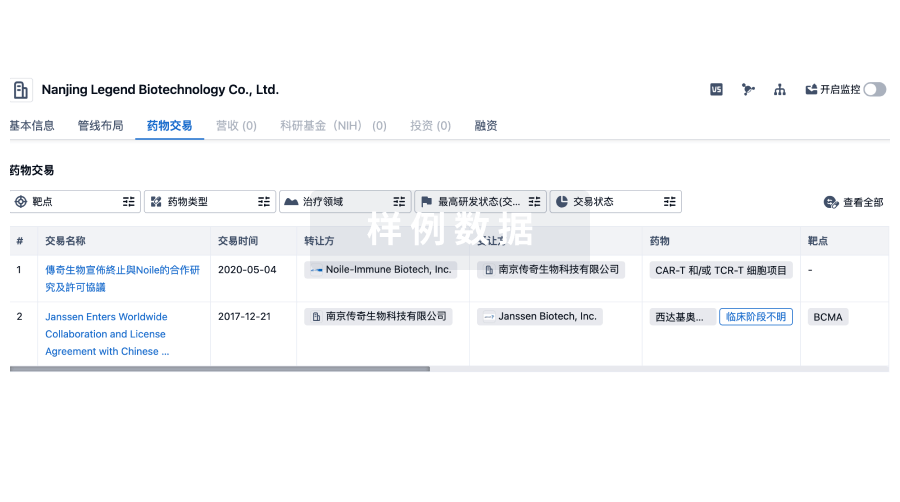
药物交易
使用我们的药物交易数据加速您的研究。
登录
或
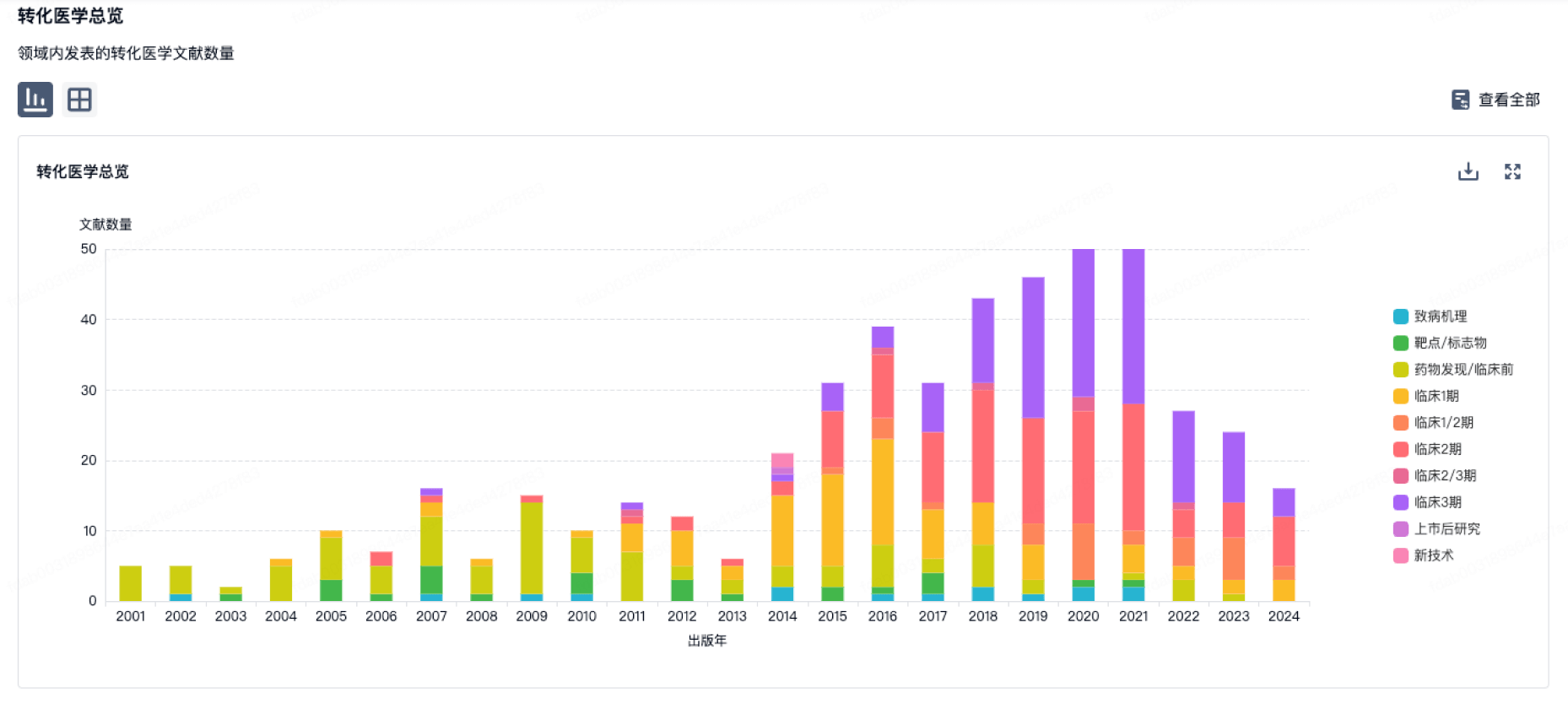
转化医学
使用我们的转化医学数据加速您的研究。
登录
或
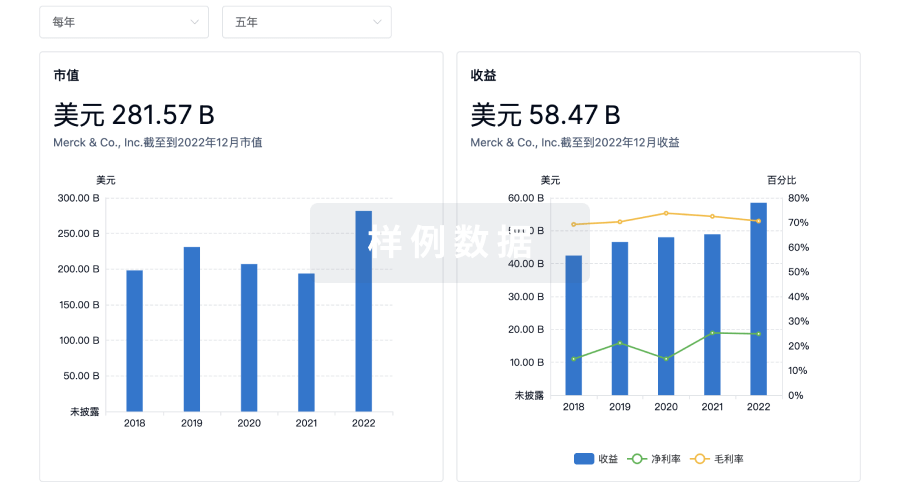
营收
使用 Synapse 探索超过 36 万个组织的财务状况。
登录
或
科研基金(NIH)
访问超过 200 万项资助和基金信息,以提升您的研究之旅。
登录
或
投资
深入了解从初创企业到成熟企业的最新公司投资动态。
登录
或
融资
发掘融资趋势以验证和推进您的投资机会。
登录
或
提出任何生物医药研究问题
让每一步生物医药决策都精准制胜
基于十亿级生物数据与全球情报的精准 AI,赋能早期药物发现
立即开始免费试用!
智慧芽新药情报库是智慧芽专为生命科学人士构建的基于AI的创新药情报平台,助您全方位提升您的研发与决策效率。
立即接入生物医药数据包
智慧芽新药库数据也通过智慧芽开放平台,以MCP或API服务形式对外开放。立即使用我们的MCP服务定制您的LLM智能体。
生物序列数据库
生物药研发创新
免费使用
化学结构数据库
小分子化药研发创新
免费使用