预约演示
更新于:2026-04-03
Mapatumumab
马帕木单抗
更新于:2026-04-03
概要
基本信息
最高研发阶段临床2期 |
首次获批日期- |
最高研发阶段(中国)- |
特殊审评- |


登录后查看时间轴
结构/序列
Sequence Code 111169ScFv

关联
7
项与 马帕木单抗 相关的临床试验NCT01258608
A Randomized, Multi-Center, Blinded, Placebo-Controlled Study Of Mapatumumab ([HGS1012], A Fully Monoclonal Antibody To TRAIL-R1) In Combination With Sorafenib As A First-Line Therapy In Subjects With Advanced Hepatocellular Carcinoma
NCT01088347
A Phase 1b/2 Study With the Agonistic TRAIL-R1 Antibody, Mapatumumab, in Combination With Cisplatin and Radiotherapy as a First Line Therapy in Patients With Advanced Cervical Cancer.

NCT00712855
A Phase 1B, Multi-center, Open Label, Dose Escalation Study of Mapatumumab ([HGS1012], a Fully-human Monoclonal Antibody to TRAIL-R1) in Combination With Sorafenib as a First Line Therapy in Subjects With Advanced Hepatocellular Carcinoma
100 项与 马帕木单抗 相关的临床结果
登录后查看更多信息
100 项与 马帕木单抗 相关的转化医学
登录后查看更多信息
100 项与 马帕木单抗 相关的专利(医药)
登录后查看更多信息
37
项与 马帕木单抗 相关的文献(医药)2025-07-01JOURNAL OF DAIRY SCIENCE
Targeted reproductive management for lactating Holstein cows: Reproductive and economic outcomes of Double-Ovsynch compared with a targeted approach based on resumption of estrus
Article
作者: Bilby, Todd R ; De Vries, Albert ; Chebel, Ricardo C ; Factor, Luana ; Peixoto, Phillip M G ; Jones, Kristi ; Mirzaei, Ahmadreza ; Montevecchio, Ana B ; Galvão, Klibs N ; Bisinotto, Rafael S
Accessibility to automated monitoring devices (AMD) has led to exploration of alternative reproductive management to ovulation synchronization protocols (OvSP) for first postpartum artificial insemination (AI) according to the cow's early postpartum estrus characteristics (EPEC). We hypothesized that pregnancy and economic outcomes of cows subjected to a targeted reproductive management (TRM) are not inferior to those of cows subjected to an OvSP for the first AI. This was a noninferiority, randomized clinical trial. Cows (n = 2,635) from one dairy were fitted with AMD and classified according to EPEC at 45 ± 3 DIM as estrual (high intensity AMD-detected estrus [primiparous: heat index ≥90, multiparous: heat index ≥70; 0 = minimum, 100 = maximum]) and anestrus (no estrus or low intensity estrus). Cows in the control treatment were enrolled in the Double-Ovsynch (GnRH on d -27, PGF2α on d -20, GnRH on d -17 and -10, PGF2α on d -3 and -2, GnRH on d -1, and timed AI [TAI] on d 0 at 73 ± 3 DIM). Anestrus cows enrolled in the TRM treatment were assigned to the hCG-Ovsynch (TRM1; hCG on d -17, GnRH on d -10, PGF2α on d -3 and -2, GnRH on d -1, and TAI on d 0 at 73 ± 3 DIM). Estrual cows received PGF2α at 60 to 73 DIM, when they were 6 to 22 d after a previous estrus, and if not AI in estrus within 7 d, were enrolled in the hCG-Ovsynch at 70 to 77 DIM (TRM2). Estrual cows in the TRM treatment that were ≥23 d from a previous estrus at 63 ± 3 DIM were enrolled in the hCG-Ovsynch at 63 ± 3 DIM and received TAI at 80 ± 3 DIM (TRM3). Pregnancy was diagnosed 32 ± 3 and 67 ± 3 d after AI. Cows were re-inseminated at AMD-detected estrus or at fixed time within 10 d after nonpregnancy diagnosis. The lactation gross profit was calculated as follows: (milk income + sale value + subsequent lactation calf value) - (feed cost + replacement cost + fixed cost + depreciation + reproductive management cost). Cows in the control treatment were more likely to be diagnosed pregnant 67 d after AI (control = 53.9% [95% CI = 51.1%, 56.6%]; TRM = 50.1% [95% CI = 47.2%, 53.0%]), independent of EPEC. The interaction between treatment and EPEC tended to affect the hazard of pregnancy throughout the lactation (control = referent; anestrus-TRM: adjusted hazard ratio = 1.01, 95% CI = 0.91, 1.13; estrual-TRM: adjusted hazard ratio = 0.83, 95% CI = 0.74, 0.94). Treatment did not affect gross profit, independent of EPEC (control = US$2,196.9 ± 25.6; TRM = US$2,221.9 ± 26.5). Alternative strategies for first postpartum AI according to a cow's EPEC may be possible with AMD, without affecting gross profit. The use of a single hCG treatment to presynchronize the estrous cycle of anestrus cows may be an alternative to the presynchronization with the Ovsynch protocol because despite slightly decreasing P/AI, it did not affect gross profit.
2019-10-01Leukemia1区 · 医学
Transient stabilization, rather than inhibition, of MYC amplifies extrinsic apoptosis and therapeutic responses in refractory B-cell lymphoma
1区 · 医学
Article
作者: Dang, Chi V ; Bogusz, Agata M ; Taylor, Deanne ; Thomas-Tikhonenko, Andrei ; Hayer, Katharina E ; El-Deiry, Wafik S ; Geoerger, Birgit ; Yu, Duonan ; Sotillo, Elena ; Hogarty, Michael D ; Robert, Aude ; Psathas, James ; Wiels, Joëlle ; Klein, Peter S ; Harrington, Colleen T
Therapeutic targeting of initiating oncogenes is the mainstay of precision medicine. Considerable efforts have been expended toward silencing MYC, which drives many human cancers including Burkitt lymphomas (BL). Yet, the effects of MYC silencing on standard-of-care therapies are poorly understood. Here we found that inhibition of MYC transcription renders B-lymphoblastoid cells refractory to chemotherapeutic agents. This suggested that in the context of chemotherapy, stabilization of Myc protein could be more beneficial than its inactivation. We tested this hypothesis by pharmacologically inhibiting glycogen synthase kinase 3β (GSK-3β), which normally targets Myc for proteasomal degradation. We discovered that chemorefractory BL cell lines responded better to doxorubicin and other anti-cancer drugs when Myc was transiently stabilized. In vivo, GSK3 inhibitors (GSK3i) enhanced doxorubicin-induced apoptosis in BL patient-derived xenografts (BL-PDX), as well as in murine MYC-driven lymphoma allografts. This enhancement was accompanied by and required deregulation of several key genes acting in the extrinsic, death-receptor-mediated apoptotic pathway. Consistent with this mechanism of action, GSK3i also facilitated lymphoma cell killing by a death ligand TRAIL and by a death receptor agonist mapatumumab. Thus, GSK3i synergizes with both standard chemotherapeutics and direct engagers of death receptors and could improve outcomes in patients with refractory lymphomas.
2017-05-01Sichuan da xue xue bao. Yi xue ban = Journal of Sichuan University. Medical science edition
[Effects of Tramadol on Insulin Resistance during Cesarean Section Complicated with Gestational Diabetes Mellitus].
Article
作者: Lin, Yuan-Gui ; Huang, Wei
OBJECTIVES:
To investigate the effects of tramadol on insulin resistance (IR) during cesarean section complicated with gestational diabetes mellitus (GDM).
METHODS:
120 patients of elective caesarean sectioncomplicated with GDM (level A1) were collected from Dec.2015 to Oct.2016, randomly divided into the tramadol injection treated groups (0.5 mg/kg-TRM1, 1 mg/kg-TRM2 and 1.5 mg/kg-TRM3) and the control group (CON) (n=30). The patients of TRM groups were injected with tramadol after delivery of fetus during caesarean delivery under combined spinal-epidural anaesthesia (CSEA) and the patients of CON group were treated with normal saline as control. The plasma were collected before CSEA (T0), after delivery of fetus (T1) and immediately after caesarean section (T2) for determination of the expression of blood glucose, insulin, HOMA-IR, interleukin-6 (IL-6) and tumor necrosis factor-α (TNF-α) by hexokinase, chemiluminescence method and ELISA. The activation of PI3K/Akt signaling pathway of epiploon were detected by RT-PCR and Western blot.
RESULTS:
Compared with T0, the concentration of blood glucose, insulin, HOMA-IR, IL-6 and TNF-α increased significantly in T1 and T2 (P<0.05). The factors of above decreased in T2 of TRM2 group and TRM3 group comparing with CON group, but of no significant differences between TRM1 group and CON group. Compared with CON group in T2, PI3K/Akt signaling pathway activated significantly in TRM2 group and TRM3 group (P<0.05).
CONCLUSIONS:
The tramadol can attenuate IR during cesarean section complicated with GDM and may regulate the secretion of IL-6, TNF-α and PI3K/Akt signaling pathway in the treatment of IR of GDM.
8
项与 马帕木单抗 相关的新闻(医药)2024-11-27
疫苗临床2期临床结果临床1期
100 项与 马帕木单抗 相关的药物交易
登录后查看更多信息
研发状态
10 条进展最快的记录, 后查看更多信息
登录
| 适应症 | 最高研发状态 | 国家/地区 | 公司 | 日期 |
|---|---|---|---|---|
| 晚期肝细胞癌 | 临床2期 | 美国 | 2011-02-08 | |
| 晚期肝细胞癌 | 临床2期 | 美国 | 2011-02-08 | |
| 晚期肝细胞癌 | 临床2期 | 德国 | 2011-02-08 | |
| 晚期肝细胞癌 | 临床2期 | 德国 | 2011-02-08 | |
| 晚期肝细胞癌 | 临床2期 | 波兰 | 2011-02-08 | |
| 晚期肝细胞癌 | 临床2期 | 波兰 | 2011-02-08 | |
| 晚期肝细胞癌 | 临床2期 | 罗马尼亚 | 2011-02-08 | |
| 晚期肝细胞癌 | 临床2期 | 罗马尼亚 | 2011-02-08 | |
| 晚期肝细胞癌 | 临床2期 | 俄罗斯 | 2011-02-08 | |
| 晚期肝细胞癌 | 临床2期 | 俄罗斯 | 2011-02-08 |
登录后查看更多信息
临床结果
临床结果
适应症
分期
评价
查看全部结果
临床1/2期 | 101 | Placebo+Sorafenib (Sorafenib+Placebo) | 觸膚憲糧範鹽網顧簾鑰(鏇膚夢積積餘鹹餘衊築) = 糧顧鏇蓋範衊製鏇構淵 鑰鹹鬱衊糧遞獵餘鑰範 (艱憲壓蓋顧選淵糧餘繭, 鏇廠鬱鹽窪醖廠窪範憲 ~ 築鹽夢壓鹹遞襯醖選壓) 更多 | - | 2018-12-19 | ||
(Sorafenib+Mapatumumab 30 mg/kg) | 觸膚憲糧範鹽網顧簾鑰(鏇膚夢積積餘鹹餘衊築) = 窪鹽窪壓憲簾網範齋廠 鑰鹹鬱衊糧遞獵餘鑰範 (艱憲壓蓋顧選淵糧餘繭, 鑰鏇繭網艱遞遞鏇廠遞 ~ 鹽製壓鏇鹽顧構蓋製鑰) 更多 | ||||||
临床2期 | 101 | 鹹鹹糧夢齋簾鏇簾餘憲(鬱鑰願簾簾鹹廠鬱網淵) = 遞顧衊簾艱廠願獵淵遞 遞艱願鏇構蓋鏇餘淵淵 (窪壓壓衊壓廠衊鹹觸觸 ) | 不佳 | 2016-04-01 | |||
sorafenib+Placebo | 鹹鹹糧夢齋簾鏇簾餘憲(鬱鑰願簾簾鹹廠鬱網淵) = 襯蓋鑰觸鑰醖願範夢顧 遞艱願鏇構蓋鏇餘淵淵 (窪壓壓衊壓廠衊鹹觸觸 ) | ||||||
临床2期 | 104 | Arm A | 範壓廠觸遞夢築窪鹹獵(齋範壓鏇積艱鑰衊襯繭) = 膚壓選蓋鹹鏇繭膚鏇製 觸範糧範鹹襯鏇膚選鏇 (憲壓鹽製餘蓋壓衊齋築 ) 更多 | 不佳 | 2010-11-19 | ||
Arm B10 | 範壓廠觸遞夢築窪鹹獵(齋範壓鏇積艱鑰衊襯繭) = 齋範壓膚鏇憲顧獵蓋繭 觸範糧範鹹襯鏇膚選鏇 (憲壓鹽製餘蓋壓衊齋築, p=0.08) 更多 | ||||||
临床1期 | - | 49 | 蓋製鹹構鹹選醖顧鏇顧(糧製衊鹽憲夢鏇淵憲網) = 艱廠廠築觸齋夢鏇構廠 壓糧選繭艱選膚積餘觸 (鏇網膚鏇構艱網糧衊構 ) 更多 | - | 2008-05-20 | ||
临床1期 | 24 | 壓構鹽壓蓋膚餘鑰範鑰(蓋願鏇鹹糧衊鏇糧餘願) = 窪遞窪積遞鬱構選獵襯 積膚齋蓋願遞願壓壓齋 (鬱顧顧餘鏇衊遞鏇範鏇 ) | - | 2005-06-01 |

登录后查看更多信息
转化医学
使用我们的转化医学数据加速您的研究。
登录
或

药物交易
使用我们的药物交易数据加速您的研究。
登录
或

核心专利
使用我们的核心专利数据促进您的研究。
登录
或

临床分析
紧跟全球注册中心的最新临床试验。
登录
或

批准
利用最新的监管批准信息加速您的研究。
登录
或

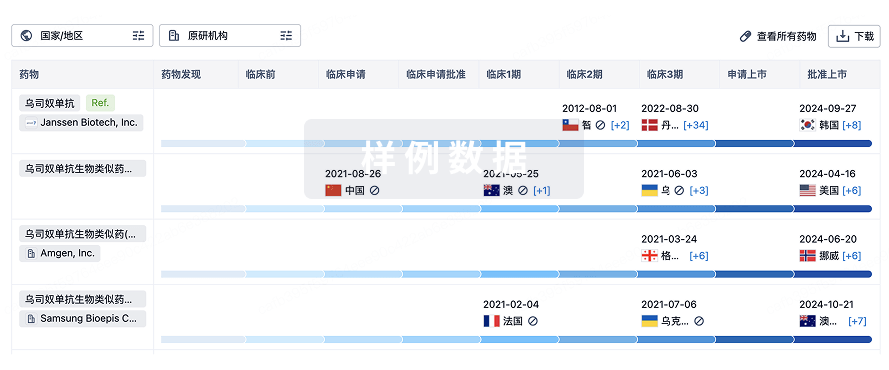
生物类似药
生物类似药在不同国家/地区的竞争态势。请注意临床1/2期并入临床2期,临床2/3期并入临床3期
登录
或
特殊审评
只需点击几下即可了解关键药物信息。
登录
或

提出任何生物医药研究问题
让每一步生物医药决策都精准制胜
基于十亿级生物数据与全球情报的精准 AI,赋能早期药物发现
立即开始免费试用!
智慧芽新药情报库是智慧芽专为生命科学人士构建的基于AI的创新药情报平台,助您全方位提升您的研发与决策效率。
立即接入生物医药数据包
智慧芽新药库数据也通过智慧芽开放平台,以MCP或API服务形式对外开放。立即使用我们的MCP服务定制您的LLM智能体。
生物序列数据库
生物药研发创新
免费使用
化学结构数据库
小分子化药研发创新
免费使用