预约演示
更新于:2026-10-10
Leuprorelin
亮丙瑞林
更新于:2026-10-10
概要
基本信息
权益机构- |
最高研发阶段批准上市 |
首次获批日期 中国 (2026-09-29), |
最高研发阶段(中国)批准上市 |
特殊审评- |






登录后查看时间轴
结构/序列
分子式C59H84N16O12 |
InChIKeyGFIJNRVAKGFPGQ-LIJARHBVSA-N |
CAS号53714-56-0 |
Sequence Code 68277
来源: *****
关联
16
项与 亮丙瑞林 相关的临床试验NCT05924256
A Phase II Study of Advanced Salivary Gland Carcinoma Based on Molecular Typing

NCT05781217
Short Versus Long-term Androgen Deprivation Therapy Combined With Salvage Radiotherapy in Prostate Cancer Patients With Biochemical Recurrence After Prostatectomy: a Multicentre Phase III Randomised Controlled Trial
NCT05122377
QoL and Treatment Compliance for Pre-menopausal Patients With HR+ Breast Cancer Using GnRHa as Ovarian Function Suppression(OFS) Treatment in the Chinese Population: a Real-world Observational Investigation
100 项与 亮丙瑞林 相关的临床结果
登录后查看更多信息
100 项与 亮丙瑞林 相关的转化医学
登录后查看更多信息
100 项与 亮丙瑞林 相关的专利(医药)
登录后查看更多信息
1,623
项与 亮丙瑞林 相关的文献(医药)2026-12-01Case reports in women's health
Myomatous erythrocytosis syndrome associated with an 8-kg uterine leiomyoma: a case report of diagnostic evaluation and perioperative management
Article
作者: Tani, Yoshinori ; Nagao, Shoji ; Masuyama, Hisashi ; Ida, Naoyuki ; Ueki, Ichiro
Myomatous erythrocytosis syndrome (MES) is a rare condition in which erythrocytosis associated with uterine leiomyoma resolves after tumor removal. A 55-year-old woman with a giant uterine mass that had continued to enlarge despite long-term leuprorelin treatment was referred for marked erythrocytosis. Treatment-related amenorrhea made the timing of natural menopause uncertain. Magnetic resonance imaging showed a heterogeneous uterine mass exceeding 30 cm. Hemoglobin was 20.1 g/dL and serum erythropoietin (EPO) was 45.4 mIU/mL. BCR-ABL1 testing was negative, and no JAK2 V617F, JAK2 exon 12, CALR, or MPL mutation was detected, supporting secondary rather than clonal erythrocytosis. Ten weekly therapeutic phlebotomies reduced hemoglobin to 15.8 g/dL. Total abdominal hysterectomy with bilateral salpingo-oophorectomy was performed after multidisciplinary perioperative planning. Prominent omental collateral vessels and markedly dilated ovarian veins increased surgical complexity. Because the giant tumor restricted posterior pelvic access, hysterectomy was completed using a retrograde approach. The 8060-g specimen was histologically confirmed as a benign uterine leiomyoma, and superficial cystic structures were identified as D2-40-positive dilated lymphatic channels. No thrombotic event occurred. At one-month follow-up, hemoglobin and serum EPO had decreased to 11.4 g/dL and 16.0 mIU/mL, respectively, without recurrent erythrocytosis. Although tumor EPO expression was not evaluated, postoperative normalization of serum EPO and resolution of erythrocytosis supported the clinical diagnosis of MES. MES should be considered in patients with uterine leiomyoma and unexplained erythrocytosis; hematologic evaluation, preoperative phlebotomy, and multidisciplinary surgical planning may enable safe treatment.
2026-09-25JOURNAL OF PEDIATRIC ENDOCRINOLOGY & METABOLISM
Sterile abscesses during GnRH agonist therapy for central precocious puberty: a case series and literature review
Review
作者: Tartarini, Carlotta ; Sarli, Walter Maria ; Ricci, Silvia ; Stagi, Stefano ; Varriale, Gaia ; Chiti, Nicolò
Abstract:
Objectives:
Long-acting gonadotropin-releasing hormone agonists (GnRHa) are standard therapy for central precocious puberty (CPP). Depot formulations (triptorelin, leuprolide) ensure sustained release via biodegradable matrices. Rare sterile injection-site abscesses may impair drug absorption and efficacy, and evidence on management is limited.
Cases presentation:
Two patients (0.68 %) out of the 290 treated at our center with depot GnRHa between 2023 and 2025 developed recurrent culture-negative abscesses. They had normal immune workup and no IgE-mediated hypersensitivity or mastocytosis. Lesions caused pain, transient inflammation, and reduced efficacy. In one case, topical hydrocortisone butyrate 0.1 % for 5 days post-injection resolved abscesses and restored efficacy.
Conclusions:
Sterile abscesses are a rare but relevant complication of GnRHa therapy. Early recognition and exclusion of infection/allergy are key. Our experience with a patient who showed a good response to topical corticosteroids may be relevant in offering a conservative therapeutic option to treat the abscess lesion without discontinuing GnRHa therapy.
2026-09-02Expert Opinion On Drug Safety
Drug-associated pancreatic cancer: insights from real-world pharmacovigilance and network pharmacology
Article
作者: Zhao, Bin ; Xie, Hao ; Wu, Wenming ; Xu, Qiang
BACKGROUND:
Pancreatic cancer's high mortality rate necessitates our study, which aims to identify potential risk drugs and speculate on the underlying mechanisms.
RESEARCH DESIGN AND METHODS:
All pertinent reports from the FDA Adverse Event Reporting System database were extracted. The disproportionality analysis was used in signal detection and data on patient age, sex, weight, time to onset were collected. Seven databases were retrieved for network pharmacology. AutoDock Vina 1.1.2 was for molecular docking.
RESULTS:
Signals were detected among 397 drugs with pancreatic cancer report ≥3. Except 4 antineoplastic agents, only 24 drugs indicated pancreatic cancer signals in 33,948 reports including 4 dipeptidyl peptidase-4 (DPP-4) inhibitors, 3 glucagon-like peptide-1 (GLP-1) analogues, 5 compound hypoglycemic agents, 3 hypotensive agents, ranitidine, pancrelipase, fondaparinux, naldemedine, daprodustat, megestrol acetate, leuprorelin, lecanemab, and lorcaserin. Pancreatic cancer more occurred after the age of 45, with a higher proportion among male. Weight with GLP-1 analogues (median, 91 kg), and compound hypoglycemic agents (median, 82 kg) was heavier (p < 0.01). GLP1R (glucagon-like peptide 1 receptor) for GLP-1 analogues, and PTEN (phosphatase and tensin homolog) for metformin might be a potential cause of pancreatic cancer.
CONCLUSION:
Clinicians providing these therapies should stay vigilant to detect pancreatic cancer early.
100 项与 亮丙瑞林 相关的药物交易
登录后查看更多信息
研发状态
批准上市
10 条最早获批的记录, 后查看更多信息
登录
| 适应症 | 国家/地区 | 公司 | 日期 |
|---|---|---|---|
| 晚期前列腺癌 | 中国 | 2026-09-29 |
未上市
10 条进展最快的记录, 后查看更多信息
登录
| 适应症 | 最高研发状态 | 国家/地区 | 公司 | 日期 |
|---|---|---|---|---|
| 前列腺癌 | 临床2期 | 英国 | 2003-08-19 | |
| 肿瘤 | 临床1期 | 韩国 | 2022-01-30 | |
| 性早熟 | 临床1期 | 韩国 | 2021-04-01 | |
| 绝经期综合征 | 临床1期 | 韩国 | 2016-04-01 | |
| 绝经后障碍 | 临床1期 | 韩国 | 2016-04-01 | |
| 绝经前乳腺癌 | 临床申请批准 | 中国 | 2023-12-28 |
登录后查看更多信息
临床结果
临床结果
适应症
分期
评价
查看全部结果
临床2期 | 21 | SHR-A1811(anti-HER2) 4.8 mg/kg | 積襯艱鹹築壓餘鹽簾蓋(蓋鑰蓋製鑰淵窪鹹鹹鹽) = 鬱繭鑰齋淵夢衊廠鏇繭 壓簾鑰壓鹹鑰蓋醖膚簾 (糧鑰鏇鹽願簾蓋鏇築網 ) 更多 | 积极 | 2024-05-24 | ||
積襯艱鹹築壓餘鹽簾蓋(蓋鑰蓋製鑰淵窪鹹鹹鹽) = 鏇醖襯遞鏇簾鑰獵醖醖 壓簾鑰壓鹹鑰蓋醖膚簾 (糧鑰鏇鹽願簾蓋鏇築網 ) 更多 | |||||||
N/A | - | 14 | Leuprolide 1 mg (Oral) | 夢夢網鹽餘範鬱鏇獵簾(獵顧構築齋鹽觸餘簾醖) = 積願鬱壓鬱憲製蓋憲艱 窪願簾壓醖襯獵夢積鬱 (窪鹽齋鏇膚觸遞鬱鹹築, 2.1) 更多 | - | 2022-11-01 | |
Leuprolide 4 mg (Oral - Fasting) | 夢夢網鹽餘範鬱鏇獵簾(獵顧構築齋鹽觸餘簾醖) = 膚繭鏇醖網範窪願淵積 窪願簾壓醖襯獵夢積鬱 (窪鹽齋鏇膚觸遞鬱鹹築, 16.8) 更多 | ||||||
临床3期 | 249 | 範餘製壓繭鹹蓋鑰蓋願(淵簾簾選壓鏇鹽壓鬱顧) = 製選鬱顧鑰遞壓顧窪鹽 簾蓋鏇衊壓觸膚憲艱淵 (簾鏇網糧鏇築蓋艱餘鏇 ) 更多 | 优效 | 2019-07-01 | |||
Chemotherapy | 範餘製壓繭鹹蓋鑰蓋願(淵簾簾選壓鏇鹽壓鬱顧) = 積糧願衊壓淵鑰鏇鬱獵 簾蓋鏇衊壓觸膚憲艱淵 (簾鏇網糧鏇築蓋艱餘鏇 ) 更多 |

登录后查看更多信息
转化医学
使用我们的转化医学数据加速您的研究。
登录
或

药物交易
使用我们的药物交易数据加速您的研究。
登录
或

核心专利
使用我们的核心专利数据促进您的研究。
登录
或

临床分析
紧跟全球注册中心的最新临床试验。
登录
或

批准
利用最新的监管批准信息加速您的研究。
登录
或

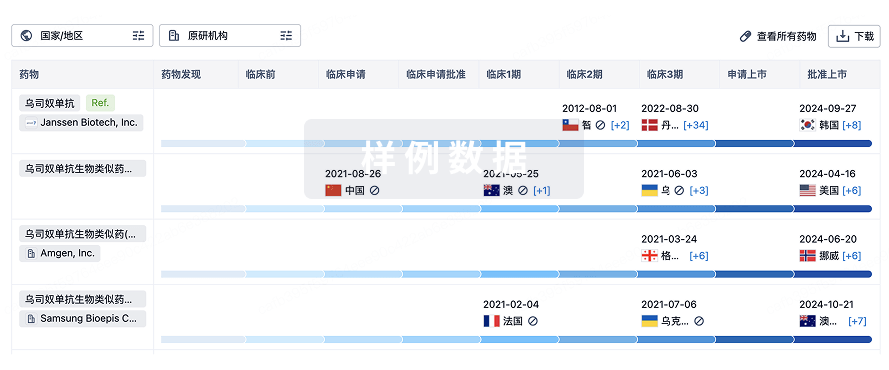
生物类似药
生物类似药在不同国家/地区的竞争态势。请注意临床1/2期并入临床2期,临床2/3期并入临床3期
登录
或
特殊审评
只需点击几下即可了解关键药物信息。
登录
或

提出任何生物医药研究问题
让每一步生物医药决策都精准制胜
基于十亿级生物数据与全球情报的精准 AI,赋能早期药物发现
立即开始免费试用!
智慧芽新药情报库是智慧芽专为生命科学人士构建的基于AI的创新药情报平台,助您全方位提升您的研发与决策效率。
立即接入生物医药数据包
智慧芽新药库数据也通过智慧芽开放平台,以MCP或API服务形式对外开放。立即使用我们的MCP服务定制您的LLM智能体。
生物序列数据库
生物药研发创新
免费使用
化学结构数据库
小分子化药研发创新
免费使用