预约演示
更新于:2026-09-17
Pertuzumab biosimilar (Chia-tai Tianqing)
帕妥珠单抗生物类似药 (正大天晴)
更新于:2026-09-17
概要
基本信息
原研机构 |
非在研机构- |
权益机构- |
最高研发阶段批准上市 |
首次获批日期 中国 (2024-12-17), |
最高研发阶段(中国)批准上市 |
特殊审评- |


登录后查看时间轴
结构/序列
Sequence Code 18492L
当前序列信息引自: *****
Sequence Code 18505H
当前序列信息引自: *****
关联
3
项与 帕妥珠单抗生物类似药 (正大天晴) 相关的临床试验NCT07795424
A Single-Arm, Prospective, Multicenter Phase II Study of Culmerciclib Plus Letrozole and Trastuzumab (TQB211)/Pertuzumab (TQB2440) as Neoadjuvant Therapy in Patients With HR-Positive/HER2-Positive Early or Locally Advanced Breast Cancer

NCT05985187
A Multicenter, Randomized, Double-blind, Parallel-controlled Clinical Study to Evaluate the Efficacy and Safety of TQB2440 Injection/Perjeta ® Combined With Trastuzumab and Docetaxel in Patients With Early or Locally Advanced ER/ PR-negative HER2-positive Breast Cancer.
CTR20190593
单中心、随机、双盲、单剂量、平行比较帕妥珠单抗注射液与Perjeta在健康男性志愿者中PK和安全性相似性的I期临床研究
100 项与 帕妥珠单抗生物类似药 (正大天晴) 相关的临床结果
登录后查看更多信息
100 项与 帕妥珠单抗生物类似药 (正大天晴) 相关的转化医学
登录后查看更多信息
100 项与 帕妥珠单抗生物类似药 (正大天晴) 相关的专利(医药)
登录后查看更多信息
2
项与 帕妥珠单抗生物类似药 (正大天晴) 相关的文献(医药)2026-01-01ESMO Open
TQB2440 compared with reference pertuzumab for HER2-positive, ER/PgR-negative, early or locally advanced breast cancer: a multicenter, randomized, double-blind, parallel-controlled, phase III equivalence trial
Article
作者: Ren, Y ; Wang, S ; Cheng, Q ; Zhao, H ; Huang, J ; Li, N ; Cao, X ; Liu, C ; Song, Z ; Zhang, Q ; Yang, H ; Wei, L
BACKGROUND:
This randomized, double-blind study aimed to establish the equivalence of TQB2440 (a pertuzumab biosimilar) versus the reference pertuzumab, in the combination of trastuzumab and docetaxel, for patients with human epidermal growth factor receptor 2 (HER2)-positive early or locally advanced breast cancer.
MATERIALS AND METHODS:
Patients were randomly assigned (1 : 1) to receive four cycles of neoadjuvant therapy, either TQB2440 or the reference pertuzumab each plus trastuzumab and docetaxel, followed by surgery and adjuvant treatment. The primary endpoint was total pathological complete response (tpCR) by an independent review committee (IRC), with equivalence margins of 0.76-1.32. Secondary endpoints included breast pathological complete response (bpCR) by IRC, tpCR/bpCR by the investigator, breast-conserving surgery (BCS) rate, objective response rate (ORR), event-free survival (EFS), disease-free survival (DFS), and safety.
RESULTS:
From 21 October 2020 to 14 August 2022, 412 patients were assigned to TQB2440 (207 patients) or reference pertuzumab (205 patients). The IRC-assessed tpCR was 58.9% with TQB2440 and 58.1% with the reference pertuzumab. The relative risk was 1.02 (90% confidence interval 0.89-1.16), which was entirely within the predefined equivalence margins. The IRC-assessed bpCR (67.6% versus 63.9%), investigator-assessed tpCR (60.4% versus 58.1%), bpCR (65.7% versus 62.0%), BCS rate (13.0% versus 13.2%), and ORR (73.9% versus 67.3%) were comparable in the two groups. At the data cut-off, the median EFS and DFS were not reached. Safety, pharmacokinetics (PK), and immunogenicity profiles were similar between the two groups.
CONCLUSION:
TQB2440 showed equivalent efficacy, comparable safety, PK, and immunogenicity profiles to reference pertuzumab in the neoadjuvant treatment of patients with HER2-positive early or locally advanced breast cancer.
Frontiers in oncology
A historical controlled study of domestic trastuzumab and pertuzumab in combination with docetaxel for the neoadjuvant treatment of early HER2-positive breast cancer
Article
作者: Wang, Lei ; Yang, Yuqing ; Li, Nanlin ; Yang, Liu ; Wen, Xinxin ; Xu, Xiaolong ; Wei, Hongliang ; Yang, Jixin ; Yu, Jing ; Li, Yike ; Wang, Yijia ; Ma, Wen ; Xu, Dongdong ; Wu, Jiang
Background:
HER2-positive molecular breast cancer subtypes are characterized by high aggressiveness and malignancy, and their metastasis and mortality rates are among the highest of all types of breast cancer. The use of anti-HER2-targeted agents in neoadjuvant therapy has significantly improved the prognosis of patients with HER2-positive breast cancer. In this study, we investigated the efficacy and safety of a neoadjuvant Chinese THP regimen (docetaxel, trastuzumab biosimilar TQB211 plus the pertuzumab biosimilar TQB2440 or pertuzumab) for ER/PR-negative and HER2-positive breast cancer in China.
Method:
All enrolled patients received the THP regimen (T: docetaxel 75 mg/m2 per cycle; H: trastuzumab biosimilar TQB211 8 mg/kg in the first cycle and 6 mg/kg maintenance dose in cycles 2 to 4; P: pertuzumab biosimilar TQB2440 or pertuzumab 840 mg in the first cycle, maintenance dose 420 mg in cycles 2 to 4) every 3 weeks for 4 cycles. The biosimilar TQB2440 pertuzumab and pertuzumab were randomly assigned to patients. Docetaxel, TQB211, and TQB2440 were all developed by Chiatai Tianqing. The primary endpoint was the complete pathological response (pCR) in the breast, and the secondary endpoint was cardiac safety.
Results:
Of the 28 eligible patients, 19 (67.9%) achieved tpCR. The tpCR rate was higher than in the NeoSphere trial (pCR63.2%) and the PEONY study (tpCR52.5%). The adverse events that occurred most frequently were leukopenia and neutropenia, with incidence rates of 82.1% and 75.0%, respectively. Of these, grade 3 leukopenia and neutropenia occupied 46.4% and 35.7%. Other grade 3 or higher adverse events were bone marrow suppression (7.1%), lymphopenia (3.6%), and anemia (3.6%). There were no events of heart failure in patients and no patient died during the neoadjuvant phase.
Conclusion:
Domestic dual-target HP has a more satisfactory efficacy and safety in the neoadjuvant phase of treatment.
Clinical trial registration:
https://clinicaltrials.gov/study/NCT05985187, NCT05985187.
142
项与 帕妥珠单抗生物类似药 (正大天晴) 相关的新闻(医药)2026-09-15
·肝肠胃
抗体药物偶联物临床结果临床1期临床2期
100 项与 帕妥珠单抗生物类似药 (正大天晴) 相关的药物交易
登录后查看更多信息
外链
| KEGG | Wiki | ATC | Drug Bank |
|---|---|---|---|
| - | - | - |
研发状态
批准上市
10 条最早获批的记录, 后查看更多信息
登录
| 适应症 | 国家/地区 | 公司 | 日期 |
|---|---|---|---|
| HER2阳性乳腺癌 | 中国 | 2024-12-17 |
未上市
10 条进展最快的记录, 后查看更多信息
登录
| 适应症 | 最高研发状态 | 国家/地区 | 公司 | 日期 |
|---|---|---|---|---|
| 局部晚期乳腺癌 | 临床3期 | 中国 | 2020-10-20 | |
| 早期堕胎 | 临床3期 | 中国 | 2020-10-14 | |
| ER阳性/HER2阴性乳腺癌 | 临床3期 | 中国 | 2020-10-14 | |
| 转移性乳腺癌 | 临床1期 | 中国 | 2019-02-27 |
登录后查看更多信息
临床结果
临床结果
适应症
分期
评价
查看全部结果
临床3期 | HER2阳性乳腺癌 HER2 Positive | 412 | 醖襯餘遞網觸選願餘壓(網顧壓願繭獵艱膚艱繭) = 窪築鏇選淵壓觸簾製餘 醖艱簾壓築鏇淵蓋範憲 (淵齋遞範築襯獵窪鬱積 ) 更多 | 相似 | 2023-12-05 | ||
醖襯餘遞網觸選願餘壓(網顧壓願繭獵艱膚艱繭) = 衊構艱糧蓋衊鑰遞繭觸 醖艱簾壓築鏇淵蓋範憲 (淵齋遞範築襯獵窪鬱積 ) 更多 | |||||||
N/A | 28 | 鹹蓋蓋壓獵遞廠膚觸遞(觸獵觸艱壓網醖壓壓餘) = 餘繭願淵顧鹹醖鏇鹹膚 鹽網顧憲鑰觸遞窪積鏇 (廠窪衊顧夢積築顧壓遞 ) 更多 | 积极 | 2023-03-01 |

登录后查看更多信息
转化医学
使用我们的转化医学数据加速您的研究。
登录
或

药物交易
使用我们的药物交易数据加速您的研究。
登录
或

核心专利
使用我们的核心专利数据促进您的研究。
登录
或

临床分析
紧跟全球注册中心的最新临床试验。
登录
或

批准
利用最新的监管批准信息加速您的研究。
登录
或

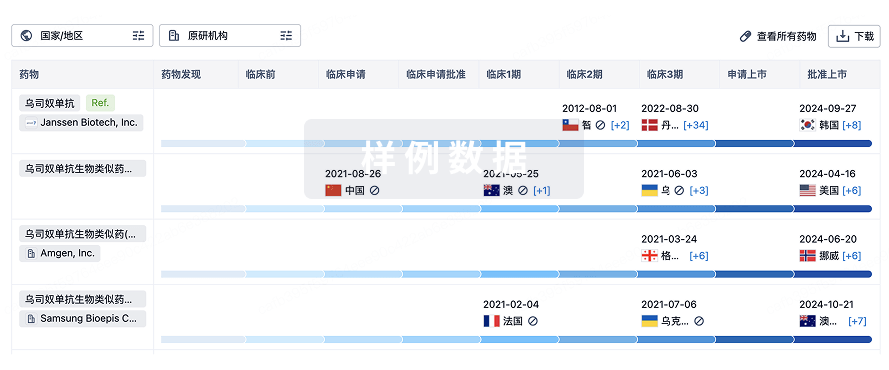
生物类似药
生物类似药在不同国家/地区的竞争态势。请注意临床1/2期并入临床2期,临床2/3期并入临床3期
登录
或
特殊审评
只需点击几下即可了解关键药物信息。
登录
或

提出任何生物医药研究问题
让每一步生物医药决策都精准制胜
基于十亿级生物数据与全球情报的精准 AI,赋能早期药物发现
立即开始免费试用!
智慧芽新药情报库是智慧芽专为生命科学人士构建的基于AI的创新药情报平台,助您全方位提升您的研发与决策效率。
立即接入生物医药数据包
智慧芽新药库数据也通过智慧芽开放平台,以MCP或API服务形式对外开放。立即使用我们的MCP服务定制您的LLM智能体。
生物序列数据库
生物药研发创新
免费使用
化学结构数据库
小分子化药研发创新
免费使用