Gene therapies were supposed to be competition-proof. They are scientifically complex, require bespoke manufacturing, often go after small patient populations and can cost millions per dose.
But that assumption is being tested by a wave of competitors being developed in China — with prices starting at a fraction of what’s currently available in the US.
An
Endpoints News
analysis
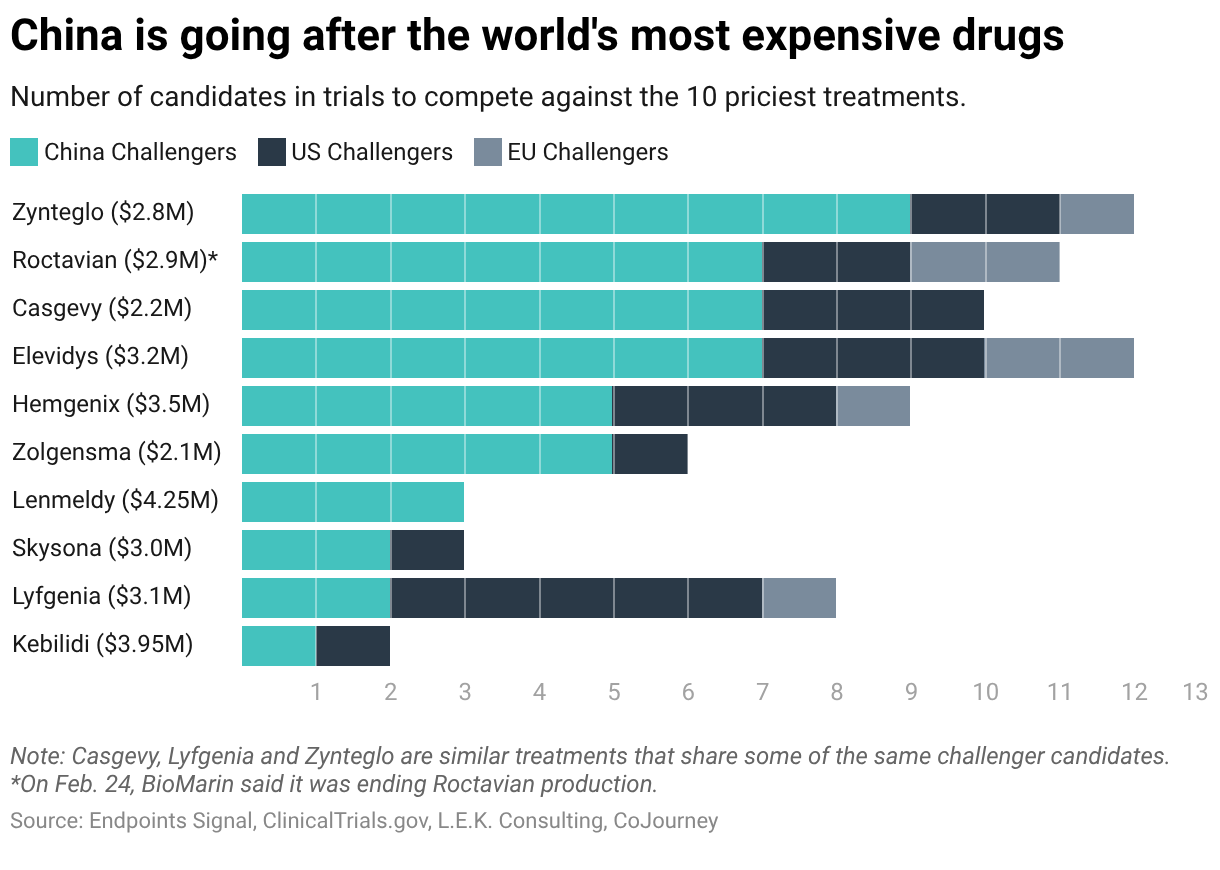
looked at the world’s 10 most expensive gene therapies and found 77 competitors in development around the world. Of those, 48 are from China — more than double the number under development in the US, and 7 times what’s being worked on in Europe.
The development of these gene therapies is the latest piece of evidence that
China is competing
higher and higher on the spectrum of innovative science.
In gene therapy, the concentration of Chinese challengers is striking across nearly every target. Zynteglo ($2.8 million per treatment), Elevidys ($3.2M), Roctavian ($2.9M) and Casgevy ($2.2M) each face seven or more Chinese challengers. Lenmeldy ($4.25M), the most expensive therapy on the list, has three competitors coming from China — and none from the US or Europe.
The only chart-topping gene therapy for which the US or Europe has more competing treatments under development than China is Lyfgenia ($3.1M), for sickle cell disease. Even there, Chinese companies own more than a third of the competitive field under development.
The pressure arrives at a vulnerable moment for Western-originated gene therapy work. BioMarin said on Feb. 24 that it would pull its struggling hemophilia A therapy
Roctavian from the market after failing to find a buyer. Uptake
of UniQure’s Hemgenix for hemophilia B has been slow, with only
75 patients receiving
it in the first three years after its US approval
, as of December.
Other first-generation therapies have
been mostly limited to wealthy countries
or have underperformed clinically. And payers across the world continue to resist multi-million-dollar price tags for single-course treatments. The economics that were supposed to justify the steep prices of gene therapies — replacing a lifetime of chronic care with a single course of treatment — haven’t fully materialized.
China’s cost advantage
The regulatory path to first-in-human dosing is significantly faster in China. The time it takes to enroll patients in clinical trials there is half the global average, and the cost per patient is also about 50% lower,
according to McKinsey
.
And China’s domestic pricing constraints force cost discipline. The
first fully homegrown Chinese gene therapy
, approved last April for hemophilia B, launched for about $350,000. That’s a tenth of the price of a rival gene therapy in the US.
At least 34 Chinese drug developers have programs aimed at the top 10 therapies, with several running multiple simultaneous efforts across different disease targets. Shanghai Vitalgen BioPharma leads with five unique therapies in development. Shenzhen Geno-Immune Medical Institute has four. Belief BioMed, CorrectSequence Therapeutics and HuidaGene Therapeutics each have three.
Outside of gene therapy, China already has a blockbuster: the blood-cancer pill Brukinsa from BeOne Medicines, now headquartered in Switzerland, with $3.9 billion in sales last year. It also has a
potential
giant slayer: Akeso’s Ivonescimab, the first drug to beat the global bestseller, Merck’s Keytruda, in a
head-to-head Phase 3 trial
. Almost
half of the new drug molecules
entering human testing now originate in China.
Read more about the companies:
Multimillion-dollar gene therapies weren’t supposed to face competition. China has other plans