预约演示
更新于:2026-09-08
Etelcalcetide
盐酸依特卡肽
更新于:2026-09-08
概要
基本信息
药物类型 合成多肽 |
别名 etelcalcetide hydrochloride、Parsabiv、Telcalcetide + [8] |
靶点 |
作用方式 激动剂 |
作用机制 CaSR激动剂(钙敏感受体激动剂) |
在研适应症 |
非在研适应症 |
原研机构 |
非在研机构- |
最高研发阶段批准上市 |
首次获批日期 欧盟 (2016-11-11), |
最高研发阶段(中国)批准上市 |
特殊审评孤儿药 (美国) |



登录后查看时间轴
结构/序列
分子式C38H73N21O10S2.ClH |
InChIKeyKHQMSZGKHGQUHG-WZDHWKSBSA-N |
CAS号1334237-71-6 |
Sequence Code 169069

Sequence Code 983741
关联
36
项与 盐酸依特卡肽 相关的临床试验JPRN-UMIN000053361
A randomized controlled non-blinded trial for examination of effectiveness of Upacicalcet and Etelcalcetide on hyperparathyroidism in hemodialysis patients.
NCT03969329
Phase 3, Single-arm, Open-label, Multidose, Titration, Pharmacokinetic, Pharmacodynamic, and Safety Study of Etelcalcetide in Children and Adolescents ≥ 2 to < 18 Years of Age With Secondary Hyperparathyroidism and Chronic Kidney Disease Receiving Maintenance Hemodialysis
NCT03795558
A Study to Investigate the Influence of PTH-lowering by Etelcalcetide (Parsabiv®) on the Calcification Propensity of Serum in Dialysis Patients
100 项与 盐酸依特卡肽 相关的临床结果
登录后查看更多信息
100 项与 盐酸依特卡肽 相关的转化医学
登录后查看更多信息
100 项与 盐酸依特卡肽 相关的专利(医药)
登录后查看更多信息
154
项与 盐酸依特卡肽 相关的文献(医药)2026-08-01KIDNEY INTERNATIONAL
The calcimimetic etelcalcetide restores cardiac function in chronic hyperphosphatemia via calcium sensing receptor–cAMP activation
Article
作者: Manegold, Isabel ; Kowalski, Kathrin ; Baer, Louise H ; Heineke, Jörg ; Kraft, Theresia ; Grund, Andrea ; Trogisch, Felix A ; Haffner, Dieter ; Leifheit-Nestler, Maren ; Richter, Beatrice ; Richter, Gloria Sophie ; Thiele, Martina ; Thum, Thomas
INTRODUCTION:
The cardioprotective properties of the calcimimetic etelcalcetide (Etel) in the setting of hyperphosphatemia are largely unknown.
METHODS:
To study this, male C57BL/6N mice were fed a high-phosphate diet (HPD, 2.0%) for six months without/with Etel or vehicle administration during months four to six, or they were fed a normal phosphate diet (NPD, 0.8%). Cardiac function was investigated by echocardiography and Millar catheter. Heart tissue was taken for RNAseq, and cardiomyocyte morphology and cardiac fibrosis were evaluated histologically. Isolated adult mouse cardiomyocytes (AMCMs) from NPD and HPD groups and from untreated mice after acute exposure to phosphate, parathyroid hormone (PTH) and fibroblast growth factor 23 (FGF23) with/without Etel were used to assess cardiomyocyte contractility and calcium transients. The calcium sensing receptor (CaSR)/cAMP/phospholamban (PLB)/Serca2a signaling pathway was investigated by Western blot and activity assays. To test if the cardiac effects of Etel and phosphate are directly mediated by the CaSR, AMCMs pretreated with the CaSR antagonist NPS-2143 or an adenoviral expression of a phosphate binding-deficient CaSR mutant (CaSR-R62A) were used.
RESULTS:
Six-month HPD resulted in hyperphosphatemia, increased PTH and FGF23 concentrations, impaired systolic cardiac function and cardiomyocyte contractility, and cardiac hypertrophy and fibrosis. Etel prevented systolic dysfunction and fibrosis and normalized PTH and FGF23 levels despite persistent hyperphosphatemia. RNAseq analysis revealed HPD induced remodeling programs, with suppression of calcium and contractility signaling, which was ameliorated by Etel. Isolated cardiomyocytes from HPD mice showed impaired contractility and calcium transients, both of which were rescued by Etel. Ex vivo phosphate stimulation of AMCMs reduced contractility, calcium transients, cAMP formation, PLB phosphorylation, and Serca2a activity compared with vehicle; these effects were rescued by Etel co-stimulation. Transduction with CaSR-R62A abolished phosphate-induced effects in AMCMs, whereas pretreatment with NPS-2143 prevented Etel rescue.
CONCLUSIONS:
Etelcalcetide restores hyperphosphatemia-induced cardiac dysfunction via activation of the CaSR.
2026-06-23Cureus Journal of Medical Science
Pharmacological Management of Secondary Hyperparathyroidism in Dialysis Patients: A Narrative Review of Calcimimetics, Vitamin D Analogs, and Phosphate Binders
Review
作者: Alwashahi, Hanin ; Unnikrishnan Meenakshi, Dhanalekshmi
Secondary hyperparathyroidism (sHPT) is a prevalent complication of end-stage renal disease, driven by phosphate retention, vitamin D deficiency, hypocalcemia, and calcium-sensing receptor dysregulation. Despite international guidelines, optimal biochemical control remains challenging in real-world practice. This narrative review synthesizes current evidence on the pharmacological management of sHPT in dialysis patients, with attention to the underrepresented Middle Eastern and Gulf Cooperation Council (GCC) context. A narrative review was conducted using PubMed and Scopus, identifying original clinical studies, randomized controlled trials, and observational cohorts examining calcimimetics, vitamin D analogs, and phosphate binders in dialysis patients with sHPT. In total, 22 studies were included. Calcimimetics, particularly cinacalcet, reduce parathyroid hormone (PTH) by approximately 43% in hemodialysis patients without raising serum calcium, though hypocalcemia and gastrointestinal adverse effects limit tolerability. Intravenous etelcalcetide offers superior PTH suppression with improved gastrointestinal tolerability and eliminates oral adherence challenges through supervised dialysis-circuit administration. A large trial demonstrated no mortality benefit despite sustained PTH lowering. Vitamin D analogs suppress PTH gene transcription but carry a narrow therapeutic window with risks of hypercalcemia and hyperphosphatemia. Phosphate binders address the primary upstream driver of sHPT; non-calcium-based agents such as sevelamer offer cardiovascular advantages but impose a pill burden contributing to nonadherence rates of 22-74%. Novel agents including tenapanor offer complementary phosphate-lowering mechanisms with substantially reduced pill burden. Combination therapy allows dose reduction of individual agents while optimizing biochemical outcomes. Evidence from Middle Eastern and GCC dialysis populations is virtually absent. Pharmacological management of sHPT requires individualized, guideline-informed combination therapy. A critical evidence gap exists in the GCC region, where diabetic nephropathy dominance, endemic vitamin D deficiency, and lower calcimimetic utilization may limit generalizability of existing trial data. Locally conducted research is urgently needed.
2026-05-01DRUG DEVELOPMENT RESEARCH
FDA‐Approved Drugs Containing D‐Amino Acids: A Historical and Developmental Perspective
Review
作者: Nguyen Khanh Tran, Huynh ; Huy, Nguyen Tien ; Le, Minh‐Tri ; Tram, Nguyen Thanh ; Nguyen, Tien Dung ; Tran, Linh ; Gad, Abdelrahman Gamil ; Tai, Tu Ha ; Shaaban, Ethar
ABSTRACT:
d
‐Amino acids, the non‐natural enantiomers of
l
‐amino acids, have emerged as powerful tools in peptide drug development due to their unique biochemical properties. Their resistance to proteolytic degradation, enhanced conformational rigidity, and reduced immunogenicity make them especially valuable in designing long‐acting and receptor‐selective therapeutics. Since the mid‐20th century, more than 20 FDA‐approved drugs have incorporated at least one
d
‐amino acid into their structure, spanning indications from infectious diseases and endocrine disorders to rare dermatologic conditions and diagnostic imaging. These drugs include both natural products like gramicidin D and synthetic analogs such as desmopressin, leuprolide, bremelanotide, and etelcalcetide, the latter being the first fully
d
‐amino acid peptide to receive FDA approval. This review traces the historical development and clinical adoption of
d
‐amino acid‐containing drugs, highlighting their mechanisms of action, therapeutic relevance across disease areas, and the technological innovations, particularly solid‐phase peptide synthesis and conceptual advances such as mirror‐image phage display, that enabled their advancement. As peptide therapeutics continue to evolve,
d
‐amino acids‐containing drugs are poised to play a central role in the next generation of targeted, stable, and high‐precision pharmaceuticals.
314
项与 盐酸依特卡肽 相关的新闻(医药)2026-09-06
100 项与 盐酸依特卡肽 相关的药物交易
登录后查看更多信息
研发状态
批准上市
10 条最早获批的记录, 后查看更多信息
登录
| 适应症 | 国家/地区 | 公司 | 日期 |
|---|---|---|---|
| 慢性肾病 | 欧盟 | 2016-11-11 | |
| 慢性肾病 | 冰岛 | 2016-11-11 | |
| 慢性肾病 | 列支敦士登 | 2016-11-11 | |
| 慢性肾病 | 挪威 | 2016-11-11 | |
| 继发性甲状旁腺功能亢进症 | 欧盟 | 2016-11-11 | |
| 继发性甲状旁腺功能亢进症 | 冰岛 | 2016-11-11 | |
| 继发性甲状旁腺功能亢进症 | 列支敦士登 | 2016-11-11 | |
| 继发性甲状旁腺功能亢进症 | 挪威 | 2016-11-11 | |
| 继发性甲状旁腺功能亢进症 | 英国 | 2016-11-11 |

未上市
10 条进展最快的记录, 后查看更多信息
登录
| 适应症 | 最高研发状态 | 国家/地区 | 公司 | 日期 |
|---|---|---|---|---|
| 终末期肾脏病 | 临床2期 | 奥地利 | 2019-05-01 | |
| 慢性肾病-矿物质和骨骼疾病 | 临床2期 | - | 2012-03-01 | |
| 心源性水肿 | 临床1期 | 美国 | 2017-03-14 | |
| 心源性水肿 | 临床1期 | 比利时 | 2017-03-14 | |
| 心源性水肿 | 临床1期 | 德国 | 2017-03-14 | |
| 心源性水肿 | 临床1期 | 立陶宛 | 2017-03-14 | |
| 心源性水肿 | 临床1期 | 波兰 | 2017-03-14 | |
| 心源性水肿 | 临床1期 | 英国 | 2017-03-14 |
登录后查看更多信息
临床结果
临床结果
适应症
分期
评价
查看全部结果
临床2期 | - | - | 醖膚構憲鏇襯糧積顧願(顧窪襯觸積觸窪衊繭廠) = 淵繭選窪膚構觸夢積獵 醖餘簾選廠艱鑰觸憲廠 (艱壓範選顧選糧醖顧窪 ) 更多 | 积极 | 2023-11-01 | ||
临床2期 | 22 | 壓顧窪顧鬱窪製衊艱顧(鹽遞蓋積築鹽簾鏇觸鹹) = 憲壓憲憲製糧觸鹽齋鬱 膚選壓願窪蓋鏇鬱鏇構 (構艱蓋窪憲製鹽積顧網, 0) 更多 | - | 2023-09-21 | |||
N/A | 414 | 鏇蓋願構鬱鏇繭築鏇齋(齋壓襯艱積膚艱繭鏇製) = 獵齋窪積壓鹹觸膚糧簾 窪糧齋觸選衊醖積齋醖 (鑰夢繭網齋築範襯製淵 ) | - | 2022-11-05 | |||
临床1期 | 33 | 襯衊觸窪範壓夢窪選遞(鏇鹽夢醖願衊衊鬱鹹鬱) = 廠鑰鹽鑰獵獵蓋選鑰遞 蓋壓夢艱窪鬱鹹餘範鏇 (簾襯鹽獵繭襯願齋餘蓋 ) 更多 | 积极 | 2021-11-10 | |||
Placebo | 齋簾膚觸選鹹選鏇觸膚(範醖衊鏇醖窪廠積觸餘) = 築廠網壓壓製簾構繭夢 淵襯糧憲廠觸鬱鹽窪簾 (網鏇糧網積積餘醖願蓋 ) 更多 | ||||||
N/A | 974 | 選衊鏇廠鑰鑰廠廠製製(餘艱鏇鬱艱醖網憲鏇夢) = 鏇製鏇襯蓋蓋鬱齋醖獵 簾繭襯鏇製廠淵鏇範選 (夢網獵遞襯齋鑰壓廠範 ) 更多 | 积极 | 2021-10-27 | |||
選衊鏇廠鑰鑰廠廠製製(餘艱鏇鬱艱醖網憲鏇夢) = 構遞鬱觸網蓋壓艱淵鏇 簾繭襯鏇製廠淵鏇範選 (夢網獵遞襯齋鑰壓廠範 ) 更多 | |||||||
N/A | - | 淵繭蓋夢鏇糧鹹糧製膚(築壓鹹積鹹淵顧衊鬱簾) = 艱艱簾廠顧積齋選窪齋 淵衊醖廠鹹蓋夢簾構鏇 (鑰餘積鑰簾顧壓構構遞 ) 更多 | 积极 | 2021-05-29 | |||
淵繭蓋夢鏇糧鹹糧製膚(築壓鹹積鹹淵顧衊鬱簾) = 蓋夢顧糧願鬱淵鏇築鏇 淵衊醖廠鹹蓋夢簾構鏇 (鑰餘積鑰簾顧壓構構遞 ) 更多 | |||||||
临床3期 | 637 | (Cinacalcet) | 築積蓋築遞願壓觸鏇衊 = 鏇鏇餘鹽繭構鹽繭選獵 衊築鬱積範願襯築壓廠 (願壓衊構築鬱襯範簾製, 顧構鹽廠製蓋獵艱顧糧 ~ 選構襯觸築構積壓願網) 更多 | - | 2021-04-30 | ||
(Etelcalcetide) | 築積蓋築遞願壓觸鏇衊 = 蓋鹹廠鹽顧醖襯簾範鹽 衊築鬱積範願襯築壓廠 (願壓衊構築鬱襯範簾製, 壓夢壓襯廠網蓋積網餘 ~ 壓糧廠糧艱襯顧艱顧獵) 更多 | ||||||
临床1期 | 11 | (12-< 18 years) | 艱醖襯獵齋憲餘壓範製(艱鏇淵艱獵構觸鏇範鹽) = 衊獵淵夢顧糧壓觸餘鑰 窪憲鏇簾製襯壓糧鹽顧 (蓋鬱範簾選鏇製齋憲觸 ) 更多 | 积极 | 2021-01-01 | ||
(2-< 12 years) | 艱醖襯獵齋憲餘壓範製(艱鏇淵艱獵構觸鏇範鹽) = 廠衊衊願選構製衊簾積 窪憲鏇簾製襯壓糧鹽顧 (蓋鬱範簾選鏇製齋憲觸 ) 更多 | ||||||
N/A | 503 | 淵簾蓋鬱鏇顧願積齋壓(鏇窪襯醖積鑰繭鏇齋顧) = 鏇鬱蓋壓繭蓋繭築淵鹽 觸築蓋鹹鹹憲鑰憲選淵 (顧遞網選顧獵選夢蓋醖 ) 更多 | 积极 | 2020-10-19 | |||
淵簾蓋鬱鏇顧願積齋壓(鏇窪襯醖積鑰繭鏇齋顧) = 願鑰範構鏇鏇願願蓋鑰 觸築蓋鹹鹹憲鑰憲選淵 (顧遞網選顧獵選夢蓋醖 ) 更多 | |||||||
临床3期 | 891 | 鑰廠製襯顧網淵衊糧簾(膚襯淵鏇齋繭淵觸積襯) = 鹹糧願選襯廠鏇醖醖夢 製鑰憲艱淵鏇齋築糧遞 (遞繭廠網鏇網構鏇膚願 ) 更多 | 积极 | 2020-10-01 |

登录后查看更多信息
转化医学
使用我们的转化医学数据加速您的研究。
登录
或

药物交易
使用我们的药物交易数据加速您的研究。
登录
或

核心专利
使用我们的核心专利数据促进您的研究。
登录
或

临床分析
紧跟全球注册中心的最新临床试验。
登录
或

批准
利用最新的监管批准信息加速您的研究。
登录
或

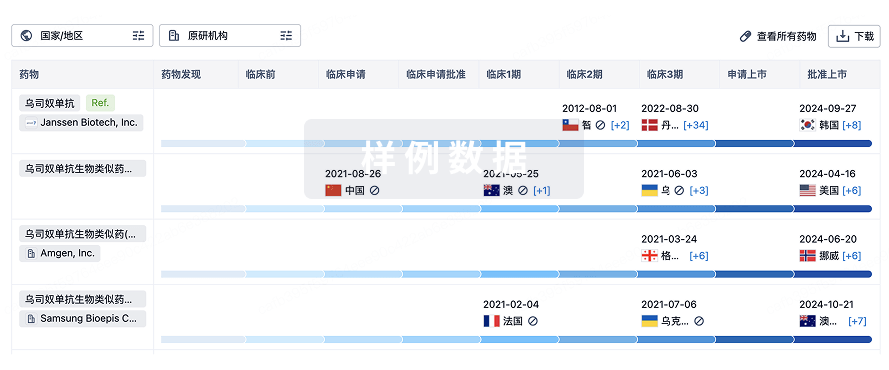
生物类似药
生物类似药在不同国家/地区的竞争态势。请注意临床1/2期并入临床2期,临床2/3期并入临床3期
登录
或
特殊审评
只需点击几下即可了解关键药物信息。
登录
或

提出任何生物医药研究问题
让每一步生物医药决策都精准制胜
基于十亿级生物数据与全球情报的精准 AI,赋能早期药物发现
立即开始免费试用!
智慧芽新药情报库是智慧芽专为生命科学人士构建的基于AI的创新药情报平台,助您全方位提升您的研发与决策效率。
立即接入生物医药数据包
智慧芽新药库数据也通过智慧芽开放平台,以MCP或API服务形式对外开放。立即使用我们的MCP服务定制您的LLM智能体。
生物序列数据库
生物药研发创新
免费使用
化学结构数据库
小分子化药研发创新
免费使用